
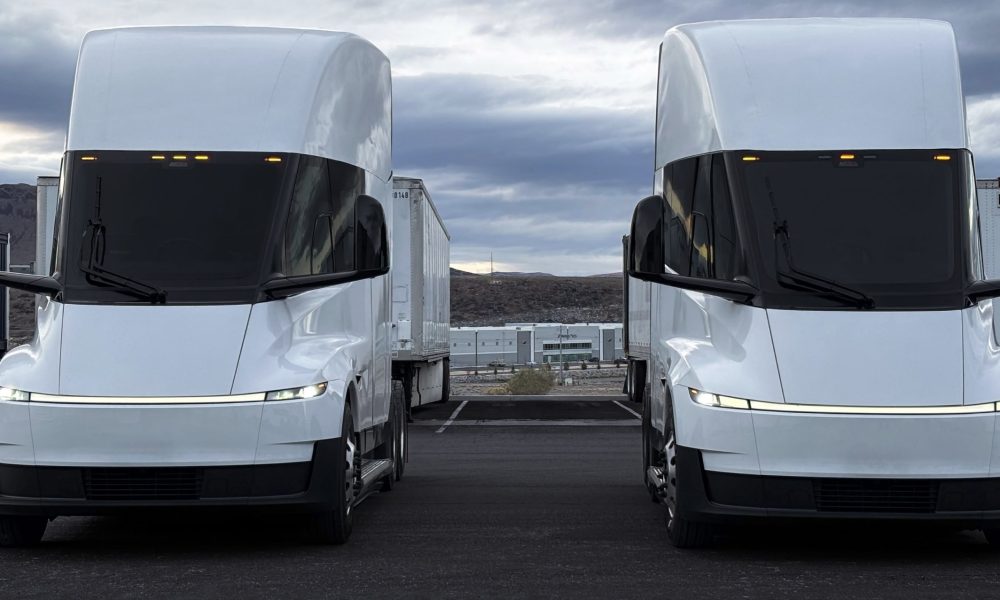
Tesla’s all-electric Semi is rapidly shifting perceptions within the heavy-duty trucking sector, consistently winning over the professional drivers who spend countless hours behind the wheel. As pilot programmes for the Tesla Semi expand across North America, a clear consensus is emerging among participants: the innovative Class 8 electric truck offers a demonstrably superior driving experience compared to traditional diesel rigs.
Drivers are particularly praising the vehicle’s unique design features, which include a centrally positioned driver’s seat, expansive touchscreen displays offering enhanced visibility, the immediate response of instant torque, and the complete elimination of gear-shifting fatigue. These advancements are not merely novelties; they are fundamentally transforming the demanding nature of long-haul trucking, contributing to significantly easier and less stressful shifts for drivers.

Beyond anecdotal feedback, the Tesla Semi promises substantial operational benefits. It delivers an impressive three times the power of many diesel counterparts while simultaneously offering dramatically lower operating costs, a crucial factor for freight and logistics companies looking to optimise their fleets.
A New Era for Truck Drivers: Comfort and Efficiency Redefined
Ergonomics and Driver Experience Redefined
The transition from a conventional diesel truck to the Tesla Semi represents a significant upgrade in driver comfort and ease of operation. The design philosophy of the electric truck places the driver at its core, literally, with a centrally located seat that optimises the field of vision and reduces common blind spots associated with traditional cabin layouts. This ergonomic shift, combined with intuitive controls accessed via large touchscreens, creates a more controlled and less fatiguing environment for drivers.
The immediate availability of torque, a characteristic inherent to electric powertrains, allows for smooth acceleration and responsiveness, eliminating the need for complex gear changes typical of diesel engines. This particular feature has been highlighted by drivers as a major factor in reducing physical strain over long journeys.

Navigating Tight Spaces with Ease
Early pilot programmes have underscored the Tesla Semi’s practical advantages in real-world scenarios. Dakota Shearer of IMC Logistics recounted an experience of navigating a tight spot he had mistakenly entered:
“I backed right out of there, no problem. It’s like I’d never done it in the first place. That right there showed me that the technology the Tesla has makes a big difference.”
This testimonial highlights the precision and manoeuvrability afforded by the Tesla Semi’s advanced technology, enabling drivers to handle challenging situations with greater confidence and less effort. Angel Rodriguez of Hight Logistics, a veteran who previously operated a 13-speed diesel truck, echoed these sentiments, emphasising the physical relief provided by the electric powertrain:
“It’s just easier on your body. It’s less stressful because you’re not really having to engage the clutch and the stick shift.”
These experiences point to a future where the physical demands of commercial driving are significantly alleviated, potentially enhancing driver retention and overall job satisfaction in the electric trucking industry.
Performance and Operational Advantages Propelling the Electric Trucking Industry
Instant Torque and Enhanced Power Delivery
Beyond comfort, the Tesla Semi delivers substantial performance benefits. Its electric motors provide instant torque, allowing for rapid acceleration and effortless handling of heavy loads. This characteristic is particularly advantageous in scenarios requiring quick merging into traffic or maintaining speed on inclines, where traditional diesel trucks often struggle.
The smooth power delivery contributes to a more predictable and controlled driving experience, which in turn enhances safety on the roads. Veteran drivers, accustomed to the mechanics of diesel engines, have expressed surprise and satisfaction at the Semi’s immediate and consistent power output.
Economic Benefits and Reduced Operating Costs
The economic proposition of the Tesla Semi is a major draw for fleet operators. By significantly reducing reliance on fossil fuels, the electric truck promises dramatically lower operating costs over its lifespan. This includes not only savings on fuel but also potentially reduced maintenance due to fewer moving parts compared to complex diesel engines.
The long-term financial advantages presented by the Tesla Semi are critical for businesses seeking to improve their bottom line and invest in sustainable transportation solutions for the electric trucking industry.
Real-World Validation and Exceeding Expectations
Feedback from various pilot programmes consistently underscores the Tesla Semi’s capabilities. Tom Sterba, a Senior Driver at Saia, spent several days testing the vehicle and was particularly impressed with its integrated navigation system:
“The navigation systems in these trucks are just unbelievable. That’s what I love about it.”
Sterba’s enthusiastic review culminated in a statement that has resonated widely within the trucking community:
“I hope I retire in this truck.”
Similar positive sentiments have been reported from pilot programmes involving ArcBest, thyssenkrupp Supply Chain Services, and Mone Transport. Drivers consistently lauded the centre-seat layout for its enhanced visibility, the seamless acceleration, and the overall superior comfort and safety features of the Tesla Semi.
Moreover, real-world data has consistently validated the truck’s performance. ArcBest has logged thousands of miles, reporting efficient consumption rates even on challenging routes such as Donner Pass. Several other fleets have reportedly exceeded Tesla’s own efficiency targets, providing tangible evidence of the Semi’s operational prowess.
Unveiling the Next Generation: Tesla Semi’s Latest Upgrades
Engineering Innovations for Enhanced Performance
The continuous evolution of the Tesla Semi was recently highlighted on an episode of Jay Leno’s Garage, where Leno became the first non-Tesla employee to drive the updated long-range production model. Joined by Tesla Chief Designer Franz von Holzhausen and Semi Program Director Dan Priestley, the segment revealed significant upgrades slated for volume production this year.
Key among these improvements is a reduction in vehicle weight, with the truck shedding approximately 1,000 pounds. This weight optimisation directly contributes to improved efficiency and payload capacity. Furthermore, the updated Tesla Semi incorporates a 48-volt architecture, a shift that allows for more efficient power distribution and potentially enables advanced electrical components. The adoption of fully electric steering, utilising actuators derived from the Tesla Cybertruck, promises enhanced precision, responsiveness, and a more refined driving feel.
The integration of advanced 4680 battery cells, specifically engineered for an impressive over-one-million-mile lifespan, addresses one of the primary concerns in commercial fleet operations: durability and longevity. This robust battery technology underpins the Tesla Semi’s economic viability and long-term sustainability.
Extended Range and Rapid Charging Capabilities
Aerodynamic improvements have played a crucial role in extending the Tesla Semi’s operational range. The long-haul version is now capable of achieving an estimated 500 miles on a single charge, while the shorter-wheelbase standard-range model offers approximately 325 miles. These ranges make the Tesla Semi a competitive option for a broad spectrum of commercial applications, from regional deliveries to cross-country freight.
To support these extended ranges, Tesla has advanced its Megacharging technology. The system can now deliver up to 1.2 megawatts of power, allowing the Tesla Semi to gain roughly 300 miles of range in approximately 30 minutes. This rapid charging capability is pivotal for maintaining high uptime and ensuring efficient logistics operations for the electric trucking industry.
During his test drive, Jay Leno hauled heavy loads and expressed amazement at the truck’s tight turning radius and seemingly effortless power delivery, noting:
“I don’t feel like I’m pulling anything.”
This sentiment encapsulates the transformative power of the Tesla Semi, offering a driving experience that defies the traditional perception of heavy-duty vehicles.
The Road Ahead for Electric Heavy-Duty Transport
With hundreds of Tesla Semis already in operation, accumulating over 13.5 million fleet miles and demonstrating consistently high uptime, the evidence points towards a significant shift in the heavy-duty trucking landscape. The overwhelmingly positive feedback from professional drivers underscores the Tesla Semi’s potential to not only meet but exceed the rigorous demands of commercial transport.
As the electric trucking industry continues to mature, vehicles like the Tesla Semi are setting new benchmarks for performance, driver comfort, and operational efficiency. The widespread enthusiasm among drivers suggests a growing readiness to embrace electric solutions, marking a pivotal moment for sustainable logistics and the future of freight transportation globally.