
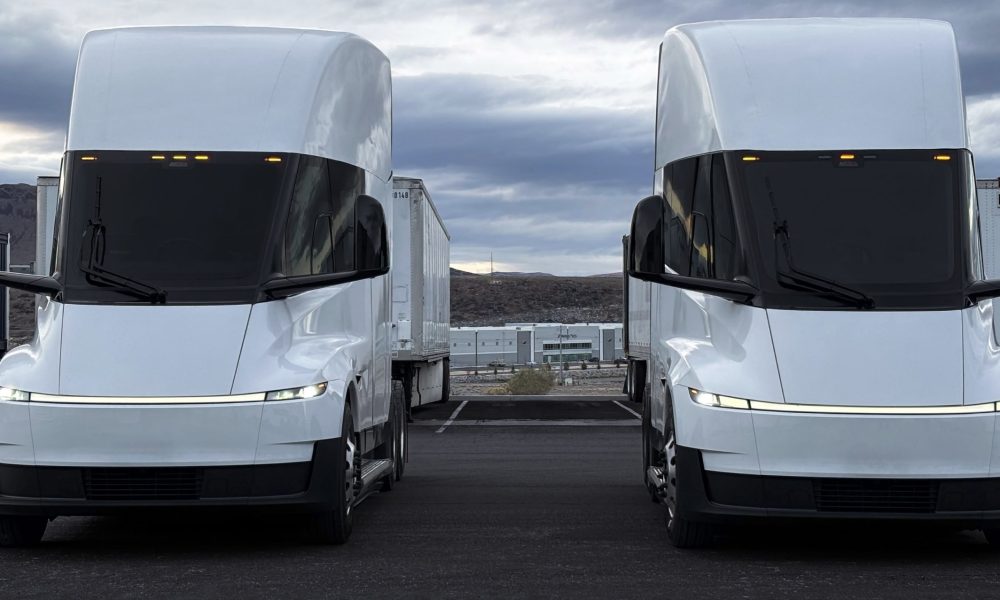
Tesla’s all-electric Semi is rapidly asserting its dominance in the heavy-duty trucking sector, consistently earning accolades from the very professionals who spend their lives behind the wheel. The advanced Class 8 electric truck is not merely a futuristic concept but a tangible revolution in logistics, lauded for its transformative impact on driver experience and operational efficiency across North America.
Early pilot programs, initiated by various fleets, reveal a unanimous consensus among participating truck drivers. They describe the Tesla Semi as significantly quieter, remarkably quicker, and substantially less physically demanding compared to conventional diesel rigs. This feedback highlights a paradigm shift, underscoring the electric truck’s ability to deliver superior performance—including three times the power—while simultaneously offering dramatically lower operating costs.

Elevating the Driver Experience: Comfort and Control
The core of the Tesla Semi’s appeal lies in its meticulously designed features that directly address long-standing challenges in the trucking industry. Drivers frequently cite the centrally positioned driver’s seat as a game-changer, eliminating traditional blind spots and providing an unparalleled panoramic view of the road and surroundings. This central seating arrangement enhances both safety and situational awareness, critical elements in heavy-duty transport.
Complementing this is the integration of massive touchscreen displays, which provide intuitive access to navigation, vehicle diagnostics, and entertainment systems, simplifying the operational interface. Beyond visibility and connectivity, the instant torque delivered by the electric powertrain fundamentally alters the driving experience. The absence of a conventional clutch and manual gear-shifting translates into significantly reduced physical fatigue, especially during demanding routes or in stop-and-go traffic.
These innovations are collectively transforming lengthy shifts into noticeably easier and less stressful journeys. The ability to navigate complex maneuvers with greater ease and precision has been a recurring theme in driver testimonials, showcasing the tangible benefits of Tesla’s advanced engineering.

Real-World Validation: Pilot Program Insights
The positive reception for the Tesla Semi is not confined to anecdotal praise; it is firmly rooted in practical application and real-world performance data from ongoing pilot programs. Companies across various logistical sectors are deploying the electric truck, with their drivers providing invaluable feedback and demonstrating its capabilities in diverse operational environments.
In a recent profile published by the Wall Street Journal, Dakota Shearer of IMC Logistics recounted a particularly challenging scenario where the Tesla Semi demonstrated its superior maneuverability. Describing an instance of mistakenly entering a tight spot, Shearer stated, “I backed right out of there, no problem. It’s like I’d never done it in the first place. That right there showed me that the technology the Tesla has makes a big difference.” This firsthand account underscores the intuitive control and technological advantage offered by the electric truck.
Angel Rodriguez of Hight Logistics, a driver with extensive experience in 13-speed diesel trucks, echoed these sentiments, emphasizing the physical relief provided by the Tesla Semi. Rodriguez noted, “It’s just easier on your body. It’s less stressful because you’re not really having to engage the clutch and the stick shift.” This highlights a significant ergonomic improvement, crucial for the long-term well-being of truck drivers.
Further reinforcing this enthusiasm, Tom Sterba, a Senior Driver at Saia, spent several days rigorously testing the Tesla Semi. He emerged deeply impressed with its integrated navigation systems and overall feel. Sterba enthusiastically remarked, “The navigation systems in these trucks are just unbelievable. That’s what I love about it.” His profound satisfaction was encapsulated in a statement that quickly resonated within the trucking community: “I hope I retire in this truck.”
Fleet Performance and Efficiency Benchmarks
The positive feedback from individual drivers is corroborated by data emerging from a wider array of pilot programs. Fleets such as ArcBest, thyssenkrupp Supply Chain Services, and Mone Transport have reported similar findings. Drivers consistently commend the Tesla Semi’s center-seat layout for its enhanced visibility, the seamless and powerful acceleration, and the overall heightened sense of comfort and safety.
Beyond driver satisfaction, operational data has confirmed the Tesla Semi’s impressive efficiency. ArcBest, for instance, has logged thousands of miles, recording efficient consumption rates even over notoriously challenging routes, including the formidable Donner Pass. Other participating fleets have not only met but often surpassed Tesla’s own initial efficiency targets, demonstrating the truck’s robust performance under real-world conditions.
The consistent feedback across these diverse operations solidifies the Tesla Semi’s reputation: it offers a quieter, quicker, and significantly less strenuous driving experience compared to traditional diesel trucks. This is coupled with a substantial increase in power output and a marked reduction in operational expenses, making a compelling case for its adoption in modern logistics.
Technological Evolution: Insights from Jay Leno’s Garage
The ongoing development and refinement of the Tesla Semi were recently showcased on Jay Leno’s Garage, offering the first public glimpse of the updated long-range production model outside of Tesla’s internal circles. Jay Leno was joined by Tesla Chief Designer Franz von Holzhausen and Semi Program Director Dan Priestley, who detailed a series of significant upgrades slated for volume production this year.
These enhancements underscore Tesla’s commitment to continuous innovation and performance optimization. The updated Tesla Semi has undergone a notable weight reduction, shedding approximately 1,000 pounds, which contributes to improved efficiency and payload capacity. A crucial architectural change includes the adoption of a 48-volt electrical system, a more efficient power distribution network for future-proofed vehicle systems.
The steering system has also seen a radical overhaul, transitioning to fully electric steering mechanisms derived from the acclaimed Cybertruck. This advancement promises enhanced precision, responsiveness, and potentially lower maintenance compared to hydraulic systems. Powering these innovations are the advanced 4680 battery cells, specifically engineered for an impressive lifespan exceeding one million miles, directly addressing concerns about battery longevity in commercial applications.
Aerodynamic improvements have further optimized the Tesla Semi’s design, directly impacting its impressive range capabilities. The long-haul version is now capable of a 500-mile range on a single charge, while the shorter-wheelbase standard-range model offers approximately 325 miles. Charging infrastructure has also evolved, with Megachargers now capable of delivering up to 1.2 megawatts of power, enabling the addition of roughly 300 miles of range in approximately 30 minutes, significantly reducing downtime.
During his test drive, Jay Leno experienced these advancements firsthand, hauling heavy loads and expressing astonishment at the vehicle’s turning radius and seemingly effortless power delivery. He famously remarked during the episode, “I don’t feel like I’m pulling anything,” a testament to the Tesla Semi’s robust performance and advanced engineering that effectively masks the immense weight it is designed to transport.
The Future of Heavy-Duty Hauling is Electric
With hundreds of Tesla Semis already in operation, collectively accumulating over 13.5 million fleet miles, the reliability and high uptime of these electric trucks are clearly established. The resounding positive reviews from experienced truck drivers, combined with demonstrable real-world performance, position the Tesla Semi as a disruptive force in the heavy-duty transportation industry.
The successful integration of cutting-edge technology, focusing on driver comfort, operational efficiency, and sustainable performance, has begun to transform perceptions. Drivers are not just accepting the electric future; they are enthusiastically embracing it, ready to transition to the electric trucking industry for good. The Tesla Semi stands as a robust testament to this shift, signaling a new era for commercial logistics.