
Carmakers are increasingly integrating substantial battery packs into their most potent performance flagships. This trend has introduced a new generation of high-performance vehicles that present a compelling, yet sometimes contradictory, driving experience. These performance hybrid vehicles offer breathtaking straight-line acceleration and considerable electric-only range, yet their added weight can significantly alter the handling dynamics compared to their purely combustion-powered predecessors.
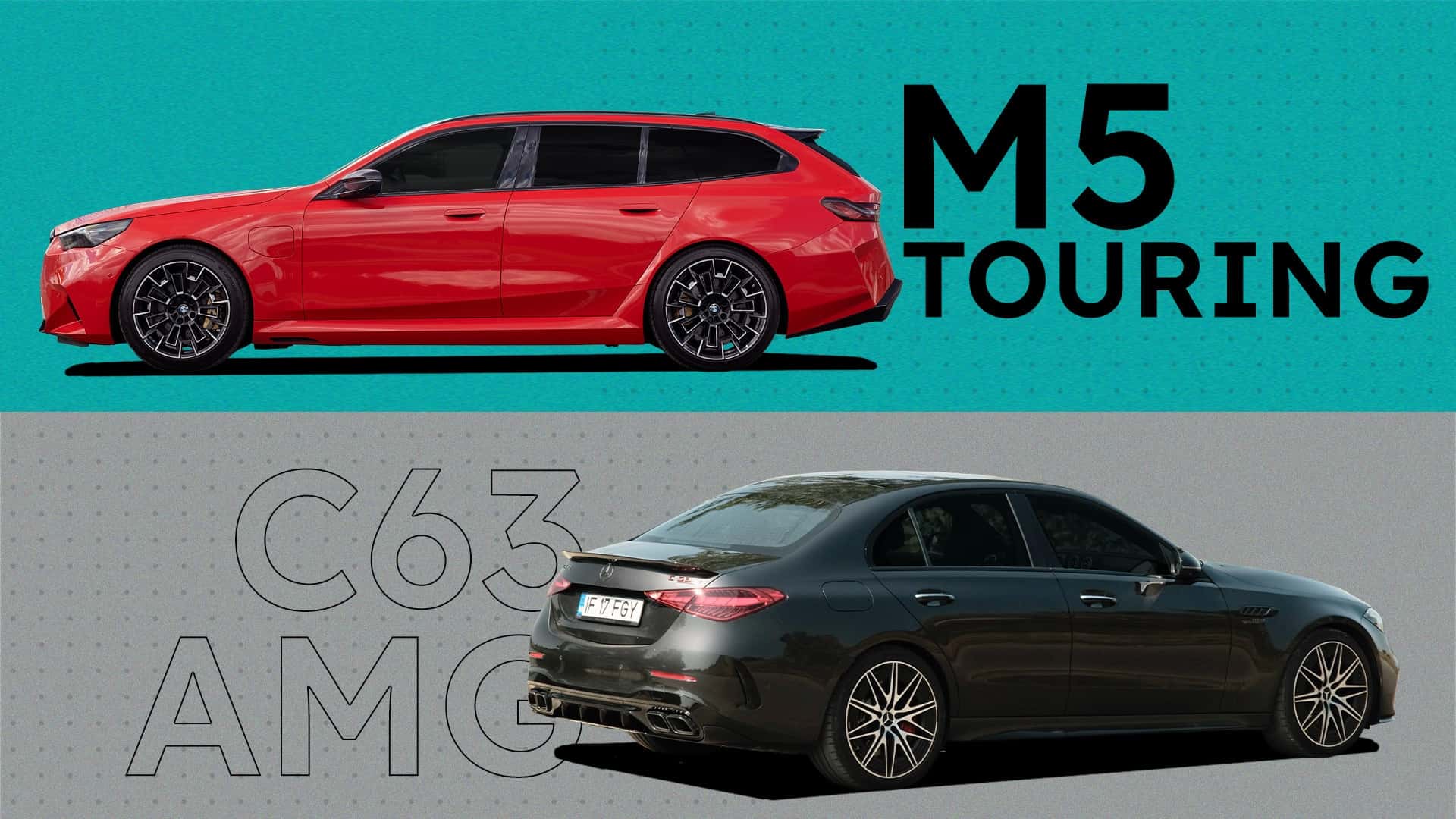
This evolving landscape of electrified performance cars is vividly illustrated through a comparative analysis of two prominent models: the new G99 BMW M5 Touring and the Mercedes-AMG C63s E-Performance. Both vehicles represent distinct philosophies in hybrid integration, leading to varied driving characteristics that have sparked debate among enthusiasts and keen drivers since their respective launches.

Key Takeaways
- The integration of large batteries into performance vehicles creates a trade-off between electric range and dynamic handling.
- The BMW M5 Touring, with its large V8 and substantial 22.1 kWh battery, offers immense power and a notable 35 miles of electric range but struggles with its 5,456-pound mass, impacting cornering agility and ride consistency.
- The Mercedes-AMG C63s E-Performance, featuring a smaller 2.0-liter four-cylinder engine and a compact 6.1 kWh battery, prioritizes performance boost over extended electric range, resulting in a significantly lighter (880 pounds less than the M5) and more agile driving experience.
- Real-world fuel efficiency for plug-in hybrid electric vehicles (PHEVs) can vary greatly from official ratings, often depending on charging frequency and driving style.
- The choice between these electrified performance cars hinges on whether a buyer prioritizes electric-only range and raw power or agile handling and a more engaging dynamic driving experience.
The Evolving Landscape of Performance Hybrids
The automotive industry’s push towards electrification, driven by stringent global emissions regulations, has transformed even the most hallowed performance marques. Traditional combustion engines are now frequently paired with electric motors and battery systems, aiming to reduce emissions without compromising raw power. However, this hybridization introduces a fundamental engineering challenge: managing the additional weight of battery technology within high-performance chassis.
The core objective for these electrified performance cars often diverges. Some manufacturers aim for significant electric-only range to meet regulatory targets and offer urban commuting capability, while others focus primarily on using electric power to augment performance through instant torque delivery and ‘boost’ functions. This divergence in philosophy is at the heart of the M5 Touring and C63s E-Performance comparison.
BMW M5 Touring: Power Meets Substantial Weight
Unpacking the Powertrain
The new BMW M5 Touring is an engineering marvel, boasting a formidable powertrain. Its 4.4-liter twin-turbocharged V-8 engine, combined with its electric motor, produces a claimed output of 717 horsepower. However, dyno tests have indicated that this figure might be conservative, with nearly 700 hp reaching the wheels, suggesting a true output closer to 800 hp.

This immense power, coupled with 737 pound-feet (1,000 Nm) of torque, delivers alarming straight-line pace, pinning occupants to their seats whether accelerating from a standstill or at speed. The V-8’s robust character is undeniably a highlight of the M5’s performance credentials.
The Electrified Driving Experience
Complementing the V-8 is an electric motor, generating 197 hp and 206 lb-ft (280 Nm) of torque, integrated within the eight-speed automatic gearbox. This motor is capable of propelling the M5 Touring on its own, providing a surprisingly brisk experience in EV mode, even for a vehicle weighing 5,456 pounds (2,475 kg).
The M5 offers approximately 35 miles of pure electric driving, making it a viable option for urban commutes. The reviewer noted a particular enjoyment of driving the M5 in EV mode, where a subtle, engaging acceleration sound is piped through the speakers. The system even simulates gear shifts, enhancing the driving sensation despite the V-8 being dormant. Power is distributed to all four wheels, ensuring reliable traction in varied conditions, including winter or low-grip scenarios.
Handling Challenges: The Weight Penalty
Despite its impressive power and electric capabilities, the M5 Touring’s substantial mass presents significant challenges to its dynamic performance. Weighing more than the fully electric i5, BMW’s engineers have had to extensively tune the suspension to manage this heft. This results in an inconsistent ride quality, described by the reviewer as vacillating between the luxurious comfort of a Maybach and the aggressive rebound of a pogo stick, offering unpredictable responses.
Mid-corner bumps proved particularly unsettling, inducing alarming transfers of force and compromising stability on winding roads. The sheer inertia of the M5 leads to a persistent sensation of understeer when driven spiritedly, akin to an athlete competing with ankle weights. This heavy feel prompted the reviewer to express an unexpected preference for the pure electric i5 Touring M60, marking the M5 as the first BMW M model that did not immediately evoke desire after driving.
Mercedes-AMG C63s E-Performance: Agility Over Absolute Range
Transitioning from the M5 Touring to the Mercedes-AMG C63s E-Performance offers a stark contrast in driving dynamics, immediately highlighting the M5’s substantial mass. While positioned in a class below the M5, the C63’s superior agility and engaging driving experience led the reviewer to express a clear preference for the Mercedes-AMG.
A Bespoke Hybrid Architecture
The C63s E-Performance adopts a unique approach to electrification, diverging significantly from its rivals. Under the hood lies an AMG M139 2.0-liter four-cylinder engine, hand-assembled with the builder’s signature proudly displayed on a plaque. Unlike the M5’s concealed V8, the C63’s engine bay prominently showcases its large turbocharger and innovative electric supercharger setup.
This compact yet potent engine produces over 400 horsepower independently. When combined with its electric motor, the C63 unleashes a total output of 670 hp and an impressive 752 lb-ft (1,020 Nm) of torque. This torque figure surpasses that of the M5, and crucially, the C63 is approximately 880 pounds (400 kg) lighter, a difference profoundly felt in its dynamic responses.
Unrivalled Acceleration and Dynamics
The C63’s lighter weight and torque advantage translate into astonishing acceleration. The force exerted on the body during a ‘Race Start’ is described as unlike anything experienced in a combustion car, giving the impression of being faster than the M5, despite comparable on-paper figures. Its all-wheel-drive system expertly channels power to the ground, facilitating shockingly quick launches.
The electric supercharger plays a vital role in minimizing turbo lag, ensuring an incredibly responsive powertrain. The combined surge of electric and gasoline torque is a visceral experience. While some critics have questioned its auditory appeal, the reviewer found the exhaust note to be characterful, complemented by the engaging sounds of the turbo building and releasing pressure, enhancing the overall driving enjoyment.
Crucially, the C63 demonstrates superior agility through corners compared to the M5. Unlike its predecessors, which were prone to excessive rear tire shredding, the new model delivers a focused, track-car-like feel. It prioritizes achieving optimal corner exit with minimal drama, showcasing a highly refined chassis and powertrain integration.
The Philosophical Divide: Battery Size and Performance
The differing design philosophies of BMW and Mercedes-AMG become evident in their battery choices. While the C63 platform is smaller than the 5 Series Touring that underpins the M5, Mercedes intentionally engineered a lighter hybrid system. The C63’s electric motor is integrated into the rear axle, not the gearbox, and its primary purpose is performance augmentation rather than extensive electric-only range, though it can provide around 5 miles of electric driving.
The M5 features a substantial 22.1-kilowatt-hour battery, contributing significantly to its overall heft. In contrast, the C63’s battery capacity is a mere 6.1 kWh. This smaller battery is crucial to its weight-saving strategy, primarily serving regulatory compliance for emissions standards while still delivering performance boosts. This strategic reduction in battery size is a key differentiator in their respective driving characteristics.
Real-World Efficiency Versus Regulatory Claims
The efficiency ratings for plug-in hybrid electric vehicles (PHEVs) often present a complex picture, varying significantly between laboratory tests and real-world driving conditions. The BMW M5 Touring, with its larger battery, boasts a WLTP efficiency rating between 1.6 and 1.7 liters per 100 km, or almost 150 miles per gallon. However, this impressive figure is contingent on consistently keeping the battery fully charged, a practice not always adhered to by many PHEV owners.
Consequently, the M5’s EPA combined rating of 13 mpg (18 l/100 km) with a depleted battery offers a more realistic reflection of its fuel consumption during normal driving. For the C63, while it does not receive a directly comparable European efficiency rating, Mercedes-AMG claims an average of 6.9 l/100 km or 34 mpg. Achieving this figure requires a very gentle driving style.
The reviewer’s experience, driving the C63 with similar enthusiasm to the M5, yielded approximately 15 mpg, which is still commendable given the car’s ludicrous acceleration. The C63’s EPA rating of 20 mpg with a depleted battery is considered achievable without specifically trying to maximize efficiency.
Beyond the Numbers: The Driver’s Perspective
For dedicated enthusiasts of electrified performance cars, the core appeal lies not in efficiency, but in the driving experience. The assessment concludes that for these specialized vehicles, a larger battery capacity does not always equate to a superior driving experience. The primary demographic for models like the C63 or M5 typically prioritizes performance over fuel economy, making advertised efficiency figures less of a selling point.
Furthermore, performance cars represent a minuscule fraction of global vehicle sales, contributing minimally to overall emissions. Therefore, focusing electrification efforts on mass-market vehicles could yield far greater environmental dividends. The BMW M5 Touring’s design demonstrates that excessive battery weight can detract from the ultimate driving dynamics.
The Mercedes-AMG C63s E-Performance, despite initial criticisms regarding its four-cylinder engine, embodies a more effective approach to building a performance PHEV. It offers a more engaging and special driving experience than the M5, which, due to its weight, can feel less dynamic. Although the C63 is still heavier than a non-electrified V-8 counterpart would be, it stands out as an excellent and exciting performance hybrid.
The Future of Performance Hybrid Vehicles
A crucial distinction must be made between electrified cars engineered primarily for fuel efficiency and those where electrification is fundamentally designed to enhance performance. While all hybrid applications offer some degree of efficiency improvement, overburdening a performance PHEV with an oversized battery can paradoxically make it less efficient than a comparable combustion-only vehicle due to the added mass.
Examples of successful performance PHEVs that prioritize dynamic excellence include the second-generation Acura NSX, the Corvette E-Ray, the Ferrari 296 GTB, and the new Lamborghini Temerario. These vehicles, similar to the C63, often feature batteries under 8 kWh, deliberately avoiding chassis overburdening and preserving handling purity. The electric driving capability in these instances serves as a beneficial bonus, with performance remaining the central tenet of electrification.
The potential drawback of a smaller battery, where the engine might need to act as a generator to replenish the pack if the charge runs low, is a minor concern for most driving scenarios. The reviewer’s intensive half-hour drive of the C63 on a demanding road still left approximately 33% battery capacity, with no perceived loss of performance. This suggests that unless subjected to prolonged, high-intensity track use, the smaller battery’s limitations are unlikely to impede the exhilarating performance of such electrified machines.
FAQ Section
Q1: What is the main difference in hybrid philosophy between the BMW M5 Touring and Mercedes-AMG C63s E-Performance?
The BMW M5 Touring prioritizes both significant power and an extended electric-only range with a large 22.1 kWh battery. In contrast, the Mercedes-AMG C63s E-Performance focuses on leveraging a smaller 6.1 kWh battery primarily for performance boost and agility, with limited electric range, making it a lighter and more dynamically focused electrified performance car.
Q2: How does vehicle weight impact the driving experience of these performance hybrid vehicles?
The BMW M5 Touring’s considerable weight (5,456 lbs) due to its large battery and V8 engine adversely affects its handling, leading to inconsistent ride quality and understeer in spirited driving. The lighter Mercedes-AMG C63s E-Performance (880 lbs lighter) demonstrates superior agility and a more engaging dynamic experience through corners.
Q3: What are the real-world fuel efficiency expectations for the M5 Touring and C63s E-Performance?
The M5 Touring has an EPA combined rating of 13 mpg with a depleted battery, a more realistic figure than its high WLTP rating which assumes constant charging. The C63s E-Performance, despite its smaller engine, achieved around 15 mpg in aggressive driving and has an EPA rating of 20 mpg with a depleted battery, indicating better real-world efficiency under spirited use.
Q4: Why does the Mercedes-AMG C63s E-Performance feel faster despite similar on-paper power figures to the M5 Touring?
The C63s E-Performance delivers 752 lb-ft of torque (more than the M5) in a car that is significantly lighter (880 lbs). This superior power-to-weight ratio, combined with a highly responsive powertrain featuring an electric supercharger, results in a more immediate and forceful acceleration sensation, especially off the line.
Q5: Is a large battery always beneficial in electrified performance cars?
According to the review, a large battery is not always beneficial for performance cars. While it provides extended electric range, the added weight can compromise handling and overall driving dynamics. The C63’s smaller battery demonstrates that a focused approach to electrification, prioritizing performance boost, can lead to a more enjoyable driver’s car.
Q6: What is the significance of the C63’s electric motor being integrated into the rear axle?
The integration of the electric motor into the rear axle in the C63s E-Performance is part of its bespoke, lighter hybrid system. This design choice primarily aims to boost performance and improve traction, contributing to the car’s agile handling characteristics, rather than solely focusing on providing extensive electric-only driving range.
Q7: How do these performance hybrids contribute to overall emissions reduction?
While performance hybrid vehicles offer some emissions reductions, particularly in electric-only mode, their overall impact on global emissions is limited given their niche market segment. The article suggests that electrifying mass-market cars would yield far greater dividends for environmental goals compared to focusing on high-performance models.