
Key Takeaways:
- Toyota’s Woven City, a living laboratory for future mobility, has officially opened its doors near Mount Fuji, Japan.
- The initial phase hosts 100 residents and focuses on testing advanced technologies for urban living and transportation.
- Despite early operational challenges like traffic light malfunctions and robot incidents, Toyota maintains transparency regarding the project’s ‘work-in-progress’ status.
- Innovations span autonomous vehicles, smart infrastructure, delivery robots, micromobility solutions, and a pioneering virtual power plant.
- The project underscores Toyota’s strategic evolution from a traditional automaker into a comprehensive mobility company.
- Woven City serves as a critical proving ground for integrating digital and physical infrastructure to achieve a ‘zero accidents’ future.
In a bold stride towards reimagining urban living and advanced mobility, Toyota’s ambitious Woven City project, nestled at the base of Mount Fuji in Japan, has begun operations. Conceived as a ‘proving ground for mobility’ and a ‘living laboratory,’ this smart city aims to test and refine technologies that could define future urban environments. While the initiative showcases groundbreaking innovations, its initial months have also highlighted the inherent complexities of pioneering such a comprehensive futuristic ecosystem, openly acknowledged by Toyota’s leadership.
The journey to establish Woven City began six years ago when Akio Toyoda, then President of Toyota Motor Corporation, announced the vision for this connected metropolis. Today, with its initial phase populated by a small community of ‘Weavers,’ the city is actively engaged in developing and integrating a diverse array of advanced solutions, ranging from autonomous transport systems to sophisticated energy management.
Early Challenges and Transparent Progress at Toyota Woven City
The inauguration of Toyota Woven City, approximately six months ago, marked a significant milestone for the global automotive giant. However, its early operational phase has been characterized by a series of teething issues, which company executives openly discussed with journalists during a recent media tour. These candid revelations underscore Toyota’s commitment to transparency in its innovative endeavors.
Among the reported incidents were a traffic light that inexplicably remained red for 30 minutes despite approaching vehicles, an unprompted city-wide illumination in the dead of night, and a robot becoming immobilized, requiring manual intervention from three individuals. Daisuke Toyoda, a senior vice president at Woven by Toyota—the carmaker’s mobility technology division—and the son of Toyota Chairman Akio Toyoda, directly shared these examples of the challenges encountered.
Such occurrences, though minor in scale, are emblematic of the iterative development process inherent in building a sophisticated, digitally integrated urban environment. They serve as valuable learning opportunities, enabling engineers and residents to collaboratively identify and rectify system flaws in real-time. This transparent approach reinforces the project’s true nature as an experimental hub, rather than a perfectly polished showcase.
A Glimpse Inside the Living Laboratory
During the unprecedented media access granted to non-Japanese journalists, Woven City presented itself as a meticulously planned, aesthetically cohesive environment. Its architecture and infrastructure hint at a future-forward design, characterized by cleanliness and a standardized appeal. Yet, the initial impression was one of quietude, with a notable absence of pedestrian or vehicular activity, partly influenced by the inclement weather during the visit.
Currently, the city is home to an initial cohort of 100 ‘Weavers,’ comprising 50 households, all affiliated with Toyota. This controlled population allows for focused testing and feedback collection. Situated against the majestic backdrop of Mount Fuji, about a 90-minute drive from Tokyo, the city’s first phase encompasses several buildings spread across an area equivalent to a few city blocks. Construction for a phase two expansion is already underway, with long-term plans to significantly enlarge Woven City’s footprint by more than tenfold and increase its population to approximately 2,000 residents.
This gradual scaling strategy is vital for the meticulous development of a smart urban ecosystem, ensuring that technologies are robustly tested and refined before wider deployment. The contained environment of Toyota Woven City provides an unparalleled opportunity to study human-technology interaction in a live setting, an aspect crucial for the success of future smart cities globally.
The Inventor Garage: A Hub for Innovation
At the heart of Woven City’s innovation ecosystem is the ‘Inventor Garage,’ a repurposed Toyota factory building now serving as a collaborative maker space. This facility provides a dedicated environment for companies and innovators participating in Woven City projects to develop and prototype their products. The diverse range of projects showcased demonstrates the broad scope of Toyota’s vision, extending beyond traditional automotive applications.
Key participants include Toyota supplier Denso, which is actively engaged in developing wireless EV charging solutions, with plans to test roads embedded with induction charging technology within Woven City. A Toyota subsidiary is piloting ‘Cocomo,’ a sidewalk delivery robot designed to navigate urban environments, currently undergoing trials both within Woven City and in other locations. Additionally, a company specializing in compact hydrogen fuel cells is exploring the potential of hydrogen-powered e-bikes as a proof of concept, hoping Weavers will engage in their testing.
The project also attracts major players in future mobility, such as Joby Aviation, the electric vertical take-off and landing (eVTOL) firm in which Toyota holds a significant investment. Beyond mobility, the Inventor Garage hosts intriguing non-automotive ventures, including a vending machine company, a ramen giant Nissin Foods developing new food concepts for resident testing, and a company leveraging AI to personalize karaoke song selections – reflecting Japan’s unique cultural landscape.
Woven City: A Proving Ground for Advanced Mobility
At its core, as articulated by Daisuke Toyoda and other executives, Toyota Woven City is fundamentally a ‘proving ground for mobility.’ This designation highlights its role as a specialized facility for stress-testing and validating emerging technologies that go beyond the capabilities of conventional vehicle test tracks. Toyota’s vision extends to a future characterized by ‘zero accidents,’ a goal it believes is unattainable solely through improved vehicle technology.
John Absmeier, CTO of Woven by Toyota, elaborated on this integrated approach: “In the city, in particular, the infrastructure is what we can get access to. We can control, we can test, we can develop new ideas around it. And that’s the biggest difference or opportunity that we have here in the city.” This perspective underscores the critical role of smart infrastructure in enhancing safety and efficiency alongside advancements in autonomous vehicles.
Central to this integrated strategy is the ‘Woven City AI Vision Engine,’ a sophisticated system fed by numerous cameras positioned at every intersection. This AI-powered platform enables Toyota to test proactive safety measures, such as systems that detect a person running into an intersection and alert an approaching driver. While currently in the testing phase, these capabilities are designed to prevent accidents before they occur.
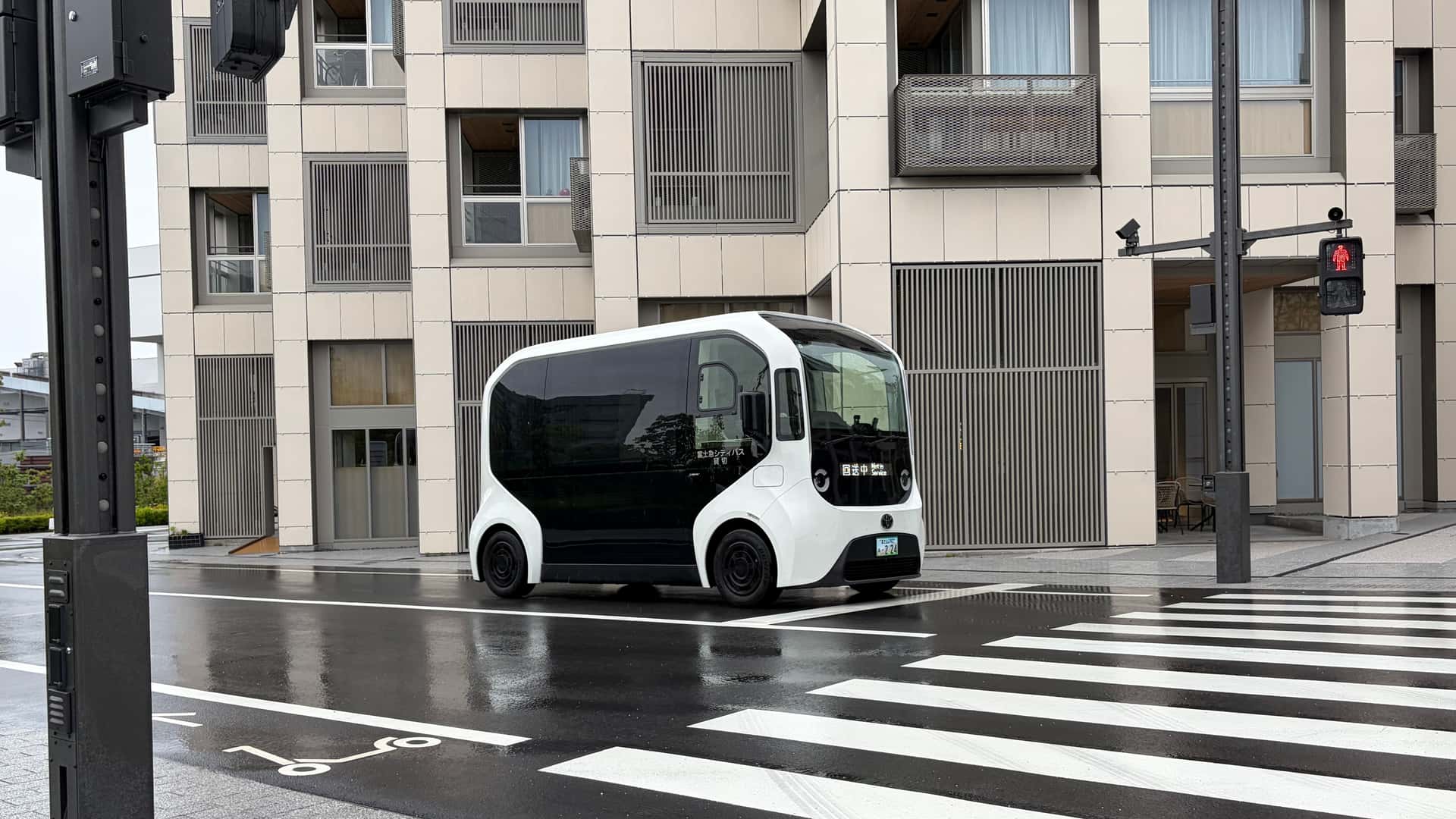
The city’s transit system, presently served by e-Palette buses, is human-operated but slated for future autonomous functionality. Similarly, traffic signals are programmed to prioritize pedestrians, although this feature is still under development. These infrastructure-level innovations are designed to create a safer, more intuitive urban environment that seamlessly integrates with future mobility solutions.
Innovative Mobility and Energy Solutions
Toyota Woven City is a crucible for a variety of next-generation mobility and energy solutions designed to enhance urban living and sustainability.
Guide Mobi and Autonomous Delivery
Among the notable robotic innovations is the ‘Guide Mobi,’ a compact, three-wheeled robot equipped with an extensive sensor array. This robot is engineered to effectively transform any conventional car into a driverless vehicle. In Woven City, Guide Mobi robots are utilized within a car-sharing service, towing Toyota bZ4X crossovers from a parking garage to a curb upon request via an app. By wirelessly interfacing with the vehicle’s braking, steering, and acceleration systems from a distance of approximately 10 feet, Guide Mobi enables autonomous delivery. Although observed with a human monitor and exhibiting some initial operational unevenness, the concept holds significant promise for applications like robo-valets and automated vehicle repositioning.
Package delivery within Woven City is also largely automated. Instead of conventional delivery trucks entering the city, packages are deposited at an underground logistics center. From there, wheeled robots transport them through a network of subterranean tunnels to centralized lockers located within each building, ensuring efficient and seamless last-mile delivery. Furthermore, Toyota plans to introduce helper robots into Weavers’ homes, where they will learn to perform domestic tasks such as washing dishes and folding laundry in a real-world environment, further integrating robotics into daily life.
The Swake: A New Micromobility Solution
For street-level personal mobility, residents have access to the ‘Swake,’ another innovative Toyota creation. These unique scooters feature three wheels, providing enhanced stability compared to conventional two-wheeled models. They are designed with a large platform to accommodate both of a rider’s feet and incorporate a ‘butt pad’ for leaning, offering a more comfortable and secure riding experience. While the Swake service was temporarily unavailable during the media visit due to weather conditions, an indoor demonstration suggested its potential as an effective micromobility solution. Its design aims to appeal to individuals who might feel less confident on traditional bikes or scooters, thereby encouraging broader adoption of non-car transportation methods in urban settings.
Virtual Power Plant (VPP) Integration
Woven City is also at the forefront of sustainable energy management with its EV-powered Virtual Power Plant (VPP). A dedicated parking garage within the city houses 50 city-owned electric vehicles capable of bidirectional charging. This setup allows these EVs not only to consume power but also to feed surplus energy back into the city’s grid. Toyota representatives indicate that this VPP proof-of-concept can reduce 5-10% of the city’s peak power demands. While currently in an experimental phase, this technology holds significant potential as a scalable solution for industrial sites and large corporate fleets, demonstrating how electric vehicles can play a dual role in transportation and energy grid stabilization.
Toyota’s Transformative Journey and the Future of Mobility
In an era of rapid technological advancement and evolving consumer expectations, Toyota, much like the broader automotive industry, is navigating a profound transformation. The company, which famously began its journey manufacturing looms before becoming the world’s largest car manufacturer, is now strategically repositioning itself as a comprehensive mobility solutions provider. This shift is crucial as it faces intensified competition from agile Chinese automakers, innovative Silicon Valley-born firms like Tesla and Rivian, and the broader implications of self-driving technologies potentially diminishing the reliance on personal car ownership.
The creation of Toyota Woven City underscores this strategic pivot. It represents a tangible commitment to exploring and defining what ‘mobility company’ truly means in the 21st century. By establishing a controlled, real-world environment for experimentation, Toyota gains an invaluable platform to test a vast spectrum of ideas, from complex urban planning to individual transportation devices.
While the early operational hurdles signify that Woven City remains very much a work in progress, these challenges are an integral part of pioneering innovation. The insights gleaned from these experiences are critical for refining the technologies and systems that will underpin future smart cities. Woven City is more than just a development site; it is a crucible where Toyota seeks to forge answers to the complex questions of sustainable, safe, and efficient urban living, ultimately contributing to a more connected and harmonious future.
FAQ Section
What is Toyota Woven City?
Toyota Woven City is a living laboratory and smart city near Mount Fuji, Japan, dedicated to testing and developing future mobility, robotics, and smart infrastructure technologies in a real-world environment. It’s designed as a fully connected ecosystem to accelerate innovation in urban living.
Who lives in Toyota Woven City?
The initial phase of Woven City is inhabited by 100 ‘Weavers’ across 50 households, all affiliated with Toyota. This controlled group provides direct feedback and participates in testing the various technologies and urban systems being developed within the city.
What kind of technologies are being tested there?
Woven City tests a wide array of technologies, including autonomous vehicles (like e-Palette buses), smart infrastructure with AI vision for accident prevention, delivery robots (Cocomo), micromobility solutions (Swake scooters), in-home helper robots, and a virtual power plant utilizing bidirectional EV charging.
What are the main goals of Woven City?
The primary goals include creating a ‘zero accidents’ urban environment through integrated infrastructure and vehicle technology, developing sustainable energy solutions, advancing robotics for daily life, and serving as a proving ground for Toyota’s evolution into a comprehensive mobility company.
What challenges has Woven City faced?
As a ‘work in progress,’ Woven City has experienced early operational challenges. These include minor glitches like a traffic light remaining red for extended periods, city lights activating unexpectedly, and robots encountering temporary malfunctions, all openly acknowledged by Toyota.
How will Woven City expand in the future?
The city is currently undergoing a phase two expansion. Toyota plans for Woven City’s footprint to eventually grow more than tenfold, with its population projected to reach approximately 2,000 residents, allowing for broader and more comprehensive testing of its integrated systems.
Why is Toyota building Woven City?
Toyota is building Woven City to accelerate its transformation into a mobility company, moving beyond traditional car manufacturing. It’s a critical strategic initiative to research and develop solutions for future urban challenges, including sustainable living, autonomous transport, and energy management, in a controlled, live environment.