
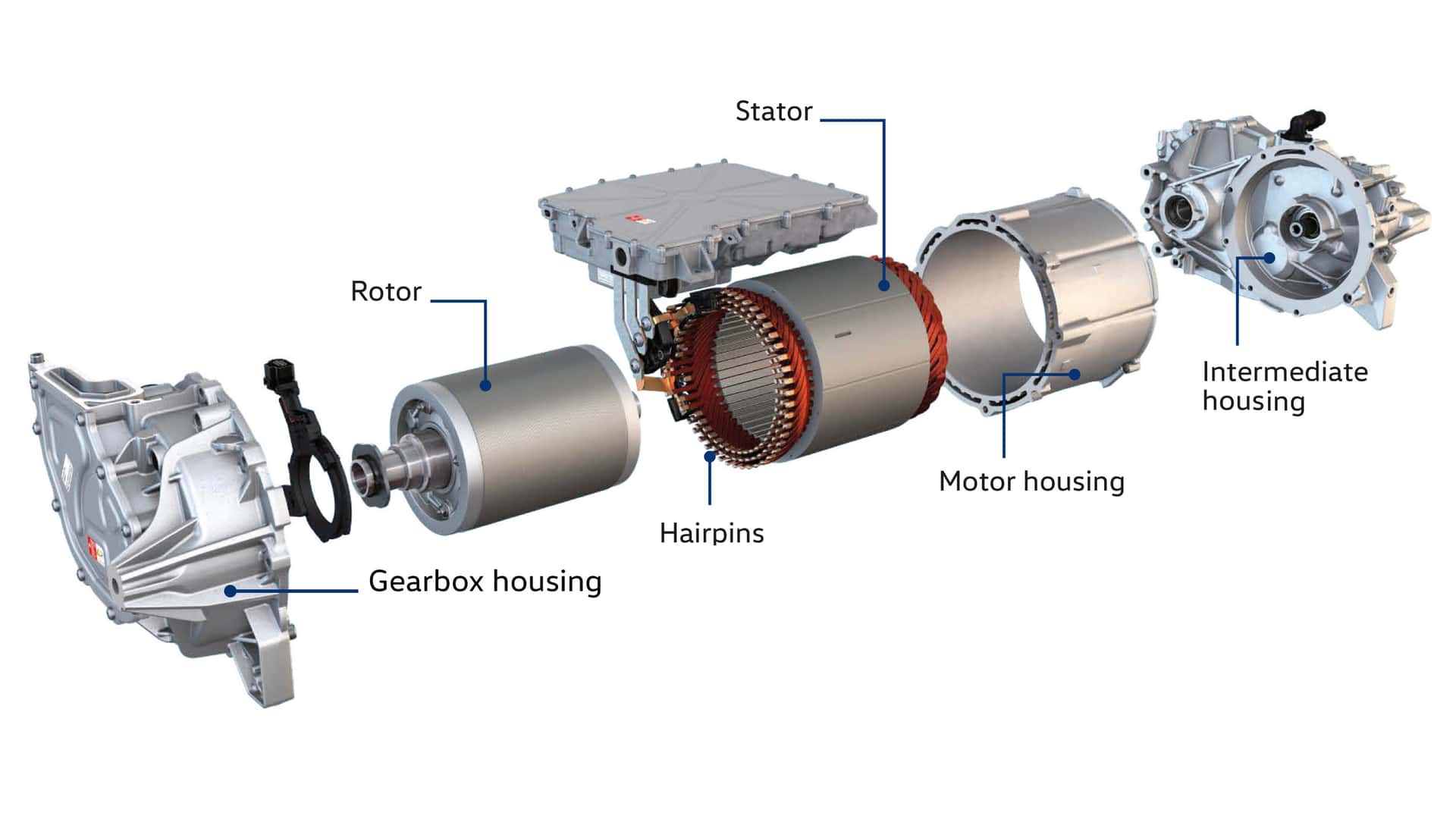
While electric vehicle batteries often garner significant attention, the motors that translate stored energy into motion are equally crucial and technologically fascinating. Far from being a uniform component, EV motors employ diverse engineering principles to balance critical factors like efficiency, performance, packaging, and overall cost.
Automakers meticulously select and often combine different EV motor types within a single vehicle, tailoring the propulsion system to specific demands. Understanding these variations is key to appreciating the sophistication beneath the surface of modern electric cars.

Key Takeaways
- EV motors convert electricity into mechanical rotation using magnetic fields.
- The primary distinction among EV motor types lies in how the rotor (spinning part) generates its magnetic field: via permanent magnets or electrically powered coils.
- Permanent-Magnet Synchronous Motors (PMSMs) offer high efficiency and power density but rely on rare earth elements.
- Induction Motors (Asynchronous Motors) are robust and avoid rare earths, providing low drag when inactive but are generally less efficient than PMSMs under continuous load.
- Electrically Excited Synchronous Motors (EESMs) use electromagnets on the rotor, allowing adjustable magnetic field strength for optimized performance and reduced reliance on rare earths.
- Many modern electric vehicles utilize a combination of these EV motor types to achieve an optimal balance of performance, efficiency, and cost, particularly in all-wheel-drive configurations.
The Fundamental Mechanics of Electric Vehicle Motors
At its core, every electric motor operates on the principle of electromagnetism. An EV motor comprises two primary sections: the stationary outer part known as the stator and the rotating inner component called the rotor. The rotor is mechanically linked to a shaft, which then transmits power to the vehicle’s wheels through reduction gearing.
The high-voltage battery in an EV supplies direct current (DC). However, electric motors typically require alternating current (AC) to generate the rotating magnetic fields necessary for propulsion. An inverter plays a vital role in this process, converting the battery’s DC into precisely controlled AC, which is then fed into the stator’s coils.
This sequential energizing of the stator coils creates a dynamic, rotating magnetic field. The rotor, whether magnetic itself or made magnetic by induction, constantly ‘chases’ this moving field, causing it to spin and generate the torque required to move the vehicle. The rotational speed of this magnetic field is a critical parameter in defining EV motor types.

Synchronous vs. Asynchronous Operation
The operational relationship between the rotor’s spin speed and the stator’s magnetic field speed categorises different EV motor types. A ‘synchronous’ motor, such as a permanent-magnet motor or an electrically excited motor, is designed so its rotor spins in perfect harmony with the stator’s rotating magnetic field.
Conversely, an ‘asynchronous’ or induction motor operates with a slight difference in speed between the stator’s magnetic field and the rotor. This speed differential, known as ‘slip,’ is crucial for its operational principle.
Permanent-Magnet Synchronous Motors (PMSMs)
Among the various EV motor types, the Permanent-Magnet Synchronous Motor (PMSM) is widely adopted, particularly for primary drive applications in electric vehicles. In a PMSM, the rotor is equipped with powerful permanent magnets, either affixed to its surface or embedded within its structure. These magnets inherently provide the rotor’s magnetic field without needing an external electrical supply.
The rotating magnetic field generated by the stator’s coils then interacts with these fixed magnets, exerting a continuous pull that drives the rotor. This mechanism is analogous to a compass needle aligning with a moving magnet, but on a larger, continuous scale, with a sophisticated control system orchestrating the field.
Advantages and Challenges of PMSMs
A significant advantage of PMSMs lies in their high efficiency. Since the rotor’s magnets do not require electrical energy to maintain their magnetic field, energy losses associated with powering rotor windings are eliminated. This contributes to a compact, lightweight package capable of delivering substantial power, making it a preferred choice for many main drive motors in EVs.
However, the powerful magnets typically employed in automotive PMSMs contain rare earth elements, such as neodymium and dysprosium. The procurement and processing of these materials can present supply chain complexities, expose manufacturers to volatile price fluctuations, and raise environmental concerns. While ‘permanent magnet’ doesn’t exclusively mean ‘rare earth,’ these specific materials are commonly chosen for their superior magnetic properties in high-performance EV applications.
Induction Motors: The “Squirrel Cage” Design
Also known as asynchronous motors, induction motors represent another significant category of EV motor types. Unlike PMSMs, these motors forgo permanent magnets entirely. Instead, their rotors feature conductive bars, often interconnected by end rings, forming a structure frequently dubbed a ‘squirrel cage’ due to its resemblance to the familiar exercise wheel.
The operational principle of an induction motor relies on electromagnetic induction. As the stator generates its rotating magnetic field, this field cuts across the conductive bars of the rotor. This action induces an electrical current within these bars, which, in turn, creates the rotor’s own magnetic field. The interaction between the induced rotor field and the stator’s rotating field then produces torque, propelling the vehicle.
Efficiency and Application of Induction Motors
A defining characteristic of induction motors is the concept of ‘slip.’ For current to be induced in the rotor bars and generate a magnetic field, the rotor must spin slightly slower than the stator’s magnetic field. If the rotor were to reach synchronous speed, the relative motion between the stator field and rotor conductors would cease, and with it, the induction of current and subsequent torque.
While induction motors are renowned for their robustness and the absence of rare-earth magnets, they generally exhibit lower efficiency compared to PMSMs, particularly under sustained high load. The process of inducing current in the rotor generates heat, contributing to energy losses. However, a key advantage is their ability to spin with very minimal drag when unpowered, making them excellent for supplementary roles.
This characteristic makes induction motors a popular choice for all-wheel-drive EV configurations. For instance, the Audi Q6 E-tron Quattro utilises a permanent-magnet motor for its primary rear axle and an induction motor for its front axle, providing additional propulsion and traction when required without significant energy penalties when inactive. Many electric vehicles from manufacturers like Tesla and General Motors also employ similar hybrid motor strategies.
Electrically Excited Synchronous Motors (EESMs)
The Electrically Excited Synchronous Motor (EESM) presents a third distinct approach within the spectrum of EV motor types, offering a blend of advantages from both permanent-magnet and induction designs. In an EESM, the rotor does not contain permanent magnets; instead, it houses coils that are supplied with electricity, effectively transforming the rotor into a controllable electromagnet.
This design allows engineers to dynamically adjust the strength of the rotor’s magnetic field by regulating the current flowing through its coils. This ‘excitation’ capability provides a crucial degree of flexibility, enabling the motor’s operation to be optimised across a wide range of speeds and loads, enhancing overall efficiency and performance characteristics.
EESMs in Modern EVs
Automakers increasingly appreciate the benefits of EESMs. BMW, for example, integrates these motors into its latest sixth-generation EV powertrains. The company highlights their efficient energy utilisation during everyday driving scenarios and their consistent delivery of strong power output even at very high rotational speeds. Renault also champions this technology, notably in vehicles like the Renault 5 E-Tech, citing the reduced reliance on rare earths and a broader supplier base for wound rotors as strategic advantages.
The primary trade-off with EESMs is the energy consumption required to power the rotor’s coils, leading to some electrical losses. Additionally, the inclusion of rotor windings and their associated power supply adds a degree of complexity to the motor’s design and control system compared to PMSMs. Nevertheless, the ability to fine-tune the magnetic field strength offers compelling performance and sourcing benefits.
Why Hybrid Motor Setups Dominate EV Drivetrains
The existence and co-existence of these diverse EV motor types underscore the complex engineering challenges in electric vehicle design. As exemplified by vehicles like the Audi Q6 E-tron Quattro, which combines a permanent-magnet rear motor with an induction front motor, automakers often deploy a strategic mix of motor technologies within a single vehicle. This approach allows for optimal energy management, enhanced performance, and superior traction.
The permanent-magnet motor typically handles the efficient, continuous propulsion, while the induction motor provides supplementary power and all-weather capability, disengaging with minimal drag when not needed. This careful allocation ensures that each motor type is utilised where its strengths are most beneficial.
Beyond Audi, other manufacturers also innovate with hybrid motor configurations. BMW’s advanced all-wheel-drive systems, for instance, pair an electrically excited rear motor with a front induction motor. Meanwhile, new electric vehicles from Mercedes-Benz feature a permanent-magnet front motor that can be mechanically disconnected from the wheels when not required, effectively eliminating drag and improving efficiency during cruising. These varied strategies highlight a universal goal: to save energy when power is not needed and to deliver it effectively when it is.
As electric vehicle technology continues to evolve, the integration of multiple EV motor types within a single powertrain is likely to become even more prevalent. This ongoing innovation ensures that future EVs will offer increasingly sophisticated balances of performance, range, and cost-effectiveness, tailored to a wide array of driving demands.
Frequently Asked Questions About EV Motor Types
What are the primary EV motor types?
The main EV motor types are Permanent-Magnet Synchronous Motors (PMSMs), Induction Motors (also known as asynchronous motors), and Electrically Excited Synchronous Motors (EESMs). Each type employs different methods for generating the magnetic fields necessary for rotation and torque production.
Why do some EV motors use rare earth elements?
Permanent-Magnet Synchronous Motors (PMSMs) often use rare earth elements like neodymium in their magnets because these materials offer exceptionally strong and stable magnetic fields. This allows for very compact, powerful, and highly efficient motor designs, crucial for electric vehicle performance.
What is the advantage of an Induction Motor in an EV?
Induction Motors are robust, cost-effective, and do not require rare earth magnets. A key benefit is their low drag when unpowered, making them suitable for secondary axles in all-wheel-drive EVs, providing on-demand power without significantly impacting efficiency when inactive.
How do Electrically Excited Synchronous Motors (EESMs) work?
EESMs use coils on the rotor, powered by electricity, to create an adjustable electromagnet. This allows engineers to control the strength of the magnetic field, optimising efficiency and power output across different operating conditions. They also reduce reliance on rare earth materials.
Can an EV have more than one type of motor?
Yes, many modern electric vehicles, especially all-wheel-drive models, use a combination of different EV motor types. This hybrid approach allows automakers to leverage the specific advantages of each motor type, optimising for factors like efficiency, performance, cost, and traction across varying driving scenarios.
What is ‘slip’ in an electric motor?
‘Slip’ refers to the necessary speed difference between the stator’s rotating magnetic field and the rotor’s actual rotation in an induction motor. This difference is essential to induce electrical currents in the rotor, which then create the magnetic field needed to generate torque and propel the vehicle.