
While the spotlight often shines on battery technology, the electric motor is equally crucial, serving as the heart of every Electric Vehicle (EV). These sophisticated components are far more diverse than commonly perceived, embodying complex engineering principles that extend beyond a simple ‘electricity in, wheels turn’ mechanism. Automakers meticulously select and integrate various EV motor types to strike a delicate balance between efficiency, outright performance, compact packaging, and manufacturing cost.
The fundamental distinction among these motors lies in how their rotating part, known as the rotor, generates its magnetic field. Some designs rely on inherently magnetic materials, while others dynamically create this magnetic force through an electrical current. All leverage the power of magnetism, but their methods of generation and utilisation vary significantly, impacting overall vehicle dynamics and operational characteristics.
Key Takeaways: Understanding EV Motor Types
- EV motors are diverse, balancing efficiency, performance, packaging, and cost.
- The primary difference lies in how the rotor’s magnetic field is generated: permanent magnets or electric currents.
- Permanent-Magnet Synchronous Motors (PMSM) are highly efficient and compact but rely on rare earth elements.
- Induction Motors (asynchronous) are robust, rare-earth-free, and offer low drag when unpowered, often used for auxiliary drive.
- Electrically Excited Synchronous Motors (EESM) offer adjustable magnetic fields for optimisation, reducing rare earth dependency but adding complexity.
- Many modern EVs utilise a combination of different EV motor types to optimise for specific driving conditions and power demands.
The Fundamental Mechanics Behind EV Motor Operation
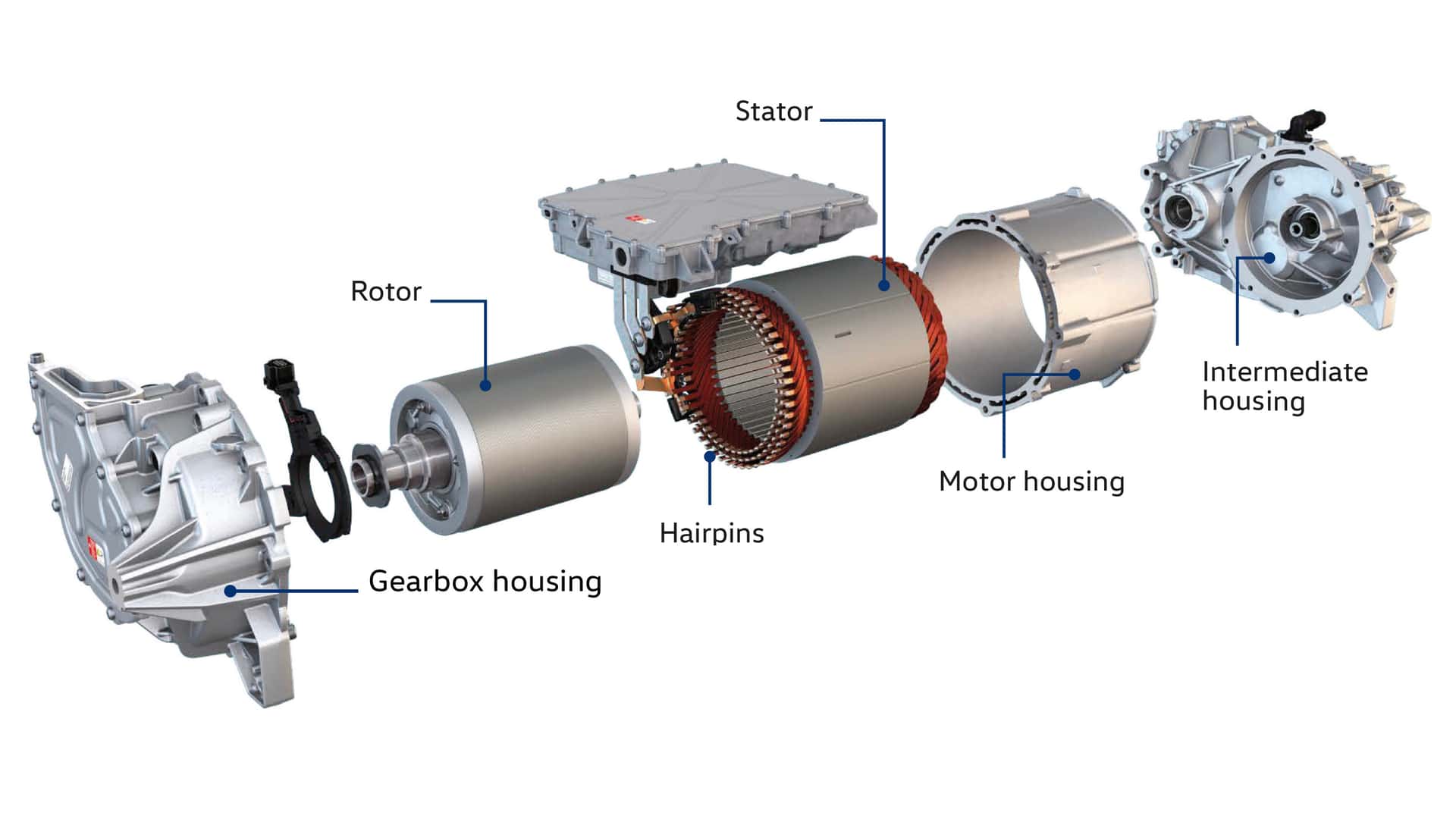
Every electric vehicle motor comprises two primary sections: the stationary outer component, termed the stator, and the rotating inner component, known as the rotor. The rotor is directly linked to a shaft, which transmits power to the vehicle’s wheels through a series of reduction gears, converting the battery’s direct current (DC) power into mechanical motion.
An integrated inverter plays a critical role, transforming the DC power from the battery into controlled alternating current (AC). This AC is then systematically fed into the stator’s coils, generating a precisely rotating magnetic field. This dynamic field acts as a continuous magnetic pull, causing the rotor to follow its movement and thus initiate rotation.
The term ‘synchronous’ describes a motor where the rotor spins in perfect alignment with the speed of this rotating magnetic field. Both permanent-magnet and electrically excited motors fall into this synchronous category. In contrast, induction motors operate with a deliberate speed differential, or ‘slip’, between the stator’s magnetic field and the rotor’s rotation.

Permanent-Magnet Synchronous Motors (PMSM): Unrivalled Efficiency
In a Permanent-Magnet Synchronous Motor (PMSM), the magnetic field essential for rotation is provided by powerful magnets permanently affixed to or embedded within the rotor. It is the stator’s intelligently controlled, rotating magnetic field that exerts a continuous pull, compelling the rotor to spin.
This design can be visualised as a compass needle constantly following a moving external magnet. Crucially, the rotor’s magnets in a PMSM do not require an external electrical supply to maintain their magnetism. This inherent magnetic property contributes significantly to the motor’s superior efficiency, as it eliminates the energy losses associated with powering additional rotor windings.
The advantages of PMSMs are substantial, encompassing high efficiency, impressive power output relative to their size, and a compact, lightweight construction. Consequently, these EV motor types are the preferred choice for the primary drive motors in the majority of electric vehicles currently on the market, underscoring their performance benefits.
However, these benefits come with certain considerations. The high-performance magnets typically used in automotive-grade PMSMs often contain rare earth elements. This dependency can expose manufacturers to the complexities of sourcing these materials, which are concentrated in specific geographic regions, as well as vulnerability to price volatility in the global market. While not all permanent magnets are rare-earth-based, the high magnetic strength required for EV applications generally necessitates their use.
Induction Motors: The Robust, Rare-Earth-Free Alternative
Also known as asynchronous motors, induction motors adopt a different approach by replacing permanent magnets with conductive bars integrated within the rotor. This distinctive configuration is frequently referred to as a “squirrel cage” design, owing to the resemblance of its bars, joined by rings at both ends, to a rodent’s exercise wheel.
In this design, the rotating magnetic field generated by the stator induces an electrical current within the rotor’s metal bars. This induced current subsequently creates the rotor’s own magnetic field, enabling the motor to produce torque without the need for permanent magnets or a direct electrical connection to the rotor windings. It represents a robust and simpler manufacturing process compared to magnet-based designs.
A defining characteristic of induction motors in an EV is that the rotor consistently turns at a slightly slower speed than the stator’s magnetic field. This speed differential, termed ‘slip,’ is absolutely essential for inducing current in the rotor and, consequently, for generating torque. Should the rotor ever perfectly catch up with the magnetic field, the induction effect and the resultant torque would diminish.
Induction motors offer significant advantages, particularly their inherent robustness and complete avoidance of rare-earth magnets, mitigating supply chain concerns. Nevertheless, the process of generating current within the rotor inevitably produces heat and can lead to a slight reduction in overall efficiency compared to PMSMs. A key operational benefit, however, is their ability to spin with minimal drag when they are not receiving power, making them ideal for specific applications.
Audi, for example, highlights this advantage in the Q6 E-tron Quattro’s front induction motor, which provides supplementary propulsion only when needed. This specific setup is quite common in all-wheel-drive (AWD) EVs. Here, a more powerful permanent-magnet motor typically handles the primary, continuously engaged drive axle, while a less potent induction motor is deployed for the secondary axle. Many electric vehicles from manufacturers like Tesla and General Motors similarly employ this strategic combination of EV motor types.
Electrically Excited Motors: The Adjustable Electromagnet
The Electrically Excited Synchronous Motor (EESM) presents a third distinct design philosophy. Unlike PMSMs, its rotor is equipped with coils that are supplied with electricity, effectively transforming the rotor into a controllable electromagnet. Crucially, and distinct from an induction motor, the EESM does not depend on ‘slip’ to generate its rotor’s magnetic field.
Consider this design as an evolution of the permanent-magnet concept, but with the added flexibility of adjustable electromagnets instead of fixed ones. The term “excited” simply denotes that the rotor coils are energised by an electrical current. This inherent ability to dynamically adjust the strength of the magnetic field provides engineers with a powerful tool to optimise the motor’s operation across varying speeds and load conditions, enhancing overall vehicle performance and energy management.
BMW has incorporated these advanced EV motor types into its latest sixth-generation EV powertrains. The German automaker states that EESMs offer efficient energy utilisation during everyday driving scenarios and maintain robust power delivery even at extremely high rotational speeds. Renault has also adopted this approach for vehicles such as the Renault 5 E-Tech, explicitly citing the reduced dependency on rare earths and the diversification of magnet suppliers as key factors driving their choice of wound rotor technology.
The primary trade-off with EESMs is that generating and maintaining the rotor’s magnetic field consumes a portion of the vehicle’s electrical energy. Furthermore, the inclusion of rotor windings and the necessary power supply system introduce an additional layer of mechanical and electrical complexity. Therefore, the benefit of avoiding permanent magnets comes with its own set of engineering challenges and energy considerations.
Strategic Synergy: Why Automakers Combine EV Motor Types
The Audi Q6 E-tron Quattro serves as a prime example of an EV that strategically deploys two distinct EV motor types. This configuration vividly illustrates the engineering rationale behind the existence and coexistence of these diverse motor designs. The permanent-magnet motor, typically situated at the rear, provides efficient primary propulsion, while its front induction motor offers supplementary performance and enhanced traction only when required, operating with minimal drag when inactive.
BMW’s latest all-wheel-drive architecture adopts a different but equally strategic combination, pairing an electrically excited motor at the rear with an induction motor at the front. Other prominent EV manufacturers, such as Mercedes-Benz, employ a permanent-magnet front motor but incorporate a sophisticated mechanical disconnect mechanism. This allows the motor to be disengaged from the wheels when not needed, effectively eliminating drag and associated energy losses, thereby enhancing overall driving efficiency.
The choice of the optimal EV motor is a multifaceted decision, extending beyond merely generating power. It heavily involves conserving energy when propulsion is not required and ensuring robust power delivery precisely when it is demanded. This intricate balancing act is why the automotive industry will continue to explore and implement a diverse array of EV motor types and configurations in the electric vehicles of tomorrow, continuously pushing the boundaries of efficiency and performance.
Frequently Asked Questions (FAQ) about EV Motor Types
Q1: What are the main types of electric motors used in EVs?
EVs primarily use three main types of electric motors: Permanent-Magnet Synchronous Motors (PMSM), Induction Motors (asynchronous), and Electrically Excited Synchronous Motors (EESM). Each type offers distinct characteristics in terms of efficiency, performance, material usage, and operational complexity.
Q2: Why do some EV motors use permanent magnets?
Permanent-Magnet Synchronous Motors (PMSM) use rare-earth magnets on their rotors because they offer high efficiency and power density from a compact design. These magnets create a constant magnetic field without needing an external power supply to the rotor, reducing energy losses.
Q3: What is the advantage of an induction motor in an EV?
Induction motors are robust and do not require rare-earth elements, addressing supply chain concerns. They also exhibit very low drag when unpowered, making them suitable for auxiliary drive axles in all-wheel-drive EVs where they can be disengaged to save energy.
Q4: How do electrically excited motors differ from permanent-magnet motors?
Electrically Excited Synchronous Motors (EESM) use coils on their rotors that are powered by electricity, creating an adjustable electromagnet. This allows for dynamic optimisation of the magnetic field strength, unlike permanent magnets which have a fixed field, but adds complexity and consumes some electricity for excitation.
Q5: Can an EV use more than one type of motor?
Yes, many modern all-wheel-drive EVs use a combination of different EV motor types. For instance, a vehicle might have a highly efficient permanent-magnet motor for the primary drive axle and an induction motor for the secondary axle, optimising for both performance and efficiency under varying conditions.
Q6: What role does the inverter play in an EV motor system?
The inverter is a critical component that converts the direct current (DC) from the EV battery into controlled alternating current (AC). This AC is then fed to the motor’s stator coils, generating the rotating magnetic field that drives the rotor and powers the vehicle.
Q7: Why is ‘slip’ important for induction motors?
‘Slip’ refers to the necessary speed difference between the stator’s rotating magnetic field and the rotor’s rotation in an induction motor. This difference is crucial because it induces an electrical current in the rotor, which in turn creates the magnetic field required to generate torque and propel the vehicle.