
Key Takeaways
- Tesla has clarified its strategy for the anticipated robotaxi network, describing it as a blend of ‘Airbnb and Uber’ during its Q1 earnings call.
- The automaker intends to operate a significant portion of the self-driving taxi fleet directly, while also allowing Tesla owners to integrate their personal vehicles into the network.
- Owners will have control over their vehicle’s availability, including options to restrict usage to friends, family, or highly-rated users, offering unprecedented flexibility.
- The ambitious plan hinges on Tesla’s ‘vision-only architecture’ and end-to-end neural networks, trained on extensive real-world driving data for autonomous operation.
- Despite these detailed plans, the company faces skepticism due to past unmet deadlines for Full Self-Driving (FSD) and autonomous vehicle deployment, requiring careful investor consideration.
In a highly anticipated first-quarter earnings call, Tesla offered new insights into its long-discussed foray into the robotaxi business, providing a clearer vision for investors and the public. The electric vehicle manufacturer, under the leadership of CEO Elon Musk, outlined a dual-pronged approach that seeks to merge company-operated autonomous vehicles with a peer-to-peer sharing model, akin to a ‘combination of Airbnb and Uber’.
This strategic clarification comes amidst considerable market speculation and investor scrutiny, particularly following reports suggesting a pivot from a cheaper consumer vehicle to prioritizing autonomous ride-hailing. While many details remain in flux, the announcements have begun to define the contours of Tesla’s future mobility services.
A Hybrid Model: Tesla’s Robotaxi Network Takes Shape
During the recent conference call, Tesla CEO Elon Musk elaborated on the foundational principles of the forthcoming Tesla robotaxi network. He confirmed that the company plans to establish and manage its own fleet of self-driving taxis, a significant undertaking that requires robust autonomous technology and a scalable operational framework.
Complementing this company-owned fleet, Tesla envisages a unique participatory model for its vehicle owners. Musk stated, “Tesla owners would be able to add or subtract their cars from the fleet whenever they want.” This unprecedented flexibility would empower owners to monetize their vehicles, transforming them into revenue-generating assets within the ride-hailing ecosystem.
Further emphasizing user control, Musk added that owners “can decide if they want to only let the car be used by friends and family, or only by five-star users or by anyone.” This layered approach to access and usage aims to provide a tailored experience, addressing privacy and trust concerns for individual owners participating in the Tesla robotaxi network.
Technological Pillars of Autonomous Operation
Tesla’s first-quarter earnings report reinforced the company’s commitment to developing the underlying technology for these autonomous services. The report explicitly stated, “We have been investing in the hardware and software ecosystems necessary to achieve vehicle autonomy and a ride-hailing service.” This sustained investment underscores the complexity and capital intensity required to bring a truly self-driving fleet to fruition.
The company reiterated its belief that “a scalable and profitable autonomy business can be realized through a vision-only architecture with end-to-end neural networks, trained on billions of miles of real-world data.” This statement highlights Tesla’s continued reliance on camera-based systems and advanced artificial intelligence, a strategy that diverges from many competitors who incorporate lidar and radar technologies.
The ‘vision-only’ approach, leveraging sophisticated neural networks, represents a core tenet of Tesla’s autonomous driving philosophy. The extensive training on real-world driving data is crucial for refining these systems, aiming to achieve the reliability and safety standards necessary for widespread deployment of self-driving taxis.
Previewing the User Experience and Future Integration
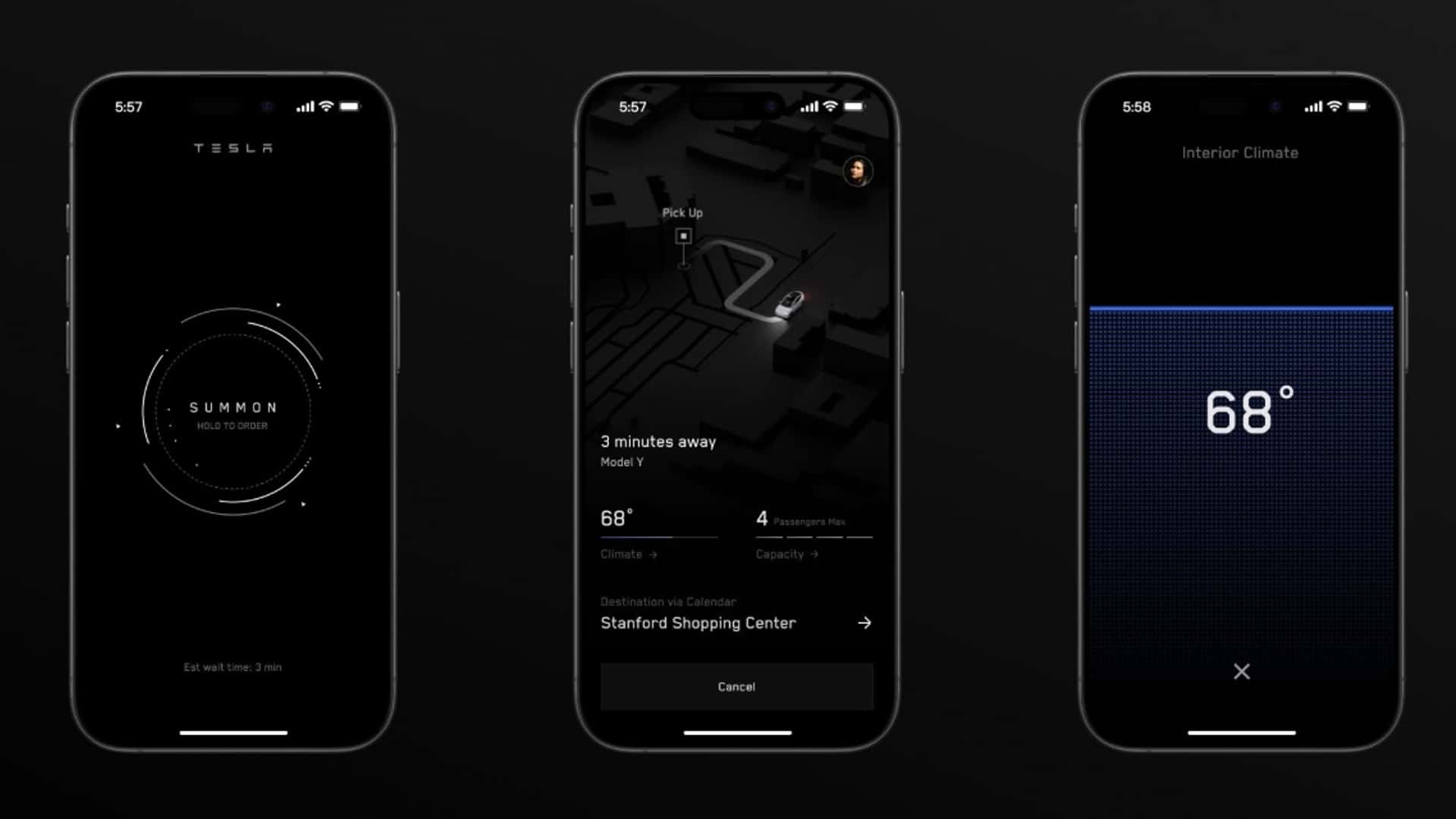
Beyond the operational and technological blueprints, Tesla also offered a glimpse into the potential user interface for its ride-hailing service. The company published a preview image of what the functionality may resemble when integrated into the existing Tesla application. This visual insight provides a tangible connection to the abstract concept of robotaxis.
The renderings notably displayed a “Summon” button, which would presumably be the primary interface for users to order an autonomous taxi. Additionally, one screen indicated a temperature of ’68 degrees’, sparking speculation that customers might eventually have the ability to pre-adjust climate settings in their assigned robotaxi before their arrival, enhancing the personalized travel experience.
While these interface details remain somewhat scant, they signify Tesla’s progress in designing the user-facing aspects of the service. The integration into the familiar Tesla app suggests an intention to provide a seamless and intuitive experience for passengers.
Navigating Investor Concerns and Market Uncertainty
The detailed disclosure on the robotaxi initiative is particularly significant given the recent period of uncertainty surrounding Tesla’s strategic direction. The market was notably unsettled by an earlier Reuters report, which suggested that Tesla had shelved plans for a more affordable consumer vehicle in favor of accelerating its robotaxi project.
This report prompted widespread questions among analysts and investors regarding the automaker’s future product pipeline and growth trajectory. Tesla’s recent earnings call served as an opportunity to address these concerns directly, offering clarity on its dual strategy for both vehicle production and future mobility services.
During the call, Tesla sought to assuage investors by indicating an accelerated launch timeline for “new vehicles, including more affordable models.” This statement clarified that while the Tesla robotaxi network remains a long-term strategic priority, the company is not abandoning its commitment to expanding its consumer vehicle offerings. The robotaxi, it was noted, would arrive “later on,” suggesting a phased deployment approach.
Addressing the Challenge of True Autonomy and Past Promises
Crucially, the success of Tesla’s ride-hailing ambitions rests squarely on its ability to deliver fully autonomous vehicles. This remains a significant hurdle, as the company has yet to achieve true self-driving capabilities despite “years of lofty promises” from its leadership. The current iteration of Tesla’s Full Self-Driving (FSD) feature, a premium software offering, still “requires total driver supervision and regularly makes mistakes.” This distinction between driver-assisted features and fully autonomous operation is paramount.
The history of ambitious projections from CEO Elon Musk also frames the current announcements. Famously, Musk proclaimed that Tesla would have 1 million robotaxis operating on the road by 2020, a target that ultimately went unmet. This historical context prompts a degree of caution among observers.
Therefore, while the concept of a Tesla-operated autonomous taxi service is intriguing and holds significant future potential, market analysts and stakeholders are encouraged to “take Musk’s grand proclamations with a grain of salt” based on previous timelines. The technical and regulatory challenges inherent in achieving Level 5 autonomy, where a vehicle can operate completely without human intervention in all conditions, are substantial and will require verifiable progress.
The latest disclosures underscore Tesla’s unwavering commitment to its autonomous future, providing a more detailed look at how the company envisions its role in the evolving landscape of urban mobility. The path to a widespread Tesla robotaxi network, however, will undoubtedly be marked by continued technological development, regulatory hurdles, and intense market scrutiny, particularly as the company balances its ambitious long-term vision with near-term production goals.
Frequently Asked Questions About Tesla’s Robotaxi Plans
What is Tesla’s vision for its robotaxi network?
Tesla envisions a hybrid model, combining a company-owned fleet of self-driving taxis with a unique peer-to-peer sharing service. CEO Elon Musk likened it to a “combination of Airbnb and Uber,” allowing existing Tesla owners to integrate their vehicles into the network for ride-hailing services.
How will current Tesla owners participate in the robotaxi network?
Tesla owners will have the flexibility to enroll their vehicles in the robotaxi fleet, enabling them to earn income. They will also be able to control who uses their car, with options to limit access to friends and family, five-star rated users, or the general public within the service.
What technology underpins Tesla’s autonomous ride-hailing service?
The system is built upon a “vision-only architecture” that utilizes end-to-end neural networks. These networks are extensively trained on billions of miles of real-world driving data, a core aspect of Tesla’s approach to achieving full vehicle autonomy without reliance on lidar or radar.
When is the Tesla robotaxi service expected to launch?
While Tesla has detailed its plans for ride-hailing functionality, the company indicated that the robotaxi service itself would arrive “later on.” This suggests a timeline after the accelerated launch of new and more affordable consumer vehicle models, with no definitive date provided in the recent earnings call.
What challenges does Tesla face in deploying its robotaxi network?
A primary challenge is achieving true full self-driving capabilities, as the current FSD feature still requires driver supervision and has limitations. Overcoming regulatory hurdles, public acceptance of autonomous vehicles, and scaling the technology safely across a vast network are also significant obstacles.
How does this announcement impact Tesla’s plans for more affordable vehicles?
Tesla clarified that it is accelerating the launch timing of “new vehicles, including more affordable models.” This suggests that while the robotaxi network remains a strategic priority, the company is concurrently working on expanding its consumer vehicle lineup, addressing earlier concerns about a shift in focus.
What does ‘vision-only architecture’ mean for autonomous driving?
The ‘vision-only architecture’ means Tesla’s self-driving system relies exclusively on cameras and advanced computer vision algorithms, mimicking human sight. Unlike some competitors, it does not use lidar (light detection and ranging) or radar (radio detection and ranging) sensors, believing cameras provide sufficient data for robust autonomy.