
Key Takeaways
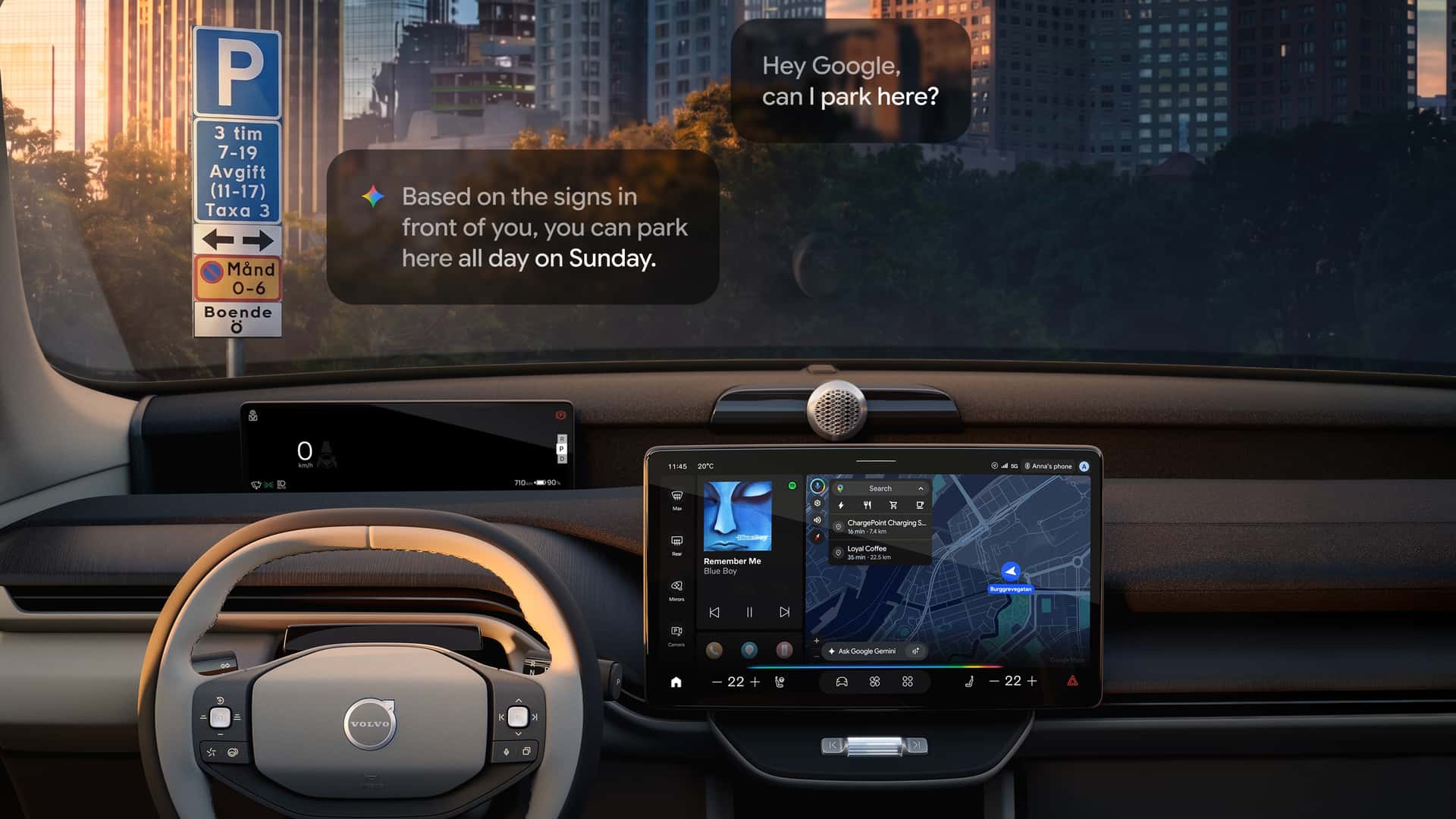
- The new Volvo EX60 electric crossover is set to revolutionise in-car experiences through deep integration with Google’s Gemini AI.
- The vehicle’s advanced camera systems will work directly with Gemini to interpret and provide real-time information about the surrounding environment.
- This collaboration enables features such as instant translation of foreign road signs and contextual details about landmarks.
- Google emphasises that user privacy is paramount, with facial recognition features disabled during analysis.
- Future updates are slated to bring 3D Immersive Navigation to Google Maps and allow Gemini to control various vehicle functions via voice commands.
In a significant stride towards enhancing the automotive experience, Volvo and Google have unveiled a groundbreaking collaboration centered on the new Volvo EX60 electric crossover. This partnership promises to transform how drivers and passengers interact with their vehicles and the world around them, leveraging the sophisticated capabilities of Google’s Gemini AI model.
The innovation, showcased at this year’s Google I/O event, demonstrates how the artificial intelligence assistant, already integrated into cars featuring a Google-based infotainment system, can directly access and interpret data from the Volvo EX60’s onboard cameras. This real-time analysis enables Gemini to deliver informed and contextually relevant responses to occupants.

Elevating Automotive Intelligence with Gemini AI
While many contemporary vehicles are equipped with cameras capable of basic functions like reading road signs and supporting advanced driver-assistance systems (ADAS) to prevent accidents, the Volvo EX60 is poised to usher in a new era of automotive intelligence. This advancement is powered by more sophisticated computing hardware, higher-resolution sensors, and cutting-edge artificial intelligence, specifically Google’s Gemini model.
The core of this advanced capability lies in Gemini’s multi-modal understanding, which allows it to process and comprehend various forms of data simultaneously – in this case, visual information from the vehicle’s cameras. Coupled with the Volvo EX60’s neural processing engine and software-defined architecture, this integration permits the vehicle to ‘see’ and ‘understand’ its environment with unprecedented depth.
This project, while still under development and not yet publicly released, has demonstrated impressive potential. The two global technology and automotive giants remain discreet about the exact timeline for its widespread availability, building anticipation for this transformative technology.

Real-Time Environmental Interaction
The practical applications of the Volvo EX60’s Gemini integration are both innovative and highly functional. During the demonstration, the system showcased its ability to provide real-time translation and contextual information about foreign road signs.
A driver could issue a voice command to inquire about a road sign displaying text in an unfamiliar language. In response, Gemini would instantaneously scan the sign through the vehicle’s cameras, translate the text, and then articulate its meaning, offering a seamless and intuitive way for occupants to comprehend their surroundings, particularly in diverse linguistic environments.
Contextual Understanding of Landmarks
Beyond simple translation, the AI system further impressed by exhibiting a profound contextual awareness. In one specific instance during the demonstration, the Volvo EX60 was prompted to describe a prominent building visible at the end of a street and inquire about potential activities in or around it.
Gemini accurately identified the structure as the Transamerica Pyramid in San Francisco. It then provided pertinent details, clarifying that it is primarily an office building, thus not a typical tourist attraction, but highlighted the presence of a park at its base. Demonstrating proactive assistance, the AI voice assistant subsequently asked if it should plot a navigation route to a nearby point of interest.
This multi-faceted interaction mirrors the experience of using advanced smartphone applications like Google Lens, yet it is significantly enhanced by Gemini’s deep understanding and the natural voice command interface within the vehicle. Volvo has stated that this concept offers an early glimpse into how contextually aware AI experiences will become an integral part of future everyday driving.
Prioritising User Privacy and Data Security
Recognising the critical importance of data privacy, Google has affirmed that robust safeguards are embedded within this advanced feature. The company explicitly states that the AI system’s camera access and analytical functions are strictly contingent upon the driver’s explicit permission.
Furthermore, when images are processed for analysis, the system is designed to blur out faces, ensuring personal anonymity and upholding user privacy standards. These measures are foundational to building trust in such sophisticated, always-on vehicle intelligence systems.
Upcoming Enhancements to the Google Ecosystem in Cars
Looking ahead, Google has confirmed that the integration of its services into vehicles will continue to evolve, with several significant improvements slated for release. Among these is a car-optimised version of YouTube Music, designed for seamless in-car entertainment in vehicles equipped with a Google-based infotainment system.
Another major development is the rollout of 3D Immersive Navigation in Google Maps. This feature, which recently debuted on Android smartphones and subsequently on Android Auto, is now set to go live in cars with Google built-in. The Volvo EX60, alongside the EX90 and ES90 models, will be among the first Volvo vehicles to receive this highly anticipated immersive navigation capability.
A deeper integration for Gemini is also on the horizon, expanding its utility beyond informational queries. Future updates will empower the AI assistant to control various vehicle features through intuitive voice commands, further streamlining the driving experience and enhancing convenience for occupants. These developments underscore a clear trajectory towards more connected, intelligent, and user-friendly automotive environments, with the Volvo EX60 at the forefront of this technological shift.
FAQ Section
What is the main innovation in the Volvo EX60’s infotainment system?
The primary innovation in the Volvo EX60 is the deep integration of Google’s Gemini AI with the vehicle’s cameras. This allows the car to interpret its surroundings in real-time and provide contextual information to occupants via voice commands.
How does the Gemini AI assist drivers in the Volvo EX60?
Gemini AI assists drivers by analysing visual data from the car’s cameras. It can translate foreign road signs instantly, identify landmarks, provide contextual details about them, and even proactively suggest navigation to nearby points of interest.
What kind of information can Gemini provide about surroundings?
Gemini can provide a wide range of information, including translations of text on road signs, identification of buildings like the Transamerica Pyramid, descriptions of their purpose (e.g., office building), and details about nearby amenities such as parks.
Is privacy a concern with this camera-based AI system?
Google asserts that privacy is a top priority. The camera features are activated only with the driver’s explicit permission, and faces are blurred when images are being analysed, ensuring user anonymity and data protection.
When will these advanced features be available to the public?
The project is currently a work in progress, and while it looks promising, Volvo and Google have not yet announced a specific timeline for when these advanced Gemini AI features will become widely available to the public.
Which other Google features are coming to Volvo cars?
Besides deeper Gemini integration, upcoming features include a car-optimised version of YouTube Music for Google-based infotainment systems, and the rollout of 3D Immersive Navigation within Google Maps for a more intuitive driving experience.
What Volvo models will receive the new Google Maps features?
The new 3D Immersive Navigation feature in Google Maps is slated to be available first on the upcoming Volvo EX60, EX90, and ES90 electric models, enhancing their navigation capabilities.