
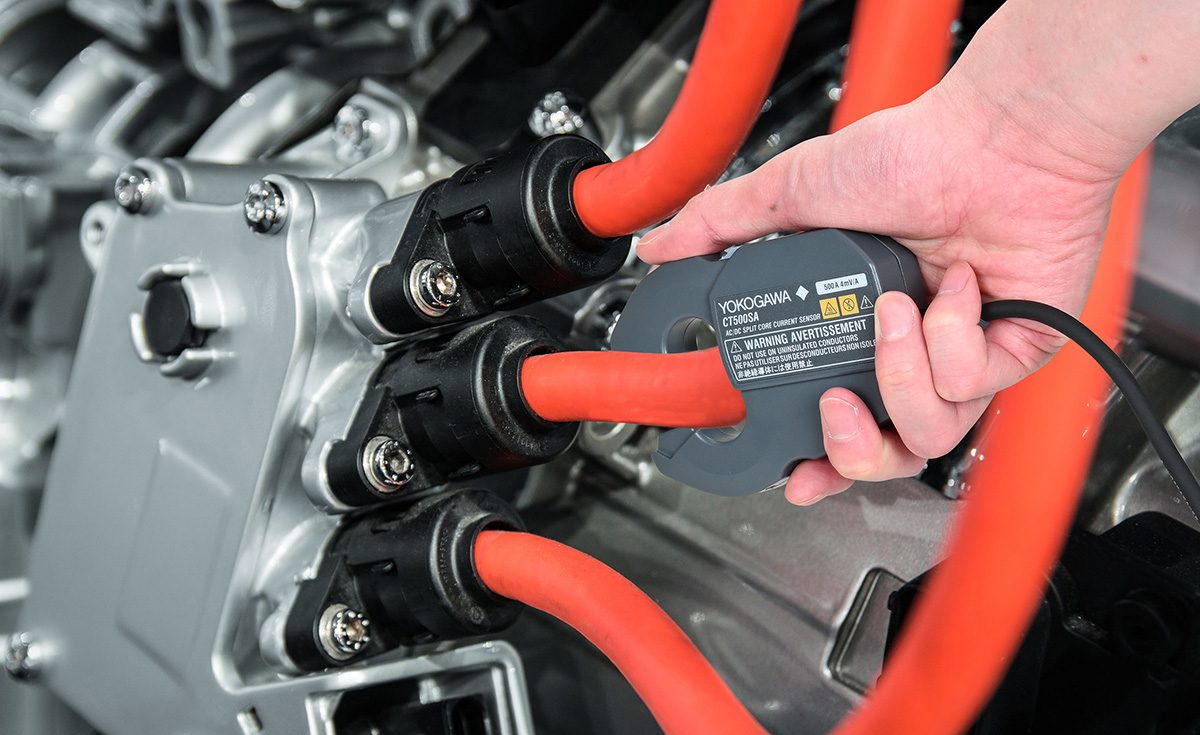
Yokogawa Test & Measurement, a global leader in measurement solutions, has announced the release of two innovative AC/DC split core current sensors, the CT500SA and CT200SA. These second-generation EV current sensors are specifically engineered to address critical measurement challenges in the rapidly evolving electric vehicle (EV) industry, alongside other high-power applications. Designed to clamp directly onto cables that cannot be cut for traditional through-hole sensors, these devices are poised to redefine current measurement in space-constrained testing environments.
Set for release on September 9, 2026, the CT500SA and CT200SA models cover the 500 Ampere and 200 Ampere ranges, respectively. Their introduction marks a significant step forward in providing accurate, reliable, and versatile current measurement capabilities essential for the rigorous validation of EV components and systems.

Key Takeaways
- Yokogawa introduces CT500SA (500A) and CT200SA (200A) AC/DC split core EV current sensors.
- These sensors are designed for current measurement on un-cuttable cables within tight, space-constrained EV test environments.
- They offer exceptional accuracy of ±0.1% over a wide temperature range and frequency bandwidths up to 1 MHz.
- A unique feature allows direct connectivity to both power analyzers and waveform measurement instruments, streamlining testing workflows.
- The compact design and one-hand operation enhance usability and measurement repeatability in demanding automotive validation tasks.
Revolutionizing Current Measurement in Electric Vehicle Testing
The electric vehicle sector is characterized by continuous innovation, demanding increasingly sophisticated testing and measurement tools. As vehicle architectures become lighter and more compact, the physical space available for test equipment shrinks significantly. This trend presents a formidable challenge for engineers needing to accurately measure current flow in critical components like inverters and motors, particularly during post-assembly validation where cables cannot be altered.
Traditional current sensors often struggle to meet these requirements. Through-hole sensors necessitate cutting and re-threading cables, which is often impractical or impossible in finished assemblies. Conventional split core sensors, while offering the convenience of clamping, have historically fallen short on the stringent accuracy demands of modern EV development due to inherent design limitations.
Addressing the Challenges of Automotive Prototyping
Yokogawa’s new EV current sensors directly confront these persistent hurdles. The inability to cut cables is a common constraint in various stages of EV development and quality assurance, especially when evaluating performance of integrated systems. The limited access around components in compact vehicle designs further complicates the use of larger measurement tools, such as Yokogawa’s existing CT1000S, which is sized for 1,000 A applications.

Engineers engaged in lower current rating applications, prevalent in many EV subsystems, often find existing high-capacity sensors disproportionately large and unwieldy. The CT500SA and CT200SA are precisely tailored to fill this critical gap, providing high-performance measurement in smaller form factors, ensuring that precise data can be gathered even in the most challenging physical layouts.
Design Innovation for Space-Constrained Environments
The physical design of the CT500SA and CT200SA reflects a deep understanding of the practical challenges faced by test engineers. Each main sensor unit measures a compact 110 mm wide by 62 mm high by 25 mm deep, making them exceptionally suitable for the tight confines of in-vehicle testing environments.
This compact footprint is crucial for gaining access to cables nestled deep within engine bays or battery enclosures, areas where conventional, bulkier sensors simply cannot fit. The design minimizes interference with surrounding components, allowing for more precise and less intrusive measurements, which is paramount for maintaining the integrity of test setups.
Compact Form Factor and Ergonomic Operation
User experience and operational efficiency were key considerations in the design. Both models feature an intuitive single unlock-and-open button, enabling effortless one-hand operation. This ergonomic design is particularly beneficial when working in confined spaces, where manipulating tools often requires dexterity and precision.
The ability to deploy and secure the sensor with one hand significantly speeds up the testing process, reduces the potential for errors, and enhances overall workflow efficiency. This thoughtful design minimizes setup time and allows engineers to focus more on data acquisition and analysis rather than wrestling with cumbersome equipment.
Ensuring Measurement Stability
Achieving repeatable and accurate current measurements, especially with clamp-on sensors, necessitates stable positioning. Recognizing this, Yokogawa has integrated practical fixing mechanisms into the body of each sensor. Both models include an M4 screw hole and a cable tie slot, allowing engineers to firmly secure the sensor in place during measurements.
Yokogawa emphasizes that securing the sensor significantly improves measurement repeatability, mitigating potential errors caused by movement or vibration. This attention to detail underscores the commitment to delivering reliable data, which is foundational for robust EV component validation and certification.
Unprecedented Accuracy and Wideband Performance
A cornerstone of the new EV current sensors is their remarkable measurement accuracy and broad frequency response. Yokogawa has achieved an accuracy rating of ±0.1% across a wide temperature range of -40° C to 85° C. For even more precise laboratory conditions, accuracy improves to ±0.09% of reading plus 0.01% of full scale over a 23 ±5° C range. Furthermore, the phase accuracy stands at an impressive ±0.1° between 0.1 Hz and 1 kHz.
Elevating Precision in Challenging Conditions
This level of precision is described by Yokogawa as an order of magnitude better than conventional current sensors, placing the new split core models on par with high-performance through-hole types. The company highlights that conventional split core sensors have historically struggled to meet the accuracy demands of critical applications due to the inherent challenges of their clamp-on design, such as magnetic circuit integrity and environmental influences.
The superior accuracy of the CT500SA and CT200SA directly addresses this historical limitation, making high-precision clamp-on measurement a reliable reality for the first time in many demanding scenarios. This advancement is vital for accurately assessing power consumption, efficiency, and overall performance characteristics in EV powertrains.
Critical for Advanced Inverter Validation
Beyond static accuracy, the frequency bandwidth of these EV current sensors is a critical feature for modern power electronics. The CT500SA delivers a frequency bandwidth of 500 kHz (-3 dB), while the CT200SA extends this even further to 1 MHz (-3 dB). These wideband capabilities are essential for analyzing the complex switching frequencies characteristic of motor inverter validation.
Modern inverters utilize pulse width modulation (PWM) to control motors, generating signals with rich harmonic content that extends into high frequencies. Accurately measuring these wideband signals is indispensable for analyzing inverter efficiency, identifying potential electromagnetic interference (EMI) issues, and validating control algorithms. The capacity to measure these dynamic switching frequencies enables engineers to thoroughly assess inverter performance, ensuring optimal operation and reliability of EV drivetrains.
Seamless Integration Across Test Phases
A distinctive feature of the CT500SA and CT200SA is their remarkable versatility in connecting with various types of test instruments. Traditionally, a current sensor is often designed for use with either a power analyzer for power efficiency measurements or a waveform measurement instrument for detailed signal analysis. This often necessitates swapping sensors as engineers transition between different test phases, leading to potential delays and synchronization challenges.
Bridging Power Analysis and Waveform Measurement
Yokogawa’s new EV current sensors eliminate this inefficiency. Both the CT500SA and CT200SA connect directly to either a power analyzer or a waveform measurement instrument without requiring conversion connectors or additional supporting accessories. This direct compatibility means that engineers can seamlessly switch between waveform and power analysis using the same sensor.
This capability not only eliminates the need for time-consuming sensor swaps but also ensures that identical signals are measured across different analysis modalities. As Yokogawa points out, measuring identical signals removes the need to synchronize data afterward, significantly streamlining the entire testing process and reducing the potential for data inconsistencies.
Broader Applications Beyond Electric Vehicles
While primarily designed with electric vehicle testing in mind, the advanced capabilities of the CT500SA and CT200SA extend their utility to a wide array of other high-power electronics applications. The high accuracy, wide bandwidth, and clamp-on design make them valuable tools in diverse industrial and research settings.
Other significant applications include photovoltaic output measurement, where precise current monitoring is crucial for evaluating solar panel efficiency and performance. They are also ideal for HVAC current monitoring, enabling accurate assessment of energy consumption and operational efficiency in heating, ventilation, and air conditioning systems. Furthermore, their ability to analyze pulse width modulation (PWM) outputs with harmonic content makes them invaluable for comprehensive inverter efficiency analysis across various industrial applications, ensuring reliable and optimized performance of power conversion systems.
Enhancing the Future of EV Component Validation
The introduction of Yokogawa’s CT500SA and CT200SA EV current sensors represents a significant advancement in measurement technology tailored for the demands of the electric vehicle industry. By combining exceptional accuracy, wide frequency response, and a user-centric design optimized for space-constrained environments, these sensors provide engineers with powerful tools to accelerate the development and validation of next-generation EVs.
Their versatility in connecting directly to both power and waveform analysis instruments further streamlines the testing workflow, ensuring that critical data is captured efficiently and accurately. As the EV market continues its rapid expansion, advanced measurement solutions like these will be indispensable in driving innovation, enhancing product quality, and ensuring the safety and performance of electric vehicles worldwide.
Source: Yokogawa Test & Measurement
Frequently Asked Questions (FAQ)
What are the primary applications for the new Yokogawa CT500SA and CT200SA sensors?
These EV current sensors are primarily designed for electric vehicle testing, particularly in space-constrained environments during post-assembly validation of inverters and motors. Beyond EVs, they are also suitable for photovoltaic output measurement, HVAC current monitoring, and general inverter efficiency analysis involving pulse width modulation (PWM) outputs with harmonic content.
How do these new sensors improve accuracy compared to conventional clamp-on sensors?
Yokogawa states that the CT500SA and CT200SA offer an accuracy of ±0.1% over a wide temperature range, improving to ±0.09% of reading plus 0.01% of full scale under controlled conditions. This precision is an order of magnitude better than conventional split core sensors, making them comparable to high-accuracy through-hole types despite their clamp-on design, addressing previous limitations.
Why is a wide frequency bandwidth important for EV testing?
A wide frequency bandwidth, up to 1 MHz for the CT200SA, is crucial for measuring the complex switching frequencies used in motor inverter validation. Modern inverters generate PWM signals rich in harmonics, requiring sensors that can accurately capture these high-frequency components to assess efficiency, understand transient behavior, and validate control strategies in EV powertrains.
Can these sensors be used with different types of test instruments?
Yes, a key feature is their versatility. Both the CT500SA and CT200SA can connect directly to either a power analyzer or a waveform measurement instrument. This eliminates the need for sensor swaps between different test phases and ensures that the same signal is measured for both power and waveform analysis, simplifying data synchronization and streamlining testing workflows.
When will the Yokogawa CT500SA and CT200SA be available?
The new AC/DC split core current sensors, CT500SA and CT200SA, from Yokogawa Test & Measurement are scheduled for release on September 9, 2026. This announcement provides engineers and testing facilities with a clear timeline for integrating these advanced measurement tools into their operations for enhanced EV component validation.
What current ranges do the new sensors cover?
The newly announced models cover two distinct current ranges to cater to various application needs. The CT500SA is designed for measurements up to 500 Amperes, while the CT200SA extends its capability to 200 Amperes. These ranges are particularly relevant for testing various electrical circuits and components found within electric vehicles and other high-power electronic systems.
How do the compact size and ergonomic design benefit users?
The main sensor unit measures only 110 mm wide by 62 mm high by 25 mm deep, making it ideal for the tight spaces found in EV testing. The ergonomic design includes a single unlock-and-open button for one-hand operation, simplifying deployment. Integrated M4 screw holes and cable tie slots allow for secure mounting, improving measurement repeatability and overall efficiency in demanding environments.