
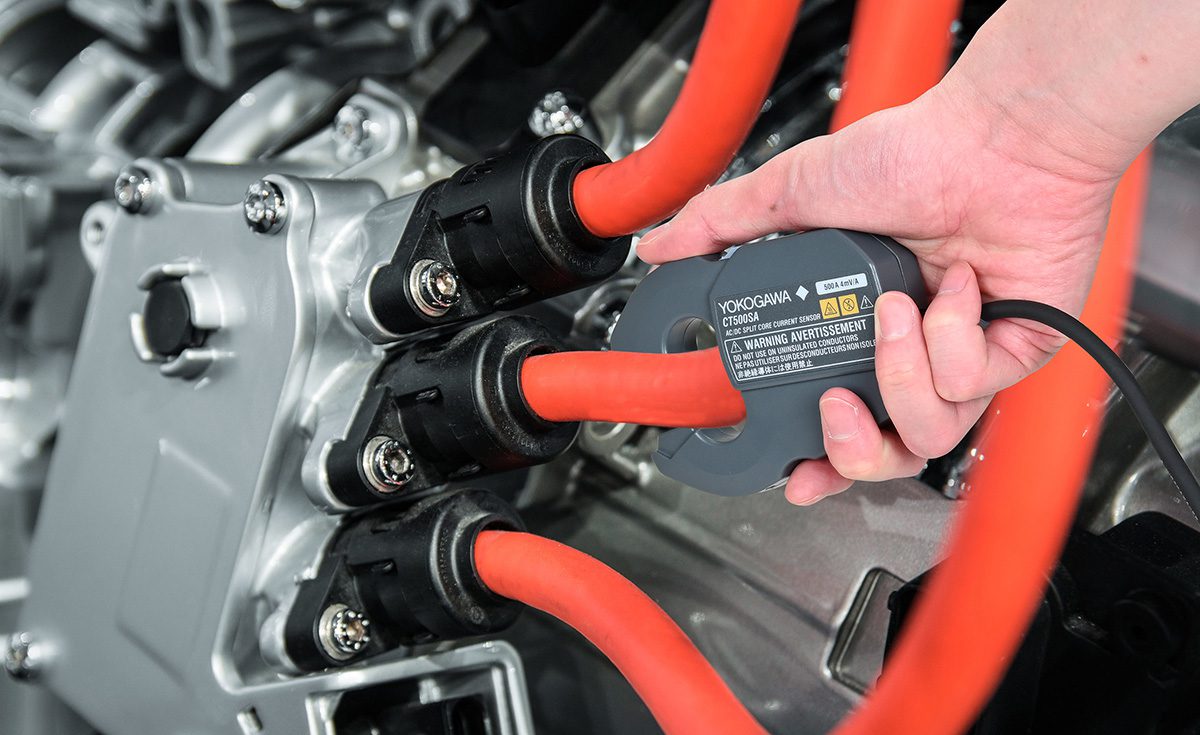
Key Takeaways:
- Yokogawa’s Latest Innovation: Yokogawa Test & Measurement introduces the CT500SA and CT200SA, advanced AC/DC split core current sensors.
- Designed for EV Testing: These second-generation sensors are engineered for precision current measurement in the highly space-constrained environments of electric vehicles, particularly where cables cannot be cut.
- Unmatched Accuracy: The new models offer exceptional accuracy, reaching ±0.09% of reading plus 0.01% of full scale in optimal conditions, a significant improvement over conventional split core sensors.
- Wideband Capability: With frequency bandwidths up to 1 MHz, they are capable of accurately measuring the high switching frequencies vital for motor inverter validation.
- Enhanced Versatility: Unique direct compatibility with both power analyzers and waveform measurement instruments streamlines the EV testing process, eliminating the need for sensor swaps and data synchronization.
Yokogawa Test & Measurement has announced the upcoming release of two new AC/DC split core current sensors, the CT500SA and CT200SA, poised to significantly enhance capabilities in critical measurement applications, particularly within the burgeoning electric vehicle (EV) sector. These second-generation models are designed to address a long-standing challenge in precision current measurement on cables that cannot be cut, a common scenario in complex modern test environments.

Scheduled for global release on September 9, 2026, these innovative sensors will cover the 500 A and 200 A current ranges. Their introduction marks a notable advancement in facilitating accurate data acquisition in highly space-constrained settings, such as those encountered during intensive in-vehicle testing of electric vehicles and their intricate power electronics.
Addressing Core Challenges in Electric Vehicle Testing
The rapid evolution of electric vehicle technology demands increasingly sophisticated and precise measurement tools. Engineers and technicians face significant hurdles, especially when conducting post-assembly validation of critical components like inverters and motors, where access is often severely limited and the integrity of power cables cannot be compromised.
Traditional measurement approaches often fall short in these demanding environments. The new Yokogawa sensors directly tackle these issues, providing a robust solution for accurate current sensing without requiring any modification to the conductor itself. This capability is paramount for maintaining the structural and electrical integrity of high-value EV components.

The Imperative for Precision in Compact Spaces
Modern vehicle architectures, particularly those for electric vehicles, are characterized by their compact and lightweight designs. This design philosophy, while beneficial for efficiency and performance, inherently limits the available space around components and wiring harnesses.
For measurement applications requiring lower current ratings, existing larger sensors, such as Yokogawa’s 1,000 A CT1000S model, can prove unwieldy and impractical. The CT500SA and CT200SA are engineered to navigate these tight confines, providing a more appropriate form factor for a wider array of EV testing scenarios.
Overcoming Accuracy Hurdles with Advanced Design
Conventional split core current sensors have historically faced limitations in achieving the same level of accuracy as their through-hole counterparts due to challenges inherent in their clamp-on design. However, Yokogawa states that its new CT500SA and CT200SA models bridge this gap, delivering precision on par with through-hole types.
The company highlights an impressive accuracy rating of ±0.1% across a wide temperature range from -40° C to 85° C. For even more controlled conditions, specifically 23 ±5° C, this precision improves further to ±0.09% of reading plus 0.01% of full scale. Furthermore, the sensors boast a phase accuracy of ±0.1° between 0.1 Hz and 1 kHz, a metric Yokogawa asserts is an order of magnitude better than many conventional current sensors available today.
Unveiling Yokogawa’s CT500SA and CT200SA Specifications
The design and technical specifications of the CT500SA and CT200SA reflect a concerted effort to optimize both performance and user experience. Every aspect, from physical dimensions to electrical characteristics, has been meticulously crafted to meet the stringent demands of advanced EV testing and related industrial applications.
These capabilities position the new sensors as essential tools for engineers striving to push the boundaries of electric vehicle efficiency, performance, and reliability. Their ability to deliver high-fidelity data in challenging conditions is a testament to Yokogawa’s commitment to measurement innovation.
Design Innovations for Enhanced Usability
Physical constraints inside an electric vehicle necessitate not only compact instrumentation but also ease of operation. Both the CT500SA and CT200SA sensors feature a remarkably compact main sensor unit, measuring just 110 mm wide, 62 mm high, and 25 mm deep.
Ease of use is further enhanced by a single unlock-and-open button, allowing for convenient one-handed operation—a significant advantage when maneuvering in tight spaces. To ensure consistent and repeatable measurements, each sensor body includes an M4 screw hole and a cable tie slot, enabling secure fixing in place. This mechanism is crucial for mitigating potential measurement variations caused by sensor positioning.
Unprecedented Measurement Fidelity and Bandwidth
Beyond static accuracy, the dynamic performance of these sensors is critical for analyzing complex electrical signals. The CT500SA delivers a frequency bandwidth of 500 kHz (-3 dB), while the CT200SA extends this capability significantly to 1 MHz (-3 dB).
This wideband measurement capability is particularly vital for accurately capturing the high switching frequencies inherent in motor inverter validation. Modern electric motors and their control systems operate at increasingly high frequencies, and the ability to precisely measure these dynamic signals is indispensable for optimizing inverter efficiency and overall system performance.
Versatility Across Diverse Applications
While primarily positioned as a solution for advanced EV testing, the utility of Yokogawa’s new current sensors extends far beyond the automotive realm. Their unique design and high-performance characteristics make them adaptable to a broad spectrum of industrial and energy-related measurement needs.
This versatility underscores their value as a foundational tool for engineers across multiple sectors, enabling high-precision current analysis wherever conventional methods prove cumbersome or inadequate. The ability to perform accurate measurements in varying contexts makes them a strategic investment for a range of technical endeavors.
Bridging Power and Waveform Analysis
A significant innovation in the CT500SA and CT200SA is their unprecedented versatility in connecting to different types of measurement instrumentation. Traditionally, current sensors are often designed to be compatible with either a power analyzer for aggregate power measurements or a waveform measurement instrument for detailed signal analysis.
These new Yokogawa models break this barrier by connecting directly to both instrument classes without the need for conversion connectors or additional accessories. This eliminates the necessity for sensor swaps during different test phases, drastically streamlining workflow and ensuring that identical signals are measured, thereby removing the complexities of data synchronization post-measurement.
Expanding Beyond EV Diagnostics
The applications for the CT500SA and CT200SA are expansive. Beyond their immediate utility in electric vehicle testing, Yokogawa identifies their suitability for photovoltaic output measurement, a critical aspect of solar energy systems.
Furthermore, these sensors are ideal for HVAC current monitoring, enabling precise energy efficiency analysis of heating, ventilation, and air conditioning systems. Their capability for inverter efficiency analysis of pulse width modulation (PWM) outputs with harmonic content further extends their reach into critical power electronics development and validation across numerous industries.
Impact on Electric Vehicle Development
The introduction of the CT500SA and CT200SA current sensors represents a significant leap forward for the electric vehicle industry. As automotive manufacturers strive for greater efficiency, extended range, and enhanced safety, the need for accurate and reliable measurement tools becomes ever more critical.
By enabling high-precision current measurement in previously challenging environments, Yokogawa is empowering engineers to refine power electronics, optimize battery management systems, and validate motor performance with greater confidence. This directly contributes to the development of safer, more efficient, and higher-performing electric vehicles, accelerating the transition to sustainable mobility.
Conclusion
Yokogawa Test & Measurement’s new CT500SA and CT200SA split core current sensors are set to become indispensable tools for the future of EV testing and a wide array of industrial applications. Their combination of compact design, exceptional accuracy, wide frequency bandwidth, and versatile instrument compatibility addresses critical measurement challenges faced by engineers today.
These second-generation sensors underscore Yokogawa’s commitment to advancing measurement technology, offering solutions that not only meet current industry demands but also anticipate the evolving complexities of next-generation electric vehicle architectures and power electronics. With their release on September 9, 2026, the global engineering community can anticipate a new standard in precision current measurement.
Frequently Asked Questions (FAQ)
What are the primary applications of the Yokogawa CT500SA and CT200SA?
These new current sensors are primarily designed for electric vehicle (EV) testing, especially in space-constrained, in-vehicle environments where cables cannot be cut. Their versatility also extends to photovoltaic output measurement, HVAC current monitoring, and inverter efficiency analysis of pulse width modulation (PWM) outputs with harmonic content in various industrial settings.
What makes these new sensors particularly suitable for EV testing?
Their compact size and split core design allow them to clamp directly onto cables in tight spaces without requiring the conductor to be cut. They offer exceptional accuracy and wide frequency bandwidths (up to 1 MHz), which are crucial for precisely measuring the high switching frequencies found in modern motor inverter validation within electric vehicles.
How do the CT500SA and CT200SA improve upon conventional split core current sensors?
Yokogawa states that these second-generation models achieve an accuracy level comparable to through-hole sensors, significantly surpassing conventional split core designs. They boast high accuracy (e.g., ±0.09% of reading plus 0.01% of full scale) and superior phase accuracy, overcoming inherent challenges in clamp-on measurement technology.
Can these sensors connect to different types of measurement instruments?
Yes, a key feature is their direct compatibility with both power analyzers and waveform measurement instruments. This eliminates the need for conversion connectors or accessories, streamlining the testing process by allowing engineers to switch between different analysis types without swapping sensors, thus ensuring consistent data from identical signals.
What are the key physical specifications of the new sensors?
The main sensor unit for both the CT500SA and CT200SA measures 110 mm wide by 62 mm high by 25 mm deep. They are designed for easy, one-handed operation with a single unlock-and-open button and include an M4 screw hole and a cable tie slot for secure mounting, which helps improve measurement repeatability in dynamic test environments.
When will the Yokogawa CT500SA and CT200SA be available?
Yokogawa Test & Measurement has scheduled the global release for both the CT500SA and CT200SA AC/DC split core current sensors on September 9, 2026. This release date positions them to address immediate and future demands in advanced measurement applications across the electric vehicle and related high-tech industries.