
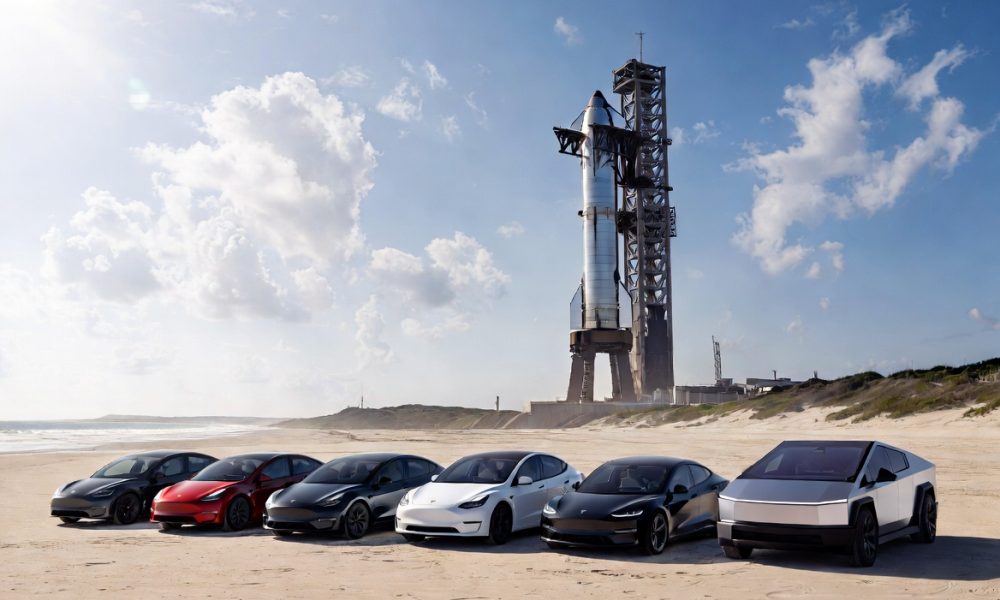
A significant shift in the landscape of technology and space exploration could be on the horizon, as a prominent Wall Street analyst has reiterated a bold prediction: a merger between Elon Musk’s two flagship companies, Tesla and SpaceX, is anticipated by 2027. This potential consolidation, if it materializes, would fundamentally redefine corporate structures and propel advancements across multiple high-stakes industries.
The forecast comes from Wedbush analyst Dan Ives, who, in a new research note, has not only reaffirmed his long-held belief but underscored the increasing inevitability of such a union. Ives posits that the strategic alignment and deepening operational synergies between the electric vehicle giant and the aerospace pioneer are paving the way for a unified entity within the next year.

The Analyst’s Rationale: Unpacking the Merger Thesis
Dan Ives argues that the proposed Tesla SpaceX merger is no longer a speculative fantasy but a logical progression driven by several key factors. These include increasingly intertwined operational frameworks, ambitious shared goals in artificial intelligence (AI) development, and Elon Musk’s overarching vision for asserting dominance in the next technological era.
Ives articulates his conviction with clear detail, stating:
“Still Expect Tesla and SpaceX to Merge in 2027. We continue to believe that SpaceX and Tesla will eventually merge into one company in 2027 with the groundwork already in place for both operations to become one organization. Tesla already owns a stake in SpaceX after the company’s $2 billion investment in xAI got converted to SpaceX shares following SpaceX’s acquisition of xAI earlier this year initially tying both of Musk’s ventures closer together but still represents <1% of SpaceX’s expected valuation. The recent announcement of a joint Terafab facility between SpaceX and Tesla further ties both operations together making it more feasible to merge operations given the now existing overlap being built out across the two with this the first step.”

This statement highlights the foundational elements already connecting the two seemingly disparate enterprises, suggesting that their convergence into a singular powerhouse is a matter of when, not if, within the projected timeframe.
Establishing the Foundation: Operational Synergies and Strategic Investments
The groundwork for this predicted Tesla SpaceX merger has reportedly been underway for some time, with several significant developments already linking the two companies. A pivotal moment occurred earlier this year when SpaceX officially acquired xAI, Elon Musk’s artificial intelligence startup.
This acquisition led to a strategic conversion of Tesla’s prior $2 billion investment in xAI into a minority equity stake in SpaceX. While representing less than one percent of SpaceX’s anticipated valuation, this move formally intertwined the financial interests of the two Musk-led companies, an integration that received regulatory clearance in March 2026.
Further solidifying their operational ties is the announcement of a joint TERAFAB facility in Austin, Texas. This ambitious project entails the construction of two advanced chip factories. One facility will be dedicated to fulfilling Tesla’s formidable AI computing requirements for its electric vehicles and Optimus humanoid robots, while the other is earmarked for developing space-based data centers.
Dan Ives views this groundbreaking Terafab initiative as the crucial “first step” toward achieving complete operational integration, laying a tangible foundation for the anticipated Tesla SpaceX merger.
SpaceX’s Impending IPO and the Capital Infusion
The realization of these ambitious merger plans is expected to be significantly propelled by SpaceX’s highly anticipated Initial Public Offering (IPO), which is projected to occur as early as mid-June 2026. Current estimates suggest that the company aims to raise approximately $75 billion, a figure that dramatically surpasses earlier projections.
This massive capital injection is set to fund a diverse array of SpaceX’s pioneering endeavors. Key allocations include accelerating Starship rocket flights, progressing the development of a NASA-contracted lunar base, and significantly expanding Starlink services across new domains such as maritime, aviation, and direct-to-mobile applications. Crucially, a substantial portion of these proceeds will be directed towards establishing advanced orbital AI infrastructure.
Addressing the Exploding Demand for AI Compute with Orbital Solutions
A primary catalyst for the integration and strategic direction of the proposed Tesla SpaceX merger is the exponential growth in demand for AI computing capabilities. Projections indicate that by 2030, U.S. data centers alone could consume a staggering 470 terawatt-hours (TWh) of electricity, presenting immense challenges related to power grid capacity and available land.
SpaceX is positioning itself to tackle this impending energy crisis through an innovative strategy: deploying millions of solar-powered satellites to host data centers in Earth’s orbit. This approach effectively bypasses the terrestrial energy bottlenecks by harnessing solar energy in space, which is not subject to atmospheric losses or day-night cycles, thereby offering a uniquely scalable solution for intensive AI training and inference tasks.
The strategic acquisition of xAI directly complements this vision, as it aims to establish the combined entity as a preeminent leader in extraterrestrial computing. This synergy underscores a forward-thinking approach to AI development, leveraging space for unprecedented computational scale.
🚨 Wedbush’s Dan Ives says that Tesla and SpaceX will merge in 2027. SpaceX will IPO soon, his new note says:
“According to media reports, SpaceX could file a prospectus for an IPO imminently with the goal of raising ~$75 billion above the prior expectation of ~$50 billion…
— TESLARATI (@Teslarati) March 27, 2026
Transformative Impact: A Conglomerate Spanning Earth and Space
Should the Tesla SpaceX merger come to fruition, it would result in the formation of an unprecedented conglomerate. This unified entity would boast a commanding presence across several critical sectors, encompassing electric vehicles, advanced robotics, global satellite communications, human spaceflight, and national defense.
Ives notably highlights SpaceX’s existing involvement in projects such as the Trump administration’s “Golden Dome” missile defense shield, a system designed to leverage Starlink satellites for advanced tracking capabilities. This demonstrates the critical defense applications that could be further integrated within a merged company.
For Tesla, access to SpaceX’s robust launch capabilities and extensive orbital assets would offer unparalleled advantages. This synergy could significantly accelerate the development and deployment of Tesla’s autonomous driving technology, the expansion of its Robotaxi fleets, and the widespread adoption of its Optimus humanoid robots.
Elon Musk, who has previously indicated his ambition to hold approximately 25 percent ownership in Tesla to guide its AI-driven future, views such a combination as crucial. A merger would be instrumental in navigating and potentially streamlining fragmented regulatory scrutiny from agencies like the Federal Trade Commission (FTC) and the Department of Justice (DOJ).
Navigating the Path: Challenges and Outlook
Despite the compelling strategic rationale, the path to a full Tesla SpaceX merger is not without its challenges. Significant hurdles remain, particularly in the realm of antitrust regulations, which could either delay the deal or necessitate substantial structural alterations. Furthermore, the complex process of securing approvals from shareholders across both companies would be a critical requirement.
Nonetheless, analyst Dan Ives maintains a robustly bullish outlook on the prospect. He continues to assign an Outperform rating to Tesla, coupled with an ambitious price target of $600, implying substantial upside potential from current market valuations.
Ives characterizes the potential Tesla SpaceX merger as the “holy grail” for consolidating Elon Musk’s array of disruptive technology ventures. If realized, this union in 2027 would not merely redraw corporate boundaries but would, more profoundly, redefine humanity’s trajectory in the dual frontiers of artificial intelligence and space exploration.
It would mark a historic moment where two pioneering companies merge into a singular, formidable force, poised to push the limits of innovation and possibility both on Earth and far beyond its atmosphere.