
Key Takeaways
- Donut Lab has released further details on the Verge TS Pro Gen2, touted as the world’s first solid-state electric bike, claiming it also holds the record for fastest charging.
- The Finnish startup asserts it has developed production-ready solid-state batteries, though independent verification of its chemistry and claims, including an energy density of 400 watt-hours/kilogram, remains pending.
- The Verge TS Pro Gen2’s battery pack features a unique air-cooled design utilizing 192 cells, delivering a nominal capacity of 18 kWh and a maximum charging rate of 100 kW.
- Despite skepticism from experts regarding unproven claims, Donut Lab highlights the practical application and performance of its battery technology in electric two-wheelers.
Helsinki, Finland – Donut Lab, the Finnish startup at the forefront of advanced battery technology, has unveiled further specifications for its groundbreaking Verge TS Pro Gen2. The company asserts that this model represents the world’s first solid-state electric bike ready for production, simultaneously claiming the title of the fastest-charging electric motorcycle globally.
These new details shed light on the battery configuration and thermal management systems integral to the Verge TS Pro Gen2, which promises a significant leap forward in electric vehicle performance and charging efficiency. However, the company continues to navigate a landscape of expert skepticism regarding the full substantiation of its core battery chemistry claims.
Revolutionising Electric Two-Wheelers: The Solid-State Promise
Donut Lab has positioned itself as a pioneer in the electric vehicle (EV) industry, particularly in the realm of advanced energy storage solutions. Its primary assertion revolves around having “cracked the code” to develop production-ready solid-state batteries, a technology long considered the holy grail for enhancing EV range, safety, and charging speeds.
The Verge TS Pro Gen2 is the practical manifestation of this purported breakthrough, serving as a high-profile platform to showcase Donut Lab’s innovative battery architecture. The integration of solid-state technology into an electric motorcycle highlights the company’s ambitions to redefine performance benchmarks for electric two-wheelers.
Unpacking Donut Lab’s Battery Claims
At the heart of Donut Lab’s innovation lies its proprietary solid-state cell technology. The company has made several ambitious claims about these cells, including an impressive energy density of 400 watt-hours per kilogram. This figure, if independently verified, would place their batteries significantly ahead of many conventional lithium-ion counterparts.

Further claims include the zero use of rare-earth materials, addressing critical environmental and supply chain concerns prevalent in current battery manufacturing. Additionally, the batteries are touted to have an extraordinary lifespan of 100,000 charge cycles, promising unparalleled durability and longevity for electric vehicle applications.
Despite these significant assertions, Donut Lab has yet to publicly provide comprehensive scientific proof of its chemistry. The absence of patents, detailed validation results, or a clear breakdown of the solid-state cell composition has led to considerable skepticism among industry experts, who await more conclusive evidence to substantiate the firm’s figures.
The Verge TS Pro Gen2: Design and Battery Architecture
In a recent video released on the company’s YouTube channel, Ville Piippo, co-founder and CTO of Donut Lab, offered a deeper look into the solid-state battery pack powering the Verge TS Pro Gen2 motorcycle. While the video did not provide the much-anticipated proof of chemistry, it detailed the intricate assembly and thermal management of the battery modules.
The Standard Range version of the new Verge TS Pro integrates 192 of Donut Lab’s 94 Wh cells. This configuration results in a nominal capacity of approximately 18 kilowatt-hours (kWh) and a maximum capacity of around 20 kWh, delivering substantial power for an electric motorcycle. A Long Range variant is also available, boasting roughly 30 kWh of nominal capacity, all housed within the same compact battery enclosure.
Innovative Thermal Management: Air Cooling for High Performance
The battery pack’s internal structure is a testament to sophisticated engineering, particularly in addressing the thermal challenges associated with high-performance solid-state batteries. Each module in the 18 kWh model features a 2P 96S configuration (two cells in parallel and 96 cells in series), culminating in a maximum system voltage of approximately 400V.
The entire battery pack comprises four modules, strategically layered on top of each other with a slight offset. Crucially, heat transfer plates are meticulously mounted between each cell layer, designed to conduct heat efficiently to the exterior of the pack. This design is vital for maintaining optimal operating temperatures and ensuring battery longevity and safety.
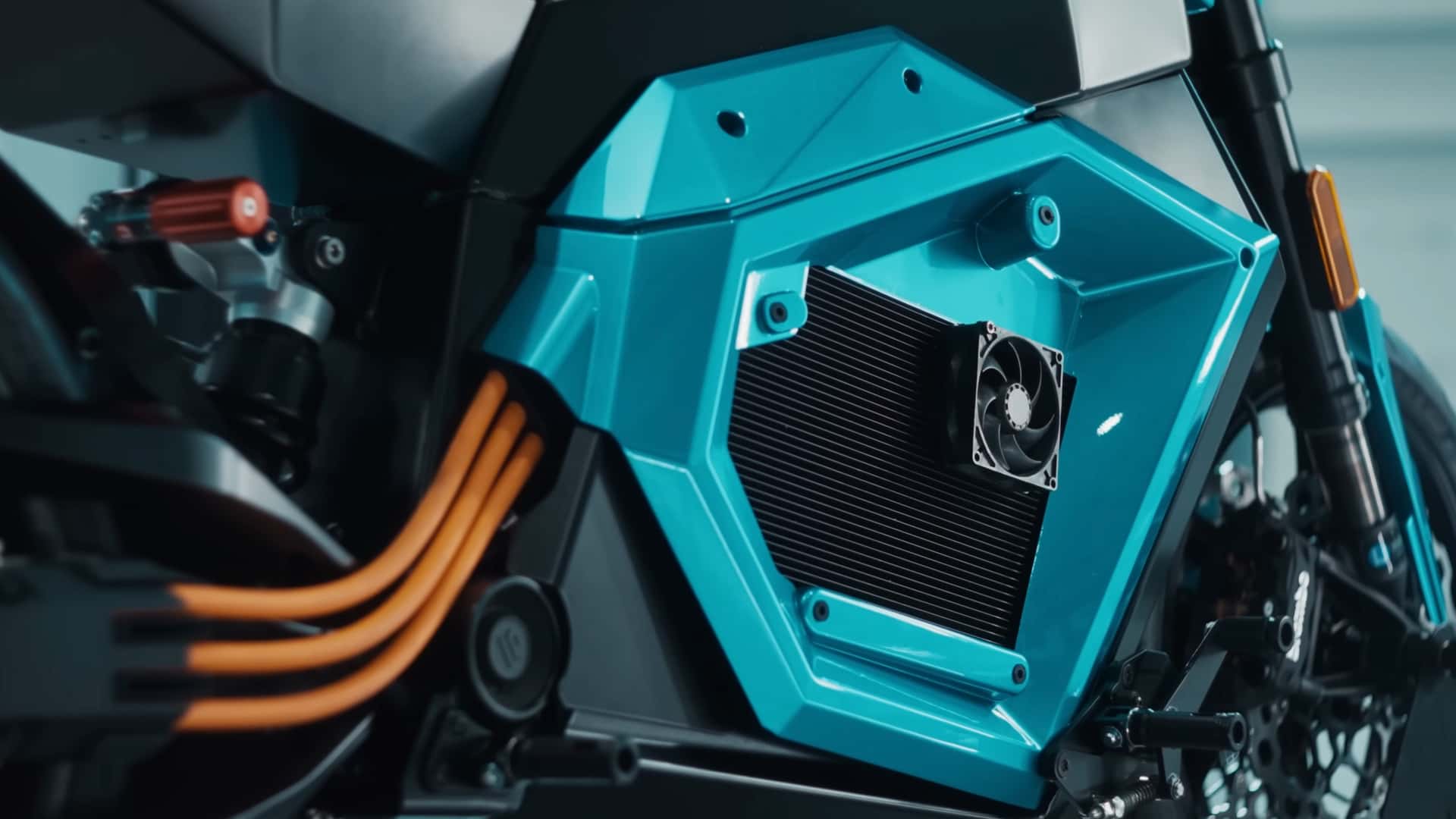
Further enhancing thermal performance, a heat sink and a small fan are positioned on each side of the battery pack. These components, reminiscent of those found in personal computer processors, actively dissipate heat into the ambient air, making the Verge TS Pro Gen2’s battery pack a fully air-cooled system.
Commenting on this design, Piipo stated, “So it’s a fully air-cooled design, and a very compact design.” This approach highlights a thoughtful solution to thermal management in the constrained space of an electric motorcycle, differentiating it from larger liquid-cooled systems typically found in electric cars.
Unprecedented Charging Speeds and Real-World Range
The Verge TS Pro Gen2 distinguishes itself with its exceptional charging capabilities, a critical factor for rider convenience and the broader adoption of electric two-wheelers. The solid-state electric bike achieves a peak charging power of approximately 100 kW when connected to a DC fast charger. This enables the battery to charge from 10% to 80% in just about 11 minutes.
For a fuller charge, a 10% to 90% top-up can be completed in a little under 15 minutes. While this peak charging power is about half of the 200 kW figure previously touted by Donut Lab, the company attributes this adjustment to the bike’s compact, air-cooled design, which prioritizes space efficiency over the liquid-cooling solutions found in larger vehicles.
Despite this, Donut Lab claims that its 94 Wh cell, when integrated into a liquid-cooled car battery pack, could achieve even faster charging speeds, reaching 0% to 80% in a mere five minutes. This indicates the underlying potential of their solid-state battery technology under optimal thermal conditions.
Understanding the C-Rate Advantage
The Verge TS Pro Gen2’s charging performance translates to an impressive C-rate of slightly over 5C. The C-rate quantifies how quickly a battery can charge or discharge relative to its maximum capacity. For instance, with the Standard Range model’s maximum capacity of 20 kWh, a 1C rate would correspond to a 20 kW charging speed.
This 5C-plus rate significantly surpasses that of most modern EV batteries, which typically operate under 4C. Such high-speed charging positions the Verge TS Pro with Donut Lab’s solid-state battery as the world’s fastest-charging motorcycle, according to the battery maker’s claims. In practical terms, this means riders can add approximately 12 miles of range for every minute of charging, considering the new TS Pro’s estimated total range of 217 miles.
Looking Ahead: Production and Market Impact
Production of the upgraded electric bike reportedly commenced last month, marking a significant milestone for Donut Lab and Verge Motorcycles. However, the industry awaits independent verification and tests of the solid-state TS Pro Gen2 to confirm its performance claims and the efficacy of its battery technology in real-world conditions.
The success of the Verge TS Pro Gen2 could signal a pivotal moment for the solid-state electric bike market, potentially accelerating the development and adoption of solid-state batteries across various electric vehicle segments. As consumer demand for faster charging and greater range intensifies, innovations in battery technology, particularly from firms like Donut Lab, will play a crucial role in shaping the future of sustainable transportation.
Gallery: Donut Lab All-Solid-State Battery
(Image content related to Donut Lab All-Solid-State Battery would be presented here as per original article.)
FAQ Section
Q1: What is a solid-state electric bike?
A solid-state electric bike is an electric motorcycle powered by solid-state batteries, which utilize a solid electrolyte instead of the liquid or gel electrolyte found in traditional lithium-ion batteries. This technology promises enhanced energy density, faster charging, and improved safety compared to conventional EV batteries.
Q2: What claims has Donut Lab made about its solid-state batteries?
Donut Lab claims its solid-state cells achieve an energy density of 400 watt-hours/kilogram, use no rare-earth materials, and boast a lifespan of 100,000 charge cycles. These figures, if proven, would represent a significant advancement in electric vehicle battery technology.
Q3: How fast does the Verge TS Pro Gen2 charge?
The Verge TS Pro Gen2, powered by Donut Lab’s solid-state batteries, can charge from 10% to 80% in approximately 11 minutes using a DC fast charger, with a peak charging power of around 100 kW. A 10% to 90% charge takes less than 15 minutes.
Q4: What is the estimated range of the Verge TS Pro Gen2?
The Verge TS Pro Gen2 has an estimated total range of 217 miles (approximately 350 kilometers). Its rapid charging capability translates to adding about 12 miles of range for each minute of charging, enhancing practical usability.
Q5: How is the battery pack in the Verge TS Pro Gen2 cooled?
The battery pack in the Verge TS Pro Gen2 utilizes an innovative air-cooled design. It incorporates heat transfer plates between cell layers and features heat sinks with small, PC-like fans on each side of the pack to dissipate heat into the ambient air, ensuring compact and efficient thermal management.
Q6: Why are experts skeptical about Donut Lab’s claims?
Experts remain skeptical because Donut Lab has not yet provided comprehensive scientific validation, patents, or a detailed breakdown of its battery chemistry to substantiate its ambitious claims regarding energy density, material composition, and cycle life. Independent testing and verification are awaited by the industry.