
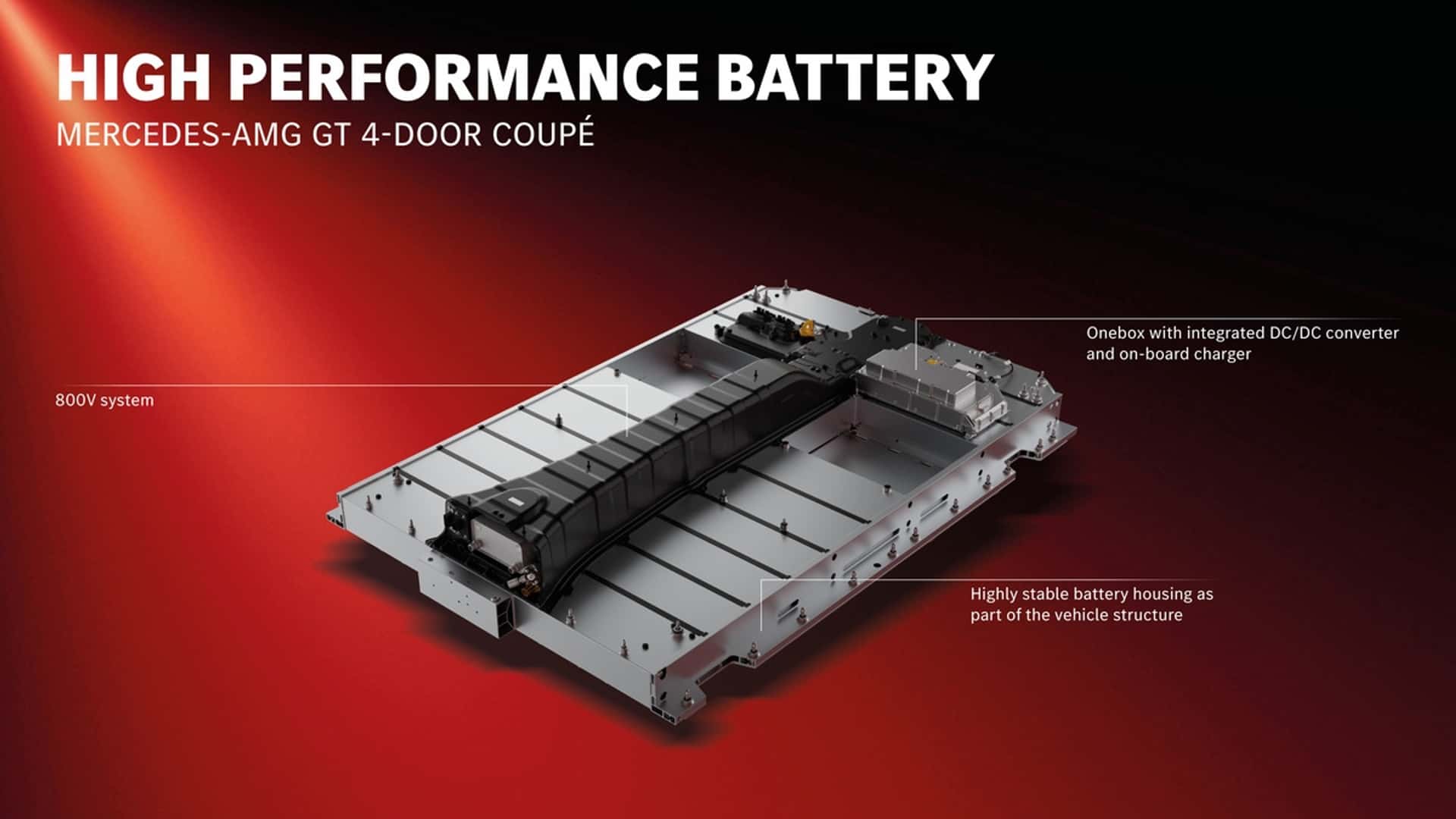
The landscape of high-performance electric vehicles (EVs) is rapidly evolving, driven by relentless innovation in battery technology. At the forefront of this revolution is the new Mercedes-AMG GT 4-Door Coupe, which showcases a groundbreaking approach to EV battery design and thermal management. This super sedan, now transitioned to an all-electric powertrain, boasts an array of sophisticated engineering solutions aimed at maximizing both power delivery and charging efficiency.
While its striking design and staggering output of 1,153 horsepower garnered significant attention at its recent launch, the true marvel lies beneath: a meticulously engineered battery system featuring advanced silicon anodes and an intricately designed cooling loop. These innovations address the critical challenge of heat management, which remains the primary adversary of sustained EV performance and battery longevity.

Key Takeaways
- The new Mercedes-AMG GT 4-Door Coupe integrates cutting-edge battery technology for superior EV performance.
- It features silicon-graphite blended anodes, enabling significantly faster charging speeds.
- The vehicle can achieve a 10-80% charge in just 11 minutes, making it one of America’s fastest-charging EVs.
- An ‘overengineered’ multi-faceted cooling system manages heat dissipation across 2,660 individual cells.
- This advanced thermal management system boasts a 20-kilowatt heat removal capacity, far exceeding typical EV systems.
The Core Challenge: Heat Management in High-Performance EVs
Electric vehicle batteries endure immense stress throughout their operational life. They are subjected to significant temperature fluctuations, physical shocks from varied road conditions, demands from repeated rapid acceleration, and the strenuous cycles of fast charging. Each of these factors generates substantial heat, pushing battery cells to their thermal limits.
Effective management of this internally generated heat is not merely a performance enhancer but a fundamental necessity. It dictates the difference between a battery operating optimally and one prone to premature degradation or, in extreme cases, catastrophic failure. This challenge is particularly acute in high-performance EVs, where power output and charging speeds are paramount.
Mercedes-AMG engineers recognized this critical bottleneck when developing the latest generation of the AMG GT. The decision to transition this iconic super sedan from its traditional V8 engine to an all-electric powertrain necessitated a complete re-evaluation of battery thermal dynamics. Their solution integrates several innovations designed to master the thermal demands of such a powerful electric vehicle.

Next-Generation Power: The Role of Silicon Anodes
Central to the Mercedes-AMG GT’s remarkable capabilities is its pioneering use of silicon anodes. The anode is a crucial component within an EV battery cell, fundamentally determining how much energy the battery can store and, crucially, how rapidly it can be recharged. It acts as the negative electrode, facilitating the movement of lithium ions during charge and discharge cycles.
Historically, battery manufacturers have relied predominantly on graphite for anodes, prized for its inherent stability and reasonable energy density. However, the global supply chain for graphite, largely controlled by China, presents both geopolitical and environmental concerns. These factors are driving a concerted industry-wide effort to explore alternative materials.
In response, automakers are increasingly integrating silicon-graphite composite anodes as an interim, yet powerful, solution. The ultimate long-term objective is to entirely phase out graphite, replacing it with either 100% silicon or advanced synthetic graphite alternatives. This shift promises significant improvements in battery performance metrics, particularly charging speed and energy density.
Unprecedented Charging Speeds and Range
The silicon-containing anode utilized in the AMG GT achieves an impressive cell-level energy density of 298 watt-hours per kilogram (Wh/kg). This figure places it at the upper echelon of commercially available automotive-grade lithium-ion cells today, highlighting a substantial leap in battery material science. Complementing this, the cathode employs a Nickel, Cobalt, Manganese, and Aluminum (NCMA) chemistry. Automakers have historically associated NCMA cathodes with enhanced energy density and extended driving range, making it an ideal partner for the high-performance anode.
This sophisticated combination of anode and cathode materials, according to Mercedes-AMG, is what enables the GT to support ultra-fast charging at a staggering 600 kW peak power. This translates into unparalleled real-world charging performance, allowing the vehicle to replenish its battery from 10% to 80% in an astonishing 11 minutes. Furthermore, this rapid charging can add nearly 250 miles of EPA-comparable range in just 10 minutes, significantly reducing downtime.
The vehicle’s 106 kilowatt-hours (kWh) of usable battery capacity provides an impressive range of up to 700 kilometers (approximately 434 miles) on the European WLTP cycle. This performance is expected to translate to well over 300 miles of comparable range under the more stringent U.S. EPA cycle. Beyond charging, the advanced battery architecture also ensures a consistently high discharge rate, critical for delivering the AMG GT’s explosive 1,000+ horsepower on demand.
Engineering for Extremes: Mercedes-AMG’s Advanced Cooling System
To effectively manage the extraordinary power and rapid charging capabilities, Mercedes-AMG has deployed a highly sophisticated and multi-layered cooling architecture alongside a novel cell design. The automaker utilizes slim, tall cylindrical cells, each measuring 4.1 inches in height and 1 inch in diameter. This smaller diameter is a deliberate engineering choice, specifically designed to minimize the distance heat must travel from the cell’s core to its surface. This design characteristic facilitates significantly faster and more efficient heat dissipation, a critical factor during both intense discharge and rapid charging.
Each of the 2,660 individual cells within the battery pack is meticulously encased in laser-welded aluminum. This robust yet lightweight casing further enhances the cells’ thermal responsiveness, enabling them to either cool down or warm up more quickly as required by operational demands. The design ensures that coolant flows evenly and precisely around every single cell, maximizing heat removal efficiency across the entire pack. This uniform cooling is vital for maintaining optimal operating temperatures and preventing localized hot spots that could compromise performance or longevity.
Building upon this foundation, Mercedes-AMG has incorporated an intelligent feature known as “on-demand cooling.” This system offers unparalleled precision in thermal management. If a specific section of the battery experiences elevated temperatures, the system can selectively cool that precise area without indiscriminately increasing coolant flow to the entire pack. This targeted approach prevents wasted energy from over-cooling other battery sections and optimizes the overall thermal state of the battery, enhancing both efficiency and durability.
Integrated Thermal Management Architecture
At the technological heart of this comprehensive thermal management system lies a trio of interconnected components: a powerful coolant pump module, an efficient oil-water heat exchanger, and a centralized coolant hub. The pump module is responsible for circulating the coolant vigorously throughout the battery pack, ensuring constant heat transfer. The oil-water heat exchanger then efficiently extracts heat from the circulating coolant, preparing it for another cycle.
The central coolant hub plays a pivotal role in streamlining and directing the coolant flow. This compact housing efficiently manages the distribution of coolant, enabling the AMG GT’s system to provide targeted cooling to various components beyond just the battery pack. For instance, if the battery pack is operating within its ideal temperature range, the intelligent system can dynamically redirect coolant flow towards other critical components that may require more intensive cooling, such as the electric drive units. This holistic approach ensures optimal thermal conditions across the entire electric powertrain.
Collectively, Mercedes-AMG states that these advanced systems are capable of removing approximately 20 kilowatts (kW) of heat. This capacity represents a significant advancement, substantially surpassing the typical 5 to 8 kW cooling capacity found in conventional EV battery thermal management systems. This high capacity underscores the robust engineering commitment to sustaining peak performance under the most demanding conditions for this class-leading EV battery technology.
The Future Outlook for EV Battery Technology
On paper, the technological advancements integrated into the Mercedes-AMG GT’s battery system appear nothing short of remarkable. However, the true litmus test for this sophisticated EV battery technology will unfold as the AMG GT enters real-world driving scenarios and, critically, over the subsequent years of ownership. The performance of these batteries, particularly their ability to maintain minimal degradation and sustain their impressive capabilities over extended periods, will be keenly observed by the automotive industry and consumers alike.
Beyond the immediate impact on luxury performance vehicles, there is a broader aspiration within the industry: the hope that such advanced battery technologies will eventually trickle down into mass-market EV models. The benefits of blistering fast-charging speeds, extended range, and enhanced battery longevity should not remain exclusive to six-figure electric vehicles. Democratizing access to these innovations could fundamentally transform the accessibility and practicality of electric mobility for a wider audience, accelerating the global transition to sustainable transportation.
Frequently Asked Questions (FAQs)
What makes the Mercedes-AMG GT’s EV battery technology unique?
The Mercedes-AMG GT features a cutting-edge battery system that includes silicon anodes blended with graphite, enabling ultra-fast charging. Combined with an NCMA cathode and a highly sophisticated thermal management system, it achieves exceptional energy density and robust heat dissipation, crucial for its high-performance capabilities.
How fast can the Mercedes-AMG GT charge?
The Mercedes-AMG GT can charge from 10% to 80% in an extraordinary 11 minutes. This is facilitated by its 600 kW peak charging power and advanced battery architecture, allowing it to recoup nearly 250 miles of EPA-comparable range in just 10 minutes of charging.
What are silicon anodes and why are they important?
Silicon anodes are an advanced battery component that can store significantly more lithium ions than traditional graphite anodes, leading to higher energy density and faster charging speeds. Their integration is crucial for improving EV performance and reducing reliance on graphite, which faces supply chain and environmental concerns.
How does the Mercedes-AMG GT manage battery heat?
The AMG GT employs a multi-faceted cooling system. It uses slim cylindrical cells for efficient heat dissipation, laser-welded aluminum casings, uniform coolant flow around all 2,660 cells, and an “on-demand cooling” system that precisely targets specific battery sections. This system can remove about 20 kW of heat.
What is the usable battery capacity and range of the AMG GT?
The Mercedes-AMG GT is equipped with 106 kilowatt-hours (kWh) of usable battery capacity. This translates to an estimated range of up to 700 kilometers (434 miles) on the European WLTP cycle, with comparable range expected to be well over 300 miles under the stricter U.S. EPA cycle.
Will this advanced EV battery technology be available in more affordable EVs?
While silicon anodes and advanced cooling systems are currently niche technologies in high-performance EVs, there is a strong industry aspiration for them to eventually become cost-competitive and scalable. This would allow these innovations to be integrated into mass-market models, enhancing electric mobility for a wider consumer base.