
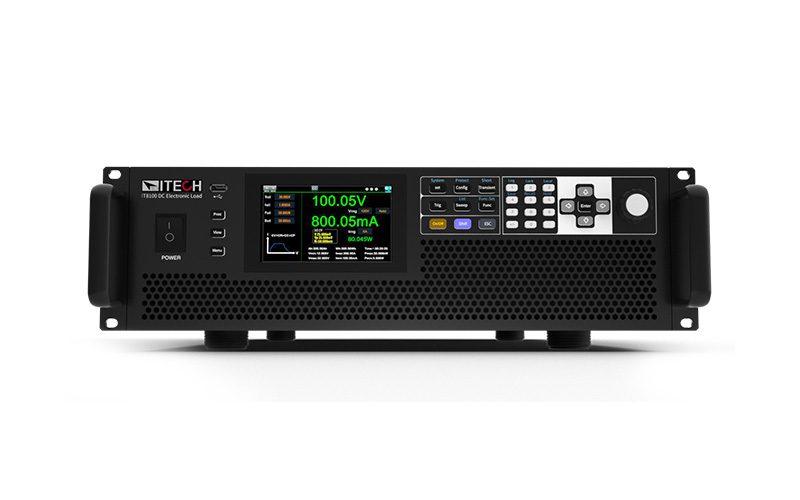
Key Takeaways:
- ITECH has launched its IT8100A/E Series of DC electronic loads, designed for high-power testing across critical sectors.
- The new series boasts a formidable parallel capacity of up to 1.8 MW and an impressive dynamic slew rate of 150 A/µs.
- Key applications include validation of EV charging stations, testing of power batteries and fuel cells, and evaluation of advanced AI power supplies.
- The IT8100A/E Series offers a power density of 7.2 kW per 3U rack unit, scaling significantly in cabinet configurations.
- A 1.5x short-term over-power capability allows for handling peak loads without requiring oversized test setups.
- The portfolio includes a specialized high-current variant (60 V / 2400 A / 6 kW) optimized for next-generation AI GPU and computing power supply testing.
- Voltage levels span 60 V, 150 V, 600 V, and 1200 V, accommodating modern 800 V EV architectures.
Mumbai, India – ITECH, a prominent manufacturer of power electronic test and measurement solutions, has officially released its new IT8100A/E Series DC electronic loads. This innovative high-power test platform is engineered to address the escalating demands of next-generation power electronics, particularly in the rapidly evolving electric vehicle (EV), renewable energy, and artificial intelligence (AI) sectors.

The series, available for immediate deployment, offers unparalleled scalability, enabling engineers and researchers to configure systems ranging from single units to robust parallel installations capable of reaching an extraordinary 1.8 MW. This capacity positions the IT8100A/E Series as a critical tool for validating high-power components and systems essential for the future of technology.
Unpacking the IT8100A/E Series: Core Capabilities
The IT8100A/E Series DC electronic loads represent a significant leap forward in testing technology. Designed with precision and versatility, these units are poised to support the rigorous demands of modern power supply validation, battery discharge characterization, and fuel cell performance assessment. Their comprehensive feature set ensures that complex testing scenarios can be replicated with high fidelity.
High Power Density and Scalability
A standout feature of the IT8100A/E Series is its remarkable power density. Each 3U rack unit delivers 7.2 kW of power, allowing for efficient use of lab space. This compact design facilitates the construction of highly powerful test benches, with the capacity to scale up to an impressive 86.4 kW within a standard 37U cabinet. This modularity is crucial for laboratories and manufacturing facilities that require flexible and expandable testing infrastructure.

The ability to pack substantial power into a smaller footprint directly translates into operational advantages. It reduces the physical space required for extensive testing setups, lowers facility costs, and simplifies the logistical challenges associated with high-power testing environments. This high-density architecture is particularly beneficial for validating components for EV charging stations and large-scale power storage systems.
Dynamic Slew Rate for Real-World Scenarios
One of the most critical aspects of testing modern power systems is the ability to accurately simulate dynamic load changes. The IT8100A/E Series excels in this area with an exceptional dynamic slew rate of 150 A/µs. This rapid response capability is vital for reproducing fast current transients, which are inherently present in switching power supplies, advanced charging systems, and highly responsive fuel cell stacks.
This high slew rate ensures that engineers can rigorously test devices under conditions that closely mimic real-world operational scenarios, where sudden changes in load are common. The accurate simulation of these transient conditions is paramount for ensuring the stability, reliability, and safety of power electronic devices before they reach commercial deployment.
Over-Power Capability for Peak Demands
To further enhance its utility, the new series incorporates a 1.5x short-term over-power capability. This feature allows the DC electronic loads to momentarily handle peak load conditions that exceed their nominal rating without requiring the user to procure an oversized test configuration. This intelligent design optimizes equipment utilization and reduces overall capital expenditure for testing facilities.
For instance, during the validation of EV charging systems, there might be momentary surges in current demand. The over-power capability ensures that the test setup can absorb these peaks, providing a more comprehensive and realistic test environment without the need for a larger, more expensive load unit that would be underutilized during typical operation.
Addressing Next-Gen AI Computing Needs
The proliferation of artificial intelligence, particularly in areas like high-performance computing and large language models, demands increasingly sophisticated and high-current power supplies. Recognizing this emerging need, ITECH has introduced a dedicated high-current variant within the IT8100A/E Series.
This specialized model, rated at 60 V / 2400 A / 6 kW, is specifically engineered for testing next-generation AI GPU and computing power supplies. These systems typically operate at low supply voltages but draw extremely high currents, posing unique challenges for traditional DC electronic loads. The IT8100A/E’s high-current variant provides the necessary capabilities to accurately evaluate the performance and reliability of these critical AI infrastructure components.
Versatile Voltage Range for Diverse Applications
The IT8100A/E Series offers a comprehensive range of voltage levels, catering to a broad spectrum of industrial applications. Users can select from four distinct voltage ceilings: 60 V, 150 V, 600 V, and 1200 V. This extensive range ensures compatibility with various power systems, from standard industrial applications to highly specialized cutting-edge technologies.
Tailored for EV Charging Infrastructure
A key application area benefiting from this broad voltage range is the testing of electric vehicle charging architectures. The 1200 V ceiling is particularly significant for validating components and systems designed for 800 V EV platforms. These advanced EV architectures are becoming increasingly prevalent, offering faster charging times and improved efficiency.
During the testing of such systems, DC link voltages at the load can often exceed the levels supported by standard 400 V infrastructure. The 1200 V capability of the IT8100A/E Series ensures that manufacturers and test engineers can thoroughly evaluate the performance and safety of components designed for these high-voltage EV platforms, thereby accelerating the development and deployment of next-generation electric vehicles.
Flexible Configurations: From Benchtop to Megawatt Platforms
The IT8100A/E Series is not a monolithic offering but rather a flexible platform comprising three distinct product families: the IT8100A Series, the IT8100E Series, and the dedicated high-current load variant. This modular approach allows for highly flexible parallel configurations, empowering users to build test systems precisely tailored to their specific requirements.
Whether the need is for a compact benchtop setup for research and development or a massive megawatt-class platform for manufacturing validation and end-of-line testing, the IT8100A/E Series can be configured to meet the demand. This adaptability ensures that the investment in these DC electronic loads can scale with evolving project requirements and technological advancements.
Industry Impact and Availability
The introduction of the IT8100A/E Series DC electronic loads marks a pivotal moment for industries reliant on high-performance power testing. By providing robust, scalable, and highly dynamic test solutions, ITECH is enabling faster innovation and more thorough validation of critical components in EV charging stations, power batteries, fuel cells, and AI power supplies. The series is available now, ready to support the next wave of technological breakthroughs.
Frequently Asked Questions (FAQs)
What are the primary applications of the ITECH IT8100A/E Series DC electronic loads?
The primary applications include validation of EV charging stations, comprehensive testing of power batteries, performance evaluation of fuel cells, and rigorous assessment of power supplies for artificial intelligence (AI) computing infrastructure.
What is the maximum parallel capacity of the IT8100A/E Series?
The IT8100A/E Series DC electronic loads can be configured in parallel systems to achieve an impressive maximum capacity of 1.8 megawatts (MW), catering to very high-power testing requirements across various industries.
What is the dynamic slew rate of these electronic loads and why is it important?
The dynamic slew rate is 150 A/µs. This high rate is crucial for accurately reproducing rapid current transients, which are common in switching power supplies, charging systems, and fuel cells, ensuring realistic and thorough testing.
How does the IT8100A/E Series support testing for 800V EV architectures?
The series offers a 1200 V voltage ceiling. This capability is essential for testing components and systems used in 800 V EV charging architectures, where DC link voltages at the load can significantly exceed the levels of standard 400 V infrastructure.
Is there a specific variant for AI computing power supply testing?
Yes, a dedicated high-current variant (60 V / 2400 A / 6 kW) is available. This model is specifically designed to address the low voltage and high current demands characteristic of next-generation AI GPU and computing power supplies.
What is the power density of the IT8100A/E Series?
The IT8100A/E Series boasts a power density of 7.2 kW per 3U rack unit. This allows for efficient space utilization, enabling up to 86.4 kW of power to be housed within a single 37U cabinet.
What is the benefit of the 1.5x short-term over-power capability?
The 1.5x short-term over-power capability allows the DC electronic loads to handle temporary peak load conditions without needing an oversized or more expensive test configuration, optimizing equipment usage and cost efficiency.