
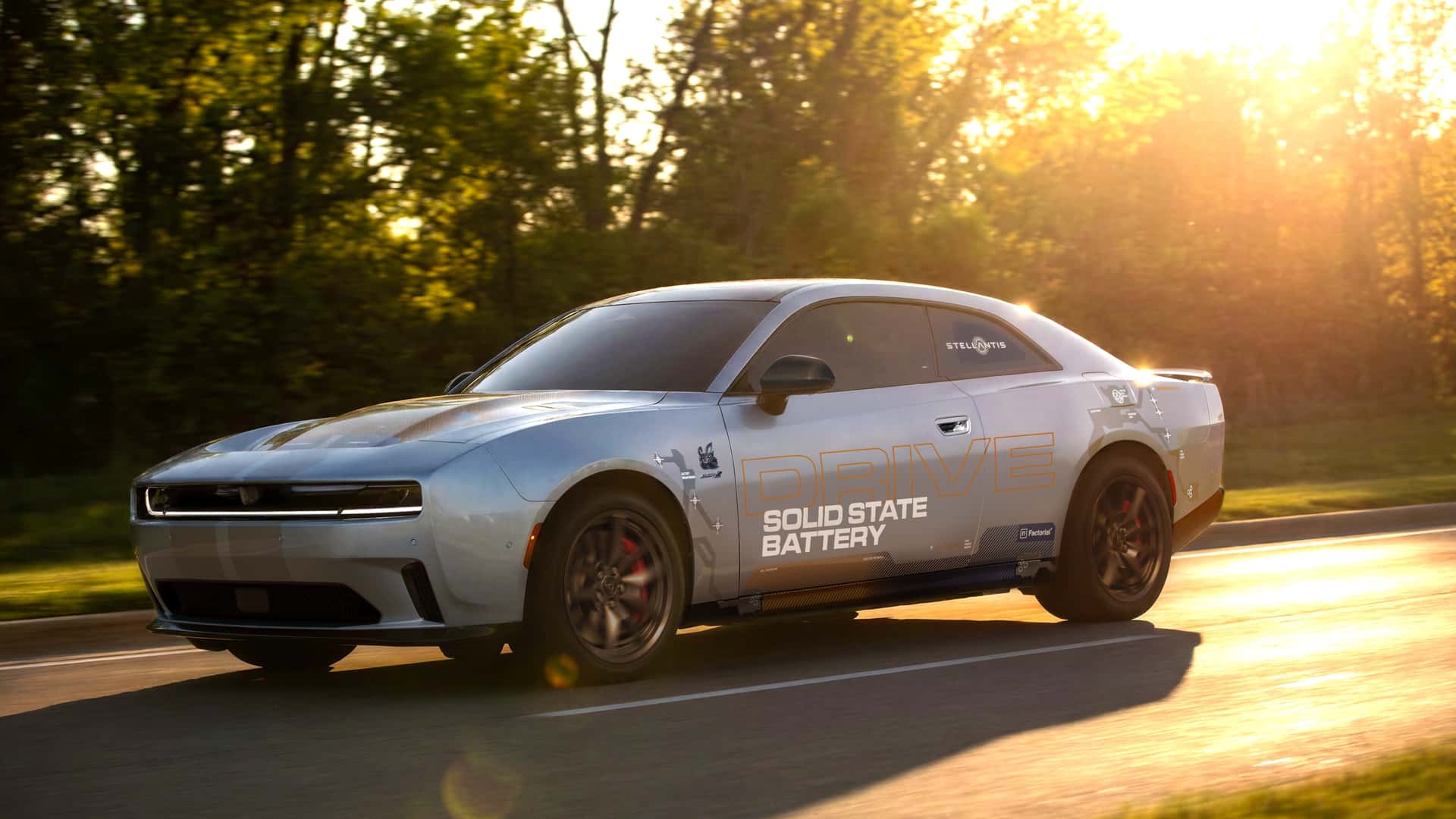
Stellantis, the global automotive giant and parent company to iconic brands like Dodge, Jeep, and Ram, has initiated critical real-world testing of an experimental semi-solid-state battery. This significant development sees a modified Dodge Charger EV prototype taking to the roads, serving as a crucial testbed for next-generation electric vehicle technology. The move underscores Stellantis’ commitment to advancing battery innovation and pushing the boundaries of EV performance, range, and charging capabilities.
This ambitious program is a collaborative effort with Factorial Energy, a Massachusetts-based startup specializing in advanced battery solutions. The objective is to fine-tune and rigorously validate the battery pack’s safety, performance, and long-term reliability under genuine driving and charging conditions, moving the technology from laboratory research to practical application in an actual Dodge Charger EV prototype.

Key Takeaways:
- A Dodge Charger EV prototype is currently undergoing real-world validation with an experimental semi-solid-state battery.
- The testing program is a joint initiative between Stellantis and battery technology firm Factorial Energy.
- This innovative battery technology promises substantial improvements in EV range, charging speed, and potentially lower production costs.
- The semi-solid-state cells boast an energy density of 375 watt-hours per kilogram, surpassing conventional lithium-ion batteries.
- Faster charging, from 15% to 90% in just 18 minutes, and broader temperature operability are key advantages under scrutiny.
- This development positions Stellantis as a key player in the competitive race for advanced battery solutions across the global automotive industry.
The Promise of Semi-Solid-State Technology for EVs
The pursuit of advanced battery technology is central to the future of electric mobility. While conventional lithium-ion batteries have seen continuous improvements and benefit from well-established supply chains, their limitations in energy density, charging speed, and temperature sensitivity are increasingly apparent. Solid-state batteries, offering a significant leap in performance, have proven notoriously challenging to develop and scale for mass production.
Semi-solid-state batteries emerge as a promising intermediate solution. These batteries incorporate a gel-like electrolyte instead of a fully solid one, offering a bridge between current lithium-ion and future all-solid-state technologies. This approach aims to deliver many benefits of solid-state technology, such as higher energy density and improved safety, while potentially mitigating some of the manufacturing complexities.
Enhancing Performance and Efficiency
The semi-solid-state battery pack, integrated into the Dodge Charger EV prototype, showcases remarkable specifications. It boasts an energy density of 375 watt-hours per kilogram (Wh/kg). To put this into perspective, typical conventional lithium-ion batteries generally range between 200-300 Wh/kg. This higher energy density directly translates to the potential for longer driving ranges for electric vehicles without increasing battery size or weight.
Furthermore, the technology promises significantly reduced charging times. Stellantis reports that the Factorial-powered pack can charge from 15% to 90% in a mere 18 minutes. This is a substantial improvement over the current production Dodge Charger Daytona’s lithium-ion pack, which takes approximately 30 minutes to charge from 10% to 80%. Such advancements are critical for alleviating range anxiety and making EV ownership more convenient for consumers.
Operational resilience across diverse climates is another crucial factor. The experimental battery is designed to function efficiently across an expansive temperature range, from a frigid -22 degrees Fahrenheit (-30°C) to a scorching 113 degrees Fahrenheit (45°C). This broad operational window is a meaningful leap forward, addressing a key challenge for EV adoption in extreme weather conditions.
Stellantis’ Strategic Investment and Collaboration
Stellantis views this development as a pivotal step towards integrating cutting-edge battery technology into its future vehicle lineup. Ned Curic, the automaker’s chief engineering and technology officer, affirmed the company’s vision, stating, “This milestone shows we are bringing solid-state batteries closer to our customers with the potential for longer range, faster charging, and lower costs.” This commitment aligns with the automotive group’s long-term electrification strategy, aiming to deliver high-performance and cost-effective electric vehicles.
The partnership with Factorial Energy is central to this strategy. Factorial’s FEST cell technology, with its unique semi-solid-state chemistry, is the foundation of the battery being tested. Factorial CEO Siyu Huang emphasized the importance of this practical validation, noting, “Real-world road testing is exactly the kind of deep full-stack collaboration that solid-state has always required.” These tests provide invaluable data for refining the battery’s design and ensuring its readiness for commercial application.
Factorial Energy’s Vision Beyond Semi-Solid-State
Factorial Energy’s current semi-solid-state cells, which utilize a gel-like electrolyte, represent a crucial evolutionary step in battery development. The insights gained from these real-world tests are not just for Stellantis; they are also vital for Factorial’s ongoing research and development. The company has publicly stated that the knowledge derived from these semi-solid-state cells will directly inform the advancement of its ultimate goal: the all-solid-state Solstice battery.
This isn’t the first instance of Factorial’s batteries undergoing rigorous real-world assessment. In a previous demonstration last year, Factorial’s semi-solid-state cells were integrated into a Mercedes-Benz EQS prototype. During a cross-country road trip across Europe, this prototype achieved an impressive feat, covering approximately 749 miles on a single charge, with an additional 85 miles of range still available at the journey’s conclusion. Such successful prior tests underscore the potential and reliability of Factorial’s technology.
The Global Race for Solid-State Batteries
The automotive industry is intensely focused on solid-state battery technology, recognizing its transformative potential for electric vehicles. This competition extends beyond Stellantis and Factorial Energy, with numerous global players investing heavily in research and development.
Last year, BMW commenced testing of all-solid-state cells from Colorado-based startup Solid Power in a prototype i7. The German automaker has also enlisted Samsung SDI, a major battery manufacturer, to assist in the development and validation of Solid Power’s cells. Toyota, a pioneer in hybrid technology, has its own robust solid-state program underway, with ambitious targets for commercialization.
Furthermore, several prominent Chinese automakers are actively pursuing solid-state battery solutions. Companies such as BYD, Nio, and MG Motor are heavily invested in this emerging field, highlighting the global scale of this technological race. The collective effort across the industry signals a broad consensus on the importance of moving beyond conventional lithium-ion chemistry to unlock the full potential of electric vehicles.
Looking Ahead: The Future of EV Battery Technology
The real-world testing of the Dodge Charger EV prototype with a semi-solid-state battery marks a significant milestone in the evolution of electric vehicle technology. By integrating this advanced power source into an existing pack design and utilizing a new, patented mechanical architecture, Stellantis is aiming to extract maximum performance and validate the technology’s readiness for future production vehicles. The successful deployment of such batteries could revolutionize EV performance, making electric cars more accessible, practical, and appealing to a broader consumer base.
FAQs:
What is a semi-solid-state battery?
A semi-solid-state battery is an advanced battery technology that uses a gel-like electrolyte instead of the liquid electrolyte found in conventional lithium-ion batteries or the completely solid electrolyte of a true solid-state battery. This design aims to offer higher energy density, faster charging capabilities, and improved safety characteristics while being potentially easier to manufacture than full solid-state variants.
What are the key advantages of this new battery in the Dodge Charger EV prototype?
The experimental semi-solid-state battery in the Dodge Charger EV prototype offers several advantages, including significantly higher energy density (375 Wh/kg) compared to conventional lithium-ion batteries. This translates to the potential for longer driving ranges. Additionally, it boasts rapid charging capabilities, achieving 15% to 90% charge in just 18 minutes, and operates effectively across a wide temperature range from -22F to 113F.
Who is Factorial Energy, and what is their role?
Factorial Energy is a Massachusetts-based startup specializing in the development of advanced battery technologies, particularly semi-solid-state and all-solid-state cells. In this collaboration, Factorial is supplying its FEST cell with semi-solid-state chemistry for integration and testing within the Dodge Charger EV prototype. The insights gained from these real-world tests will also contribute to Factorial’s long-term goal of developing its all-solid-state Solstice battery.
How does this compare to current EV battery technology?
Current EV battery technology, predominantly lithium-ion, typically offers energy densities between 200-300 Wh/kg and takes around 30 minutes for a 10-80% charge. The semi-solid-state battery in the Dodge Charger EV prototype significantly surpasses these figures with 375 Wh/kg and an 18-minute 15-90% charge time, indicating a substantial leap in efficiency, range potential, and user convenience.
Are other automakers also exploring solid-state batteries?
Yes, the development of solid-state batteries is a major focus across the global automotive industry. Automakers like BMW (partnering with Solid Power and Samsung SDI), Toyota, BYD, Nio, and MG Motor are all actively investing in and testing various solid-state and semi-solid-state battery technologies, signaling a broad industry shift towards next-generation energy storage solutions for electric vehicles.