
Key Takeaways
- Rivian announced a significant joint venture with Volkswagen, involving up to $5 billion investment, focused on software expertise.
- A recent Rivian shareholder letter featured an image hinting at multiple new, unannounced electric vehicle models beyond the R2, R3, and R3X.
- These veiled shapes suggest a comprehensive expansion of Rivian’s product portfolio, including potentially new SUVs and trucks.
- The partnership with Volkswagen underscores a strategic shift towards leveraging shared technology and platforms in the evolving EV landscape.
- While specific details remain undisclosed, the announcements signal a robust future product roadmap for the electric vehicle manufacturer.
In a move that has sent ripples through the global automotive industry, electric vehicle innovator Rivian has unveiled a groundbreaking strategic partnership with German automotive giant Volkswagen. Announced just ahead of Rivian’s anticipated Investor Day on June 25, 2024, the collaboration is poised to redefine the future trajectory of both companies, extending far beyond initial financial guidance and updates on existing models.
The joint venture, valued at up to $5 billion in investment from Volkswagen, primarily centers on Rivian lending its advanced software and electrical architecture expertise to the European conglomerate. This strategic alignment not only bolsters Rivian’s financial standing but also provides a tantalizing glimpse into its upcoming electric vehicle models, previously unseen by the public.

Groundbreaking Volkswagen-Rivian Partnership: A Strategic Deep Dive
The core of the recent announcement lies in the formation of a new, equally owned joint venture designed to create next-generation electric vehicle (EV) architectures and software platforms. This collaboration is set to benefit both parties significantly. For Volkswagen, it offers accelerated access to Rivian’s highly regarded software and electrical systems, crucial for its ongoing transition to electric mobility.
For Rivian, the financial infusion from Volkswagen is substantial, reaching up to $5 billion. This investment is structured to provide immediate capital while also securing future funding through convertible notes. This capital injection is critical for Rivian as it scales production, expands its product offerings, and navigates the capital-intensive landscape of the electric vehicle market.
The partnership highlights a growing trend in the automotive sector: collaboration over competition, especially in foundational technologies like software and platforms. As EVs become more software-defined, the ability to develop robust, scalable, and intuitive digital ecosystems is paramount. Rivian, with its acclaimed in-house software capabilities, brings a significant asset to the table, positioning it as a key technological enabler in the broader automotive landscape.

Unveiling Rivian’s Future Models: A Teaser in the Shareholder Letter
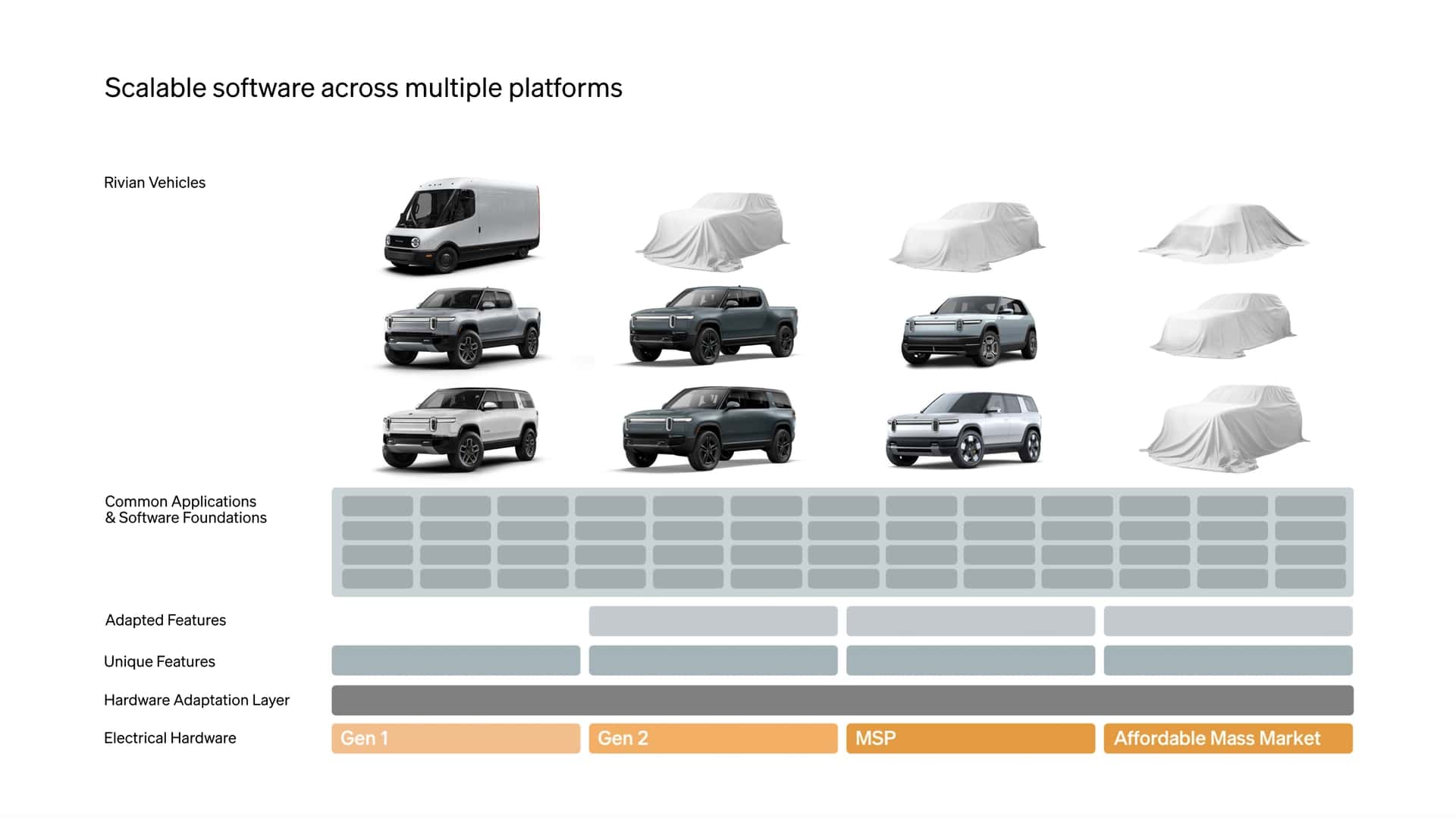
Beyond the financial and technological implications of the Volkswagen deal, Rivian’s latest shareholder letter, released concurrently with the partnership announcement, contained a compelling visual clue about its future product roadmap. The image, first spotted by BloombergNEF’s Corey Cantor on Threads today, displays several vehicles, some familiar and others completely new, shrouded under sheets.

On the left side of the slide, the first generation of Rivian electric vehicles is visible, including the original R1S SUV, the R1T pickup truck, and the custom vans developed for Amazon’s logistics fleet. Adjacent to these are representations of the recently updated second-generation R1 vehicles, which InsideEVs recently drove and reviewed.
Intriguingly, above these familiar R1 models, another vehicle remains obscured under a sheet, sparking speculation about a potential R1X variant—an unconfirmed yet highly anticipated high-performance version of the R1 platform. However, the most significant revelations are found in the subsequent columns, where multiple covered shapes emerge, hinting at a range of upcoming Rivian electric vehicles distinctly separate from the previously announced R2, R3, and R3X models.
Decoding the Silhouettes: Beyond R2, R3, and R3X
The silhouettes showcased in the shareholder letter suggest a diverse expansion of Rivian’s product line. These SUV-like shapes appear to represent models that fall outside the known dimensions and design language of the R2, R3, and R3X, which were first revealed earlier this year to considerable excitement. The R2, a mid-size SUV, and its compact counterparts, the R3 and R3X, are designed to target a broader, more accessible market segment.
The recurring shapes within the image present two primary interpretations. One possibility is that Rivian is intending to separately list multiple variants of the same core vehicle, perhaps differing in battery size, powertrain configurations, or unique body styles like a coupe-SUV or a specialized utility variant. This strategy would allow Rivian to maximize platform commonality while catering to diverse customer preferences.
Alternatively, these repeating shapes might simply be stock ‘To Be Determined’ (TBD) images, placeholders that do not accurately represent the final shapes and sizes of the planned vehicles. Given the early stage of such disclosures, it is common for automakers to use generic representations before definitive designs are locked in. Industry analysts caution against drawing definitive conclusions from these early visual cues, advocating for more clarity from the company.
Official Stance and Market Implications for Upcoming Rivian Electric Vehicles
When approached for comment on these potential future products, a Rivian spokesperson declined to offer further details. This aligns with standard automotive industry practice, where companies typically maintain secrecy regarding unannounced models until they are closer to production or official reveal. This carefully managed information flow aims to build anticipation and control narrative around new product launches.
While specific information regarding these new Rivian future models remained limited during the Investor Day call, the shareholder letter undeniably confirmed that the company has a robust and extensive product roadmap. This roadmap extends significantly beyond the already popular R1 series and the eagerly awaited R2, R3, and R3X electric vehicles, which have already garnered significant internet attention since their initial unveiling.
The partnership with Volkswagen, coupled with the hints of an expanded product portfolio, positions Rivian strategically for sustained growth in the competitive electric vehicle market. By securing a major investment and a powerful technological alliance, Rivian appears well-equipped to execute its ambitious plans for next-generation electric vehicles, promising an exciting future for electric mobility enthusiasts and investors alike.
FAQs on Rivian’s Future Electric Vehicles
What is the primary focus of the joint venture between Rivian and Volkswagen?
The joint venture primarily focuses on developing next-generation software and electrical architectures for electric vehicles. Rivian will lend its expertise to Volkswagen, while receiving a significant investment of up to $5 billion to support its growth and product development.
What new information about upcoming Rivian vehicles was revealed?
A slide in Rivian’s recent shareholder letter featured veiled images of several potential new electric vehicle models. These silhouettes appear to be distinct from the previously announced R2, R3, and R3X, suggesting an expanded future product lineup.
Are the new models in the shareholder letter confirmed for production?
While the images hint at future products, Rivian has not officially confirmed these specific new models for production. Automaker spokespeople generally decline to comment on unannounced vehicles, and some shapes could be placeholder images.
How does this partnership impact Rivian’s financial stability?
The up to $5 billion investment from Volkswagen significantly bolsters Rivian’s financial position. This capital injection is crucial for funding ongoing operations, scaling production, and accelerating the development of its future electric vehicles and technologies.
What are Rivian’s currently available or announced models?
Rivian currently offers the R1T electric pickup truck and the R1S electric SUV. The company has also announced plans for the R2 mid-size SUV and the more compact R3 and R3X models, which are expected to launch in coming years.
Why is software expertise so crucial in the electric vehicle market?
Software is increasingly vital for electric vehicles as it controls everything from powertrain management and battery optimization to infotainment, autonomous driving features, and user experience. Advanced software capabilities are key differentiators and central to innovation in the modern EV market.