
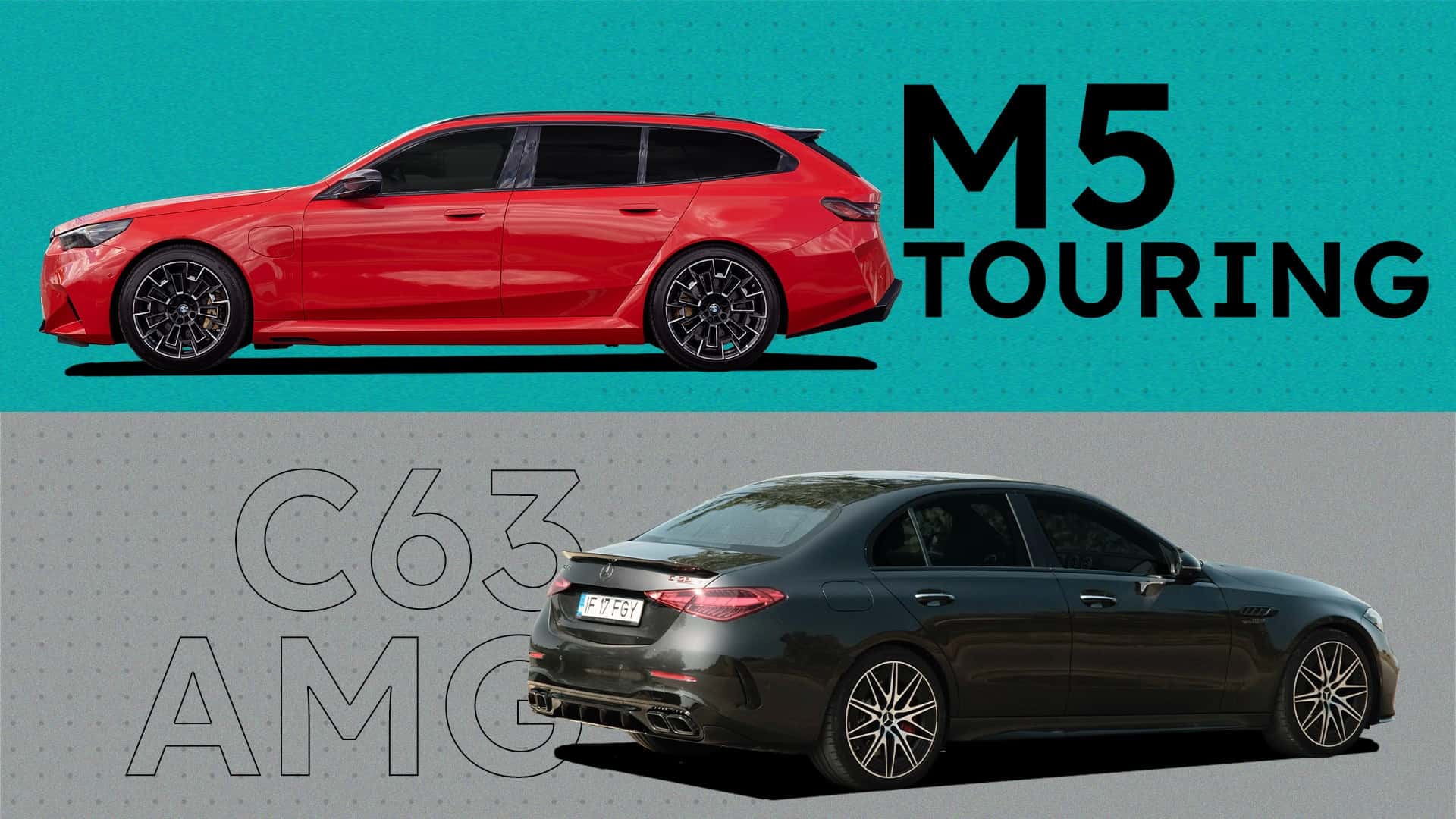
Key Takeaways:
- The integration of large batteries in high-performance vehicles, while boosting straight-line speed and electric range, significantly impacts driving dynamics due to added weight.
- The BMW M5 Touring, with its substantial 22.1 kWh battery and 717 horsepower (potentially closer to 800 hp), offers impressive power but suffers from inconsistent ride quality and handling due to its 5,456-pound (2,475 kg) curb weight.
- Conversely, the Mercedes-AMG C63s E-Performance employs a smaller 6.1 kWh battery, prioritizing performance enhancement over extensive electric range. It achieves 670 hp and superior agility, weighing approximately 880 pounds (400 kg) less than the M5.
- The C63s demonstrates that a more focused electrification strategy, with a smaller battery, can lead to a more engaging and responsive driving experience, despite a smaller four-cylinder engine.
- Actual fuel efficiency for these high-performance plug-in hybrids often falls short of optimistic WLTP ratings, with EPA figures for the M5 at 13 mpg and the C63s at 20 mpg (depleted battery).
- The debate highlights that for true driver-focused cars, excessive battery weight can compromise the intended performance and agility, suggesting a need for clear distinction between efficiency-focused and performance-focused hybrid engineering.
The automotive industry is currently navigating a pivotal shift, integrating advanced electrification into its most potent performance flagships. This trend has introduced a new generation of vehicles, characterized by extraordinary straight-line acceleration and moderate electric range, yet often challenged by the complexities of added mass. The ongoing evolution of high-performance plug-in hybrids presents a dichotomy, particularly evident in a recent comparison between the new G99 BMW M5 Touring and the Mercedes-AMG C63s E-Performance. These two vehicles exemplify distinct engineering philosophies in hybrid performance, sparking considerable discussion among enthusiasts and critics alike regarding the optimal balance of power, weight, and driving pleasure.

The BMW M5 Touring: Raw Power Meets Significant Mass
BMW’s latest M5 Touring represents a monumental leap in power, combining a formidable V-8 engine with a substantial battery system. This grand tourer is engineered to deliver an uncompromising surge of power, making it incredibly quick. Its powertrain, a 4.4-liter twin-turbocharged V-8, is complemented by a large battery, endowing the vehicle with a claimed output of 717 horsepower. Remarkably, a dyno test indicated that it was pushing almost 700 hp to the wheels, suggesting its actual engine output could be closer to 800 horsepower. This immense power translates into an alarming pace, pinning occupants to their seats with 737 pound-feet (1,000 Nm) of torque from both a standing start and rolling acceleration.
Electrification Strategy and Everyday Usability
The M5’s powertrain integration is particularly noteworthy. The electric motor, housed within the eight-speed automatic gearbox, contributes 197 hp and 206 lb-ft (280 Nm) of torque. This configuration allows the M5 Touring, despite its substantial 5,456-pound (2,475 kg) curb weight, to operate effectively in pure electric mode for approximately 35 miles. During electric-only driving, the vehicle maintains a surprising briskness, enhanced by subtle, simulated acceleration sounds piped through the speakers. The all-wheel-drive system ensures reliable traction, making the EV mode a practical and enjoyable option for urban commuting or low-grip conditions, irrespective of weather.
Driving Dynamics: The Weight Conundrum
While the BMW M5 Touring excels in sheer power and electric capability, its significant weight introduces complexities in its driving dynamics. The vehicle’s substantial mass necessitates a specific suspension tune, which, in practice, results in an inconsistent ride quality. The M5 struggles to maintain a predictable character, oscillating between feeling like a luxurious, comfortable cruiser and a more unsettled, firm sports car. This inconsistency is particularly noticeable over mid-corner bumps, which can unsettle the car unexpectedly. When driven spiritedly on winding roads, the M5’s inertia becomes pronounced, often attempting to pull the car into understeer, creating a sensation akin to an athlete competing with ankle weights. This highlights a fundamental challenge in balancing immense power with the inherent weight penalties of extensive electrification in a performance application.

Mercedes-AMG C63s E-Performance: Agility Through Focused Electrification
In contrast to BMW’s approach, Mercedes-AMG has adopted a distinct philosophy for its C63s E-Performance. While still a high-performance plug-in hybrid, its engineering prioritizes agility and driver engagement, despite having a smaller engine. The C63s features a 2.0-liter four-cylinder engine, a departure from the V-8s traditionally associated with AMG. However, this is no ordinary four-cylinder; it is an actual AMG engine hand-assembled by someone who puts their name and signature on it. This commitment to craftsmanship extends to its advanced turbocharging system, which includes a large turbo and an electric supercharger designed to minimize lag and maximize responsiveness.
Engineering Philosophy: Performance First
The M139 engine, derived from AMG’s compact performance models like the CLA 45, produces over 400 horsepower independently. Combined with its electric motor, the C63s E-Performance delivers a total of 670 horsepower and an impressive 752 lb-ft (1,020 Nm) of torque. This torque figure surpasses that of the BMW M5 Touring, and it is deployed in a vehicle that is approximately 880 pounds (400 kg) lighter. This weight advantage is palpable, translating into a feeling of even greater acceleration than its specifications might suggest. The force experienced during a ‘Race Start’ in the C63s is particularly visceral, delivering shockingly quick off-the-line performance thanks to its responsive powertrain and effective all-wheel-drive system.
Enhanced Driving Experience and Handling
Beyond straight-line speed, the C63s E-Performance offers a markedly more enjoyable experience through corners compared to the M5. Unlike its V-8 predecessors, which were renowned for their enthusiastic oversteer, the new C63s behaves more like a dedicated track car, focused on optimal corner exit with minimal drama. The powertrain’s responsiveness is amplified by the electric supercharger, which rapidly builds boost. While some critics have questioned its sound, the C63s retains a characterful exhaust note, complemented by the audible workings of the turbo, adding to the overall engagement.
Battery Concepts and Real-World Efficiency
A key differentiator between these two high-performance plug-in hybrids lies in their battery specifications and the underlying intent behind their size. The BMW M5 Touring features a substantial 22.1-kilowatt-hour battery, contributing significantly to its weight. This larger battery is intended to provide a more extended electric-only range, aligning with regulatory objectives for plug-in hybrids. In Europe, this translates to an optimistic WLTP efficiency rating of between 1.6 and 1.7 liters/100 km, or almost 150 mpg, under ideal conditions, i.e., with a fully charged battery. However, real-world driving often sees this figure drop dramatically, with the EPA combined rating for the M5 at 13 mpg (18 l/100 km) when the battery is depleted, reflecting typical combustion-engine usage.
In contrast, the Mercedes-AMG C63s E-Performance utilizes a much smaller 6.1 kWh battery. This bespoke setup is strategically designed, with the electric motor integrated into the rear axle rather than the gearbox, primarily to boost performance. Its electric-only range is modest, around 5 miles, but this minimal battery capacity prevents it from overburdening the chassis with excessive weight. The C63s achieves a claimed average of 6.9 l/100 km (34 mpg) in Europe, which, while requiring a light foot, is attainable even with a drained battery. During spirited driving, real-world returns hover around 15 mpg, and the EPA rates the C63s at 20 mpg with a depleted battery, demonstrating a more balanced efficiency profile for a performance-oriented hybrid when the battery is not actively contributing to electric-only propulsion.
The Core Debate: Performance vs. Efficiency in High-Performance Plug-in Hybrids
The comparison between the BMW M5 Touring and the Mercedes-AMG C63s E-Performance underscores a critical debate in the automotive industry: how to optimally leverage electrification in high-performance vehicles. While the move towards plug-in hybrids is often driven by emissions regulations and the desire for enhanced efficiency, these benefits can be negated if the electrification strategy compromises the fundamental driving experience. For enthusiasts seeking a truly engaging and dynamic car, the added weight from an overly large battery can undermine the agility and responsiveness traditionally expected from performance models.
The M5 Touring, despite its immense power, exemplifies how a significant battery can detract from the nuanced handling and ride quality that define a premium performance vehicle. Its struggle with inertia and inconsistent suspension tune indicates that simply adding more power and electric range does not inherently lead to a better driver’s car. Conversely, the C63s E-Performance demonstrates that a more targeted application of hybrid technology, focusing on performance augmentation with a smaller, lighter battery, can yield a superior and more special driving experience. This approach aligns with that of high-end sports car manufacturers like Ferrari (e.g., 296 GTB, SF90) and Lamborghini (Temerario), where batteries typically remain under 8 kWh to preserve chassis integrity and dynamic purity, making the few miles of electric range a secondary bonus to the primary goal of performance enhancement.
Ultimately, the objective of electrification in performance cars should be clearly defined. If the goal is pure efficiency, mass-market cars offer greater dividends. However, if electrification is to genuinely enhance performance without compromise, a more refined engineering philosophy, as seen in the C63s and other exotic high-performance plug-in hybrids, proves more effective. The ability to maintain battery charge under hard driving, as evidenced by the C63s retaining 33% battery after a vigorous half-hour drive, further validates this performance-centric approach, dispelling concerns about power loss under sustained demand.
Frequently Asked Questions (FAQs)
What is the primary difference in the hybrid philosophy of the BMW M5 Touring and Mercedes-AMG C63s E-Performance?
The BMW M5 Touring integrates a large battery (22.1 kWh) for extended electric range and significant power, leading to a heavier vehicle. The Mercedes-AMG C63s E-Performance uses a smaller, performance-focused battery (6.1 kWh) to boost acceleration and agility, with minimal electric-only range.
How do the weight differences impact the driving experience of these high-performance plug-in hybrids?
The BMW M5 Touring’s 5,456-pound (2,475 kg) weight can result in an inconsistent ride and noticeable understeer during spirited driving. The lighter C63s E-Performance, approximately 880 pounds (400 kg) lighter, offers superior agility, more responsive handling, and a better cornering experience.
Which vehicle offers more raw power, the M5 Touring or the C63s E-Performance?
The BMW M5 Touring claims 717 horsepower (potentially 800 hp real output) and 737 lb-ft (1,000 Nm) of torque. The Mercedes-AMG C63s E-Performance delivers 670 horsepower and 752 lb-ft (1,020 Nm) of torque. While the M5 has higher peak horsepower, the C63s’ lighter weight makes its acceleration feel even more pronounced.
What are the real-world fuel efficiency figures for these luxury performance cars?
The BMW M5 Touring has an EPA combined rating of 13 mpg when operating with a depleted battery. The Mercedes-AMG C63s E-Performance is rated by the EPA at 20 mpg with a depleted battery, indicating better real-world efficiency under combustion-only operation.
Is the four-cylinder engine in the C63s E-Performance a compromise compared to the M5’s V8?
While the C63s has a 2.0-liter four-cylinder, it is a hand-assembled AMG engine, paired with an advanced hybrid system to produce 670 hp. Its focused engineering, lighter weight, and superior handling make it feel more special and agile, proving that cylinder count isn’t the sole determinant of performance car appeal.
Why do some high-performance plug-in hybrids use smaller batteries?
Smaller batteries, like the 6.1 kWh unit in the C63s or those in Ferrari PHEVs, are chosen to minimize added weight. This preserves the vehicle’s chassis integrity, handling purity, and dynamic characteristics, prioritizing performance enhancement over extensive electric-only driving range. The electrification primarily serves as a power boost.