
Key Takeaways
- Carmakers are adopting distinct electrification strategies for performance plug-in hybrids (PHEVs), impacting driving dynamics.
- The 2025 BMW M5 Touring features a large 22.1 kWh battery for extended electric range, contributing to its substantial 5,456-pound weight and affecting handling.
- The Mercedes-AMG C63s E-Performance employs a smaller 6.1 kWh battery, prioritizing performance boost over electric range, resulting in a more agile 880-pound lighter vehicle.
- Despite the M5’s higher overall power output, its weight compromises driver engagement, leading to an inconsistent ride and understeer.
- The C63, with its bespoke four-cylinder AMG engine and performance-focused electrification, delivers a more responsive and track-like driving experience.
- This comparison highlights that for true performance cars, an overly large battery can hinder agility, suggesting that ‘more battery’ is not always the optimal solution for enthusiast driving.
In a significant shift across the automotive landscape, manufacturers are increasingly integrating substantial battery packs into their high-performance flagship models. This trend is driven by regulatory pressures and the pursuit of enhanced power, yet it has given rise to a unique category of vehicles that offer bewildering straight-line speed coupled with notable electric-only capabilities. However, this heavy hybridization often introduces a trade-off, with the added mass potentially compromising the agile handling characteristic of their conventionally powered predecessors.
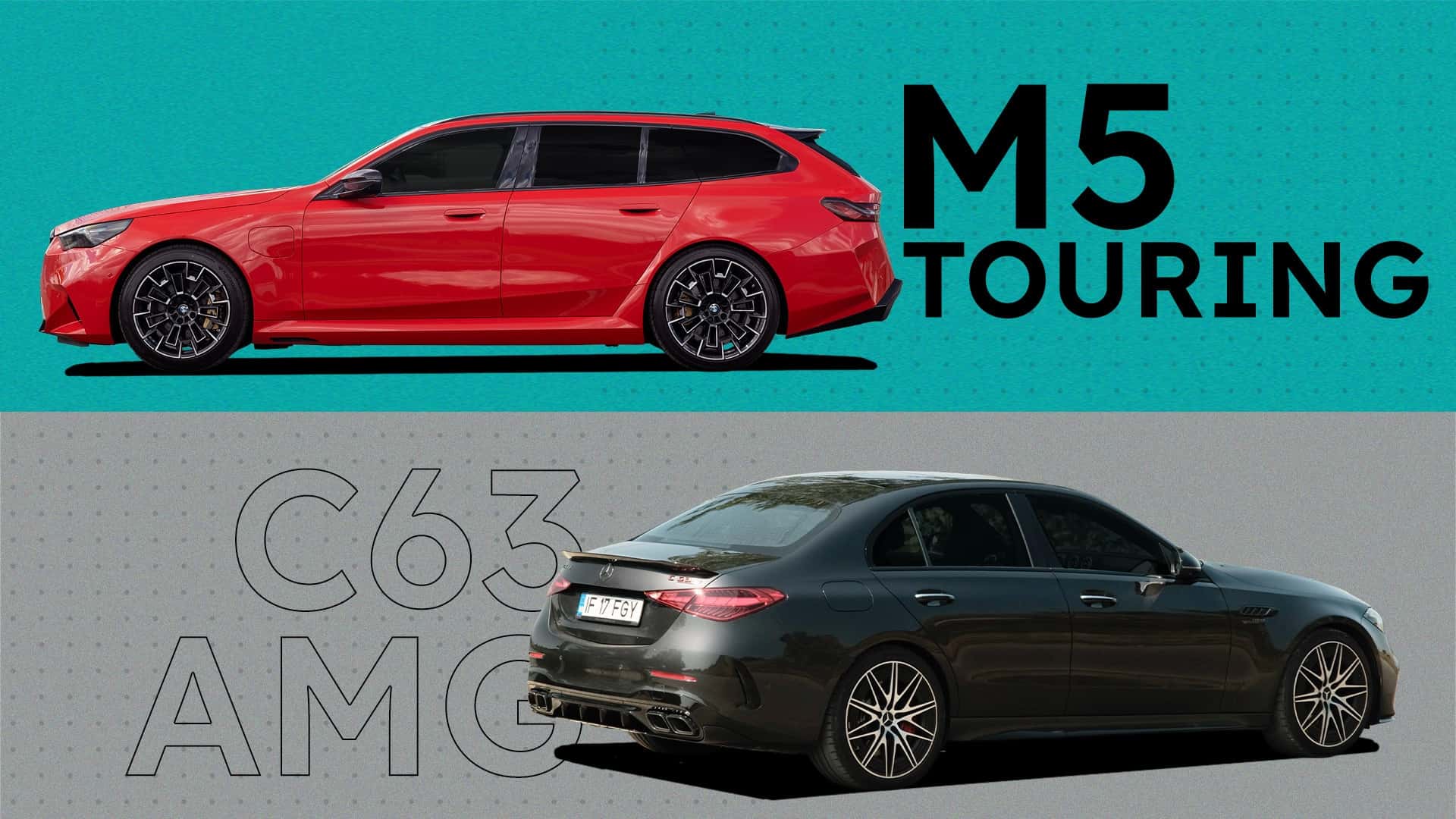
This evolving dynamic became particularly evident during a recent evaluation involving the new G99 BMW M5 Touring and the Mercedes-AMG C63s E-Performance. These two vehicles represent contrasting philosophies in the realm of performance PHEV design. The M5 Touring combines a potent V-8 engine with a large battery engineered for dozens of miles of electric range, while the C63s E-Performance pairs a smaller four-cylinder unit with a more compact battery primarily dedicated to augmenting raw power. Both approaches, upon their respective launches, have garnered considerable discussion and criticism from automotive enthusiasts, albeit for fundamentally different reasons concerning their electrification strategy.

The 2025 BMW M5 Touring: A Gutsy Yet Challenged Performer
The 2025 BMW M5 Touring presents an undeniably powerful package, feeling even more robust than its officially claimed 717 horsepower output suggests. Recent dynamometer tests have reportedly indicated that the vehicle delivers nearly 700 horsepower to the wheels, implying a real-world engine output closer to 800 horsepower. This immense power, coupled with 737 pound-feet (1,000 Nm) of torque from its 4.4-liter twin-turbocharged V-8 engine, delivers an alarming pace that pins occupants to their seats, whether from a standstill or during rolling acceleration.
The M5’s powertrain is lauded for its engineering brilliance, partly due to its impressive standalone electric capabilities. The integrated electric motor, housed within the eight-speed automatic gearbox, contributes 197 horsepower and 206 lb-ft (280 Nm) of torque. This allows the M5 to move independently on electric power, feeling surprisingly brisk even in its hefty 5,456-pound (2,475 kg) Touring model. The vehicle offers approximately 35 miles of pure electric driving range.
Interestingly, the M5 delivered an enjoyable experience predominantly in its EV mode. A subtle, yet engaging, acceleration sound is piped through the speakers, complementing the simulated gear shifts felt even when the V-8 engine is inactive. While these shifts are not driver-controllable in EV mode, the system’s ability to send electric power to all four wheels provides reassuring traction, making it a capable and versatile option for urban commuting and low-grip conditions.

Despite its formidable powertrain, the M5 Touring failed to evoke the instant desire typically associated with BMW M cars. This sentiment arose after extended driving, where the vehicle’s substantial mass became a critical factor. Being heavier than even the pure electric i5 Touring M60, BMW engineers were compelled to tune the suspension extensively to manage this weight. The result is an inconsistent ride quality, exhibiting an unpredictable oscillation between a plush, Maybach-like comfort and a far more rigid, ‘pogo stick’ sensation.
Furthermore, mid-corner undulations proved unsettling, often alarming the driver as forces transfer across the chassis. When driven spiritedly, the M5 struggles with an uncomfortable amount of inertia, constantly pulling the vehicle towards understeer. This sensation makes the car feel like an athlete attempting to perform with significant ankle weights, ultimately detracting from the visceral driver engagement expected from a top-tier performance car.
The Mercedes-AMG C63s E-Performance: Agile Power and Purposeful Electrification
Transitioning from the M5 Touring to the Mercedes-AMG C63s E-Performance immediately brought the BMW’s sheer mass into sharp perspective. While the C63 operates in a size class below the M5, making it an imperfect direct comparison, its agility and driving feel stand in stark contrast. Despite possessing only half the cylinders of the BMW and a marginally lower horsepower figure, the C63 delivers a profoundly more special and engaging driving experience.
Under the hood, the C63 is powered by a 2.0-liter four-cylinder engine. This is no ordinary unit; it is a genuine AMG engine, meticulously hand-assembled by an individual technician whose signature adorns a plaque proudly displayed upon lifting the bonnet. This bespoke engine compartment offers a more impressive visual than the M5’s rather unassuming plastic engine cover, revealing a prominent turbocharger and an innovative electric supercharger setup.
The M139 engine, derived from Mercedes-AMG’s potent compact models like the CLA 45, produces over 400 horsepower on its own. When combined with its electric motor, the C63s E-Performance unleashes a staggering 670 horsepower and 752 lb-ft (1,020 Nm) of torque. This torque figure surpasses that of the BMW, all within a vehicle that is approximately 880 pounds (400 kg) lighter. The difference in power-to-weight ratio is acutely felt from behind the wheel.
Performing a ‘Race Start’ in the C63 generates a visceral force unlike almost any other combustion car, feeling distinctly faster than the BMW despite their paper-matched acceleration figures. The C63 exhibits shockingly quick off-the-line performance, thanks to its immense torque and an all-wheel-drive system expertly designed to transfer power to the ground. The electric supercharger ensures rapid boost build-up, effectively minimizing turbo lag and contributing to a highly responsive powertrain. The combined surge of torque from both electric and gasoline sources is truly exceptional.
Even with the piped-in enhanced engine sound disabled, the C63’s exhaust note is characterful, complemented by the distinct sounds of the turbo building and releasing pressure, which enhances the overall driving enjoyment. Crucially, the C63 is significantly more engaging through corners than the M5. Unlike earlier C63 models known for their propensity to shred rear tires, this new iteration feels like a focused track machine, prioritizing optimal corner exit with remarkable stability and minimal drama.
Engineering Philosophies: The Role of Battery Size in Performance Hybrids
While the C-Class, upon which the C63 is based, is inherently smaller and lighter than the G61 5 Series Touring platform of the M5, Mercedes-AMG’s strategic battery design is a pivotal differentiator. Currently, a direct E63 PHEV counterpart to the M5 is not available. The E53 plug-in hybrid, though featuring a widebody aesthetic, does not compete in the same performance league as the M5 and C63.
Mercedes-AMG intentionally opted for a lighter hybrid system in the C63, diverging from BMW’s approach in the M5 and E53, which utilize similar battery and motor configurations as their lesser PHEV siblings. The C63’s electric motor is integrated into the rear axle, distinct from being housed within the gearbox, and its primary purpose is performance enhancement rather than extended EV-only driving. While it can provide around 5 miles of electric range, its core function is to deliver an instantaneous power boost.
The crucial aspect of Mercedes’ engineering ‘genius’ lies in its choice of a smaller battery. While the M5 features a substantial 22.1-kilowatt-hour battery, largely responsible for its considerable weight, the C63’s battery capacity is a mere 6.1 kWh. This compact battery, while small by general PHEV standards, effectively fulfills its dual mandate: boosting performance and meeting stringent European Union emissions regulations through favorable lab testing results.
Regarding efficiency, the heavier and more powerful BMW M5 Touring boasts a WLTP efficiency rating of 1.6 to 1.7 liters per 100 kilometers, equating to nearly 150 miles per gallon. However, this figure is contingent on consistently keeping the battery fully charged, a habit many PHEV drivers do not maintain. Consequently, the M5’s EPA combined rating of 13 mpg (18 l/100 km) offers a more realistic reflection of its fuel consumption in typical driving scenarios.
The C63, in contrast, is rated in Europe with an average of 6.9 l/100 km, or approximately 34 mpg. While achieving this requires an extremely gentle throttle input, it remains feasible even with a depleted battery. When driven in a manner akin to the M5 – focusing on enjoying the car’s performance rather than maximizing fuel economy – the C63 returned around 15 mpg. This figure is impressive considering the vehicle’s ludicrous acceleration capabilities. The EPA rates the C63 at 20 mpg with a depleted battery, a target readily achievable without active efficiency driving.
Driving Experience: The True Measure of Performance Electrification
As specialists in electric vehicle technology, it is understood that electrons play a vital role in future mobility. However, in the niche of high-performance vehicles, the adage of ‘more battery’ does not always translate to a superior driving experience. For buyers of vehicles like the C63 or M5, who typically have the means to afford higher fuel costs, the often-unrealistic advertised efficiency figures are rarely a primary selling point. Moreover, performance cars constitute a tiny fraction of overall vehicle sales, accounting for a minimal share of global emissions. The broader electrification of mass-market cars offers far greater environmental dividends.
The M5 unequivocally demonstrates that an excessively large battery can impede the desired driving experience. Despite criticisms leveled against Mercedes-AMG’s powertrain downsizing, its approach to creating a performance PHEV appears to be the more astute. The C63 emerges as a superior driver’s car compared to the M5, which is ultimately too heavy to truly be considered fun by performance standards.
While the C63 is still heavier than a hypothetical non-electrified V-8 equivalent, its current PHEV iteration provides an excellent and exhilarating driving experience. It feels more distinctive and engaging than the M5, even with half the cylinder count. This outcome underscores the critical need for a clear distinction between electrified cars designed for pure efficiency and those where electrification is meticulously engineered to enhance performance.
Examples of well-executed performance PHEVs include the second-generation Acura NSX, the Corvette E-Ray, the Ferrari 296 GTB, and the new Lamborghini Temerario. In these models, electrification undoubtedly contributes to efficiency to a degree, but it is not the core focus. Crucially, the battery packs in these high-end performance hybrids typically remain under 8 kWh, preventing the chassis from becoming overburdened and preserving the purity of their handling dynamics. The ability to achieve a few miles of electric driving is a pleasant bonus, but the primary objective of the electrification remains unequivocally performance augmentation.
Mercedes-AMG’s strategy with the C63 PHEV closely mirrors that of Ferrari’s plug-in hybrids, where efficiency is secondary to performance. The relatively small battery size, similar to the sub-8 kWh packs in the Ferrari SF90 and 296 GTB, ensures the chassis is not compromised. A potential drawback, where a low battery state could cause the engine to divert power for recharging, akin to a ‘hamster wheel’ effect, is largely theoretical for most drivers. Unless engaging in multiple full laps of a demanding circuit like the Nürburgring, this scenario is unlikely to impact real-world performance. During rigorous driving of the C63 on a twisty road for over half an hour, the battery consistently maintained around 33% charge, with no discernible performance loss.
FAQ Section
What are the primary differences in electrification strategy between the BMW M5 Touring and Mercedes-AMG C63s E-Performance?
The BMW M5 Touring uses a larger 22.1 kWh battery to provide substantial electric-only range (around 35 miles), prioritizing efficiency alongside power. In contrast, the Mercedes-AMG C63s E-Performance employs a smaller 6.1 kWh battery, primarily for boosting performance and meeting regulatory emissions, offering only about 5 miles of electric range.
How does the weight difference impact the driving experience of these two performance PHEVs?
The BMW M5 Touring’s 5,456-pound curb weight, largely due to its larger battery, leads to an inconsistent ride and noticeable understeer during spirited driving. The Mercedes-AMG C63s E-Performance is significantly lighter (approximately 880 pounds less), and its focused electrification allows for much greater agility, responsiveness, and a more engaging, track-like handling feel.
What are the actual power outputs of the BMW M5 Touring and Mercedes-AMG C63s E-Performance?
The BMW M5 Touring is officially rated at 717 horsepower and 737 lb-ft of torque, with dyno tests suggesting a real output closer to 800 horsepower. The Mercedes-AMG C63s E-Performance combines its 2.0-liter four-cylinder engine with an electric motor to produce 670 horsepower and 752 lb-ft of torque.
Which vehicle offers better fuel efficiency in real-world driving conditions?
While the BMW M5 Touring has a high theoretical WLTP rating, its real-world EPA combined rating with a depleted battery is 13 mpg. The Mercedes-AMG C63s E-Performance, despite its smaller battery, achieves a more practical EPA rating of 20 mpg with a depleted battery, proving more efficient in everyday spirited driving.
Does the smaller battery in the C63s E-Performance compromise its performance during extended hard driving?
In practice, the C63’s smaller battery, designed for performance boost, does not significantly compromise performance during spirited road driving. While theoretical scenarios of extreme track use might see some power diversion for recharging, real-world testing showed the battery maintaining sufficient charge and delivering consistent power output.
Why might a smaller battery be preferable in a performance hybrid car?
A smaller battery in a performance hybrid helps to minimize added weight, preserving the vehicle’s agility and handling dynamics. This approach, seen in high-end sports cars, prioritizes instantaneous performance enhancement from the electric motor without burdening the chassis, thus ensuring a purer, more engaging driver experience.