
Key Takeaways
- Rivian and Volkswagen have announced a significant joint venture, involving a $5 billion investment from VW in exchange for Rivian’s advanced software expertise.
- The announcement, made ahead of Rivian’s Investor Day, signals a major strategic shift for both electric vehicle manufacturers.
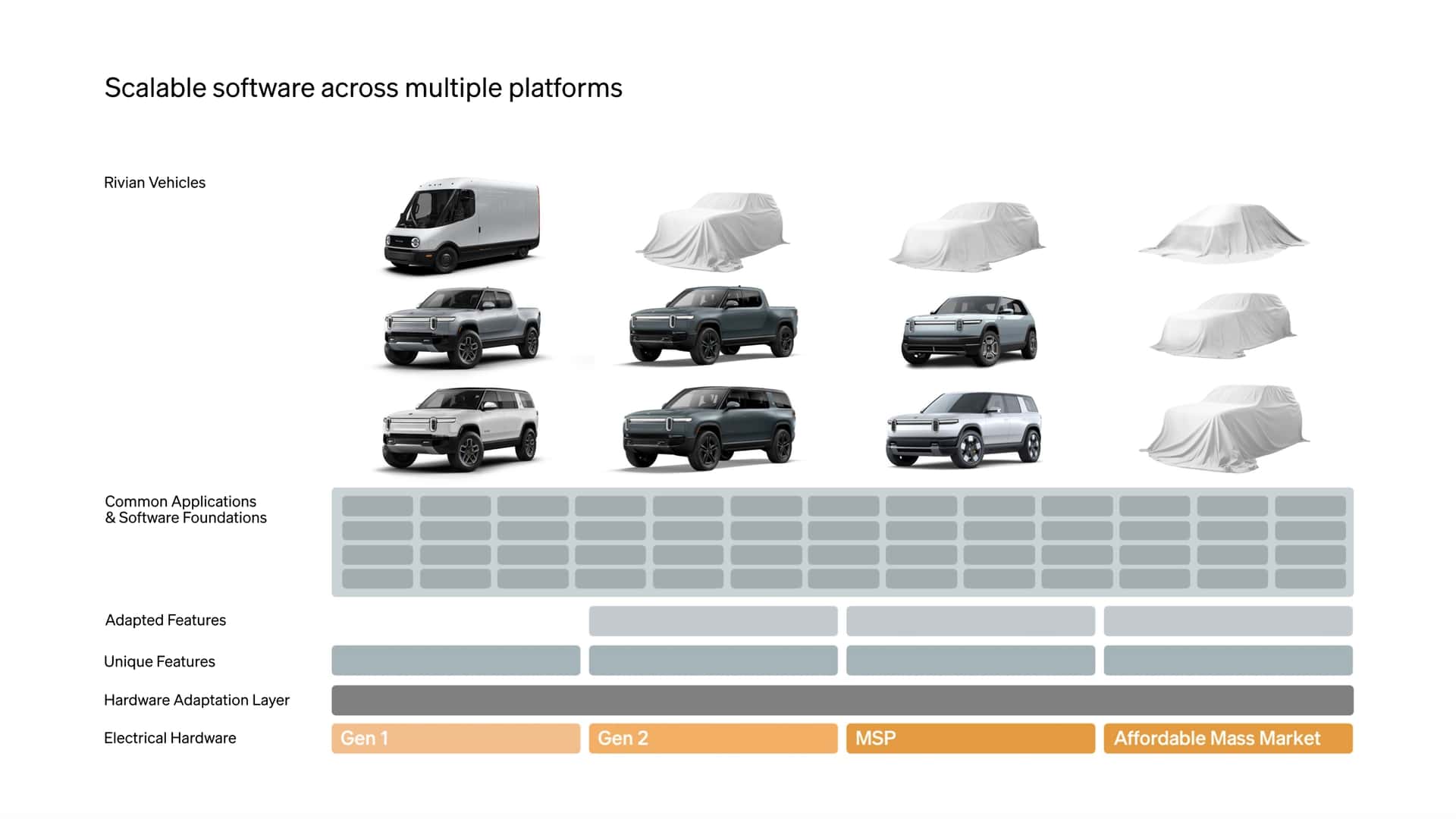
- A recently released Rivian shareholder letter contained an image hinting at several previously unseen future Rivian vehicles, extending beyond the well-known R2, R3, and R3X models.
- The mysterious silhouettes suggest potential new electric SUVs and trucks, indicating an ambitious expansion of Rivian’s product portfolio.
- While details remain scarce, this strategic partnership and the teased vehicles underline Rivian’s commitment to broadening its market reach and accelerating its product development.
In a significant development shaking the global electric vehicle landscape, Rivian Automotive surprised the financial and automotive sectors with an unexpected announcement ahead of its Investor Day event. The American electric vehicle manufacturer revealed a landmark joint venture with German automotive titan Volkswagen, a partnership poised to reshape both companies’ strategic directions.
This alliance, confirmed on June 25, 2024, involves a substantial investment of up to $5 billion from Volkswagen into Rivian. In return, Rivian will share its cutting-edge software and electrical architecture expertise with the European conglomerate, forming a critical collaboration in the competitive EV market.
The news, however, held an additional layer of intrigue. A closer examination of Rivian’s latest shareholder letter, highlighted by BloombergNEF’s Corey Cantor on Threads, unveiled an image featuring several enigmatic, covered vehicle shapes. These previously unseen silhouettes hint strongly at a substantial expansion of Rivian’s future vehicles, suggesting a product roadmap that stretches far beyond the anticipated R2, R3, and R3X models.
A Strategic Alliance Forged: Rivian and Volkswagen’s $5 Billion Partnership
The core of Rivian’s recent announcement is the strategic partnership with Volkswagen Group. This unprecedented collaboration is multifaceted, primarily focusing on shared technology and financial investment. Volkswagen’s commitment of up to $5 billion is a significant injection of capital into Rivian, a company that has, like many EV startups, faced considerable financial pressures while scaling production.
The investment will unfold in stages, providing Rivian with crucial resources for its ongoing research, development, and manufacturing expansion. This financial backing is expected to bolster Rivian’s position, offering stability and accelerating its long-term growth objectives in a capital-intensive industry.
In exchange for this substantial investment, Rivian is set to license its innovative software and electrical architecture to Volkswagen. This technology transfer is particularly noteworthy, as advanced software platforms are increasingly becoming a defining differentiator in the electric vehicle sector. Rivian’s expertise in this domain is highly valued, offering Volkswagen a shortcut in developing its next-generation software-defined vehicles and reducing time-to-market for future models.
For Volkswagen, this partnership represents a strategic move to enhance its own electric vehicle development, particularly in software integration, an area where traditional automakers have sometimes struggled to keep pace with agile EV startups. By leveraging Rivian’s proven capabilities, Volkswagen aims to accelerate its transition to a fully electric future and strengthen its competitive edge globally.
Decoding the Unseen: Rivian’s Future Vehicle Roadmap
While the financial and technological aspects of the Volkswagen partnership dominated headlines, the shareholder letter provided a tantalizing glimpse into Rivian’s expanded product vision. An image within the document presented a visual timeline of Rivian’s model evolution, featuring current and future offerings, with several unexpected additions under opaque sheets.
This graphic, which quickly circulated among industry analysts and enthusiasts, outlined Rivian’s product trajectory in distinct phases. The leftmost column depicted the first generation of Rivian electric vehicles, including the flagship R1S SUV, the R1T pickup truck, and the custom electric delivery vans developed for Amazon.
Unveiling New Silhouettes Beyond R2 and R3
Moving across the image, the second column showcased the second-generation R1 vehicles, which InsideEVs recently had the opportunity to test drive. Significantly, positioned above these upgraded R1 models, another vehicle lay concealed under a sheet. Industry observers have speculated this could be the anticipated R1X, a high-performance variant that has been a subject of interest within the Rivian community.
The true revelation, however, emerged from the subsequent columns. Here, several SUV-like shapes appeared under distinct covers, appearing to represent entirely new vehicle lines. These forms seem separate and distinct from the previously announced and highly anticipated Rivian R2 SUV, the R3 compact crossover, and its more rugged R3X variant, which were globally unveiled earlier this year.
The presence of these additional, unidentified models signals a broader, more ambitious expansion of Rivian’s product portfolio than previously understood. It suggests that Rivian’s strategy for capturing a larger share of the electric vehicle market extends beyond its current and near-future offerings.
Interpreting the Mysterious Shapes: Variants or Placeholder?
A notable detail within the image is the repetition of two of the covered shapes in the later columns. This redundancy prompts a cautious interpretation. One possibility is that Rivian is indicating multiple variants of the same foundational vehicle, perhaps different body styles or specialized trims built on a common platform. This approach is common in the automotive industry, allowing for market diversification with shared engineering.
Conversely, the repetition could imply that these are generic “TBD” (To Be Determined) placeholder images, not definitive representations of the final shapes and sizes of the planned vehicles. As the original analysis advised, it is prudent to avoid drawing firm conclusions until Rivian provides further clarity on these intriguing developments. Automakers often use conceptual imagery in early-stage roadmaps, which may not precisely reflect the production design.
Expanding the Horizon: Rivian’s Vision for Future Products
The discovery of these veiled models suggests Rivian is actively exploring diverse segments of the electric vehicle market. Beyond the premium adventure segment currently served by the R1 series and the more accessible mid-size segment targeted by the R2, R3, and R3X, these new silhouettes could indicate aspirations for entirely new categories of electric trucks or SUVs.
This expansion aligns with the broader industry trend of automakers diversifying their EV lineups to cater to a wider range of consumer preferences and price points. By developing a comprehensive array of Rivian’s future vehicles, the company aims to solidify its position as a leading innovator in sustainable transportation, offering solutions from rugged off-roaders to potentially urban-focused models.
The strategic injection of capital from Volkswagen could be instrumental in funding the development and eventual production of these newly hinted vehicles. Scaling up manufacturing for multiple new models requires immense investment, and the partnership provides a significant boost to Rivian’s capabilities in this regard.
Strategic Silence and Market Implications
In response to inquiries regarding the newly revealed silhouettes, a Rivian spokesperson maintained the standard industry stance, declining to comment on future product specifics. This professional reticence is typical of automakers, who prefer to control the narrative and timing of major product announcements. It implicitly confirms that these are indeed potential future products in various stages of consideration or development.
The strategic timing of this image’s release, coinciding with the Volkswagen partnership announcement, could be a deliberate move by Rivian. It serves to project an image of robust growth and an expansive long-term vision to investors and the market alike. The partnership provides the financial stability, while the teased models demonstrate an ambitious and diversified product pipeline.
While the Investor Day call itself offered limited specific details on upcoming products beyond what was already known, the shareholder letter undeniably laid out a compelling, albeit mysterious, roadmap for Rivian’s next crop of SUVs and trucks. This signifies a trajectory of sustained innovation and growth for Rivian, positioning it as a significant player in the evolving landscape of electric mobility.
Frequently Asked Questions (FAQ)
What is the significance of the Rivian-Volkswagen partnership?
The partnership involves Volkswagen investing up to $5 billion in Rivian, while Rivian will share its advanced software and electrical architecture. This provides Rivian with crucial capital for growth and offers Volkswagen a boost in its software-defined vehicle development.
How many new Rivian vehicles were hinted at in the shareholder letter?
The shareholder letter image showed several new, covered vehicle shapes. Beyond the known R1S, R1T, Amazon vans, second-gen R1s, and the speculated R1X, there were multiple additional SUV-like forms, indicating a broader expansion.
Are these new models distinct from the Rivian R2, R3, and R3X?
Yes, the newly teased silhouettes appear to be separate from and additional to the R2, R3, and R3X models that were revealed earlier in 2024. This suggests an even more extensive product strategy for Rivian’s future vehicles.
What could the repeating covered shapes in the image mean?
The repeating shapes could either signify multiple variants of the same new vehicle platform or serve as generic placeholder images (“TBD”) that do not necessarily represent the final design or size of the upcoming models. Further clarity from Rivian is awaited.
Why did Rivian’s spokesperson decline to comment on these new vehicles?
Automaker spokespeople typically decline to comment on unannounced or future products to control information flow and timing for official reveals. This is a standard practice to manage market expectations and strategic announcements effectively.
What does this mean for Rivian’s market strategy?
This expanded roadmap, combined with the Volkswagen partnership, suggests Rivian is aiming for significant market diversification. It indicates a strategy to offer a wider range of electric trucks and SUVs, catering to various customer segments beyond its initial adventure-focused offerings.