
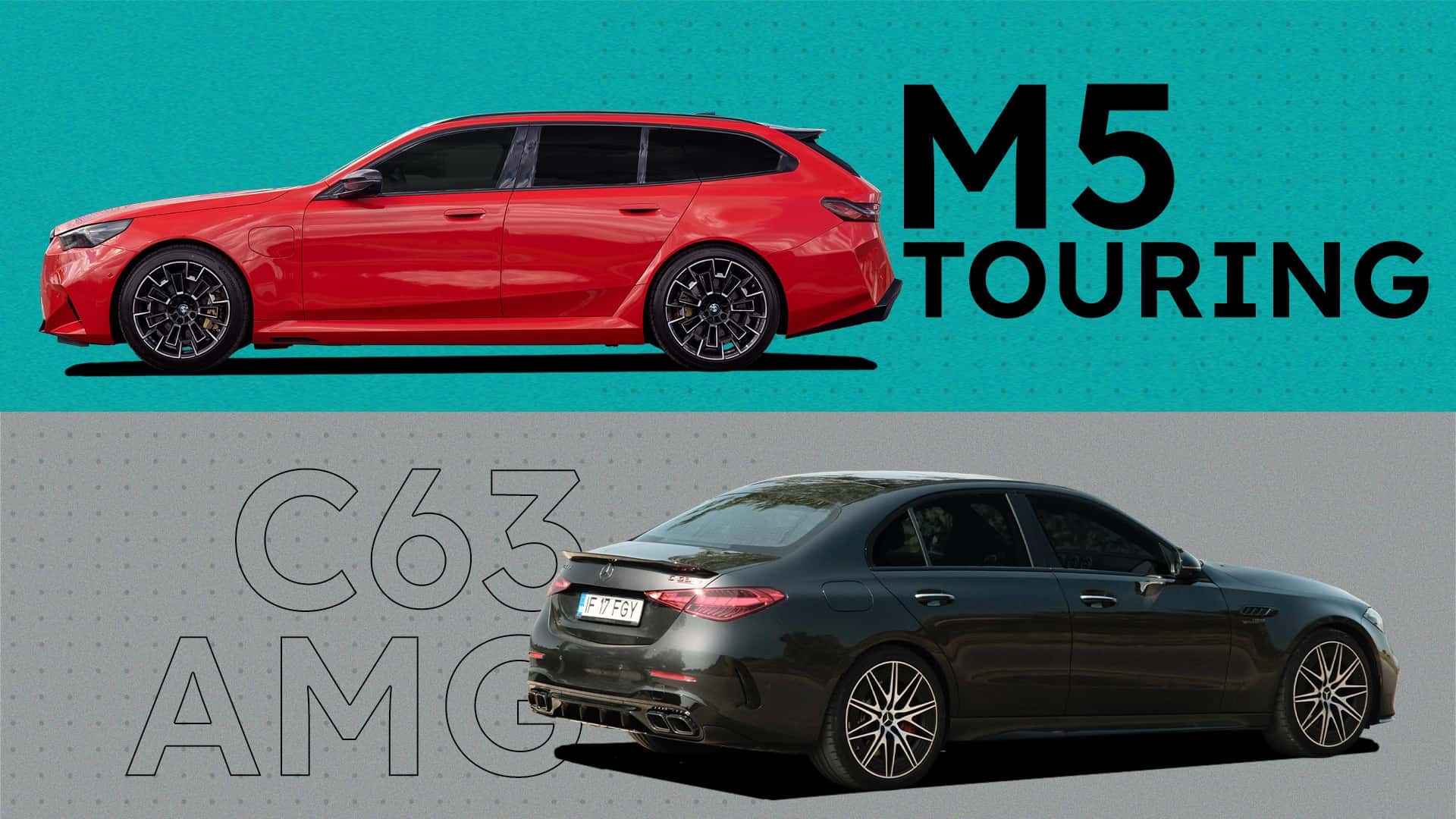
In the evolving landscape of high-performance vehicles, a new paradigm is emerging: the integration of large batteries into flagship models. While designed to curb emissions and extend electric range, this strategy often introduces significant weight, leading to a complex trade-off between power and agile driving dynamics. This inherent conflict becomes strikingly evident when examining two recent entrants: the G99 BMW M5 Touring and the Mercedes-AMG C63s E-Performance. Each represents a distinct philosophy in hybrid performance, with one prioritizing substantial electric capability and the other, a more focused approach to enhancing raw power delivery.
Key Takeaways: BMW M5 Touring vs. Mercedes-AMG C63s E-Performance
- Divergent Hybrid Strategies: The BMW M5 Touring employs a large battery for significant electric range, while the Mercedes-AMG C63s E-Performance uses a smaller, performance-oriented battery.
- Weight Impact: The 5,456-pound BMW M5 Touring struggles with inconsistent ride quality and understeer, demonstrating how excessive battery weight can compromise traditional performance car agility.
- Mercedes-AMG’s Agility: Despite being a PHEV, the 880-pound lighter C63s E-Performance, with its focused hybrid system, offers superior cornering capability and a more engaging driving experience.
- Powertrain Philosophy: BMW’s robust V8-hybrid delivers immense straight-line power, but Mercedes-AMG’s potent four-cylinder hybrid, with its electric supercharger, emphasizes responsive, track-focused performance.
- Real-World Efficiency: Stated efficiency figures for performance PHEVs can be misleading; real-world fuel economy often reflects driving style and battery charge habits more accurately.
The Electrification Conundrum in High-Performance Vehicles
Automakers are increasingly equipping their most formidable performance vehicles with substantial battery packs, driven by both regulatory pressures and the pursuit of enhanced performance through electrification. These plug-in hybrid electric vehicles (PHEVs) aim to offer the best of both worlds: blistering acceleration and the ability to travel silently on electric power alone. However, this convergence has created a new category of performance cars that, while immensely quick in a straight line, can exhibit unexpected characteristics when pushed to their dynamic limits.

The inherent challenge lies in managing the additional mass introduced by batteries and electric motors. For vehicles traditionally celebrated for their finely tuned chassis and responsiveness, this added weight can profoundly alter the driving experience, often leading to compromises in agility and handling that were once hallmarks of their non-electrified predecessors.
G99 BMW M5 Touring: A Powerful, Yet Compromised Goliath
The new G99 BMW M5 Touring exemplifies the large-battery, high-power hybrid approach. Beneath its muscular exterior lies a formidable powertrain: a 4.4-liter twin-turbocharged V-8 engine working in concert with a potent electric motor. BMW claims a combined output of 717 horsepower and 737 pound-feet (1,000 Nm) of torque, figures that a recent dyno test suggested might be closer to 800 hp in actual output, pushing nearly 700 hp to the wheels. This immense power translates into an alarming straight-line pace, pinning occupants to their seats with a relentless shove.
Electric Capability and Driving Impressions
The M5 Touring’s electric motor, integrated within its eight-speed automatic gearbox, is remarkably capable on its own. Delivering 197 hp and 206 lb-ft (280 Nm) of torque, it can propel the substantial 5,456-pound (2,475 kg) wagon with surprising briskness in EV mode. The system provides approximately 35 miles of pure electric driving, complete with a subtle, simulated acceleration sound piped through the speakers and noticeable shifts through the gears, even without the V-8 engaged. Its all-wheel-drive system ensures reliable traction, making it a viable option for urban commuting regardless of weather conditions.

However, the M5 Touring’s prodigious weight casts a long shadow over its dynamic prowess. This mass necessitates a highly specialized suspension tune, which, in practice, results in an inconsistent ride quality. The car struggles to strike a balance, oscillating between the plushness of a luxury cruiser and the firmness of a high-performance machine. This variability can be disconcerting for drivers expecting a consistent feel.
Critically, mid-corner bumps often unsettle the vehicle, leading to an uncomfortable transfer of forces. When driven spiritedly, the sheer inertia of the M5 Touring becomes a dominant factor, constantly attempting to pull the car straight into understeer. This sensation, akin to an athlete competing with ankle weights, detracts from the engaging driving experience expected from an M performance model. It presents a notable shift from previous M cars, where instant coveting was the norm after a drive.
Mercedes-AMG C63s E-Performance: Agility Through Focused Electrification
In contrast, the Mercedes-AMG C63s E-Performance presents a compelling alternative, prioritizing driving engagement over extensive electric range. Despite still being a heavy vehicle by conventional standards, it feels significantly more agile than its BMW counterpart, a difference that becomes palpable when transitioning directly between the two models. The C63s, while a size class smaller, offers a driving experience that many enthusiasts might find more rewarding.
Powertrain and Performance Focus
At the heart of the C63s lies an AMG-crafted 2.0-liter four-cylinder M139 engine, hand-assembled with a signature plaque proudly displayed under the hood. This unit, derived from Mercedes-AMG’s compact performance offerings like the CLA 45, produces over 400 horsepower independently. Paired with an electric motor, the system collectively delivers 670 hp and an astonishing 752 lb-ft (1,020 Nm) of torque. This torque figure surpasses that of the BMW, and critically, it’s channeled through a car that is approximately 880 pounds (400 kg) lighter than the M5 Touring.
The C63s’s acceleration is genuinely shocking. During a Race Start, the force exerted on the driver’s body is unlike many combustion-only vehicles. It feels perceptibly quicker than the BMW, even though their on-paper acceleration figures might appear closely matched. An electric supercharger works to rapidly build boost and virtually eliminate turbo lag, contributing to a remarkably responsive powertrain. The combined surge of electric and gas torque is truly impactful.
While some have criticized the four-cylinder engine note, the C63s provides a characterful exhaust sound, even with the enhanced engine sound disabled. The audible build-up and release of turbo pressure further contribute to the car’s engaging auditory experience.
Superior Handling and Electrification Philosophy
Through corners, the Mercedes-AMG C63s E-Performance demonstrates a clear advantage. Unlike the C63s of previous generations, which were notoriously eager to shred their rear tires, this new model feels like a finely honed track instrument. It focuses on delivering optimal corner exit with minimal drama, offering a more precise and confident feel than the M5 Touring.
This enhanced agility stems directly from Mercedes-AMG’s distinctive approach to electrification. Unlike the M5, which shares a similar battery and motor configuration with lesser PHEV models in its lineup, the C63s features a smaller, bespoke hybrid setup. Its electric motor is integrated into the rear axle, rather than the gearbox, and its primary purpose is explicitly to boost performance. While it offers approximately 5 miles of electric driving, this is not its defining characteristic. The design is geared towards regulatory compliance without sacrificing dynamic integrity.
Battery Size, Efficiency, and Real-World Performance
The fundamental difference in battery philosophy is stark. The BMW M5 Touring is equipped with a substantial 22.1-kilowatt-hour battery, a significant contributor to its overall heft. In contrast, the Mercedes-AMG C63s E-Performance utilizes a mere 6.1 kWh battery. This smaller capacity is sufficient for its performance-boosting role and for meeting stringent European Union emissions standards through favorable lab testing, without overburdening the chassis.
Official efficiency figures often paint a misleading picture for performance PHEVs. The heavier, more powerful BMW M5 Touring, for example, boasts a WLTP efficiency rating of between 1.6 and 1.7 liters/100 km (nearly 150 mpg). However, this figure is contingent on consistently keeping the battery topped up, a practice not always adhered to by drivers. The EPA combined rating of 13 mpg (18 L/100 km) with a depleted battery offers a more realistic reflection of its fuel consumption in normal driving scenarios.
The C63s, while not directly comparable by the same European efficiency metric, claims an average of 6.9 L/100 km (34 mpg). Achieving this requires an extremely gentle driving style. When driven with the enthusiasm it encourages, mirroring the BMW’s test conditions, the C63s returned around 15 mpg. Its EPA rating of 20 mpg with a depleted battery is readily achievable without deliberate efficiency efforts, proving remarkable given its ludicrous acceleration capabilities.
The Future of Performance Hybrids: Focus on Purpose
The comparison between the BMW M5 Touring and the Mercedes-AMG C63s E-Performance highlights a crucial insight: for high-performance vehicles, more battery capacity is not always the optimal solution. While electrification undeniably enhances efficiency to some degree across all applications, the primary objective for performance PHEVs should be to augment power and responsiveness without compromising the core driving experience.
The considerable weight penalty incurred by large batteries can render a PHEV less efficient than a purely combustion-powered equivalent, particularly if the battery is rarely charged. For a niche market segment like high-performance cars, where buyers often prioritize driving enjoyment over maximum fuel economy, the advertised, often unrealistic, efficiency numbers are not the key selling point. The greater environmental dividends will come from electrifying mass-market vehicles.
Mercedes-AMG’s strategy with the C63s aligns more closely with the philosophy seen in high-end hypercars and supercars. Performance-focused plug-in hybrids like the second-generation Acura NSX, the Corvette E-Ray, the Ferrari 296 GTB, or the new Lamborghini Temerario typically employ smaller batteries, often under 8 kWh. This design choice prevents the battery from becoming an undue burden on the chassis, thus preserving the purity of handling and dynamic balance.
While a potential drawback of such a focused system is the engine being forced to recharge the battery when it runs low, this scenario is largely theoretical for most enthusiastic road driving. During a rigorous, half-hour session on a twisty road with the C63s, the battery still retained approximately 33% of its charge, indicating no perceptible performance degradation. Only in extended track scenarios, where the throttle is consistently pinned, might this become a factor.
Ultimately, the Mercedes-AMG C63s E-Performance demonstrates that a sophisticated, purpose-built hybrid system, even with half the cylinders of its competitor, can deliver a more special, exciting, and dynamically superior driver’s car experience than a larger, heavier rival designed with a greater emphasis on electric range. It underscores the critical distinction between electrified cars built for efficiency and those where electrification is meticulously engineered to enhance pure, unadulterated performance.
Frequently Asked Questions (FAQ)
What is the primary difference in the hybrid approach of the BMW M5 Touring and Mercedes-AMG C63s E-Performance?
The BMW M5 Touring features a large 22.1 kWh battery for extended electric range, impacting weight. The Mercedes-AMG C63s E-Performance uses a smaller, 6.1 kWh battery, primarily to boost performance and meet emissions regulations with minimal weight penalty.
How does the weight of the BMW M5 Touring impact its driving dynamics?
Weighing 5,456 pounds, the M5 Touring’s mass leads to an inconsistent ride quality and notable inertia. This translates into unsettling behavior over mid-corner bumps and a tendency towards understeer when driven spiritedly, compromising its agility compared to its predecessors.
What are the key specifications of the BMW M5 Touring’s powertrain?
The M5 Touring combines a 4.4-liter twin-turbo V-8 with an electric motor, delivering a claimed 717 hp and 737 lb-ft (1,000 Nm) of torque. The electric motor alone provides 197 hp and 206 lb-ft, enabling approximately 35 miles of pure electric driving.
Why is the Mercedes-AMG C63s E-Performance considered more agile than the M5 Touring?
The C63s is about 880 pounds lighter than the M5 Touring and utilizes a performance-focused hybrid system with its electric motor on the rear axle. This design strategy prioritizes dynamic handling, resulting in a more responsive and enjoyable driving experience through corners.
What role does the battery size play in the performance of these PHEVs?
Battery size is crucial for performance PHEVs. While a larger battery (like in the M5 Touring) offers more electric range, it adds significant weight, compromising handling. A smaller, purpose-built battery (like in the C63s) enhances performance and responsiveness without overly burdening the chassis.
How do the real-world fuel efficiencies of the M5 Touring and C63s compare?
The M5 Touring has an EPA rating of 13 mpg with a depleted battery. The C63s is rated by the EPA at 20 mpg with a depleted battery. Both figures reflect real-world driving conditions more accurately than optimistic WLTP ratings, which often assume constant battery charging.
Are four-cylinder engines sufficient for high-performance cars like the C63s E-Performance?
Yes, the C63s E-Performance demonstrates that a sophisticated four-cylinder engine, when combined with a powerful electric motor and electric supercharger, can deliver exceptional performance. Its 2.0-liter M139 engine, along with the hybrid system, produces 670 hp and 752 lb-ft, making it remarkably quick and engaging.
What other performance PHEVs adopt a similar philosophy to the C63s?
Several high-performance PHEVs prioritize performance enhancement over extended electric range, similar to the C63s. Examples include the second-generation Acura NSX, the Corvette E-Ray, the Ferrari 296 GTB, and the new Lamborghini Temerario, which typically use smaller batteries to preserve chassis purity.