
Key Takeaways:
- The early Nissan Leaf, a pioneering electric vehicle, inadvertently fueled widespread concerns about EV battery degradation due to its passively air-cooled battery system.
- This design limitation led to significant and rapid battery capacity loss, especially in hot climates, diminishing the vehicle’s usable range over time.
- A 2026 AAA consumer survey highlighted the high cost of battery repair or replacement as the leading reason (56%) people hesitate to buy an EV.
- Modern electric vehicles have largely overcome these challenges by adopting advanced active thermal management systems, primarily liquid cooling, which regulate battery temperature effectively.
- Studies, such as one by Geotab, demonstrate that contemporary EVs with active cooling exhibit significantly lower annual degradation rates compared to early passively cooled models like the Leaf.
- Ongoing advancements in battery cooling technology, including heat pumps and integrated thermal management, ensure long-term durability and consistent performance for today’s electric car batteries.
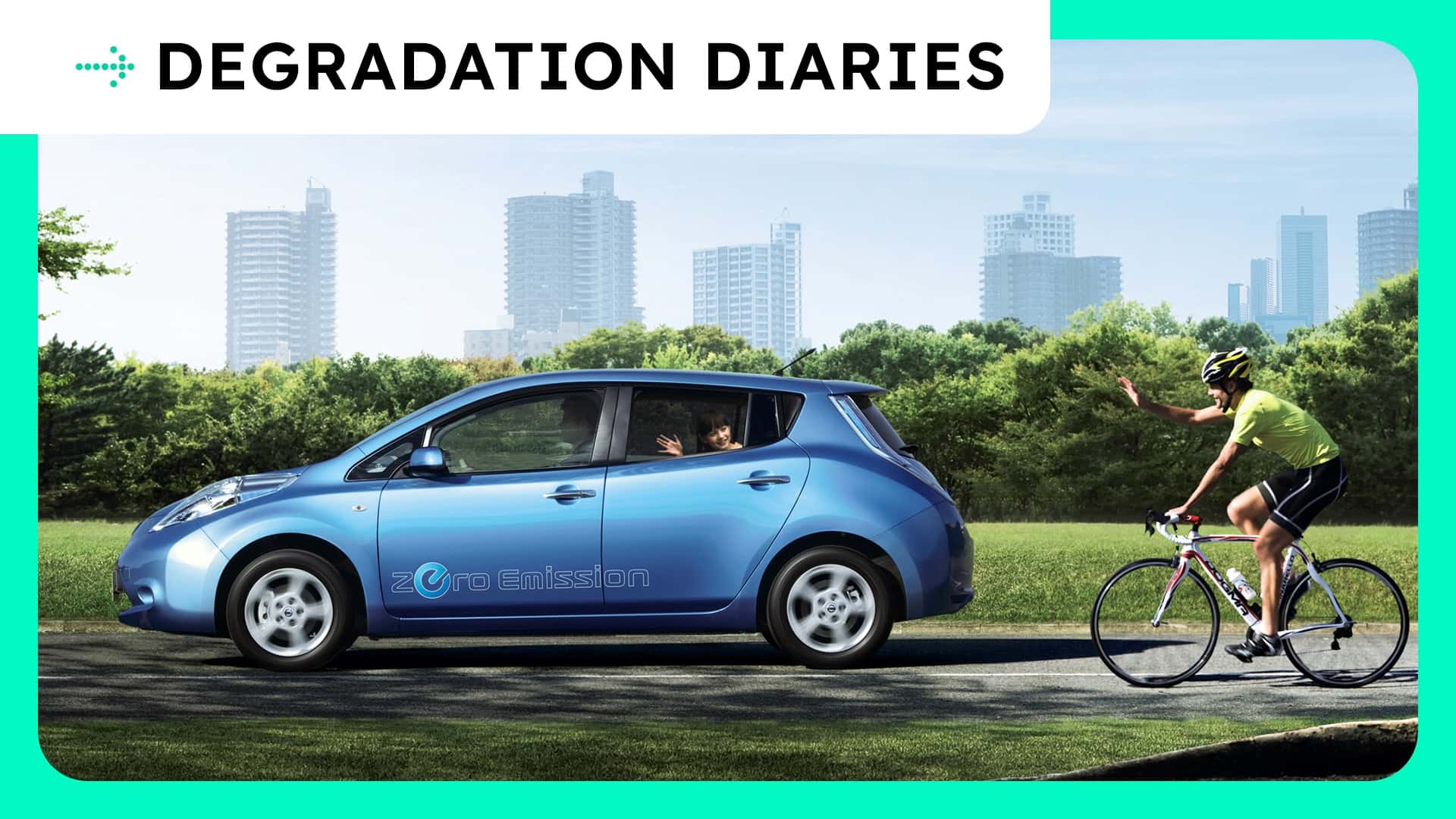
The conversation surrounding electric vehicles (EVs) is often shadowed by a persistent concern: battery degradation. This apprehension, which suggests that EV batteries are short-lived and prone to rapid capacity loss, largely stems from the early experiences with one of the first mass-market electric cars: the Nissan Leaf. While the Leaf was a groundbreaking and essential vehicle in the nascent EV market, its engineering compromises on battery thermal management inadvertently cast a long shadow over the entire sector.

As one of the original purpose-built electric vehicles, the Nissan Leaf introduced many consumers to the viability of electric mobility. It was a likable, forward-thinking car that played a pivotal role in accelerating EV adoption. However, a specific design choice—the implementation of a passively air-cooled battery pack—left it vulnerable to rapid capacity loss, particularly in regions with high ambient temperatures. This crucial design decision is widely considered responsible for cementing the public’s fear of EV battery degradation, a perception that modern electric cars are still working to overcome.
The Nissan Leaf’s Pioneering Flaw: Passive Cooling
The core issue with the early Nissan Leaf models was their battery pack’s reliance on passive air-cooling. Unlike actively managed systems, this design offered minimal control over the cell temperature. Consequently, the Leaf’s batteries were susceptible to overheating, which is a known accelerator of lithium-ion battery degradation.
This vulnerability meant that Nissan Leaf vehicles tended to lose battery capacity at a noticeably faster rate than other EVs equipped with actively liquid-cooled battery packs. The impact was particularly pronounced in hotter climates, where elevated temperatures exacerbated the degradation process. For an EV initially offering around 80 miles of range, a rapid decline to 30 miles within a few years transformed it from a viable daily driver into a limited-use local runabout.

Such experiences led many to draw parallels between EV batteries and those found in smartphones, assuming a similar short lifespan. However, for the vast majority of electric vehicles on the market today, this comparison is far from accurate, as advancements in battery technology and thermal management have dramatically altered the landscape of EV battery health.
Addressing EV Battery Degradation Concerns
Battery degradation stands apart from other EV-related concerns like charging delays or winter range loss. The term itself, ‘degraded battery,’ often evokes images of a catastrophic failure akin to a blown engine in a conventional vehicle. This fear is compounded by the high potential cost associated with replacing an entire battery pack.
Indeed, a 2026 AAA consumer survey underscored this sentiment, revealing that 56% of respondents cited the high cost of battery repair or replacement as the primary reason they were unlikely to purchase an EV. This factor even outweighed concerns about a higher purchase price, long-distance suitability, range anxiety, and charging infrastructure availability.
Despite these anxieties, the reality of EV battery degradation in modern vehicles is far less dire than the early Leaf stories might suggest. Actual battery failure in contemporary cars is exceedingly rare. Many older, high-mileage EVs are still operating efficiently on their original battery packs, some well over a decade old. While a slow, unavoidable capacity loss is inherent to lithium-ion battery chemistry, modern packs are designed to last for a considerable period, providing sufficient range and usability throughout the vehicle’s lifespan.
The Leaf’s Enduring Legacy: Studies and Owner Experiences
For over 15 years and across two generations, the Nissan Leaf consistently utilized air-cooled batteries, even as other manufacturers adopted more sophisticated thermal management solutions. As one of the world’s most recognizable EVs, its degradation issues quickly became a significant topic of discussion, extending far beyond dedicated owner forums.
A New Zealand study, based on 1,382 battery-health readings from 283 Nissan Leafs, provided concrete data on this accelerated degradation. It found that 30-kWh Leaf models exhibited an unusually high annual battery health decline of 9.9% at just two years old. This figure drastically contrasts with the degradation rates observed in modern EVs featuring active battery cooling. Even earlier 24-kWh Leaf variants, while performing better, still averaged a 3.1% degradation per year.
Nissan later addressed some of the reporting inaccuracies by issuing a software update for certain 30-kWh models, acknowledging that the battery controller could incorrectly report capacity. However, the initial owner experiences had already cemented a negative perception.
Early Leaf forums were replete with accounts of drivers observing battery bars disappear rapidly, particularly those in hot climates. An independent test conducted in Arizona in 2012, cited by Green Car Reports, notably found that one tested car retained only 60-65% of its original battery capacity, managing just 59 miles before depletion, despite being less than two years old. This rapid loss dramatically affected the perceived value and usability of these early models.
The cost of replacing a battery pack further exacerbated these concerns. In January 2014, Nissan priced a replacement pack for an early first-generation Leaf at $5,499, excluding tax and installation, with the caveat that the dealer retained the old pack, valued at $1,000. These factors made the Leaf’s battery issues a significant deterrent for many potential EV buyers, leaving a lasting mark on the entire electric vehicle market, even as current data demonstrates vast improvements.
The Paradigm Shift: Active Thermal Management Systems
The widespread adoption of active thermal management systems marks the most significant advancement in mitigating EV battery degradation. Research by the National Renewable Energy Laboratory (NREL) unequivocally states that both high and low average battery temperatures can accelerate lithium-related capacity loss in any EV. Crucially, high temperatures specifically hasten undesirable chemical reactions within the battery cells, leading to the gradual consumption of usable lithium as the battery ages.
Active battery thermal management systems are engineered precisely to counteract these effects. Their primary objective is to maintain the battery pack within an optimal temperature window, minimize temperature discrepancies between individual cells, and avert the hazards and accelerated wear associated with extreme temperatures. Virtually every EV sold in the U.S. today, and most globally, comes equipped with such a system.
A January study by Geotab starkly illustrated the difference: “the 2015 Tesla Model S, which uses liquid cooling, has an average degradation rate of 2.3%. In contrast, the 2015 Nissan Leaf, with passive air cooling, shows a much higher rate of 4.2%.” This data highlights the critical role active cooling plays in preserving battery health. For example, a 2014 Tesla Model S with over 100,000 miles can still retain a remarkable 85% of its original battery capacity after more than 11 years, a feat that would be nearly impossible for a first- or second-generation Nissan Leaf.
Glycol-based liquid cooling systems are now standard across a vast array of EVs, from Teslas and Fords to Chevrolets and Volkswagens. Automakers universally recognize that maintaining the battery within its optimal temperature range is fundamental to ensuring long-term reliability and minimizing EV battery degradation. Some manufacturers have even innovated beyond dedicated liquid loops; BMW, with its original i3, integrated the air-conditioning system to cool its battery, providing precise control over the pack’s temperature.
Evolution of Battery Cooling Technologies
Thermal management systems have continued to evolve significantly, advancing even beyond the early liquid-cooled designs. Many modern EVs now pair their glycol-based battery cooling systems with advanced heat pumps for enhanced efficiency. While often lauded for their ability to extend cold-weather range by more efficiently heating the cabin than traditional resistive heaters, heat pumps are integral to a much broader thermal management strategy in contemporary electric vehicles.
Instead of merely generating heat, a heat pump intelligently transfers it. This allows the vehicle to scavenge warmth from various sources, including the motors, power electronics, battery, or ambient air, and direct it precisely where needed. In vehicles like the Tesla Model Y, the heat pump integrates with components such as the Octovalve, which functions as a sophisticated coolant traffic director. This system routes heat between the battery, cabin, drivetrain, chiller, and radiator, dynamically responding to whether the car needs to pre-warm the pack for fast charging, cool it during intensive use, or efficiently heat the cabin.
The future of EV battery thermal management promises even greater advancements. Shell, for instance, recently showcased an innovative EV concept that focuses on direct immersion cooling of battery cells. Current EVs typically circulate coolant around the cells, cooling them indirectly. Shell’s approach aims to fully immerse the cells in a specialized coolant, thereby enhancing heat extraction effectiveness and overall efficiency. Furthermore, an increasing number of EVs are directing coolant through the top and along the sides of the battery pack modules, meticulously preventing the formation of hot spots that could accelerate degradation.
Dispelling the Myth: The Modern EV Battery Reality
The evolution of battery technology and sophisticated thermal management systems has fundamentally changed the reality of EV battery degradation. The industry has demonstrably moved beyond the rudimentary air-cooled approach that characterized early models like the Nissan Leaf. Modern engineering ensures that electric vehicle batteries can now last for hundreds of thousands of miles without experiencing crippling degradation.
While the Nissan Leaf was an undeniable pioneer, paving the way for the electric revolution, its early battery challenges inadvertently created a widespread perception of fragility. Fortunately, the industry absorbed these lessons, universally adopting active battery cooling systems for virtually every new model. Thanks to these continuous innovations, today’s EV owners can drive with confidence, knowing their vehicle’s battery pack is designed for long-term reliability and will provide consistent performance for years to come.
FAQ Section
What is EV battery degradation?
EV battery degradation refers to the natural, gradual loss of capacity and power that occurs in lithium-ion batteries over time and use. This process reduces the maximum range an electric vehicle can achieve on a full charge and can slightly impact performance, though modern systems significantly mitigate its effects.
Why did early Nissan Leaf models experience rapid battery degradation?
Early Nissan Leaf models utilized passively air-cooled battery packs. This design lacked active temperature control, making the batteries highly susceptible to overheating, especially in hot climates. Elevated temperatures accelerate the chemical reactions that lead to faster capacity loss, hence the quicker degradation.
How do modern EVs prevent significant battery degradation?
Modern electric vehicles employ advanced active thermal management systems, predominantly liquid cooling. These systems precisely regulate the battery’s temperature, keeping it within an optimal operating range. This prevents overheating or excessive cold, significantly slowing down the degradation process and preserving battery health over many years.
Is EV battery replacement a common occurrence for modern electric cars?
No, actual battery failure and the need for full replacement are exceedingly rare in modern electric vehicles. While batteries do degrade slowly, they are designed to last the lifetime of the vehicle, often exceeding 10-15 years and hundreds of thousands of miles, while retaining ample usable capacity.
What is the average EV battery degradation rate for contemporary vehicles?
For modern electric vehicles equipped with active thermal management, the average annual battery degradation rate is typically low, often ranging from 1% to 2.5%. This allows most EVs to retain 80% or more of their original capacity even after a decade or significant mileage, offering long-term reliability.
How do heat pumps contribute to better EV battery health?
Heat pumps in modern EVs are part of an integrated thermal management system. They efficiently transfer heat, not just for cabin comfort, but also to warm or cool the battery pack. This ensures the battery remains at its ideal operating temperature for optimal performance, faster charging, and reduced degradation across various climates.
Are there future innovations that will further improve EV battery longevity?
Yes, battery technology is continuously evolving. Innovations such as direct immersion cooling, where battery cells are fully submerged in a specialized dielectric fluid, promise even more effective heat extraction and temperature control. Improved coolant routing within battery packs also aims to eliminate hot spots and further enhance longevity.