
Key Takeaways
- Tesla has unveiled more details about its planned self-driving robotaxi service, confirming a hybrid operational model.
- The service will integrate a fleet of Tesla-owned autonomous vehicles alongside cars contributed by individual Tesla owners.
- Owners will have granular control over their vehicles, dictating who can use them within the ride-hailing network.
- Tesla’s strategy for achieving autonomy hinges on a vision-only architecture powered by end-to-end neural networks, trained on extensive real-world driving data.
- The announcement aims to reassure investors following recent speculation about the company’s strategic priorities, although challenges in achieving full self-driving remain.
BENGALURU, INDIA – April 23, 2024 – Tesla, the electric vehicle titan, has provided further clarity on its long-anticipated push into the autonomous ride-hailing market, revealing a sophisticated operational model that blends elements of established sharing economy platforms. During its first-quarter earnings call, the automaker elaborated on its vision for a self-driving Tesla robotaxi fleet, aiming to address critical inquiries from analysts and investors regarding its future strategic direction.
The highly anticipated earnings call on Tuesday served as a pivotal platform for Tesla to shed light on its evolving business plans. Amid a landscape of shifting market dynamics and intense competition in the electric vehicle sector, stakeholders were particularly keen to understand the concrete steps Tesla intends to take in realizing its autonomous vehicle ambitions.
The Dual-Layered Robotaxi Model Explained
Elon Musk, CEO of Tesla, offered significant insights into the proposed structure of the company’s ride-hailing service. He confirmed that Tesla intends to operate a substantial portion of the self-driving taxi fleet directly. This core fleet, managed by the company, forms the backbone of the envisioned autonomous mobility network.
Crucially, Musk also revealed a novel component: individual Tesla owners will have the opportunity to integrate their personal vehicles into the Tesla robotaxi fleet. This owner-contributed aspect introduces a flexible, scalable dimension to the service, drawing parallels with established peer-to-peer platforms.
Detailing the owner participation model, Musk stated that Tesla owners would be able to “add or subtract their cars from the fleet whenever they want.” This flexibility is designed to empower owners, allowing them to monetize their vehicles during periods of non-use. The CEO further specified that owners “can decide if they want to only let the car be used by friends and family, or only by five-star users or by anyone.” This granular control over vehicle access underscores a personalized approach to the sharing economy.
Characterizing the innovative approach, Musk advised investors and the public to “think of it like a combination of Airbnb and Uber.” This analogy highlights the dual functionality: company-managed assets akin to a traditional service, coupled with a community-driven, owner-operated component that fosters broader participation and leverages existing vehicle assets.
Technological Foundation and Future Functionality
The company’s first-quarter earnings report corroborated Musk’s statements, outlining the foundational investments being made. The report noted that Tesla is “currently working on ride-hailing functionality that will be available in the future,” underscoring the developmental stage of the service.
Tesla’s commitment to achieving full vehicle autonomy and a viable ride-hailing service extends across its hardware and software infrastructure. The company affirmed, “We have been investing in the hardware and software ecosystems necessary to achieve vehicle autonomy and a ride-hailing service.” This comprehensive investment strategy aims to build a robust platform capable of supporting widespread autonomous operation.
Central to Tesla’s long-term autonomy strategy is its distinct technological philosophy. The earnings report reiterated the company’s belief that “a scalable and profitable autonomy business can be realized through a vision-only architecture with end-to-end neural networks, trained on billions of miles of real-world data.” This emphasis on cameras as the primary sensors, complemented by advanced neural networks processing vast datasets, positions Tesla’s approach distinctively within the autonomous driving landscape.
App Integration and User Interface Preview
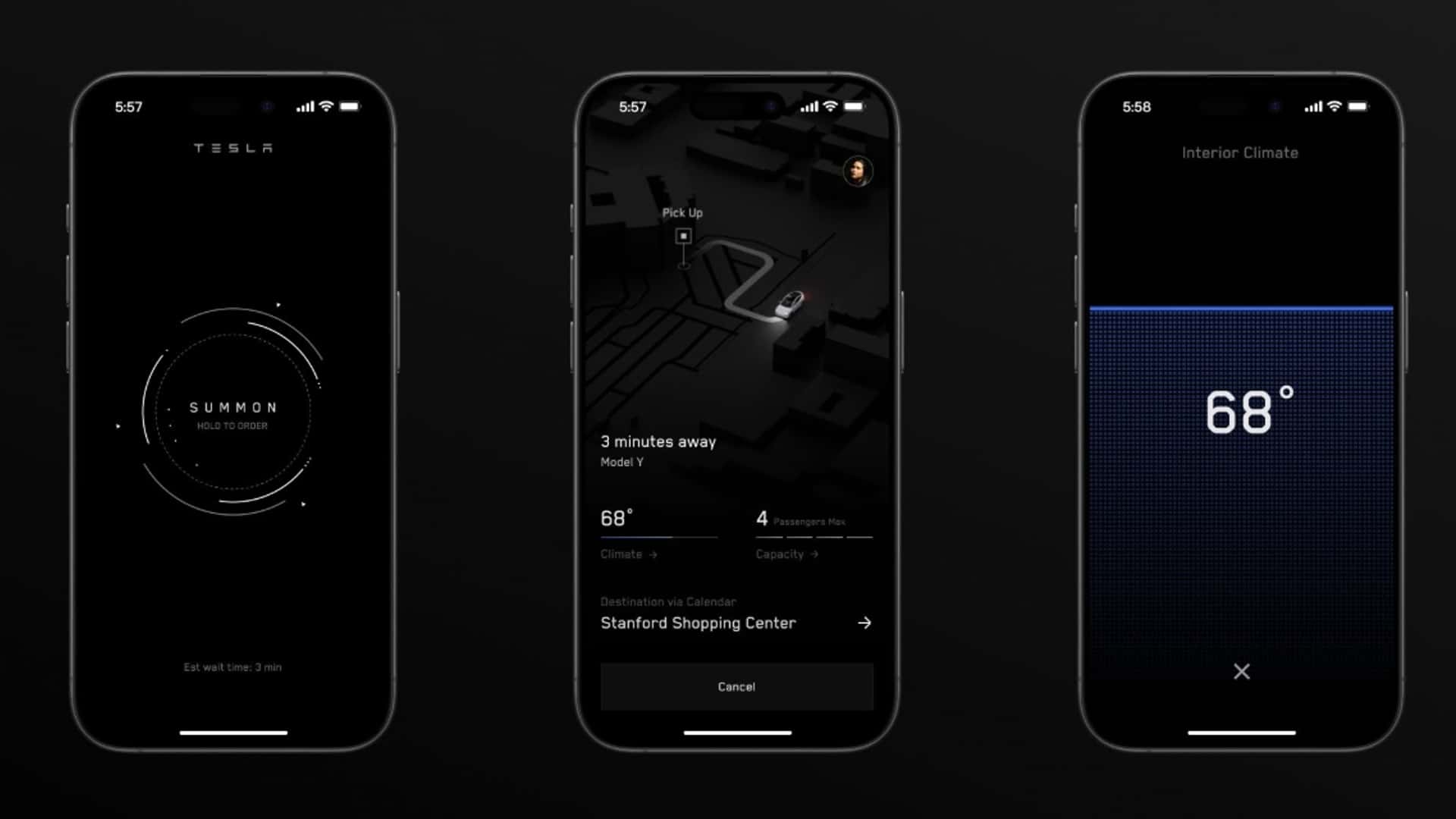
To provide a tangible glimpse into the future user experience, Tesla also released a preview of the prospective ride-hailing functionality as it would appear within the Tesla app. These renderings offer initial insights into how customers might interact with the forthcoming service, enhancing the understanding of Tesla’s ride-hailing plans.
The visual previews showcased a prominent “Summon” button, which is presumably intended for requesting an autonomous taxi. Additionally, one screen displayed a temperature reading of 68 degrees, suggesting a potential feature allowing users to pre-set climate control settings in their robotaxi before it arrives. While these details remain somewhat sparse, they offer an early indication of the convenience and personalization Tesla aims to deliver with its Tesla robotaxi fleet.
Strategic Reorientation Amid Market Speculation
The detailed announcement regarding the Tesla robotaxi fleet arrives at a critical juncture for the company. Recent reports from Reuters had indicated a potential shift in Tesla’s strategic priorities, suggesting that plans for a more affordable consumer vehicle might have been deprioritized in favor of accelerating the robotaxi project. This speculation had generated considerable uncertainty among investors and the broader automotive community regarding the company’s immediate and long-term product roadmap.
Questions arose concerning the exact nature of a dedicated robotaxi business and the timeline for its deployment. During the earnings call, Tesla sought to clarify these points, indicating a revised launch timing for its product pipeline. The company stated its intention to accelerate the launch of “new vehicles, including more affordable models,” while concurrently confirming that the dedicated robotaxi would follow at a later stage.
This nuanced update suggests a rebalancing of product development, aiming to deliver on both the mass-market affordability promise and the ambitious autonomous mobility vision. The explicit mention of a sophisticated ride-hailing business model is widely perceived as Tesla’s strategic move to reassure investors, demonstrating a clear and actionable plan behind its advanced autonomy endeavors.
Challenges and Historical Context of Autonomous Driving
Despite the ambitious unveiling, the successful implementation of Tesla’s robotaxi strategy fundamentally depends on its ability to achieve true, reliable self-driving capabilities. This remains a significant hurdle, as the company has faced considerable challenges in delivering on previous timelines for fully autonomous vehicles.
Tesla’s existing Full Self-Driving (FSD) feature, a premium offering, currently requires continuous human driver supervision and has, on occasion, demonstrated limitations and made errors. This ongoing requirement for driver intervention highlights the complexities and inherent difficulties in perfecting autonomous technology for widespread, unsupervised deployment.
It is also important to contextualize this latest robotaxi announcement within Elon Musk’s history of ambitious projections. He famously declared in 2019 that Tesla would have one million robotaxis operational by 2020. Such ambitious timelines have historically been subject to revision, prompting a degree of cautious optimism when evaluating the latest pronouncements regarding the Tesla robotaxi fleet.
As Tesla continues its journey towards autonomous mobility, the integration of a flexible, owner-contributed ride-hailing network presents both significant opportunities and considerable technological and regulatory challenges. The coming years will reveal the pace and success of this ambitious undertaking, shaping the future of urban transportation and personal vehicle ownership.
FAQ: Tesla’s Robotaxi Fleet
Q1: What is Tesla’s new robotaxi strategy?
Tesla plans to launch a self-driving ride-hailing service that combines company-owned autonomous vehicles with a network of cars contributed by individual Tesla owners. This hybrid model allows owners to generate income by adding their vehicles to the fleet, while retaining control over who can utilize their car, similar to a blend of Airbnb and Uber.
Q2: How will Tesla owners participate in the robotaxi fleet?
Tesla owners will be able to opt their cars into or out of the robotaxi fleet as they choose. They will also have the flexibility to define usage parameters, such as limiting access to friends and family, only five-star-rated users, or allowing general public use. This offers a new avenue for vehicle monetization.
Q3: What technology underpins Tesla’s autonomous driving?
Tesla is investing heavily in a vision-only architecture for its autonomous vehicles. This system relies predominantly on cameras as primary sensors, coupled with sophisticated end-to-end neural networks. These networks are trained extensively on billions of miles of real-world driving data to enable the vehicles to perceive, understand, and navigate diverse environments.
Q4: Has Tesla released any visuals of the robotaxi app functionality?
Yes, Tesla provided preview renderings of the ride-hailing functionality integrated into the existing Tesla app. These visuals indicated features such as a ‘Summon’ button for ordering a taxi and potentially the ability for users to adjust cabin climate settings, like temperature, before their autonomous vehicle arrives, enhancing passenger comfort and convenience.
Q5: What are the main challenges for Tesla’s robotaxi plans?
The primary challenge remains achieving true, unsupervised full self-driving capabilities. Tesla’s current Full Self-Driving (FSD) feature still requires active driver supervision and has demonstrated limitations. Overcoming these technological hurdles and navigating complex regulatory landscapes globally will be crucial for the widespread deployment and success of the Tesla robotaxi fleet.
Q6: How does this announcement relate to Tesla’s other vehicle plans?
The robotaxi announcement provides clarity amid speculation that Tesla might have prioritized autonomous vehicles over more affordable consumer models. Tesla has since indicated it is accelerating the launch of new, including more affordable, vehicles, with the dedicated robotaxi coming at a later stage. This suggests a balanced approach to its future product line-up.