
Key Takeaways:
- Toyota has launched an internal program, “Electrification 101,” to educate employees, including those without automotive backgrounds, on hybrid, electric, and fuel cell technologies.
- The initiative aims to bridge a significant knowledge gap within the company regarding the nuances of electrification and Toyota’s multi-pathway strategy.
- Despite a focus on hybrids, the training also works to demystify Battery Electric Vehicles (BEVs) and their advantages, fostering internal advocacy for a more electrified future.
- The program’s success, marked by high attendance and a long waitlist, suggests a growing internal shift towards embracing electric propulsion.
- By empowering its workforce with foundational knowledge, Toyota seeks to embed its long-term Toyota electrification strategy across all corporate functions.
NEW DELHI — In an era defined by rapid automotive evolution, even industry giants like Toyota are grappling with the pervasive challenge of educating their own workforce about the shift towards electrification. A recent internal training program, “Electrification 101” at Toyota Motor North America, has shed light on an unexpected reality: fundamental knowledge gaps exist even among employees of the world’s largest automaker, necessitating a concerted effort to align internal understanding with the company’s future trajectory.
While industry critics and automotive enthusiasts are deeply immersed in the nuances of electric vehicles (EVs), hybrid technologies, and alternative powertrains, the average corporate employee at a legacy automaker often operates without this specialized insight. This observation, made during a firsthand experience at Toyota’s program, underscores a broader industry challenge and Toyota’s proactive approach to address it head-on.
Bridging the Internal Knowledge Divide
The premise for Toyota’s “Electrification 101” program stems from a clear understanding that not every employee, from corporate accountants to app developers, is inherently a car enthusiast or an expert in advanced automotive propulsion. Many join the company for its reputable benefits, career stability, corporate culture, or the prestige associated with working for a global leader. Consequently, a deep understanding of battery chemistry, charging infrastructure, or the philosophical debates surrounding electrification may not be part of their daily professional scope.
Even among employees who consider themselves car enthusiasts, familiarity with the intricate differences between battery types like Nickel Manganese Cobalt (NCM) and Lithium Iron Phosphate (LFP) chemistries is not a given. The technical complexities of modern electrified powertrains represent a new frontier even for those with a passion for traditional internal combustion engines.
Toyota’s initiative is not its first foray into foundational employee education. Earlier in the year, the company offered an introduction to general automotive principles, further emphasizing the need to cultivate a baseline understanding of its core products across its diverse workforce. This systematic approach highlights a commitment to internal competence as a cornerstone of its evolving Toyota electrification strategy.
Toyota’s Multi-Pathway Electrification Strategy Unveiled
The program’s nomenclature, “Electrification 101” rather than “EV 101,” is deliberate, reflecting Toyota’s well-documented “multi-pathway” approach to sustainable mobility. This strategy emphasizes a diverse portfolio, prioritizing hybrids in the immediate term while simultaneously developing battery electric vehicles (BEVs) and, notably, hydrogen fuel cell vehicles (FCEVs) for the future. This comprehensive approach aims to offer customers a wide array of choices tailored to varying needs and infrastructural readiness.
Recent sales figures reinforce this strategy: in a recent quarter, 56.8% of Toyota’s total vehicle sales comprised electrified models, encompassing hybrids, plug-in hybrid electric vehicles (PHEVs), BEVs, and FCEVs. However, pure BEVs constituted a mere 1.7% of these electrified sales, underscoring the company’s current emphasis on hybrid technology as a primary bridge to a fully electric future.
The curriculum meticulously outlined the fundamental differences between these powertrain types, including the often-confused distinction between traditional hybrids and PHEVs. A significant portion of the training was dedicated to addressing and dispelling common misconceptions surrounding BEVs, aiming to foster a more informed perspective among employees.
Dispelling Myths and Presenting Advantages
The training commenced with a historical parallel, comparing the nascent electric vehicle market to the early 20th-century automotive landscape, where horse ownership was simpler than navigating new infrastructure, education, service, and unclear regulations for gasoline cars. The historical context highlighted how cars eventually prevailed, suggesting a similar trajectory for electrification.
The program then delved into the inherent advantages of electrification, focusing on superior efficiency and environmental cleanliness. It specifically advocated for the multi-pathway approach as the most effective method for utilizing finite battery resources, arguing it provides broader environmental benefits. This perspective, while integral to Toyota’s Toyota electrification strategy, is often debated within the broader industry, with much research suggesting that BEVs generally offer the cleanest option on a life cycle basis.
Evidence That EVs Are The Cleanest Option
EV Myth Busted: No, They’re Not ‘Dirtier’ Than Gas Cars, Even If You Use Fossil Fuel Power
Yes, EVs Really Are Cleaner Than Gas Cars. Here’s By How Much
While presenting the relative advantages of each powertrain, the curriculum exhibited a more critical stance on BEV limitations compared to other powertrain types, notably omitting discussions on the increased maintenance or noise, vibration, and harshness (NVH) associated with gasoline vehicles. Conversely, the program maintained a characteristically optimistic outlook on hydrogen fuel cell technology.
A slide, for instance, stated that hydrogen “can reduce ‘range anxiety’ as number of stations grow,” citing the Toyota Mirai’s impressive 402 miles per tank. While such figures were groundbreaking when EVs had limited range, it is pertinent to note that at least eight BEV models currently available in the U.S. market now offer greater driving range, with more advanced options continually emerging. The Mirai, running on compressed hydrogen, remains largely confined to specific regions in California due to limited infrastructure, with fuel costs often double that of gasoline.
Beyond these specific emphases, the classroom sessions covered essential technical fundamentals, including an overview of various battery chemistries, different charging types, core electrical concepts such as kilowatts and kilowatt-hours, and an update on global battery recycling initiatives.
The Simplicity and Power of Electric Propulsion
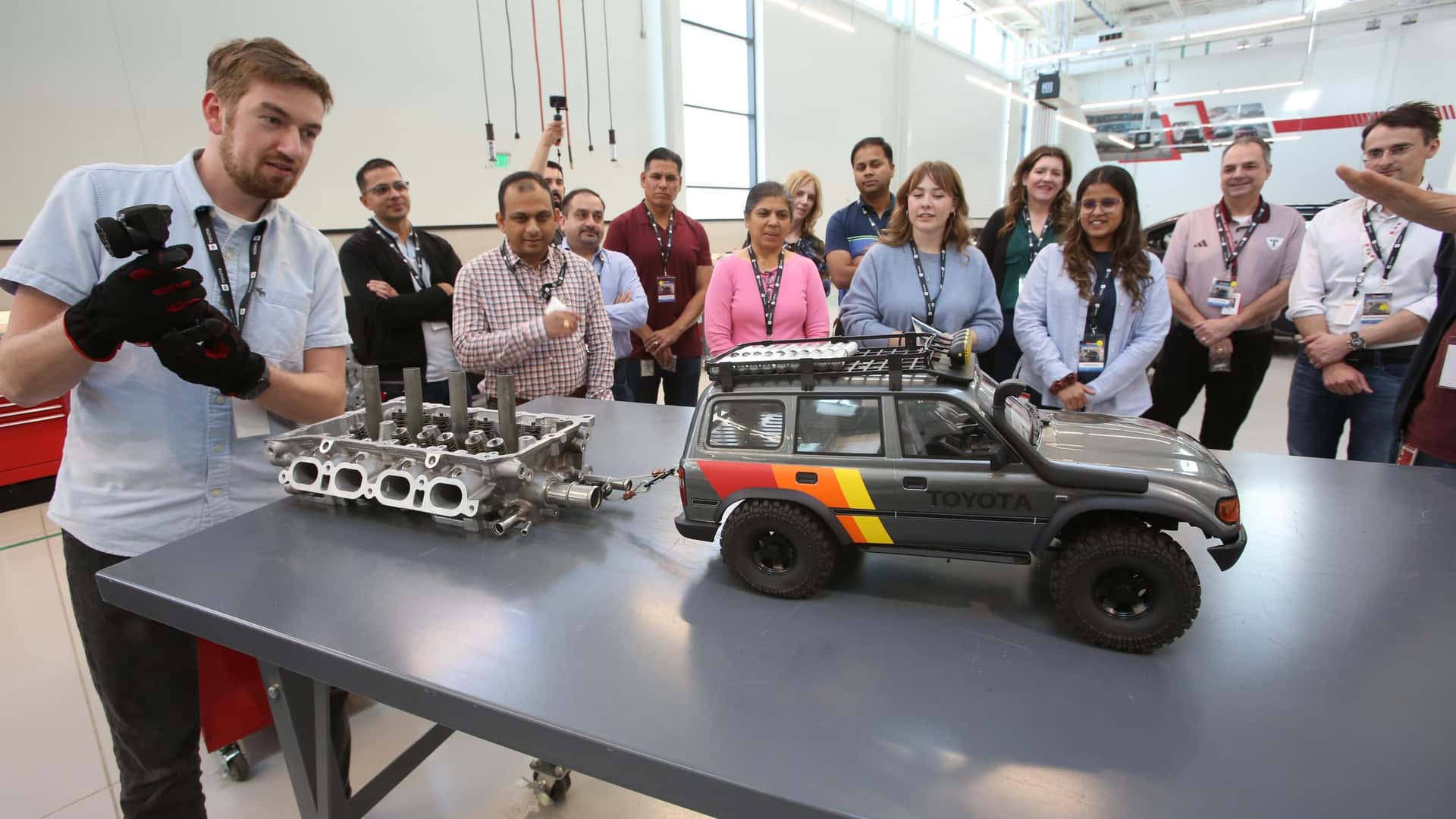
The most impactful segment of the program involved interactive demonstrations, designed to bring theoretical concepts to life. Employees were tasked with constructing a rudimentary electric motor using only a screw, a magnet, a AA battery, and a piece of wire. Participants also assembled a basic potato-based battery and observed diverse charging outputs firsthand. A compelling demonstration showcased the instantaneous torque of an EV motor, using a miniature remote-controlled Land Cruiser to effortlessly tow a cylinder head weighing over 30 pounds.
This hands-on experience underscored a critical message: electric motors are a remarkably efficient and simple technology. Presenters showcased a stripped-down Toyota V-6 engine, revealing its complex array of accessories and intricate components. This was contrasted with an equivalent electric motor, which demonstrated superior power output within a significantly smaller footprint and a fundamentally simpler design. The discussion extended to how even integrating an electric motor into a gasoline powertrain, as seen in Toyota’s hybrid systems, can reduce overall complexity by eliminating the need for a convoluted transmission system.
The core lesson resonated clearly: incorporating electric propulsion, in any form, can enhance efficiency with minimal sacrifices. As one progresses further towards pure battery electric vehicles, the inherent simplicity of the system becomes even more pronounced, leading to fewer potential points of failure.
While Toyota representatives acknowledged that significant improvements in battery chemistry and charging infrastructure are still necessary before BEVs become a universal solution, the underlying sentiment conveyed throughout the program was one of genuine excitement for an increasingly electric future. This forward-looking perspective is a crucial element of the company’s evolving Toyota electrification strategy.
Cultivating Internal Advocates for Electrification
The strategic importance of this internal educational initiative cannot be overstated. Without a fundamental understanding of electrification’s long-term benefits, employees in roles such as corporate procurement might solely perceive the immediate costs associated with new component designs or the complexities of onboarding novel suppliers. Such a limited perspective could naturally foster resistance to change, a common human tendency.
However, by instilling excitement and a clear vision for the future, Toyota aims to empower its workforce to embrace short-term complexities in pursuit of long-term strategic goals. This internal advocacy is vital for driving the company’s broader Toyota electrification strategy.
Brigette Armato, a Toyota employee who participated in the class, exemplifies this transformation. She candidly admitted to knowing “nothing” about EVs and hybrids prior to the training. Post-program, her perspective has shifted dramatically, transforming her into an informed advocate.
“I work with our lease experience team, so I’m actually working with the customers and the vehicles. This was extremely helpful because now I can have an educated conversation with them and maybe convince them to go for an electric vehicle, whereas before I don’t think I had that skill,” Armato stated, reflecting on the program’s immediate impact on her customer interactions.
Beyond her professional role, Armato’s personal outlook has also evolved. She is now seriously considering purchasing an EV herself, despite her current attachment to her Toyota 4Runner. “I wish we would gravitate more towards electric vehicles across the lineup,” she expressed, echoing the sentiments of many looking for broader electric options.
The success of “Electrification 101” is evident in its popularity, with hundreds of employees having already attended and a substantial waitlist for upcoming sessions. This growing cadre of “EV believers” within Toyota’s North American headquarters signifies a crucial internal shift. It’s not that employees were actively hostile to electrification previously, but rather that, much like the general public, many simply lacked comprehensive information. This internal awakening is poised to be a significant driver for Toyota’s future product development and overall Toyota electrification strategy.
Frequently Asked Questions (FAQ)
What is Toyota’s “Electrification 101” program?
Toyota’s “Electrification 101” is an internal training initiative designed to educate its diverse employee base on the fundamentals of various electrified powertrains, including hybrids, plug-in hybrids, battery electric vehicles (BEVs), and hydrogen fuel cell vehicles (FCEVs). It aims to bridge knowledge gaps within the company.
Why did Toyota create this internal training?
Toyota created the program to ensure its entire workforce, including non-automotive experts, understands the company’s Toyota electrification strategy and the underlying technologies. Many employees, even within an automaker, lack deep knowledge of electric vehicles, and this training aims to convert them into informed advocates.
What is Toyota’s “multi-pathway” electrification strategy?
Toyota’s “multi-pathway” strategy involves a diverse approach to electrification, focusing on hybrids as an immediate solution while developing BEVs and FCEVs for the long term. This strategy aims to offer varied customer choices and optimize battery resource utilization, aligning with its comprehensive sustainability goals.
What are the key benefits of electric motors highlighted in the training?
The training emphasized the incredible simplicity and efficiency of electric motors. They offer more power in a smaller footprint compared to complex internal combustion engines, leading to fewer moving parts, reduced maintenance requirements, and overall greater reliability in electrified powertrains.
How is Toyota addressing common myths about electric vehicles?
The “Electrification 101” program actively dispels common myths surrounding BEVs through educational content and interactive demonstrations. It provides foundational knowledge on battery chemistries, charging infrastructure, and the environmental advantages of electrification, fostering a clearer understanding among employees.
What impact is the “Electrification 101” program having on employees?
The program is transforming employees into internal advocates for electrification. Participants like Brigette Armato have gained confidence to discuss electrified vehicles with customers and are now personally considering EV adoption, demonstrating a significant shift in perspective and commitment to Toyota’s Toyota electrification strategy.
Does Toyota prioritize fully electric vehicles in its strategy?
While Toyota is investing in BEVs and FCEVs, its current “multi-pathway” approach prioritizes hybrids as the primary electrified offering. Recent sales data shows hybrids dominating electrified vehicle sales, with BEVs representing a smaller, albeit growing, segment of its portfolio. The strategy emphasizes a gradual transition.
What role does hydrogen play in Toyota’s future plans?
Hydrogen fuel cell vehicles (FCEVs) are an integral part of Toyota’s long-term “multi-pathway” Toyota electrification strategy. The company views FCEVs, exemplified by models like the Mirai, as a potential solution for range anxiety and heavy-duty applications, despite current limitations in refueling infrastructure.