
As the global automotive industry navigates a transformative shift towards sustainable mobility, legacy automakers face the critical challenge of ensuring their internal workforce is equipped with the necessary knowledge and enthusiasm for the future. Toyota Motor North America has stepped up to this challenge, rolling out its ‘Electrification 101’ program, a comprehensive training initiative designed to educate its employees on the nuances of electric vehicles and hybrid technologies. This program serves as a vital reality check, revealing that even within the world’s largest automaker, foundational understanding of electrification varies significantly among staff.
The initiative highlights a crucial insight: not every employee, regardless of their position within a major car company, is inherently a ‘car nerd’ or deeply immersed in the ongoing debates surrounding electrification. Many join for corporate stability, benefits, or career prestige, rather than an innate passion for automotive minutiae. For a considerable number of attendees, nearly all the information presented was entirely new, underscoring the program’s necessity and strategic importance.
Key Takeaways
- Toyota Motor North America has launched ‘Electrification 101’ to educate its diverse workforce on electric vehicle and hybrid technologies.
- The training addresses a significant knowledge gap, recognizing that many employees are not automotive enthusiasts or experts in electrification.
- It reinforces Toyota’s ‘multi-pathway’ strategy, advocating for hybrids today while preparing for future EVs and hydrogen fuel cell vehicles.
- The program demystifies electric powertrains, showcasing their efficiency, simplicity, and instant torque through interactive sessions.
- By fostering internal understanding and excitement, Toyota aims to cultivate employee advocates crucial for long-term strategic decision-making and customer engagement.
Bridging the Knowledge Gap Within Toyota’s Workforce
Toyota’s decision to implement the ‘Electrification 101’ program stems from a pragmatic understanding of its diverse employee base. The assumption that every Plano, Texas, office worker, from corporate accountants to app developers, possesses an innate expertise in automotive electrification is often misplaced. These individuals contribute invaluable skills to the company but may not follow the intricate technical details or philosophical debates of the electric vehicle (EV) sector.
Even seasoned car enthusiasts within the company, particularly those with a background in traditional internal combustion engine (ICE) vehicles, may find themselves unacquainted with the complexities of modern electric powertrains. Concepts like the differences between NCM and LFP battery chemistries are highly technical and represent a significant departure from conventional automotive engineering. Recognizing this, Toyota designed its ‘Electrification 101’ as an introductory course, making it the second such foundational program offered, following an earlier general introduction to automotive concepts.
The Curriculum: Unpacking Electrified Mobility
The core of the four-hour ‘Electrification 101’ course is primarily classroom-based, meticulously structured to bring curious staff members up to speed. Crucially, the program is termed ‘Electrification 101’ rather than ‘EV 101,’ reflecting Toyota’s well-documented ‘multi-pathway’ approach to sustainable mobility. This strategy champions a clear focus on hybrid electric vehicles (HEVs) in the present, while maintaining a keen eye on the future development of battery electric vehicles (BEVs) and hydrogen fuel cell electric vehicles (FCEVs).
Recent sales figures underscore this strategy: in the last quarter, 56.8% of Toyota’s total vehicle sales were electrified. This category encompasses a broad spectrum of technologies, including HEVs, BEVs, plug-in hybrid electric vehicles (PHEVs), and FCEVs. However, pure battery electric vehicles constituted only 1.7% of these electrified sales, indicating the company’s current emphasis on hybrid solutions as a primary avenue for emission reduction.
The training delves into the fundamentals of all these powertrain types, drawing clear distinctions, for instance, between standard hybrids and plug-in hybrids. While Toyota’s immediate market strategy leans heavily on hybrids, a significant portion of the program’s energy is dedicated to addressing and dispelling common misconceptions surrounding pure EVs.
Historical context is employed to frame the current transition, with the program briefly revisiting the early 20th-century automotive industry. It highlights the challenges faced by gasoline cars at their inception—lack of infrastructure, limited public education, and evolving regulations—drawing parallels to the current EV landscape. The central message is clear: just as cars eventually overcame the simplicity of horse ownership, electrified vehicles are poised to become the dominant mode of transport.
The program extensively details the manifold advantages of electrification, prioritizing efficiency and environmental cleanliness. It champions the multi-pathway approach not merely for offering customer choice but also for what the company posits as the most judicious utilization of finite battery resources. This particular viewpoint remains a subject of debate within the industry, with much research suggesting that BEVs often emerge as the cleanest option over their entire lifecycle.
Toyota’s Mirai, one of the few FCEVs available in the United States, is presented as an example, highlighting its 402 miles of range per tank. While impressive in earlier stages of EV development, this figure is now surpassed by at least eight BEV models currently on the U.S. market, with more long-range EVs continually entering production. The program’s section on the relative advantages of each powertrain type, while thorough, was observed to focus more on the current limitations of BEVs without extensively detailing the maintenance requirements or noise, vibration, and harshness (NVH) characteristics inherent to gasoline cars, while maintaining a characteristically bullish outlook on hydrogen technology.
Interactive Learning: Engaging Employees with Electrification
Beyond classroom theory, a critical and highly engaging component of the Toyota electrification training involves practical, interactive demonstrations. Employees are guided through the hands-on construction of a basic electric motor using minimal components: a screw, a magnet, a AA battery, and a length of wire. Participants also engage in building a rudimentary potato-based battery, providing a tangible understanding of energy generation. Visual demonstrations of different charging outputs are also part of the experiential learning.
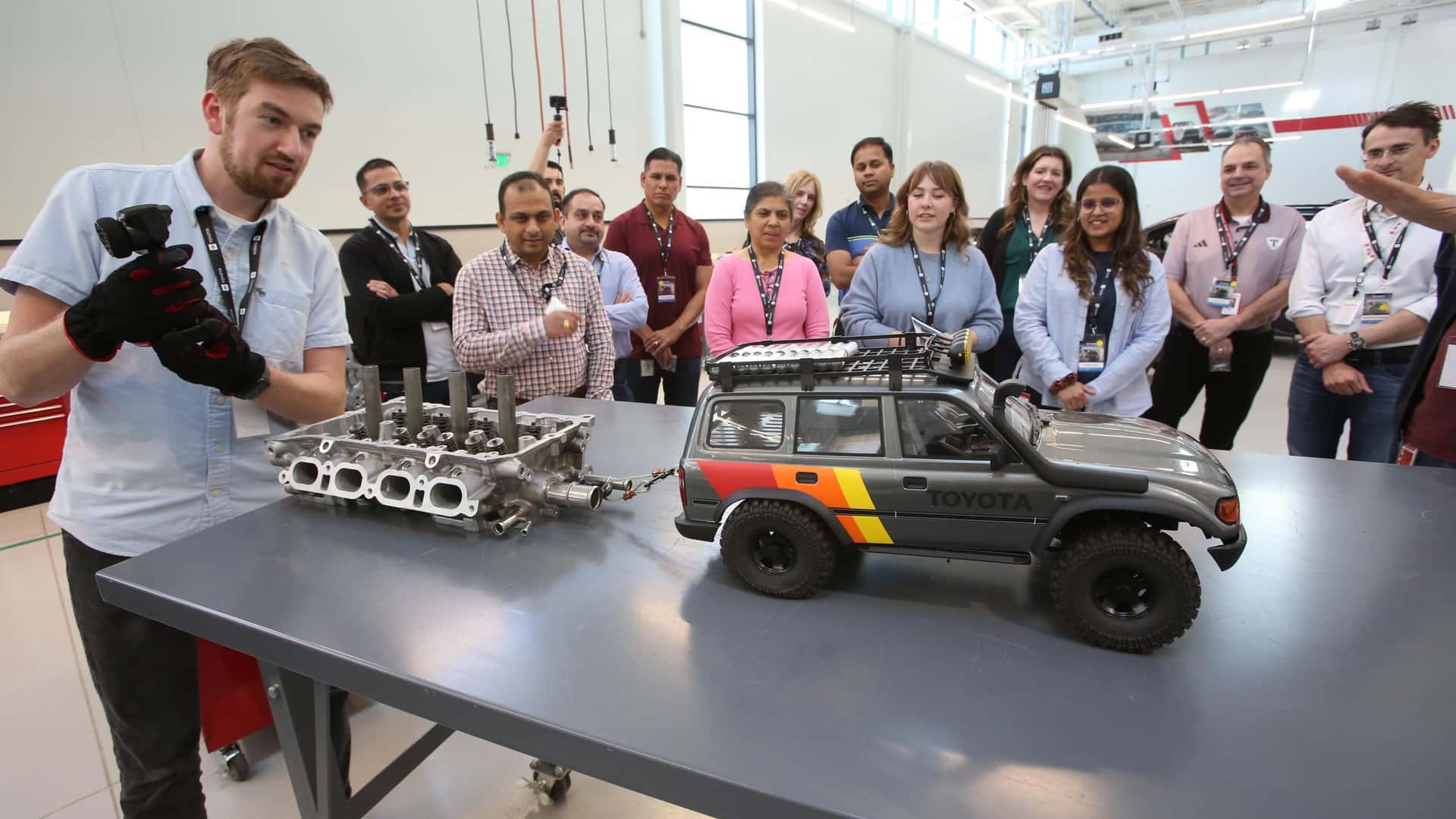
Perhaps the most striking demonstration involves showcasing the instant torque capabilities of an EV motor. This is illustrated using a small, remote-controlled Land Cruiser model, which effortlessly tows a cylinder head weighing over 30 pounds, offering a compelling, real-world experience of electric propulsion’s power and efficiency.
The Strategic Significance of Electric Propulsion
The overarching lesson from the ‘Electrification 101’ program is the undeniable superiority and elegance of electric motor technology. Presenters visually contrast a stripped-out Toyota V-6 engine, with its myriad complex accessories and intricate mechanical components, against an equivalent electric motor. The electric motor, despite its significantly smaller footprint and simpler design, is shown to generate greater power.
This comparison underscores that integrating electric propulsion, even partially through the company’s advanced hybrid systems, inherently reduces mechanical complexity by simplifying or eliminating finicky transmissions. The further one progresses along the electrification spectrum, culminating in a pure battery electric vehicle, the less prone the system becomes to mechanical failure due to fewer moving parts.
Despite the inherent advantages of electric motors, Toyota representatives maintained a clear stance during the training: the company awaits considerable improvements in battery chemistry and charging infrastructure before fully endorsing BEVs as a universal, one-size-fits-all solution. Nevertheless, the underlying intent of the program is palpable: to cultivate enthusiasm among its employees for a future increasingly dominated by electric technologies.
Cultivating Internal Advocates for Electrification
The strategic importance of this internal educational initiative cannot be overstated. A workforce unfamiliar with the long-term benefits of electrification, particularly those in corporate procurement or supply chain roles, might perceive only the immediate challenges: the added costs of new component designs or the complexities of onboarding new suppliers. Without adequate understanding, such individuals might naturally resist change.
However, when employees become genuinely excited about the prospects of electrification, they are more inclined to navigate short-term complexities for the sake of long-term strategic goals, and to actively champion these goals within their spheres of influence. Brigette Armato, a Toyota employee who participated in the training, exemplifies this transformation. She openly admitted to knowing “nothing” about EVs and hybrids prior to the course.
Post-training, Armato has become an enthusiastic advocate. “I work with our lease experience team, so I’m actually working with the customers and the vehicles. This was extremely helpful because now I can have an educated conversation with them and maybe convince them to go for an electric vehicle, whereas before I don’t think I had that skill,” she stated as the session concluded. Her enhanced understanding not only impacts customer interactions but has also spurred her personal consideration of an electric vehicle.
While she currently drives a Toyota 4Runner, Armato expressed a clear desire for an electric alternative, stating, “I wish we would gravitate more towards electric vehicles across the lineup.” This sentiment reflects a growing internal consensus. With hundreds of employees attending these ‘Electrification 101’ classes and a substantial waitlist for future sessions, Toyota is steadily cultivating a cadre of informed and passionate advocates within its North American headquarters. This initiative is effectively addressing a fundamental knowledge gap, transforming employees from passive observers into active proponents of the electrified future.
FAQ: Toyota Electrification Training
What is Toyota’s ‘Electrification 101’ program?
Toyota’s ‘Electrification 101’ is a comprehensive internal training program designed to educate employees at Toyota Motor North America about various electrified powertrain technologies, including hybrids, plug-in hybrids, battery electric vehicles, and hydrogen fuel cell vehicles. It aims to deepen understanding and foster internal advocacy.
Why is Toyota offering this training to its employees?
Toyota recognizes that not all its employees are automotive experts, particularly in the rapidly evolving field of electrification. The training addresses this knowledge gap, ensuring that staff members across different departments understand the company’s multi-pathway strategy and the benefits of electric propulsion, thereby reducing resistance to change and encouraging informed decision-making.
What is Toyota’s ‘multi-pathway’ strategy?
Toyota’s multi-pathway strategy emphasizes offering a diverse range of electrified vehicles to meet varied customer needs and infrastructure realities. This includes a strong focus on hybrids in the current market, alongside continued development and future deployment of battery electric vehicles and hydrogen fuel cell electric vehicles.
What types of vehicles are covered in the training?
The program covers all types of electrified vehicles central to Toyota’s strategy: traditional hybrids (HEVs), plug-in hybrids (PHEVs), pure battery electric vehicles (BEVs), and hydrogen fuel cell electric vehicles (FCEVs). It explains the distinct characteristics, advantages, and operational principles of each.
What are some of the key benefits of electrification highlighted?
The training highlights several key benefits, including the superior efficiency and environmental cleanliness of electrified powertrains. It also demonstrates the simplicity of electric motors compared to complex internal combustion engines, their instant torque delivery, and the potential for reduced maintenance requirements.
How does the training program aim to convert employees into advocates?
By providing in-depth education, hands-on experiences, and dispelling myths, the program aims to build enthusiasm and confidence among employees regarding electrification. This empowers them to have informed discussions with customers and colleagues, becoming internal champions who promote Toyota’s electrified product lineup and future vision.
What are Toyota’s long-term views on battery electric vehicles?
Toyota acknowledges the inherent advantages of BEVs but maintains a cautious long-term view. The company has expressed that it seeks significant improvements in battery chemistry, charging infrastructure, and overall resource availability before it considers BEVs as a universal ‘one-size-fits-all’ solution, continuing to promote its multi-pathway strategy.