
Key Takeaways
- Toyota has launched an “Electrification 101” program to educate its diverse employee base on hybrid, electric, and fuel-cell vehicle technologies.
- The initiative addresses a surprising gap in knowledge among non-automotive specialist staff, who may not be “car nerds” despite working for a leading automaker.
- The training covers fundamental concepts of electrification, dispels common myths, and highlights Toyota’s “multi-pathway” strategy, which includes a strong focus on hybrids.
- Interactive sessions demonstrated the simplicity and power of electric motors, fostering a deeper appreciation for the technology’s advantages.
- The program aims to transform employees into informed advocates for electrified vehicles, influencing both internal processes and external customer interactions.
While the automotive industry rapidly pivots towards sustainable mobility, a significant challenge often goes unnoticed: ensuring a foundational understanding of electric vehicle (EV) technology among the very people who build, market, and manage these advancements. For many within legacy automakers, the intricate details of electrification remain unfamiliar territory. This surprising reality was brought to light during a recent immersion into Toyota Motor North America’s “Electrification 101” program.
The assumption that every employee at a global automotive giant like Toyota possesses an innate understanding of battery chemistries, charging infrastructures, or the philosophical underpinnings of the EV transition proved to be a misconception. This realization, however, is not a cause for discouragement but rather an insight into a critical opportunity that Toyota is actively addressing.
The pioneering “Electrification 101” program serves as a strategic move to bridge this knowledge gap, equipping its workforce with essential insights into the evolving landscape of sustainable powertrains. This internal educational initiative underscores a commitment to fostering a comprehensively informed workforce, critical for navigating the complexities of the future automotive market.
Bridging the Knowledge Gap: The Unsung Reality of Automotive Expertise
It is often presumed that every individual employed by a major automotive manufacturer like Toyota is, by default, a passionate car enthusiast deeply ingrained in every facet of vehicle technology. However, this assumption frequently overlooks the diverse professional backgrounds that populate a large corporation.
Many employees are drawn to Toyota not solely by a fervent love for automobiles, but by the robust benefits, career stability, respectful corporate culture, and the prestige associated with working for the world’s largest automaker. For an accountant in Plano, Texas, or an app developer, a detailed understanding of electric vehicle components or hybrid powertrain intricacies is not an inherent job requirement.
Even among employees who do consider themselves car enthusiasts, their passion might traditionally lie with internal combustion engines, classic muscle cars, or specific performance aspects that differ significantly from the emerging field of electrification. Concepts such as the distinctions between Nickel Cobalt Manganese (NCM) and Lithium Iron Phosphate (LFP) battery chemistries can seem highly technical and entirely new, even to seasoned automotive professionals.
Recognizing this nuanced landscape, Toyota strategically designed its comprehensive internal Toyota electrification training. This program aims to bring all curious staff members up to speed, ensuring that a broad spectrum of employees can engage meaningfully with the company’s evolving product line and strategic direction. It represents a proactive step to align its workforce with the company’s ambitious goals in sustainable mobility.
Toyota’s Strategic Approach to Electrification Training
The “Electrification 101” program marks the second such educational initiative hosted by Toyota, following an earlier general introduction to automotive concepts for employees. This continuous investment in internal education highlights the company’s dedication to developing a well-informed and adaptable workforce capable of navigating the swift changes within the industry.
Significantly, the program is titled “Electrification 101” rather than “EV 101.” This deliberate nomenclature reflects Toyota’s well-documented “multi-pathway” strategy. This approach emphasizes a clear, immediate focus on hybrids, while concurrently looking towards the long-term potential of Battery Electric Vehicles (BEVs) and, notably, hydrogen Fuel Cell Electric Vehicles (FCEVs). This strategy aims to offer diverse customer choices and optimize battery resource utilization.
Understanding the “Multi-Pathway” Strategy in Detail
Toyota’s commitment to diversified powertrain solutions is evident in its recent sales figures. In the last quarter, a substantial 56.8% of the company’s total vehicle sales were electrified models. This category broadly encompasses hybrids, BEVs, Plug-in Hybrid Vehicles (PHEVs), and FCEVs. However, within this electrified segment, pure BEVs constituted a smaller proportion, accounting for just 1.7% of those sales, underscoring the current emphasis on hybrid technologies.
The program extensively covered the fundamentals of each powertrain type, meticulously explaining the crucial distinctions between conventional hybrids and PHEVs. While Toyota currently champions hybrids, a considerable segment of the training was dedicated to demystifying and dispelling common misconceptions surrounding BEVs. This indicates a forward-looking perspective despite the present sales mix.
A notable example discussed was the Toyota Mirai, one of the limited FCEVs available in the United States market. Operating on compressed hydrogen, its refueling infrastructure is primarily concentrated in specific regions of California. The current cost of hydrogen for the Mirai is approximately double that of gasoline, presenting a unique set of challenges and considerations for this advanced technology.
Deconstructing Electrification: Classroom Insights
The classroom segment of the Toyota electrification training began with a historical parallel, examining the nascent gasoline car industry in the early 20th century. At that time, nascent infrastructure, limited public education, developing service networks, and unclear regulations made owning a horse a seemingly simpler option. Yet, automobiles ultimately prevailed, illustrating the potential for transformative technologies to overcome initial hurdles.
The curriculum then transitioned to highlighting the numerous advantages of electrification, primarily focusing on enhanced efficiency and environmental cleanliness. It strongly advocated for the multi-pathway strategy, asserting that it not only provides customers with broader choices but also represents the most effective allocation of finite battery resources. It is important to note that this specific claim is often debated, and “most research I’ve seen suggests that EVs are almost always the cleanest option on a life cycle basis.”
One section of the program, comparing the relative advantages of each powertrain type, was perceived as having some limitations. This segment appeared to focus more heavily on the constraints of BEVs, without adequately addressing the additional maintenance requirements or the inherent noise, vibration, and harshness (NVH) associated with gasoline-powered vehicles. Conversely, the presentation was notably optimistic regarding hydrogen technology.
For instance, a slide proclaimed that hydrogen “can reduce ‘range anxiety’ as number of stations grow,” highlighting the Mirai’s impressive range of up to 402 miles per tank. While such figures were pioneering during the early stages of EV development, the current market now offers at least eight BEV models in the U.S. that surpass this range, with many more advanced models on the horizon. This highlights the rapid evolution of BEV capabilities.
Beyond these specific points, the remainder of the in-classroom instruction was generally comprehensive and unbiased. It covered essential topics such as the foundational principles of various battery chemistries, the different categories of charging technologies, core electrical concepts like kilowatts (kW) and kilowatt-hours (kWh), and an overview of ongoing battery recycling initiatives. These fundamental insights are crucial for a well-rounded understanding of the electrification landscape.
Hands-On Learning: The Power of Electric Motors
The most engaging and impactful component of the Toyota electrification training was undeniably its interactive practical sessions. These hands-on activities provided participants with a tangible understanding of electric propulsion technology.
Employees were guided through the process of constructing a basic electric motor using only a few common items: a screw, a magnet, a AA battery, and a piece of wire. This simple yet powerful demonstration vividly illustrated the core principles of electromagnetism and kinetic energy conversion. Furthermore, participants created a rudimentary battery using a potato, showcasing the basic concepts of galvanic cells and power generation.
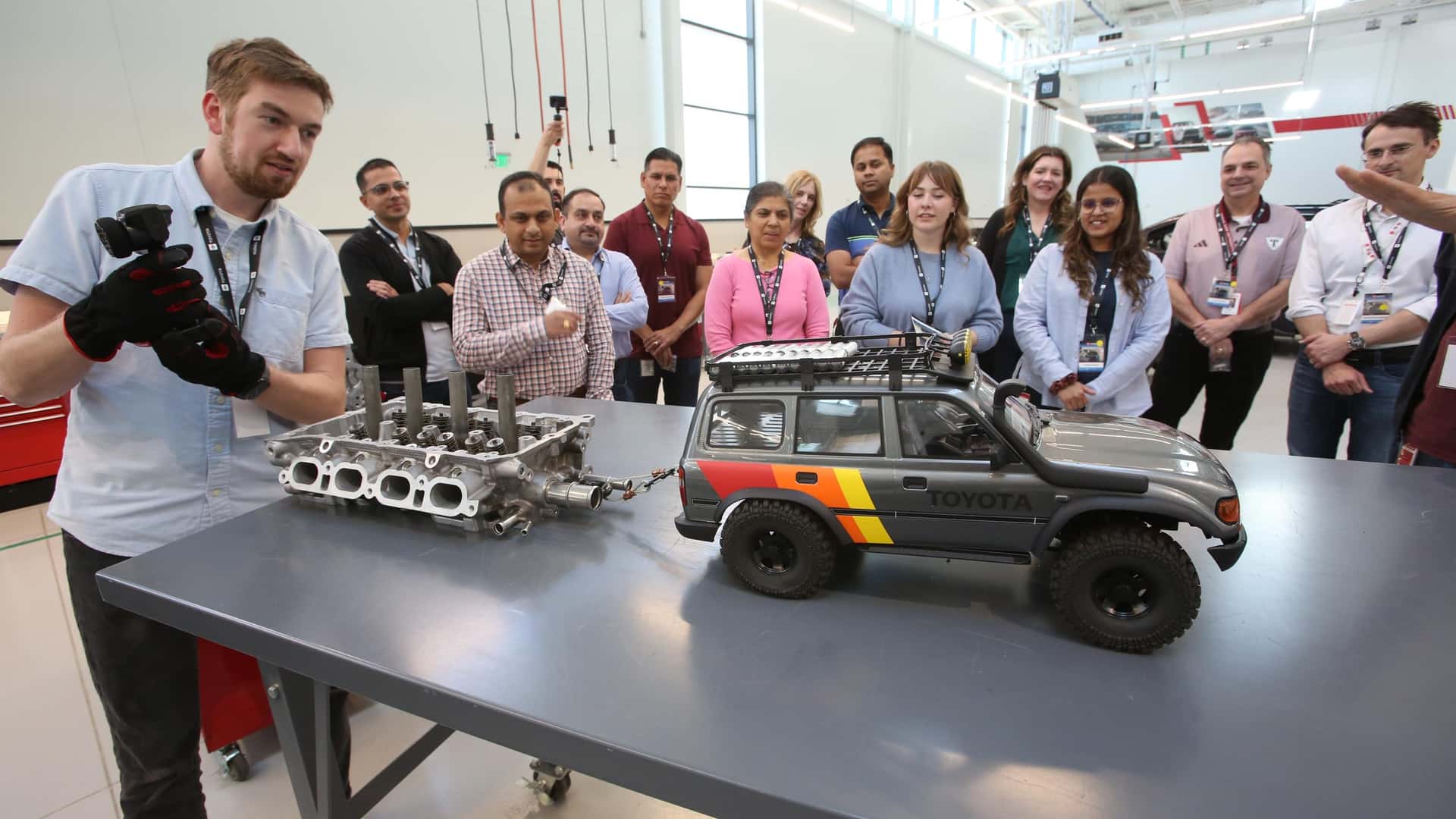
A particularly memorable demonstration involved showcasing the instant torque capabilities of an EV motor. A miniature remote-controlled Land Cruiser, powered by an electric motor, effortlessly pulled a cylinder head weighing over 30 pounds. This vivid display underscored one of the most compelling performance advantages of electric powertrains – their immediate and robust power delivery, offering a clear contrast to the gradual power build-up of traditional internal combustion engines.
The Simplicity and Promise of Electric Propulsion
The overarching lesson derived from the Toyota electrification training was a profound appreciation for the inherent advantages of electric motors. Presenters effectively contrasted a stripped-down Toyota V-6 engine, with its numerous complicated accessories and intricate moving parts, against an equivalent electric motor.
The comparison starkly highlighted the electric motor’s ability to generate more power within a significantly smaller footprint, all while boasting a far simpler design. Even when integrated into a gasoline powertrain, as seen in Toyota’s hybrid systems, electric propulsion can paradoxically reduce overall complexity by eliminating the need for finicky, multi-gear transmissions.
The core message was clear: incorporating electric propulsion into any vehicle architecture enhances efficiency with minimal compromises. As one progresses further along the electrification spectrum, towards pure Battery Electric Vehicles (BEVs), the system fundamentally becomes simpler, with fewer components susceptible to wear and tear. This inherent simplicity translates into potentially lower maintenance and increased reliability over the vehicle’s lifespan.
Despite these clear advantages, Toyota representatives reiterated the company’s cautious stance, emphasizing that significant improvements in battery chemistry and charging infrastructure are prerequisites before BEVs can be considered a universal solution. However, the prevailing sentiment within the program indicated a clear organizational effort to cultivate enthusiasm among employees for a future increasingly defined by all-electric mobility.
Cultivating Internal Advocacy for Electric Vehicles
The strategic importance of internal education, such as the Toyota electrification training, cannot be overstated. A workforce that truly understands and believes in the long-term benefits of electrification is crucial for driving innovation and overcoming organizational inertia.
Without such knowledge, employees in roles like corporate procurement might primarily perceive electrification as an added cost due to new component designs or the logistical headache of onboarding new suppliers. This limited perspective can naturally lead to resistance to change, a common human tendency when faced with unfamiliar complexities.
However, when individuals become genuinely excited about the potential, they are often willing to navigate short-term challenges for the realization of a compelling long-term objective. They become catalysts for change, advocating for the vision within their respective departments and influencing broader corporate strategies.
Brigette Armato, a Toyota employee on the lease experience team who participated in the training, exemplifies this transformative impact. She openly admitted to knowing “nothing” about EVs and hybrids prior to the program. Post-training, her perspective profoundly shifted. “I work with our lease experience team, so I’m actually working with the customers and the vehicles. This was extremely helpful because now I can have an educated conversation with them and maybe convince them to go for an electric vehicle, whereas before I don’t think I had that skill,” she shared.
Her newfound understanding extends beyond customer interactions. Ms. Armato is now seriously contemplating purchasing an electric vehicle for herself, despite her current attachment to her Toyota 4Runner. She expressed a desire for more electric alternatives across the Toyota lineup, stating, “I wish we would gravitate more towards electric vehicles across the lineup.”
Looking Ahead: Toyota’s Electrified Future
The experience of employees like Brigette Armato highlights the profound internal shift spurred by programs like Electrification 101. With hundreds of employees already attending these classes and a substantial waitlist for subsequent sessions, Toyota is steadily cultivating a growing cadre of “EV believers” within its North American headquarters.
This internal advocacy is not about overcoming active resistance, but rather about addressing a fundamental lack of information. Much like a significant portion of the general car-buying public, many Toyota employees simply lacked comprehensive knowledge about the benefits and realities of electrified vehicles. By empowering its workforce with education, Toyota is laying crucial groundwork for accelerating its transition towards a more electrified and sustainable future, ensuring that its internal capabilities match its external ambitions in the rapidly evolving global automotive landscape.
FAQ
What is the primary goal of Toyota’s “Electrification 101” program?
The program aims to educate Toyota employees on the fundamentals of electrified vehicle technologies, including hybrids, plug-in hybrids, battery electric vehicles (BEVs), and hydrogen fuel cell vehicles (FCEVs). It seeks to enhance their understanding and foster internal advocacy for the company’s multi-pathway approach to sustainable mobility.
Why is Toyota offering this type of internal training to its employees?
Toyota recognizes that not all employees, particularly those in non-automotive specific roles, possess in-depth knowledge of electrification. This training bridges that gap, ensuring a comprehensively informed workforce that can better support the company’s strategic shift towards an electrified future and effectively communicate these advancements.
What does Toyota’s “multi-pathway” approach to electrification entail?
Toyota’s “multi-pathway” strategy focuses on offering a diverse range of electrified powertrains. This includes a strong emphasis on current hybrid technologies, alongside ongoing development in battery electric vehicles (BEVs) and hydrogen fuel cell vehicles (FCEVs). The approach aims to provide broad customer choice and optimize the use of limited battery resources.
What kind of information is covered in the “Electrification 101” classroom sessions?
Classroom sessions cover the historical context of automotive transitions, the advantages of electrification (efficiency, cleanliness), basic principles of battery chemistries, different charging types, core electrical concepts like kilowatts and kilowatt-hours, and overviews of battery recycling efforts. It also discusses the distinctions between various electrified powertrain types.
Are there hands-on components to the Toyota electrification training?
Yes, the program includes interactive demonstrations designed to provide a practical understanding of electric propulsion. Participants engage in activities such as building a simple electric motor and a rudimentary potato battery. There is also a demonstration of an EV motor’s instant torque using a remote-controlled vehicle.
How is the “Electrification 101” program impacting Toyota employees?
The training is transforming employees into informed advocates. Participants, who previously had limited knowledge, gain the confidence to discuss electrified vehicles intelligently with customers and colleagues. Many express a newfound interest in owning an EV themselves and hope for more electric models across Toyota’s product lineup.