
In an era witnessing rapid advancements in automotive technology, the complexities of electric vehicles (EVs) and hybrid powertrains often remain a mystery, even to those within the industry’s leading manufacturers. A recent experience at Toyota Motor North America’s ‘Electrification 101’ program revealed a surprising truth: not all employees at major car companies possess an inherent, deep understanding of electrification, or the compelling reasons behind its widespread adoption.
This insight, initially unexpected for an industry observer immersed daily in the nuances of EV development and corporate strategies, highlights a significant educational gap. Far from being a discouraging revelation, it underscores a proactive and critical initiative by Toyota to empower its workforce with foundational knowledge, fostering internal advocacy for its diverse electrification roadmap.
Key Takeaways: Understanding Toyota’s Electrification Initiative
- Toyota’s ‘Electrification 101’ program addresses a knowledge gap among its diverse workforce, many of whom are not automotive enthusiasts but joined for stable careers.
- The training emphasizes Toyota’s ‘multi-pathway’ approach, focusing on hybrids, plug-in hybrids (PHEVs), battery electric vehicles (BEVs), and hydrogen fuel cell vehicles (FCEVs).
- While Toyota’s sales are predominantly hybrids (56.8% electrified, with pure EVs at 1.7%), the program dispels common EV myths and highlights the efficiency and simplicity of electric propulsion.
- Interactive sessions, such as building simple electric motors and battery systems, effectively demonstrate fundamental principles and benefits of electrification.
- The training aims to convert employees into advocates, equipping them to make informed decisions and promote electrified vehicles to customers and colleagues alike.
Bridging the Knowledge Gap: Why ‘Electrification 101’ is Crucial
For an automotive critic, deeply entrenched in the daily discourse surrounding electric vehicle adoption and the strategic shifts of global manufacturers, it is easy to assume a universal level of understanding within the industry. High-ranking executives often engage in complex philosophical debates about future mobility, leading to a perception that all employees share this specialized knowledge. However, the reality within Toyota’s corporate offices in Plano, Texas, proved otherwise.
The typical employee at a legacy automaker, irrespective of their department, may not possess an encyclopedic knowledge of vehicle electrification. Many join the ranks of a global giant like Toyota for reasons such as robust benefits, career stability, a respectful work culture, or the professional prestige associated with the world’s largest automaker. An accountant, a human resources specialist, or an app developer does not necessarily need to be a devoted car enthusiast, let alone an expert on the intricacies of electric powertrains.
Even among car enthusiasts, specific knowledge about EVs and hybrids can be limited. The technical jargon of battery chemistry, distinguishing between NCM (Nickel Cobalt Manganese) and LFP (Lithium Iron Phosphate) cells, or understanding advanced charging protocols, represents a new and highly specialized domain. This evolving landscape necessitates a structured educational approach to ensure the entire organisation is aligned with the company’s future direction.
The Genesis of an Essential Program
Recognizing this critical internal knowledge disparity, Toyota developed the ‘Electrification 101’ program. This initiative marks the second time Toyota has hosted such an introductory course, following an earlier program designed to familiarize employees with general automotive concepts. It reinforces the idea that comprehensive internal education is vital for a company navigating a transformative period in automotive history.
Notably, the program is termed ‘Electrification 101,’ not ‘EV 101.’ This nomenclature is deliberate, reflecting Toyota’s well-documented ‘multi-pathway’ strategy towards sustainable mobility. This approach emphasizes a pragmatic, phased transition, with a strong focus on hybrid vehicles in the present, while simultaneously investing in the long-term potential of battery electric vehicles (BEVs) and, notably, hydrogen fuel cell electric vehicles (FCEVs).
The company’s latest sales figures underscore this strategy: 56.8% of its recent sales comprised electrified vehicles, a category that includes hybrids, plug-in hybrid electric vehicles (PHEVs), and hydrogen FCEVs. Pure BEVs, however, accounted for a more modest 1.7% of these electrified sales, indicating the current weighting of Toyota’s diversified portfolio.
A Detailed Look at the Curriculum
Exploring Powertrain Diversity and Dispelling Myths
The core of the four-hour course was primarily classroom-based, meticulously covering the fundamentals of various powertrain types. Participants learned to differentiate between conventional hybrids and plug-in hybrids (PHEVs), understanding their unique operational characteristics and charging requirements. A significant portion of the instruction was dedicated to dispelling common misconceptions surrounding battery electric vehicles.
Instructors contextualized the current shift by drawing parallels to the early 20th century, when gasoline-powered automobiles began to supplant horse-drawn carriages. At that time, infrastructure was nascent, public education was minimal, and regulatory frameworks were unclear, making horse ownership appear simpler. Yet, cars ultimately prevailed, a historical lesson used to illustrate the inevitable progression towards electrification despite initial challenges.
The program thoroughly explored the inherent advantages of electrification, emphasizing superior efficiency and reduced environmental impact. It presented Toyota’s ‘multi-pathway’ approach not merely as a strategy for offering customer choice but also as the most responsible method for optimizing finite global battery resources. This particular point, however, remains a subject of considerable debate within the broader industry, with a substantial body of research suggesting that BEVs generally offer the cleanest option on a life cycle basis, even when considering the energy mix used for charging.
Analyzing Strengths and Addressing Perceived Limitations
While comprehensive, the section on the relative advantages of each powertrain type revealed a notable bias, particularly when viewed from an EV-centric perspective. It tended to highlight the limitations of BEVs more prominently than those of other powertrain types, omitting discussions on the increased maintenance or noise, vibration, and harshness (NVH) associated with gasoline-powered vehicles.
Furthermore, the program maintained a characteristically optimistic outlook on hydrogen fuel cell technology. A slide presented during the training proclaimed that hydrogen “can reduce ‘range anxiety’ as number of stations grow,” citing the Toyota Mirai’s impressive range of up to 402 miles per tank. While such figures were indeed remarkable during the nascent stages of EV development, modern BEVs now routinely offer comparable, or even superior, driving ranges, with at least eight models in the U.S. market already exceeding the Mirai’s stated range, and many more anticipated.
Despite these specific observations, the remainder of the classroom content proved to be informative and well-structured. It delved into essential topics such as fundamental battery chemistries, various charging standards and methodologies, core electrical concepts like kilowatts (kW) and kilowatt-hours (kWh), and an overview of ongoing global battery recycling initiatives. This foundational knowledge is crucial for any employee interacting with the rapidly evolving ecosystem of electrified transport.
Engaging Through Experiential Learning
Beyond theoretical instruction, a standout component of the ‘Electrification 101’ program was its interactive, hands-on segment. This practical application brought abstract concepts to life, significantly enhancing employee engagement and comprehension. Participants were guided through the process of constructing a basic electric motor using minimal components: a simple screw, a small magnet, a standard AA battery, and a length of wire. This exercise vividly demonstrated the principles of electromagnetism and rotational force in a tangible manner.
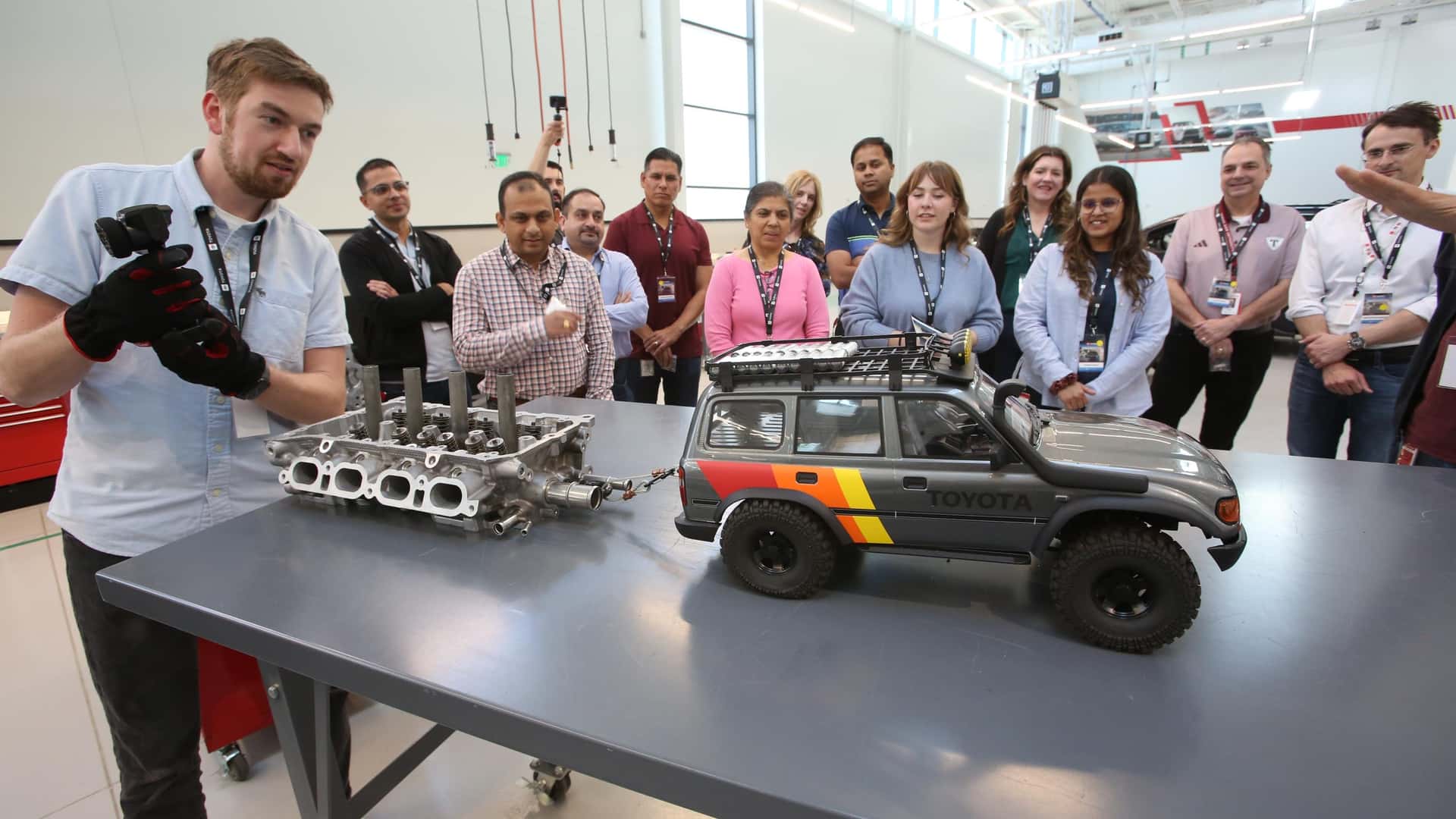
Further enhancing this experiential learning, attendees also built a rudimentary battery using potatoes, gaining a basic understanding of electrochemical energy generation. Demonstrations of varying charging outputs in action provided practical context to the discussions on power delivery. Perhaps most strikingly, employees witnessed the instantaneous torque delivery characteristic of an EV motor firsthand. A miniature, remote-controlled Land Cruiser was used to effortlessly tow a heavy cylinder head, weighing over 30 pounds, showcasing the formidable power and efficiency packed into compact electric powertrains.
The Profound Lesson: Simplicity and Efficiency
The central takeaway from the interactive portion, and indeed the entire program, was the remarkable capability of electric motor technology. Presenters juxtaposed a stripped-down Toyota V-6 engine, with its intricate array of accessories and numerous moving parts, against an equivalent electric motor. The contrast was stark: the electric motor delivered greater power within a significantly smaller footprint, all while boasting a fundamentally simpler design. This inherent simplicity translates into fewer components, reducing potential points of failure and simplifying maintenance.
Even when integrating an electric motor into a conventional gasoline powertrain, as seen in Toyota’s hybrid systems, complexity can be reduced. The motor can effectively replace or augment a traditional transmission, streamlining the drivetrain. The core message was clear: incorporating electric propulsion into any vehicle significantly enhances its efficiency with minimal compromises. As one progresses further down the electrification path, towards pure battery electric vehicles, the underlying engineering becomes even more streamlined, fundamentally reducing the complexity and potential for mechanical issues.
Toyota representatives were transparent about the company’s cautious stance, reiterating that significant improvements in battery chemistry and charging infrastructure are prerequisites before BEVs become a universally applicable solution. Nevertheless, the overarching sentiment conveyed during the training indicated a concerted effort to cultivate excitement and understanding among employees regarding a future dominated by electric drive systems.
Cultivating Internal Advocates for Electrification
This internal cultivation of understanding and enthusiasm is paramount for driving long-term strategic decisions. An employee in corporate procurement, for instance, who remains unaware of the long-term benefits of electrification, might perceive only the immediate challenges: the increased costs of new component designs or the complexities of onboarding novel suppliers. Such a perspective naturally fosters resistance to change, a common human response to unfamiliarity.
However, by igniting excitement and demonstrating the tangible advantages of electrification, employees become willing to navigate short-term complexities in pursuit of overarching, long-term objectives. They transform into internal champions, capable of influencing peers and driving forward the company’s strategic goals. Brigette Armato, a Toyota employee who participated in the ‘Electrification 101’ class, exemplifies this transformation.
Armato candidly admitted that she “knew “nothing” about EVs and hybrids going in.” Yet, upon completing the program, she emerged as an informed advocate. “I work with our lease experience team, so I’m actually working with the customers and the vehicles. This was extremely helpful because now I can have an educated conversation with them and maybe convince them to go for an electric vehicle, whereas before I don’t think I had that skill,” she stated, highlighting the immediate practical impact of the training on her customer interactions.
Her newfound conviction extends beyond customer engagement; Armato is now seriously considering an electric vehicle for her personal use, despite her current attachment to her Toyota 4Runner. She expressed a desire for more electric options across the lineup, stating, “I wish we would gravitate more towards electric vehicles across the lineup.” Her sentiment mirrors a growing internal shift.
The Road Ahead: A Growing Cohort of EV Believers
The success of the ‘Electrification 101’ program, evidenced by hundreds of attendees and a substantial waitlist for future sessions, signifies a pivotal internal shift within Toyota’s North American headquarters. A steadily increasing number of employees are becoming ‘EV believers,’ not because they were inherently resistant before, but because, like many consumers, they simply lacked comprehensive information and understanding.
This initiative represents more than just a training program; it is a strategic investment in Toyota’s human capital, ensuring that its workforce is knowledgeable, engaged, and ultimately, enthusiastic about the electrified future. By empowering its employees with a clear understanding of the benefits and mechanics of electrification, Toyota is strategically positioning itself to navigate the evolving automotive landscape from within, building a foundation of internal support for its ambitious goals.
Frequently Asked Questions About Toyota’s Electrification 101
What is Toyota’s ‘Electrification 101’ program?
Toyota’s ‘Electrification 101’ is an internal training initiative designed to educate its employees about various electrified vehicle technologies, including hybrids, plug-in hybrids, battery electric vehicles, and hydrogen fuel cell vehicles. It aims to bridge knowledge gaps and foster internal advocacy for electrification.
Why did Toyota launch this training for its employees?
Toyota recognized that many employees, despite working for an automotive giant, might not be experts on the nuances of electrification. The program was created to inform its diverse workforce, from corporate accountants to app developers, about the technical aspects and strategic importance of electric propulsion.
What is Toyota’s ‘multi-pathway’ approach to electrification?
Toyota’s ‘multi-pathway’ strategy involves developing and offering various electrified powertrains simultaneously. This includes a strong focus on hybrids today, alongside continued development of battery electric vehicles (BEVs) and hydrogen fuel cell electric vehicles (FCEVs) for future market needs.
What kind of content is covered in the ‘Electrification 101’ program?
The program covers fundamentals of battery chemistries, different charging types (kilowatts, kilowatt-hours), distinctions between hybrid and PHEV systems, and an overview of battery recycling. It also includes interactive sessions to build electric motors and potato batteries.
Does the program address myths about electric vehicles?
Yes, a significant portion of the training is dedicated to dispelling common myths surrounding electric vehicles. It uses historical parallels from the early automotive industry to illustrate how new technologies overcome initial challenges and skepticism.
How does the program impact Toyota employees?
The training aims to transform employees into informed advocates for electrified vehicles. Participants like Brigette Armato reported gaining the skills to have educated conversations with customers and colleagues, leading some to consider purchasing an EV themselves.
What are the long-term goals of the ‘Electrification 101’ initiative?
The long-term goal is to cultivate a knowledgeable and enthusiastic workforce that understands the benefits of electrification. This internal advocacy helps drive long-horizon decisions, overcomes resistance to change, and ensures company-wide alignment with Toyota’s strategic shift towards an electrified future.