
Key Takeaways:
- Toyota Motor North America’s “Electrification 101” program addresses a significant knowledge gap among employees regarding electric vehicle (EV) and hybrid technologies.
- The training aims to educate staff, from corporate accountants to app developers, who may not be traditional car enthusiasts or deeply familiar with electrification nuances.
- The curriculum covers various powertrain types, including hybrids, plug-in hybrids (PHEVs), battery electric vehicles (BEVs), and hydrogen fuel cell vehicles (FCEVs), aligning with Toyota’s “multi-pathway” strategy.
- Interactive sessions, such as building electric motors and demonstrating instant torque, are key to demystifying complex electric propulsion concepts.
- The program fosters internal advocacy, transforming employees into informed proponents of electrification, crucial for driving long-term strategic decisions within the company.
In a rapidly evolving automotive landscape, the transition towards electrified vehicles presents complex challenges, not least within the industry’s own workforce. A recent experience at Toyota Motor North America’s “Electrification 101” program provided a stark, yet ultimately encouraging, revelation: the average legacy automaker employee, despite working for a leading manufacturer, may not possess extensive knowledge about electrification or its fundamental advantages.
This observation, far from being discouraging, underscores a critical proactive step taken by the global automotive giant. It highlights an understanding that a company’s internal knowledge base is as vital as its technological advancements in navigating the future of mobility. The program is designed to cultivate a foundational understanding and enthusiasm for electric propulsion across various departments.
Addressing the Internal Knowledge Divide
The assumption that every employee at a major car company is an automotive aficionado deeply immersed in the nuances of vehicle technology is a common misconception, particularly among industry critics. However, the reality within large corporations like Toyota is often different. Many individuals join for career opportunities, comprehensive benefits, a stable work environment, or the prestige associated with a global leader, rather than an inherent passion for cars.
Roles such as corporate accounting or software development, for instance, typically do not require detailed knowledge of battery chemistry or electric motor design. Therefore, expecting these employees to be conversant in the technical intricacies of electric vehicles (EVs) or hybrid systems would be unreasonable without dedicated internal educational initiatives.
Even automotive enthusiasts, particularly those with a traditional focus on internal combustion engines (ICE), might find the technical specifics of electrification—such as the differences between Nickel Manganese Cobalt (NCM) and Lithium Iron Phosphate (LFP) battery chemistries—to be entirely new territory. This generational and technological shift necessitates targeted education to bridge the knowledge gap.
The “Electrification 101” Program Structure
Recognizing this internal educational need, Toyota developed its “Electrification 101” program. This initiative represents the second iteration of such foundational training, following an earlier general introduction to automotive concepts. The very existence of these programs signals Toyota’s commitment to ensuring its diverse workforce is well-versed in the evolving product landscape.
Notably, the program is titled “Electrification 101,” not “EV 101.” This naming convention is deliberate, reflecting Toyota’s stated “multi-pathway” strategy for decarbonization. This approach champions a portfolio of technologies, including a significant focus on hybrids in the immediate term, alongside continued development in battery electric vehicles (BEVs), plug-in hybrid electric vehicles (PHEVs), and hydrogen fuel cell electric vehicles (FCEVs) for the future.
Recent sales figures underscore this strategy: in the last quarter, a substantial 56.8% of Toyota’s total sales were electrified vehicles. However, pure BEVs constituted a smaller fraction, accounting for only 1.7% of these electrified sales. This data highlights the company’s current emphasis on hybrid technology as a primary avenue for reducing emissions while building towards broader electrification.
Curriculum and Core Concepts
The four-hour training session largely unfolds in a classroom setting, covering the foundational aspects of various powertrain types, clearly differentiating between conventional hybrids and PHEVs. Despite Toyota’s immediate commercial focus on hybrids, a significant portion of the curriculum is dedicated to dispelling common misconceptions surrounding BEVs.
The historical context of the automotive industry’s early 20th-century transition from horse-drawn carriages to gasoline vehicles serves as a compelling parallel. The program illustrates how initial challenges—lack of infrastructure, limited public education, nascent service networks, and unclear regulations—were overcome, eventually leading to the widespread adoption of automobiles over simpler, more understood horse ownership.
The program thoroughly explores the numerous advantages of electrification, emphasizing efficiency and environmental cleanliness. Toyota’s presentation also advocates for its multi-pathway approach, arguing it offers customer choice and represents the most efficient use of finite battery resources. While this perspective is acknowledged as controversial, with much research suggesting BEVs offer the cleanest option over their lifecycle, the program presents Toyota’s strategic rationale.
- EV Myth Busted: No, They’re Not ‘Dirtier’ Than Gas Cars, Even If You Use Fossil Fuel Power
- Yes, EVs Really Are Cleaner Than Gas Cars. Here’s By How Much
One specific section discussing the relative advantages of each powertrain type, particularly hydrogen, drew scrutiny from experts more aligned with BEV advocacy. For instance, a slide highlighted hydrogen’s potential to reduce range anxiety as stations grow, noting the Toyota Mirai’s 402-mile range. While impressive in the past, a growing number of BEVs in the U.S. market now exceed this range, with more advanced models continuously emerging.
Beyond this, the classroom content maintains a neutral and informative stance, delving into essential topics such as battery chemistries, different charging standards, core electrical concepts like kilowatts (kW) and kilowatt-hours (kWh), and an overview of ongoing battery recycling initiatives. The aim is to equip employees with a robust, fundamental understanding of the technology.
Engaging with Interactive Learning
The most impactful segment of the Toyota Electrification Training is its interactive component. This hands-on experience transforms abstract concepts into tangible realities. Employees are guided through constructing a basic electric motor using minimal components: a screw, a magnet, a AA battery, and a piece of wire. This simple yet effective exercise vividly illustrates the fundamental principles of electromagnetism that power modern EVs.
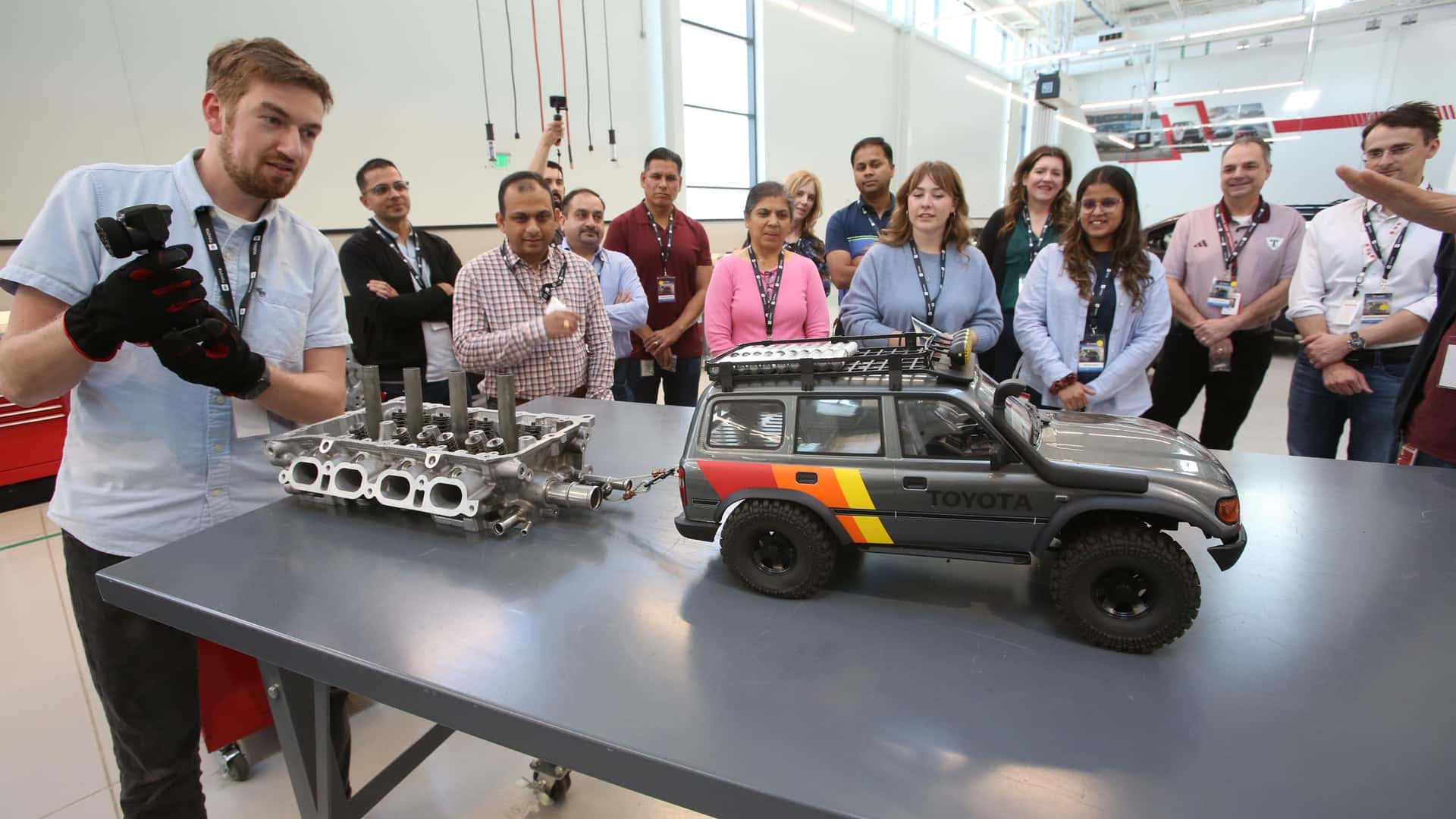
Further practical demonstrations include building a rudimentary potato-based battery, providing insight into basic electrochemistry, and showcasing various charging outputs in action. A highlight involves a demonstration of the instantaneous torque characteristic of an electric motor, where a small remote-controlled Land Cruiser effortlessly pulls a cylinder head weighing over 30 pounds. These interactive elements serve to demystify the technology and build an intuitive appreciation for electric propulsion.
The Core Lesson: Simplicity and Efficiency
The overarching lesson from the training program is the inherent elegance and efficiency of electric motors. Presenters effectively illustrate this by contrasting a stripped-down Toyota V-6 engine, with its intricate array of accessories and complex moving parts, against an equivalent electric motor. The electric motor, capable of generating more power, occupies a significantly smaller footprint and features a vastly simpler design.
This principle extends even to hybrid systems, where the integration of an electric motor can reduce the complexity of the traditional gasoline powertrain by simplifying or even eliminating the need for a finicky transmission. The deeper a vehicle progresses into electrification, towards a pure battery electric vehicle, the fewer potential points of failure emerge, leading to greater reliability and reduced maintenance over its lifespan.
Toyota representatives clearly articulated that while the company is committed to an electrified future, it seeks substantial improvements in battery chemistry and charging infrastructure before exclusively adopting BEVs as a universal solution. Nevertheless, the underlying message of the Toyota Electrification Training is unequivocal: the company is actively fostering enthusiasm among its employees for a future increasingly defined by electric propulsion.
Cultivating Internal Advocates for Electrification
Employee understanding and buy-in are paramount for any organization embarking on a significant strategic shift. Without a clear grasp of the long-term benefits of electrification, individuals in roles like corporate procurement might primarily perceive the added costs of new component designs or the complexities of integrating new suppliers. This limited perspective can lead to resistance against necessary changes.
Conversely, an informed and excited workforce is more likely to embrace and champion innovation. They become willing to navigate short-term complexities for the sake of achieving long-term goals. Brigette Armato, a Toyota employee who participated in the program, exemplifies this transformation. Admitting she knew “nothing” about EVs and hybrids beforehand, she now serves as an advocate.
“I work with our lease experience team, so I’m actually working with the customers and the vehicles. This was extremely helpful because now I can have an educated conversation with them and maybe convince them to go for an electric vehicle, whereas before I don’t think I had that skill,” Armato stated following the class. Her enhanced knowledge empowers her to guide customers more effectively towards electrified options.
Beyond her professional role, the training has influenced Armato’s personal vehicle considerations. While attached to her current Toyota 4Runner, she expressed strong interest in an electric alternative if one were available. Her sentiment, “I wish we would gravitate more towards electric vehicles across the lineup,” reflects a growing internal desire for a broader EV portfolio.
Outlook: A Growing Wave of Electrification Belief
The success of the Toyota Electrification Training program, evidenced by hundreds of attendees and a lengthy waitlist for future sessions, signifies a growing cohort of electrification proponents within Toyota’s North American operations. This shift is not about overcoming active resistance, but rather about addressing a common knowledge gap, much like many car buyers themselves experience.
By investing in comprehensive employee education, Toyota is strategically cultivating a workforce that is not only knowledgeable but also genuinely enthusiastic about the company’s electrified future. This internal advocacy will be instrumental in driving innovation, informing customer interactions, and ultimately accelerating Toyota’s path towards a sustainable mobility ecosystem.
FAQ Section
Q1: What is the primary goal of Toyota’s “Electrification 101” program?
A1: The program aims to educate Toyota employees, regardless of their role, on the fundamental principles, advantages, and various types of electrified vehicle technologies. Its goal is to bridge knowledge gaps, dispel myths, and foster enthusiasm for Toyota’s multi-pathway approach to electrification.
Q2: Why is this training necessary for employees at a leading automaker like Toyota?
A2: Not all employees, especially those in non-technical or administrative roles, are inherently knowledgeable about advanced automotive technologies like EVs or hybrids. The training ensures a consistent, informed understanding across the company, vital for strategic alignment and effective customer engagement in the evolving market.
Q3: What does Toyota’s “multi-pathway” approach to electrification entail?
A3: Toyota’s multi-pathway strategy involves developing and offering a diverse range of electrified vehicles, including conventional hybrids, plug-in hybrids (PHEVs), battery electric vehicles (BEVs), and hydrogen fuel cell electric vehicles (FCEVs). This approach aims to provide customers with choices and optimize the use of limited battery resources.
Q4: What interactive elements are included in the Electrification 101 training?
A4: The program features hands-on activities such as building a basic electric motor with simple components, creating a rudimentary potato-based battery, and demonstrating the instant torque capabilities of an electric motor using a remote-controlled vehicle. These practical sessions enhance understanding and engagement.
Q5: How does employee education contribute to Toyota’s broader electrification goals?
A5: By educating employees, Toyota cultivates internal advocates who can champion electrification within their departments and effectively communicate its benefits to customers. This internal buy-in is crucial for overcoming resistance to change, fostering innovation, and driving the company’s long-term transition towards a more electrified future.
Q6: Does the program exclusively focus on Battery Electric Vehicles (BEVs)?
A6: No, the program is titled “Electrification 101” and covers all forms of electrified powertrains, including hybrids, PHEVs, BEVs, and FCEVs. This aligns with Toyota’s multi-pathway strategy, which emphasizes a comprehensive approach to reducing carbon emissions across various technologies.
Q7: What surprised the author most about attending the training?
A7: The author, an automotive critic deeply immersed in EV debates, was surprised by the significant lack of basic electrification knowledge among many Toyota employees. This underscored the need for such foundational training, even within a major automotive company.