
In a significant move to align its workforce with the evolving automotive landscape, Toyota Motor North America has initiated an internal ‘Electrification 101’ training program. This comprehensive initiative, designed for corporate employees, has unveiled a crucial insight: not all staff members at even the world’s largest automaker possess a deep understanding of electric vehicle (EV) technology or the broader shift towards electrification.
While industry analysts and automotive journalists often immerse themselves in the intricate debates surrounding EV adoption and corporate strategies, the reality within large corporations can be different. Many employees, even at leading car manufacturers, join for diverse reasons—ranging from career stability and benefits to company culture—rather than a pre-existing passion for automotive engineering or emerging powertrain technologies.
This realisation, observed during a recent session of Toyota’s program, underscores a vital point: the successful transition to an electrified future hinges not only on technological innovation but also on internal education and cultural alignment. The program’s effectiveness in converting general staff into advocates for electric vehicles highlights its strategic importance.
Key Takeaways: Understanding Toyota’s Electrification Push
- **Knowledge Gap:** Many legacy automaker employees, including those at Toyota, initially lack deep knowledge about electrification, hybrids, and EVs.
- **Training Initiative:** Toyota’s ‘Electrification 101’ program addresses this gap, offering foundational knowledge on various electrified powertrains.
- **Multi-Pathway Strategy:** The training emphasises Toyota’s ‘multi-pathway’ approach, focusing on hybrids, plug-in hybrids, fuel cell vehicles, and pure EVs.
- **Dispelling Myths:** A significant portion of the course is dedicated to dispelling common myths about EVs and highlighting the advantages of electrification.
- **Hands-on Learning:** Interactive sessions, including building electric motors and potato batteries, enhance understanding of core concepts.
- **Internal Advocacy:** The program aims to foster internal advocates, transforming employees into informed proponents of electrification.
- **Strategic Importance:** Educating employees is crucial for long-horizon decision-making and overcoming resistance to change within the organisation.
Bridging the Knowledge Gap in a Changing Industry
Toyota’s decision to launch ‘Electrification 101’ acknowledges a fundamental truth: a corporate accountant in Plano, Texas, or an app developer working for the automaker, may not inherently be an electrification expert. While car enthusiasts might assume every employee shares their passion, the daily realities of a large corporation encompass a wide range of roles and expertise.
Even automotive enthusiasts within the company might not be well-versed in the specifics of EV or hybrid technology. Concepts like the distinctions between NCM (Nickel Cobalt Manganese) and LFP (Lithium Iron Phosphate) battery chemistries are highly technical and relatively new, often falling outside the purview of traditional automotive knowledge, particularly for those whose passion lies with conventional powertrains like V8 muscle cars.
This internal training program is not Toyota’s first foray into foundational education. Earlier this year, the company offered an ‘Introduction to All Things Automotive’ course, further demonstrating a proactive approach to ensuring its diverse workforce possesses a baseline understanding of its core products and strategic directions.
The “Multi-Pathway” Strategy
Notably, the program is titled ‘Electrification 101,’ not ‘EV 101.’ This nomenclature reflects Toyota’s distinct ‘multi-pathway’ strategy, which advocates for a diverse range of electrified solutions. This approach currently prioritises hybrids, with a clear vision for eventual integration of battery electric vehicles (BEVs) and, notably, hydrogen fuel cell electric vehicles (FCEVs).
The company’s sales figures from the last quarter underscore this strategy: 56.8% of its total sales were electrified vehicles, a category that encompasses hybrids, BEVs, plug-in hybrid vehicles (PHEVs), and hydrogen FCEVs. However, pure BEVs accounted for a modest 1.7% of these sales, indicating the current emphasis within the broader electrification spectrum.
Inside the “Electrification 101” Curriculum
The four-hour ‘Electrification 101’ course is predominantly classroom-based, delivering a structured overview of various powertrain types. It meticulously explains the fundamental distinctions between hybrids and PHEVs, laying a crucial groundwork for understanding Toyota’s diverse offerings.
Despite Toyota’s current market focus on hybrids, a significant portion of the training is dedicated to addressing and dispelling common misconceptions surrounding pure electric vehicles.
Dispelling EV Myths and Highlighting Advantages
The program initiates its discussion on EVs by drawing parallels to the early 20th-century automotive industry. It highlights how the nascent gasoline car industry faced challenges similar to those EVs encounter today, including nascent infrastructure, a need for consumer education, and unclear regulations. Owning a horse, in that era, was simpler and more familiar, yet cars ultimately prevailed.
The curriculum then transitions to the multifaceted advantages of electrification, primarily focusing on efficiency and environmental cleanliness. It reinforces Toyota’s argument for its multi-pathway approach, positing that this strategy offers customer choice and is the most judicious way to utilise finite battery resources. It is important to note that while this position is advanced by Toyota, most independent research indicates that BEVs generally offer the cleanest option over their lifecycle.
The section detailing the relative advantages of each powertrain type, while thorough, did exhibit a particular emphasis on the limitations of BEVs. It did not extensively highlight the increased maintenance requirements or the noise, vibration, and harshness (NVH) associated with gasoline-powered vehicles. Furthermore, it presented an optimistically bullish view on hydrogen technology.
For instance, one slide projected that hydrogen “can reduce ‘range anxiety’ as number of stations grow,” citing the Toyota Mirai’s up to 402 miles per tank. While such figures were impressive in the early days of EVs, the current market sees eight BEV models in the U.S. offering superior range, with more advanced options continually emerging. This comparison highlights a point of divergence in perspective compared to an EV-centric outlook.
Hands-on Learning and Fundamental Concepts
Beyond the comparative analysis, the core in-classroom content was comprehensively informative. It covered the fundamentals of battery chemistries, various charging types, and essential concepts such as kilowatts and kilowatt-hours. The training also provided an overview of battery recycling efforts, showcasing a holistic view of the EV ecosystem.
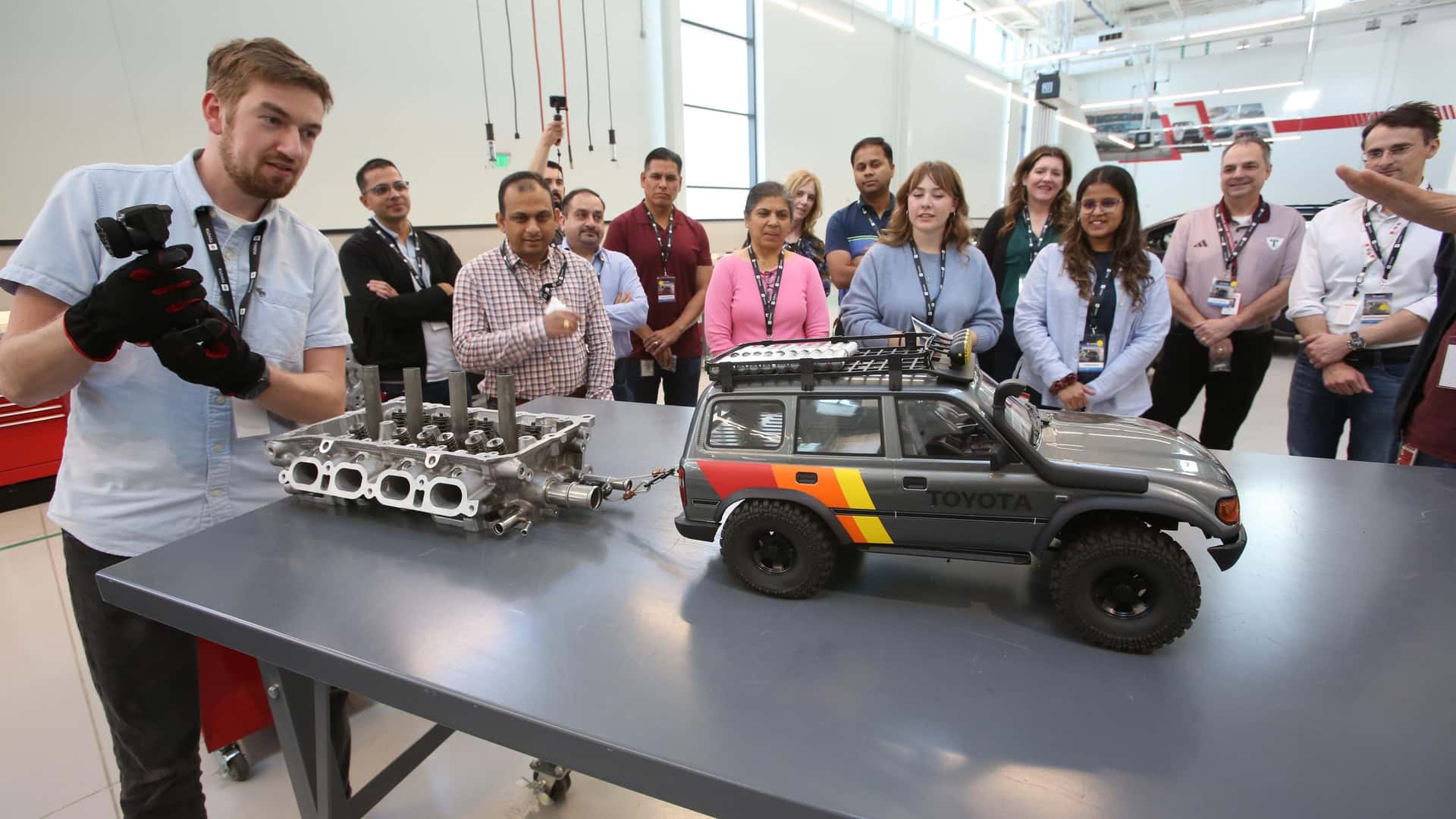
The program’s most engaging segment was its interactive component. Participants were guided through building a basic electric motor using only a screw, a magnet, a AA battery, and a piece of wire. Employees also constructed a rudimentary potato-based battery and observed different charging outputs in real-time. A compelling demonstration involved using a tiny remote-controlled Land Cruiser to effortlessly pull a cylinder head weighing over 30 pounds, vividly illustrating the instant torque capabilities of an EV motor.
The Transformative Power of Electric Propulsion
A pivotal lesson from the training was the inherent superiority and simplicity of electric motors. Presenters showcased a stripped-down Toyota V-6 engine, revealing its complex array of accessories and intricate parts. In stark contrast, an equivalent electric motor was presented, demonstrating its ability to generate more power in a significantly smaller footprint, all within a much simpler design.
The program effectively articulated that integrating electric propulsion, even into a traditional gasoline powertrain through a hybrid system, reduces overall mechanical complexity. By leveraging an electric motor, the need for a complex and often finicky transmission can be mitigated. This illustrates a clear progression: the further one moves towards full electrification, the simpler the underlying mechanical design becomes, leading to fewer potential points of failure in a pure battery electric vehicle.
Toyota representatives were transparent about the company’s perspective, emphasising that significant advancements in battery chemistry and charging infrastructure are still necessary before BEVs can be considered a universal, one-size-fits-all solution. However, the overarching impression conveyed was Toyota’s earnest effort to instil enthusiasm among its employees for a future increasingly defined by electric mobility.
Cultivating Internal Advocacy for an Electric Future
This internal education holds immense strategic importance. Without a clear understanding of the long-term benefits of electrification, employees in corporate procurement, design, or other non-technical roles might perceive only the immediate challenges: the increased costs of new component designs, or the complexities of onboarding novel suppliers. Such a perspective often leads to resistance to change, a natural human tendency.
However, by generating genuine excitement and understanding, the training empowers employees to embrace short-term complexities in pursuit of a long-term vision. It fosters a culture where individuals are not only willing to adapt but also to champion the cause of electrification to their peers and, crucially, to customers.
From Skeptic to Supporter
The impact of this Toyota electrification training is already evident among attendees. Brigette Armato, a Toyota employee who participated in the class, admitted she initially knew “nothing” about EVs and hybrids. Post-training, her perspective profoundly shifted.
“I work with our lease experience team, so I’m actually working with the customers and the vehicles. This was extremely helpful because now I can have an educated conversation with them and maybe convince them to go for an electric vehicle, whereas before I don’t think I had that skill,” Armato stated, underscoring the immediate practical application of her newfound knowledge.
Her advocacy extends beyond professional interactions; Armato is now actively considering an EV for her personal use, despite her current attachment to her Toyota 4Runner. She articulated a sentiment shared by many EV proponents: “I wish we would gravitate more towards electric vehicles across the lineup.”
With hundreds of employees attending these foundational courses and a growing waitlist for future sessions, Toyota is steadily cultivating a new cohort of informed and enthusiastic EV believers within its North American headquarters. This internal shift, moving from general awareness to active advocacy, is a critical step for a legacy automaker navigating the transformative journey towards an electrified automotive future.
Frequently Asked Questions (FAQ)
What is Toyota’s ‘Electrification 101’ program?
Toyota’s ‘Electrification 101’ is an internal training initiative for its employees, designed to educate them on the fundamentals of various electrified powertrain technologies, including hybrids, plug-in hybrids, fuel cell vehicles, and battery electric vehicles. It aims to bridge a knowledge gap within the workforce.
Why did Toyota launch this electrification training?
Toyota recognised that many corporate employees, even within an automotive company, might not possess in-depth knowledge of electrification. The program aims to educate them on the benefits and technologies, fostering a deeper understanding and creating internal advocates for the company’s multi-pathway electrification strategy.
What is Toyota’s “multi-pathway” approach to electrification?
Toyota’s “multi-pathway” approach is a strategy to offer diverse electrified vehicle options, including conventional hybrids, plug-in hybrids (PHEVs), hydrogen fuel cell electric vehicles (FCEVs), and battery electric vehicles (BEVs). This strategy focuses on providing choices to customers while efficiently utilising limited battery resources across different technologies.
Did the training address common EV myths?
Yes, a significant portion of the ‘Electrification 101’ program was dedicated to dispelling common myths about electric vehicles. It aimed to highlight the advantages of electrification, such as efficiency and cleanliness, though it also presented a cautious outlook on immediate widespread EV adoption compared to other electrified options.
What kind of hands-on activities were included in the program?
The training featured interactive elements, such as employees building rudimentary electric motors from simple components (screw, magnet, battery, wire) and constructing potato-based batteries. These activities provided a practical understanding of core electrical concepts and demonstrated the instant torque of an EV motor.
What was the main takeaway about electric motors from the training?
A key lesson was the inherent simplicity and efficiency of electric motors. The training highlighted how electric motors offer more power in a smaller, less complex design compared to traditional internal combustion engines, and how their integration can reduce overall powertrain complexity, even in hybrid systems.
How does this training impact Toyota’s future strategy?
By educating its employees, Toyota is fostering internal advocacy and a deeper understanding of electrification across various departments. This is crucial for long-term strategic decisions, overcoming potential internal resistance to change, and ensuring that the entire organisation is aligned with the company’s evolving electric future, from product development to customer engagement.