
In a significant move reflecting the evolving automotive landscape, Toyota Motor North America has initiated an internal educational program, ‘Electrification 101,’ aimed at equipping its diverse workforce with foundational knowledge about sustainable mobility technologies. This program reveals a critical insight: not all employees at a leading car manufacturer possess inherent expertise in the nuances of electric and hybrid vehicles, a reality that the Japanese automaker is proactively addressing.
For those deeply immersed in the electric vehicle (EV) discourse, it is easy to assume a universal understanding of electrification strategies within the automotive sector. However, the experience at Toyota’s training session underscored a different reality, indicating a substantial knowledge gap among many employees regarding the underlying principles and benefits of electrification. This initiative, rather than signalling a setback, represents a strategic investment in internal knowledge and advocacy for Toyota’s future in sustainable transportation.
It is important to note that this report details observations from attending Toyota Motor North America’s “Electrification 101” program. Toyota covered travel and lodging expenses for the attendance.
Key Takeaways: Building Internal Expertise in Sustainable Mobility
- **Addressing Knowledge Gaps:** Toyota’s ‘Electrification 101’ program acknowledges that not all its employees are automotive enthusiasts, particularly concerning the intricacies of electric and hybrid technologies, and seeks to bridge this knowledge divide.
- **Strategic Multi-Pathway Approach:** The training reinforces Toyota’s commitment to a diverse electrification strategy, encompassing hybrids, plug-in hybrids, battery electric vehicles, and hydrogen fuel cell vehicles, rather than a sole focus on pure EVs.
- **Dispelling Common Myths:** A significant portion of the curriculum is dedicated to educating staff on the advantages of electrification, including efficiency and environmental cleanliness, while also addressing common misconceptions surrounding EVs.
- **Practical Engagement:** Interactive sessions, such as building electric motors and demonstrating instant torque, are integral to making complex topics accessible and engaging for participants.
- **Fostering Internal Advocacy:** The program aims to transform employees into informed advocates for electrified vehicles, enabling them to confidently discuss these technologies with customers and potentially influence their personal vehicle choices.
- **Long-Term Vision:** By educating its workforce, Toyota is cultivating an internal culture that supports long-horizon decision-making, crucial for navigating the complexities and investments associated with the transition to sustainable mobility.
The Imperative for Internal Education
The traditional image of an automotive company employee often includes a deep passion for cars, a ‘car nerd’ if you will, intimately familiar with every technical detail. However, this assumption frequently does not align with the diverse professional backgrounds found within a global corporation like Toyota.
Employees in departments such as corporate accounting, software development, or human resources may join Toyota for its robust benefits, professional stability, esteemed corporate culture, or the prestige associated with working for the world’s largest automaker. Their roles do not inherently require them to be connoisseurs of automotive minutiae, let alone the rapidly evolving field of electric vehicle technology.
Even automotive enthusiasts within the company might find themselves unfamiliar with the highly technical aspects of modern electrification. Explanations regarding advanced battery chemistries, such as the differences between Nickel Manganese Cobalt (NCM) and Lithium Iron Phosphate (LFP) cells, can be entirely new territory for someone accustomed to traditional internal combustion engines.
Recognising this varied knowledge base, Toyota Motor North America proactively developed its Electrification 101 program. This initiative represents the second instance of such comprehensive employee education, following an earlier general introduction to automotive concepts. This consistent effort underlines Toyota’s commitment to ensuring its entire workforce is aligned with the company’s strategic direction towards sustainable mobility.
Toyota’s Multi-Pathway Electrification Strategy
Significantly, the program is titled ‘Electrification 101,’ not ‘EV 101,’ a distinction that mirrors Toyota’s well-documented ‘multi-pathway’ approach to sustainable mobility. This strategy emphasizes a broad spectrum of solutions, prioritizing hybrids in the present while maintaining a long-term vision for battery electric vehicles (BEVs) and, notably, hydrogen fuel cell electric vehicles (FCEVs).
Recent sales figures reinforce this strategic direction. In the last quarter, 56.8% of Toyota’s vehicle sales were electrified models, encompassing hybrids, BEVs, plug-in hybrid electric vehicles (PHEVs), and FCEVs. However, pure battery electric vehicles constituted only a modest 1.7% of these electrified sales, underscoring the company’s current focus on hybrid technology as a primary avenue for reducing emissions and improving fuel efficiency.
The comprehensive training program delves into the fundamentals of all these powertrain types, meticulously explaining the distinctions between traditional hybrids and plug-in hybrids. Despite Toyota’s immediate emphasis on hybrids, a substantial portion of the curriculum is dedicated to dispelling prevalent myths and clarifying misconceptions surrounding BEVs.
Dispelling Myths and Highlighting Advantages
The curriculum began by drawing parallels to the early 20th-century automotive industry, a period characterized by nascent infrastructure, limited public education, and evolving regulations for gasoline-powered cars. The analogy highlighted how horse ownership was initially simpler, yet automobiles ultimately prevailed, suggesting a similar trajectory for electrification.
The program then systematically outlined the numerous advantages of electrification, primarily focusing on enhanced efficiency and environmental cleanliness. It elaborated on Toyota’s multi-pathway strategy, not merely as a means to offer diverse customer choices, but also as a purportedly beneficial approach to optimize the use of finite battery resources. It is worth noting that this perspective is debated within the industry, with much research suggesting that BEVs often represent the cleanest option over their lifecycle.
However, the section addressing the relative advantages of each powertrain type was identified as somewhat unbalanced. It focused more extensively on the perceived limitations of BEVs without adequately detailing the additional maintenance requirements or the noise, vibration, and harshness (NVH) associated with gasoline cars. The program also presented a characteristically optimistic view of hydrogen fuel cell technology.
For instance, a presentation slide stated that hydrogen “can reduce ‘range anxiety’ as number of stations grow,” citing the Toyota Mirai’s capability of offering up to 402 miles per tank. While such figures were impressive during the nascent stages of EV development, the current market features at least eight BEV models in the U.S. that already surpass this driving range, with many more advanced electric vehicles anticipated to launch soon.
Fundamental Concepts and Interactive Learning
Beyond these specific points, the classroom segments of the Electrification 101 program were largely informative and objective. Key topics covered included the foundational aspects of various battery chemistries, different types of charging infrastructure, core electrical concepts such as kilowatts and kilowatt-hours, and an overview of ongoing battery recycling initiatives.
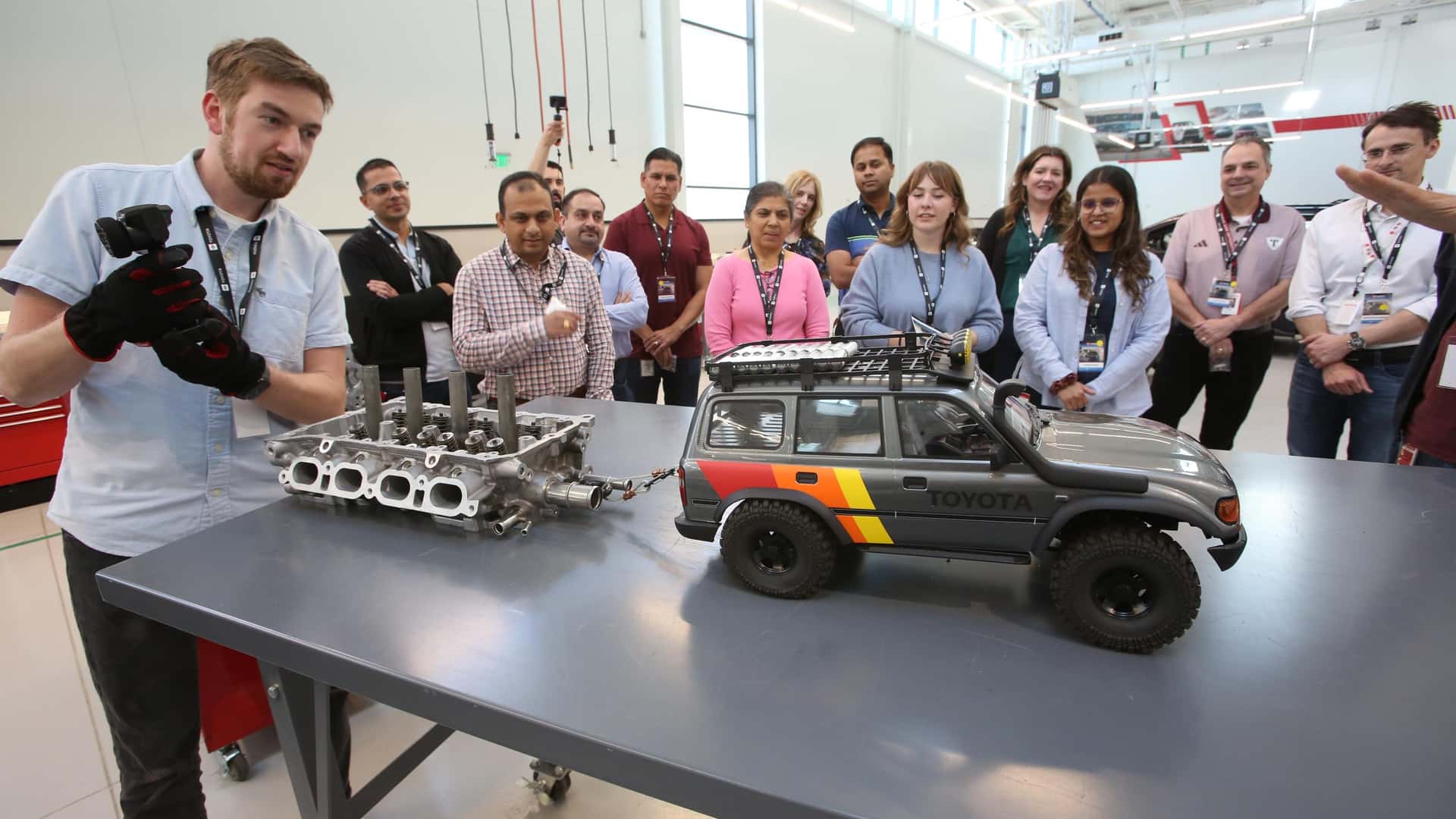
The most engaging component of the training, however, was its interactive practical segment. Participants were tasked with constructing a rudimentary electric motor using minimal components: a screw, a magnet, a AA battery, and a piece of wire. Employees also built a basic potato-based battery and observed various charging outputs in action. A highlight was a demonstration of the instant torque inherent in electric motors, where a small remote-controlled Land Cruiser effortlessly towed a cylinder head weighing over 30 pounds.
The Transformative Power of Electric Propulsion
The central lesson imparted by the training was unequivocally the remarkable capabilities of electric motor technology. Presenters showcased a stripped-down Toyota V-6 engine, revealing its intricate assembly of numerous complex accessories and parts. This was starkly contrasted with an equivalent electric motor, which demonstrated superior power output within a significantly smaller footprint and a fundamentally simpler design.
The program emphasized that integrating electric propulsion into any powertrain, as exemplified by Toyota’s hybrid systems, can actually reduce complexity by eliminating components like the often-finicky transmission. This principle suggests that the further one progresses along the path of electrification, the inherently simpler and more robust the system becomes. Ultimately, a pure battery electric vehicle features substantially fewer moving parts, thereby reducing potential points of failure.
Despite these clear advantages, Toyota representatives reiterated the company’s stance that widespread BEV adoption hinges on significant advancements in battery chemistry and the expansion of charging infrastructure. They articulated that these improvements are crucial before BEVs can be considered a universally applicable solution across all segments and use cases. However, from the perspective of the training observer, it was evident that the company’s underlying objective was to cultivate enthusiasm among its employees for a future increasingly defined by electric mobility.
Cultivating Internal Advocacy for Sustainable Mobility
Fostering this internal enthusiasm is paramount for driving long-term strategic decisions within the organization. A corporate procurement specialist, for instance, who is unaware of the profound long-term benefits of electrification, might only perceive the immediate challenges: the increased costs of new component designs or the complexities of onboarding new suppliers. Such a limited perspective can naturally lead to resistance against transformative change, a common human tendency.
However, by generating excitement and understanding, employees become willing to navigate short-term complexities in pursuit of overarching long-term goals. They are then empowered to champion these goals internally and externally. Brigette Armato, a Toyota employee who participated in the training, exemplifies this transformation. She candidly admitted to knowing “nothing” about EVs and hybrids prior to the course, but emerged as a fervent advocate.
Armato remarked, “I work with our lease experience team, so I’m actually working with the customers and the vehicles. This was extremely helpful because now I can have an educated conversation with them and maybe convince them to go for an electric vehicle, whereas before I don’t think I had that skill.” This testimonial highlights the immediate, practical impact of the training on customer-facing roles.
Beyond her professional duties, Armato’s personal perspective has also shifted dramatically. She is now seriously considering an electric vehicle for herself, despite her current attachment to her Toyota 4Runner. She expressed a desire for more electric options across the company’s product line, stating, “I wish we would gravitate more towards electric vehicles across the lineup.”
This sentiment resonates deeply within the rapidly expanding cadre of ‘EV believers’ at Toyota’s North American headquarters. With hundreds of employees already having attended these electrification training classes, and a lengthy waitlist for future sessions, the cumulative effect is a growing internal momentum for electric vehicles. This internal shift is critical, as many employees, much like the broader car-buying public, simply needed clearer, more comprehensive information to understand the undeniable advantages of electrification.
Frequently Asked Questions (FAQ)
What is Toyota’s ‘Electrification 101’ program?
Toyota’s ‘Electrification 101’ is an internal training initiative designed to educate its employees about various electrified vehicle technologies. The program covers fundamental concepts related to hybrids, plug-in hybrids, battery electric vehicles, and hydrogen fuel cell vehicles, aiming to enhance their understanding and advocacy for sustainable mobility solutions.
Why is Toyota offering this electrification training to its employees?
Toyota recognizes that not all its diverse workforce possesses in-depth knowledge of evolving electric vehicle technologies. The training aims to bridge this knowledge gap, ensuring employees understand the company’s multi-pathway strategy, dispel common myths, and become informed advocates for electrification within their roles and personal lives.
What topics are covered in the ‘Electrification 101’ program?
The program covers a wide range of topics, including the basics of different powertrain types (hybrids, PHEVs, BEVs, FCEVs), battery chemistries, various charging methods, fundamental electrical concepts like kilowatts and kilowatt-hours, and efforts in battery recycling. It also includes interactive, hands-on activities to reinforce learning.
Does the program focus solely on Battery Electric Vehicles (BEVs)?
No, the program’s title, ‘Electrification 101,’ reflects Toyota’s broader ‘multi-pathway’ strategy. While BEVs are discussed, the curriculum comprehensively covers all forms of electrified propulsion, emphasizing Toyota’s current focus on hybrids alongside future considerations for BEVs and hydrogen fuel cell vehicles.
What was a key takeaway regarding electric motors from the training?
A significant takeaway was the inherent simplicity and efficiency of electric motors compared to traditional internal combustion engines. The training highlighted how electric propulsion, even in hybrid systems, can reduce overall mechanical complexity, offer higher power output in a smaller footprint, and contribute to greater vehicle reliability.
How is Toyota addressing ‘range anxiety’ in its training?
The training addresses range anxiety, particularly in the context of hydrogen fuel cell vehicles, by highlighting models like the Mirai’s range of up to 402 miles. However, the program’s content also acknowledges the rapid advancements in BEV ranges, with many models now exceeding such figures, providing a balanced perspective on range capabilities.
What impact has the training had on participating employees?
The training has transformed employees into more informed and enthusiastic advocates for electrified vehicles. Participants, like Brigette Armato, gain the knowledge to engage confidently with customers about electrification and even consider adopting electric vehicles for their personal use, fostering a growing internal support for Toyota’s sustainable mobility goals.