
Key Takeaways:
- ABB E-mobility has launched its OM X-Series, a distributed EV charging system designed for the most demanding megawatt-scale applications.
- The system can scale significantly, from 800 kW to over 10 MW, accommodating more than 100 charge points within a single coordinated site architecture.
- A key innovation is its end-to-end liquid-cooled power path, ensuring optimal thermal management for sustained, continuous duty cycles crucial for heavy-duty fleet operations.
- The X-Series integrates a site-level DC bus, liquid-cooled silicon carbide power modules, and direct battery energy storage, enhancing efficiency by over 5% compared to AC-coupled systems and enabling advanced demand management.
- This advanced EV charging system represents the third generation of ABB’s architectural progression, building upon the A-Series and OM M-Series to address the evolving needs of high-performance electric vehicle fleets.
ABB E-mobility, a global leader in electric vehicle supply equipment (EVSE), has officially launched its groundbreaking OM X-Series, an advanced distributed charging system engineered to meet the rigorous demands of megawatt-scale operations. This new EV charging system is poised to redefine the capabilities of large-scale electric vehicle (EV) infrastructure, offering unprecedented power, scalability, and efficiency for the rapidly expanding world of electrified fleets and heavy-duty transport.

Designed to provide a single, cohesive site architecture, the OM X-Series can effortlessly scale from an initial 800 kilowatts (kW) to an impressive 10 megawatts (MW) and beyond. This robust capacity supports over 100 individual charge points, making it an ideal solution for extensive logistics hubs, public charging depots, and other high-utilization environments where continuous and reliable power delivery is paramount.
Advancing Charging Architecture for Future Mobility
The introduction of the X-Series marks a pivotal moment in ABB E-mobility’s strategic architectural progression. This development builds upon two previous innovations that have shaped the company’s offering to the electric mobility market. The journey began in 2024 with the launch of the A-Series, a line of all-in-one chargers designed for straightforward, efficient installations.
Following this, April 2026 saw the debut of the OM M-Series, which extended the same foundational architecture into more flexible, site-level split systems. These systems offered greater adaptability for various medium-scale applications, setting the stage for the next leap in high-performance EV charging.

The OM X-Series now takes this architectural evolution to its zenith, specifically targeting the most demanding applications. It is engineered to handle “highest-performance applications: sustained duty cycles, megawatt-scale site topologies, and multiple mission profiles within one shared power system.” This focus underscores the critical need for resilient and efficient infrastructure as the electrification of transport extends to heavy-duty vehicles and high-throughput operations.
Addressing the Challenges of Sustained Megawatt Charging
One of the primary challenges in deploying large-scale EV charging infrastructure, particularly at the megawatt level, is managing the immense thermal load generated during continuous operation. Unlike intermittent charging scenarios, megawatt charging sites are often expected to sustain continuous duty for years, placing immense stress on components and potentially compromising efficiency and reliability over time.
The ABB OM X-Series tackles this challenge head-on with a sophisticated, end-to-end liquid-cooled power path. This advanced thermal management system is integrated throughout the entire EV charging system, ensuring optimal performance and longevity. It comprises several critical elements working in concert.
At its core, the power cabinet features an integrated cooling unit, meticulously designed to dissipate heat from the initial conversion stages. This unit works in conjunction with proprietary liquid-cooled power modules, which are central to the system’s power conversion capabilities. Further enhancing this robust design, liquid-cooled cables transport thermal management through every stage of power delivery, from conversion to the charge point.
This comprehensive liquid cooling strategy is not merely a feature; it is a fundamental design principle that ensures the system maintains its efficiency and reliability specifications even under the most strenuous, years-long operational demands. It mitigates the risk of overheating, component degradation, and performance limitations often associated with high-power electrical systems, thus bolstering the economic viability of large-scale electrification projects.
Integrated Architecture: The Backbone of High-Performance EV Charging
The advanced capabilities of the OM X-Series stem from its meticulously engineered site architecture, which consists of three interconnected and integrated elements. This synergistic design optimizes power flow, enhances efficiency, and provides unparalleled flexibility for megawatt charging infrastructure.
Site-Level DC Bus for Dynamic Power Management
A crucial component of the X-Series architecture is the site-level DC bus, which functions as a shared power spine. This innovative approach allows all cabinets and integrated energy storage assets to coordinate seamlessly, dynamically allocating power in real time to match demand fluctuations across the entire site. This centralized DC distribution minimizes energy losses and maximizes the utilization of available power, ensuring that every connected EV receives optimal charge based on its needs and the system’s overall capacity.
Advanced Power Conversion with Silicon Carbide Modules
The power conversion layer within the OM X-Series is equipped with state-of-the-art liquid-cooled silicon carbide (SiC) modules. Silicon carbide technology is renowned for its superior efficiency, higher power density, and improved thermal performance compared to traditional silicon-based semiconductors. By integrating these advanced modules with liquid cooling, ABB E-mobility ensures highly efficient energy conversion with minimal heat generation, further contributing to the system’s overall reliability and operational lifespan.
Direct Battery Energy Storage for Enhanced Efficiency and Grid Stability
One of the most significant architectural advancements in the X-Series is the direct connection of battery energy storage systems onto the DC bus. This direct integration bypasses additional conversion stages that would be necessary in traditional AC-coupled systems. ABB highlights that this design improvement boosts round-trip efficiency by more than five percentage points.
Beyond efficiency gains, this direct battery integration empowers sites with critical capabilities such as peak shaving and demand management. By storing energy during off-peak hours or when renewable generation is abundant and discharging it during periods of high demand, the system can significantly reduce operational costs and alleviate strain on the local grid. Furthermore, this architecture is inherently designed to support future vehicle-to-grid (V2G) energy flows, positioning sites to become active participants in grid stabilization and energy trading.
Scalability and Operational Flexibility
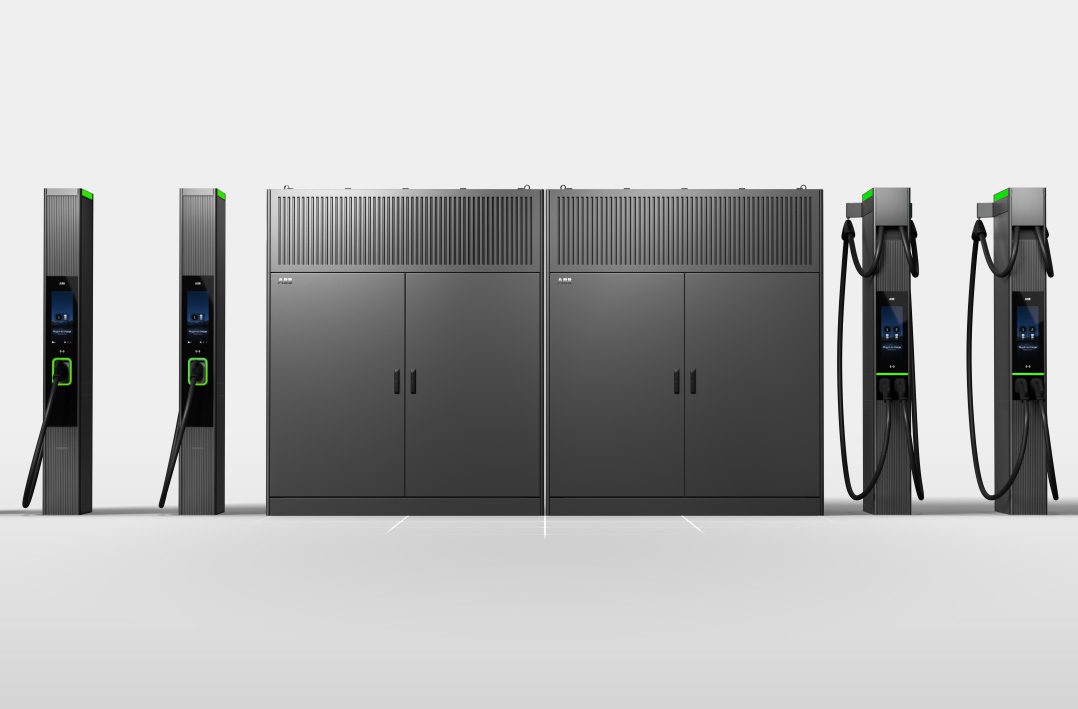
The initial configuration of the OM X-Series showcases its inherent flexibility and potential for growth. It typically consists of two 800 kW cabinets, intelligently connected through the central DC bus, and is capable of supporting up to 24 charge outputs simultaneously. This foundational setup provides substantial charging capacity for initial deployments.
Crucially, ABB E-mobility emphasizes the system’s ability to extend to a multi-megawatt scale on this same underlying architecture. This modularity means that as the demand for electric vehicle charging expands, operators can seamlessly increase their charging capacity without necessitating a complete overhaul of their existing EV charging system. This forward-thinking design ensures future-proofing for rapidly growing electric fleets.
Adding to its strategic advantage, the OM M-Series and X-Series share a common dispenser portfolio. This interoperability allows operators to initially deploy M-Series chargers to meet current needs and then, as their demand evolves and expands towards megawatt-scale requirements, seamlessly transition and extend to the more powerful X-Series topology. This provides a flexible and cost-effective upgrade path, minimizing initial investment risks while ensuring scalability.
The Economic Imperative: Efficiency and Reliability as Core Metrics
Michael Halbherr, CEO of ABB E-mobility, articulated the fundamental shift driving the design philosophy behind the X-Series. He stated, “Charging is moving toward mission profiles where systems must operate under sustained load for years, not just peak moments. At that level of utilization, thermal stability and energy efficiency are not specifications—they are the economics. The X-Series is built for that standard from the architecture up.”
Halbherr’s statement underscores a critical industry insight: for fleet operators and commercial charging providers, the long-term operational costs and reliability of their megawatt charging infrastructure are paramount. Downtime, inefficiencies, and premature component failures directly impact profitability and operational continuity. By prioritizing thermal stability and energy efficiency from the ground up, the X-Series is positioned as a financially prudent choice for organizations committed to large-scale electrification.
Impact on the Future of Electric Fleets and Logistics
The launch of the ABB OM X-Series is expected to have a profound impact on the acceleration of electric fleet adoption, particularly in sectors requiring heavy-duty vehicles such as logistics, public transport, and long-haul trucking. The ability to provide reliable, highly efficient, and scalable EV charging system solutions at a megawatt scale removes a significant barrier to entry for many businesses.
By ensuring sustained performance and offering advanced grid integration capabilities, the X-Series supports the transition to a more sustainable and economically viable electric future. It empowers businesses to manage their energy consumption intelligently, reduce operational expenditures, and contribute to grid stability, setting a new benchmark for high-performance EV charging solutions.
Source: ABB E-mobility
Frequently Asked Questions (FAQs)
What is the ABB OM X-Series EV charging system?
The ABB OM X-Series is a new, distributed electric vehicle charging system designed for large-scale, high-power applications. It offers megawatt-level charging capabilities, scaling from 800 kW to over 10 MW, and supports more than 100 charge points. Its primary focus is on sustained duty cycles and highest-performance applications for fleets and heavy-duty vehicles.
How does the X-Series address thermal management?
The X-Series features an end-to-end liquid-cooled power path. This includes an integrated cooling unit in the power cabinet, proprietary liquid-cooled power modules, and liquid-cooled cables. This comprehensive system ensures thermal stability and maintains efficiency and reliability specifications even during continuous, years-long operation, which is critical for megawatt-scale charging.
What are the key components of the X-Series site architecture?
The site architecture comprises three integrated elements: a site-level DC bus that forms a shared power spine for coordinated power allocation, a power conversion layer utilizing liquid-cooled silicon carbide modules for high efficiency, and direct battery energy storage connected to the DC bus, enhancing efficiency and enabling demand management and V2G capabilities.
What are the benefits of directly integrating battery energy storage?
Directly connecting battery energy storage to the DC bus improves round-trip efficiency by over five percentage points compared to AC-coupled systems, as it avoids additional conversion stages. This integration also enables crucial functions like peak shaving and demand management, helping to reduce electricity costs and support grid stability, along with future vehicle-to-grid (V2G) energy flows.
How is the OM X-Series scalable for future demand?
The X-Series is designed for modular growth, allowing it to extend from its initial configuration of two 800 kW cabinets (supporting 24 charge outputs) to multi-megawatt scales on the same architecture. Furthermore, it shares a common dispenser portfolio with the OM M-Series, providing a flexible upgrade path for sites to grow their charging capacity as demand increases.
Who is the primary target user for the OM X-Series?
The primary target users are operators of large electric vehicle fleets, logistics companies, public charging hub developers, and heavy-duty transport providers. Any entity requiring sustained, high-power, and reliable megawatt charging infrastructure for continuous duty cycles will find the X-Series particularly beneficial due to its focus on efficiency, thermal stability, and long-term operational economics.