
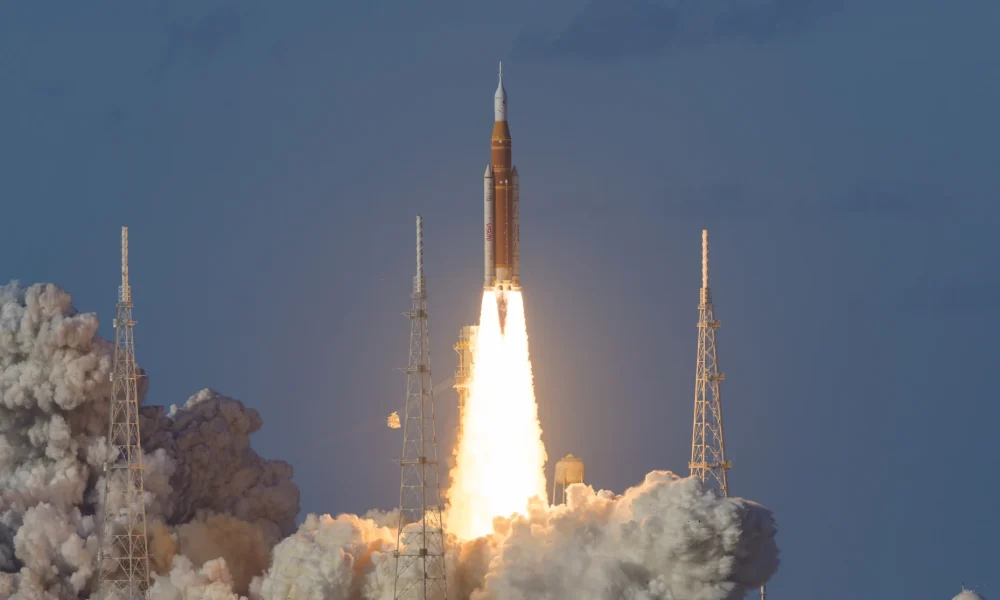
In a momentous leap for human space exploration, NASA successfully launched its Artemis II mission on April 1, 2026, propelling four astronauts toward the Moon. This landmark event marks the first crewed lunar mission since Apollo 17 in December 1972, signaling humanity’s renewed commitment to venturing beyond low Earth orbit.
The mission commenced with the powerful Space Launch System (SLS) rocket lifting off from Kennedy Space Center at 6:35 p.m. EDT. Aboard the Orion spacecraft, Commander Reid Wiseman, Pilot Victor Glover, Mission Specialist Christina Koch, and Canadian astronaut Jeremy Hansen began their ambitious 10-day journey around the far side of the Moon and back.

A Historic Return to Deep Space After Decades
For over five decades, the Moon remained an unreachable destination for human explorers, with the footsteps of Apollo 17 astronauts Gene Cernan and Harrison Schmitt in 1972 being the last direct human contact with the lunar surface. The launch of Artemis II decisively breaks this lengthy hiatus, initiating a new chapter in space exploration focused on sustainable lunar presence rather than fleeting visits.
This mission transcends a mere return; it represents a foundational step in an ambitious program designed to establish a long-term human presence on the Moon and eventually pave the way for missions to Mars. The 53-year gap underscores the technological advancements and strategic shifts that have defined space exploration in the interim, culminating in the comprehensive Artemis program.
The Critical Test Flight: Validating Orion in Deep Space
Crucially, the Artemis II mission is not intended for a lunar landing. Instead, it functions as a vital test flight, meticulously engineered to validate the Orion spacecraft’s critical systems in a deep-space environment with a crew onboard for the first time. This includes rigorous assessment of its life support systems, navigation capabilities, and communication infrastructure far beyond Earth’s protective magnetic field.

The 10-day journey will take the crew on a circumlunar trajectory, subjecting Orion and its occupants to the demanding conditions of deep space. Such comprehensive testing is indispensable to ensure the safety and success of subsequent Artemis missions that aim to land astronauts on the lunar surface and establish persistent habitats.
If the crew successfully reaches its planned distance of 252,000 miles from Earth, they will establish a new record for the farthest distance any human has ever traveled into space. This achievement would surpass the previous record set by the Apollo 13 mission, further solidifying the historical significance of Artemis II.
Orion’s Journey and Immediate Successes
Following its powerful liftoff, the Orion spacecraft quickly achieved initial milestones crucial for mission success. Within the first hours of flight, the spacecraft’s solar arrays deployed successfully, providing essential power for onboard systems.
The crew also completed a proximity operations demonstration, validating the spacecraft’s maneuvering and control systems early in their lunar mission. These early successes confirm the robust design and operational readiness of the Orion capsule and its supporting systems.
Charting a Course for Diversity: A Crew of Firsts
Beyond its technical objectives, Artemis II is celebrated for the historic milestones achieved by its diverse crew, reflecting a modern and inclusive vision for space exploration. Each member represents a significant ‘first’ in human spaceflight:
Pilot Victor Glover makes history as the first person of color to travel beyond low Earth orbit, charting new territory for diversity in deep space exploration. Mission Specialist Christina Koch becomes the first woman to venture into the Moon’s vicinity, building on her extensive experience in space.
Canadian Space Agency (CSA) astronaut Jeremy Hansen becomes the first non-American astronaut to reach the Moon’s vicinity, underscoring the international collaborative spirit of the Artemis program. Commander Reid Wiseman leads this pioneering crew, bringing extensive experience as a seasoned NASA astronaut.
These achievements not only broaden the representation in space travel but also inspire future generations globally, demonstrating that the frontier of space is open to all who dare to dream and contribute.
SpaceX’s Pivotal Role in NASA’s Lunar Ambitions
Looking ahead, SpaceX holds a central and indispensable role in the progression of the Artemis program. The company’s Starship Human Landing System (HLS) is currently under contract to transport astronauts to the lunar surface for the Artemis IV mission, which is now targeting a 2028 timeline. This crucial partnership highlights the growing collaboration between government agencies and private enterprise in advancing space exploration.
Before any lunar landing can occur, SpaceX faces a critical and unprecedented technical challenge: proving its ability to transfer propellant between two Starships in Earth orbit. This capability, essential for deep-space journeys where a single launch cannot carry enough fuel, has never been demonstrated at such a scale by any rocket program.
The vision for a sustained lunar presence is one that has been championed by industry leaders. Elon Musk, CEO of SpaceX, has long articulated the urgency of returning to Earth’s natural satellite. “It’s been now almost half a century since humans were last on the Moon,” Musk said. “That’s too long, we need to get back there and have a permanent base on the Moon.” This ambition aligns with NASA’s broader goals for the Artemis program, aiming to establish a lasting human outpost.
The Artemis Accords: A Collaborative Global Vision
The Artemis program is not solely a national endeavor but a testament to global cooperation in space. More than 60 countries have signed onto the Artemis Accords, an international agreement establishing a common set of principles to guide responsible and peaceful exploration of the Moon, Mars, comets, and asteroids. These accords provide a framework for transparent and safe activities, fostering a spirit of collaboration among signatory nations.
This extensive international participation underscores the universal appeal and strategic importance of lunar exploration. By uniting global efforts, the Artemis program aims to leverage diverse expertise and resources, accelerating humanity’s progress in understanding and utilizing space for the benefit of all.
Towards a Permanent Lunar Presence: The Road Ahead
The launch of Artemis II serves as an instrumental ‘step one’ in a meticulously planned sequence of missions. While Artemis II tests the deep-space capabilities of the Orion spacecraft with a crew, subsequent missions are designed to achieve more ambitious objectives, including the long-anticipated return of humans to the lunar surface.
The ultimate goal of the Artemis program extends beyond planting flags and collecting samples. It seeks to establish a permanent human base on the Moon, enabling sustained scientific research, resource utilization, and serving as a crucial stepping stone for future crewed missions to Mars. This long-term vision requires overcoming significant engineering and logistical challenges, which Artemis II is designed to help address.
With humanity heading back to the Moon after more than five decades, the Artemis program is not merely revisiting an old frontier. It is forging a new path, driven by cutting-edge technology, global collaboration, and an unwavering spirit of exploration, promising profound impacts on our understanding of the universe and our place within it.