
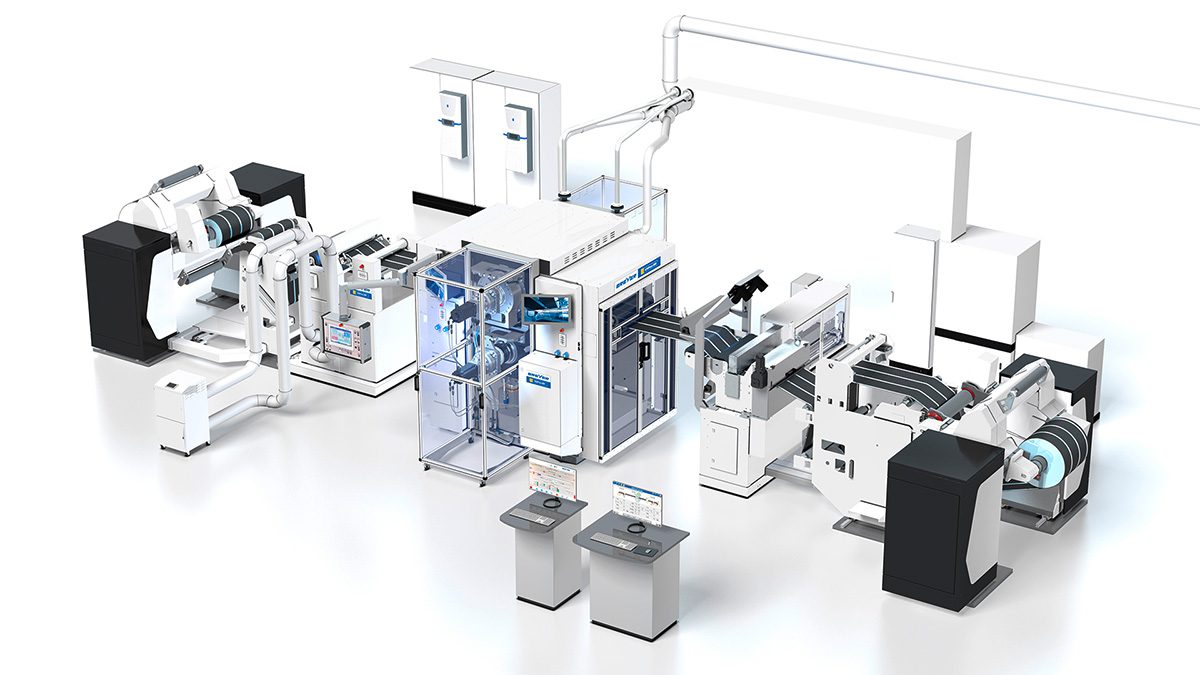
BREYER, a leading provider of specialized machinery, has announced the successful supply of its advanced calendering technology to V4Smart, the significant battery joint venture between luxury sports car manufacturer Porsche and global battery specialist VARTA. This strategic partnership aims to establish robust production of high-performance cylindrical lithium-ion cells in Germany, targeting demanding applications such as electric sports cars and hybrid vehicle models.
The deployment of BREYER’s sophisticated equipment at V4Smart’s production facilities marks a crucial step in bolstering Europe’s capabilities in advanced EV battery manufacturing. The integrated solution emphasizes precision, automation, and comprehensive traceability, all vital components for producing the next generation of high-quality automotive batteries.

V4Smart: A Strategic Venture for High-Performance EV Batteries
The V4Smart joint venture represents a concerted effort by Porsche and VARTA to localize and optimize the production of critical battery components. Their focus on cylindrical lithium-ion cells is particularly relevant for high-performance applications, where energy density, power output, and reliability are paramount. These cells are earmarked for integration into Porsche’s cutting-edge sports cars and various hybrid vehicle platforms, underscoring the demand for top-tier EV battery manufacturing.
Establishing this production capability within Germany is strategically significant, contributing to supply chain resilience and fostering technological independence within the European automotive sector. The initiative is a testament to the continent’s commitment to advancing electric mobility through localized and high-quality manufacturing processes.
Calendering: The Cornerstone of Electrode Manufacturing
Calendering stands as one of the most critical stages in the complex process of electrode manufacturing for lithium-ion batteries. Following the precise application and subsequent drying of the battery slurry onto a current collector, the electrode material undergoes a vital compression step. This involves passing the coated electrode through a series of highly accurate precision rollers.
During this compression, the material is consolidated to achieve a predetermined thickness and density. This seemingly straightforward step profoundly influences several key characteristics of the finished electrode, which directly impact the performance, longevity, and safety of the final battery cell. Without precise calendering, achieving consistent quality in EV battery manufacturing is exceptionally challenging.
Impact on Battery Performance and Consistency
The calendering process directly affects the electrode’s porosity, which is crucial for the efficient movement of ions during charge and discharge cycles. Optimal porosity ensures that the electrolyte can effectively penetrate the electrode material, facilitating faster charging and discharging rates and improving overall energy efficiency.
Furthermore, calendering enhances the adhesion between the active material and the current collector, preventing delamination and ensuring structural integrity throughout the battery’s lifespan. Consistent density across the electrode is also vital for uniform current distribution and prevents localized hot spots, thereby contributing to cell safety and extending cycle life.
In the context of high-performance cells, where even minor variations can significantly impact overall system performance, the calender is not merely an auxiliary piece of equipment. It is, in fact, one of the primary points in the production line where critical performance attributes are intrinsically engineered and locked into the cell structure. Its precision is non-negotiable for achieving the exacting standards required for sports cars and demanding hybrid applications.
BREYER’s Precision Calendering Solutions for EV Battery Manufacturing
BREYER’s calendering lines supplied to V4Smart are engineered to meet the stringent demands of high-performance EV battery manufacturing. The technology is specifically designed to deliver unparalleled dimensional accuracy, which is fundamental for ensuring consistent cell performance across entire production batches.
A key advantage of BREYER’s solution is its ability to minimize scrap material during the manufacturing process. Reducing waste not only contributes to the economic efficiency of the production line but also aligns with sustainability goals, a growing priority in modern industrial operations. This efficiency is critical for cost-effective, large-scale EV battery manufacturing.
The calendering lines have been seamlessly integrated into V4Smart’s highly automated production environments at its facilities located in Ellwangen and Nördlingen. This integration underscores the project’s commitment to advanced manufacturing principles, where digitization and automation play central roles in optimizing production efficiency and quality control. BREYER highlights that the entire production setup was established rapidly, showcasing agile project execution in sophisticated EV battery manufacturing.
Pioneering Cell-Level Traceability for Enhanced Quality Control
A cornerstone of the V4Smart project, facilitated by BREYER’s integrated systems, is the implementation of a comprehensive plant-wide track-and-trace system. This advanced digital infrastructure allows for every individual battery cell to be meticulously tracked through all stages of its manufacturing journey.
Through a higher-level control system, production data for each cell is continuously recorded, expanded, and seamlessly passed on to the subsequent manufacturing step. This unbroken chain of data provides an unprecedented level of insight into the production history of every single cell. Such granular traceability is indispensable in performance-oriented cell manufacturing, especially where the end application demands absolute precision and reliability.
Tight batch control is paramount in high-performance EV battery manufacturing. The ability to trace each cell back to its origin and through every process step ensures that any deviations in quality can be swiftly identified, isolated, and remedied. This meticulous approach significantly reduces the risk of variability and enhances the overall trustworthiness and safety of the battery cells, leaving minimal room for error in demanding automotive applications.
Catalyzing European High-Performance Battery Production
Beyond the technical specifications of the equipment, BREYER’s announcement carries a broader industrial message. The successful deployment of these advanced calendering lines within V4Smart’s facilities serves as compelling evidence that high-performance battery factories can be rapidly established and operationalized within Europe. This challenges the long-standing perception that such sophisticated manufacturing capabilities are primarily concentrated in Asian markets.
This development has significant implications for Europe’s industrial landscape, fostering greater self-sufficiency in critical technologies. It demonstrates the continent’s growing capacity to innovate and execute complex EV battery manufacturing projects quickly and effectively, positioning it as a competitive hub for future electric vehicle innovation and production. Such initiatives are crucial for strengthening the regional automotive ecosystem and securing its leadership in the global shift towards electrification.
VARTA Microbattery’s Integral Role
In this ambitious undertaking, VARTA Microbattery played a pivotal role as the general contractor for the V4Smart joint venture. Their extensive expertise in battery technology and manufacturing processes was instrumental in overseeing the project from its nascent stages to full operational status. VARTA Microbattery was directly responsible for the comprehensive planning, meticulous construction, and efficient commissioning of both the electrode and cell production facilities.
This leadership ensured that the complex interplay of various technologies and processes, including BREYER’s calendering lines, was harmonized to create a streamlined, high-efficiency manufacturing environment. Their overarching management was critical to bringing the advanced EV battery manufacturing capabilities of V4Smart to fruition in such a short timeframe.
Driving the Future of Electric Mobility
The collaboration between BREYER, Porsche, and VARTA through the V4Smart joint venture underscores a significant advancement in EV battery manufacturing. By integrating state-of-the-art calendering technology with advanced cell-level traceability, the initiative sets new benchmarks for quality, efficiency, and performance in battery production. This collective effort not only supports the production of next-generation high-performance electric and hybrid vehicles but also champions the growth of sophisticated industrial capabilities within Europe.
As the global automotive industry continues its rapid transition towards electrification, developments like V4Smart’s advanced production facilities, powered by BREYER’s specialized technology, will be instrumental in meeting the escalating demand for reliable, high-performance EV batteries. This project exemplifies the innovative spirit and collaborative drive essential for shaping the future of sustainable mobility.