
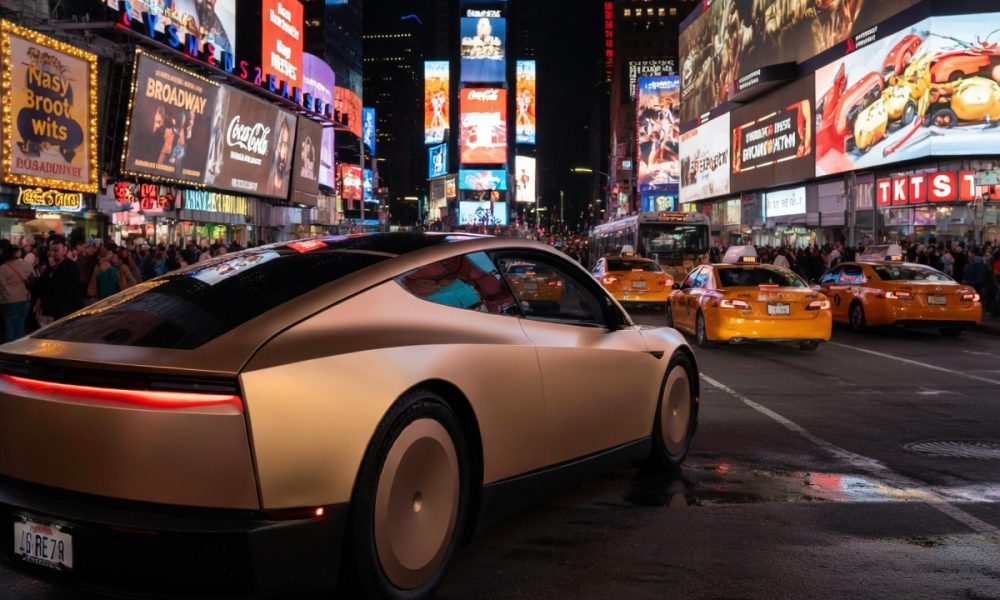
Tesla has been officially recognised on Fortune’s prestigious America’s Most Innovative Companies 2026 list, a significant acknowledgement that coincides with the commencement of its revolutionary Cybercab production. This pivotal inclusion underscores the company’s continuous drive for innovation, particularly as its driverless Robotaxi service expands across key cities in the United States.
The timing of this recognition carries considerable weight, aligning directly with the ramping up of Cybercab manufacturing at Gigafactory Texas. This development marks a new phase in Tesla’s journey, reflecting its commitment to shaping the future of transportation through advanced autonomous technology and groundbreaking production methodologies.

Fortune’s Benchmark for Innovation: Criteria and Companies
Fortune’s annual list, developed in collaboration with Statista, meticulously evaluates 300 companies based on three core dimensions: product innovation, process innovation, and innovation culture. This rigorous assessment aims to identify enterprises that are not only developing new products but also transforming how they operate and foster a culture of forward-thinking.
The 2026 cohort of 300 companies collectively generated over $12.5 trillion in revenue, highlighting the substantial economic impact of innovation leaders. Tesla’s placement on this esteemed list positions it alongside industry peers, including Rivian, which made its debut this year. Tesla’s advantage is notably attributed to its product pipeline being significantly more advanced.
While Rivian has introduced a self-driving AI model, Tesla has already achieved monumental milestones with its Full Self-Driving (FSD) technology, logging over 8 billion miles. Furthermore, its unsupervised Robotaxi service in Austin has accumulated more than 250,000 miles, demonstrating a tangible lead in real-world application and data collection.

The first production Cybercab unit rolled off the line at Gigafactory Texas in February 2026, marking a tangible output of Tesla’s ambitious vision. This milestone, combined with extensive FSD data, reinforces Tesla’s strong position on Fortune’s list as a leader in both product and process innovation.
The Tesla Cybercab: Redefining Automotive Manufacturing and Autonomy
At the heart of Tesla’s case for innovation, particularly in 2026, is the Cybercab. This purpose-built autonomous vehicle is engineered without a steering wheel or pedals, fundamentally reimagining the driver-passenger relationship and vehicle design. It is specifically conceived to integrate into a networked Robotaxi fleet, expanding beyond its initial deployment in Austin to encompass Miami, Dallas, Phoenix, and Las Vegas.
The manufacturing process for the Tesla Cybercab is equally revolutionary. Utilising an ‘unboxed manufacturing process,’ Tesla aims for an unprecedented cycle time of one vehicle every ten seconds. This radical approach seeks to transcend traditional automotive assembly lines, drawing parallels to high-volume consumer electronics production.
Elon Musk, speaking at Tesla’s 2025 Annual Shareholder Meeting, articulated this paradigm shift clearly: “Manufacturing for the Cybercab is closer to a high-volume consumer electronics device than a car manufacturing line.” He also acknowledged the inherent challenges in such an ambitious undertaking, stating, “Almost everything is new, so the early production rate will be agonizingly slow, but eventually end up being insanely fast.”
This vision for the Cybercab, priced below $30,000, represents Tesla’s next major inflection point. It builds on the company’s historical pattern of disruption, from making electric vehicles desirable to scaling Gigafactory production and accumulating vast amounts of safety data through its FSD technology.
🎥: Our FULL first ride in the @Tesla Cybercab
— TESLARATI (@Teslarati) October 11, 2024
Tesla’s Legacy of Disruptive Innovation
Tesla’s consistent recognition on innovation lists is intrinsically linked to its pattern of breakthrough achievements. The company dramatically altered the automotive industry’s trajectory by demonstrating that electric vehicles could be not only practical but also highly desirable. This initial disruption was followed by scaling Gigafactory production, setting new benchmarks for efficiency and volume in EV manufacturing.
Subsequently, Tesla’s Full Self-Driving technology began logging real-world safety data at an unprecedented scale, offering a glimpse into a future of enhanced road safety and autonomous mobility. The Cybercab represents the culmination of these advancements, a dedicated autonomous platform designed to operate within a sophisticated Robotaxi network.
The journey from concept to mass production for the Tesla Cybercab has been meticulously planned, with significant investments in research, development, and manufacturing infrastructure. This concerted effort underscores Tesla’s commitment to not just incremental improvements, but fundamental transformations within the automotive and transportation sectors.
A Pivotal Year for Tesla’s Autonomous Future
Fortune’s recognition of Tesla as a leading innovator arrives during what is undoubtedly one of the company’s most consequential years. Mass production of the Cybercab is scheduled to begin in April 2026, marking a critical transition from prototype to widespread availability. This period is vital for solidifying Tesla’s leadership in the autonomous vehicle market.
Alongside the production ramp-up, regulatory approvals are actively progressing, with deployment data from the Robotaxi service playing a crucial role in securing necessary certifications. The successful navigation of these regulatory landscapes will be paramount to the widespread adoption and expansion of the Cybercab fleet.
The industry watches closely as Tesla embarks on this ambitious venture. Rivals are observing not only the technological advancements but also the market reception and the operational efficiency of the Robotaxi service. Tesla’s success in this domain could set new global standards for autonomous urban mobility.
Top Innovators of 2026: A Broader Landscape
While Tesla stands out in the automotive and autonomous driving sectors, Fortune’s 2026 list highlights innovation across various industries. Alphabet leads the overall rankings for the fourth consecutive year, showcasing its dominance in AI across Search, DeepMind, and Waymo, alongside a robust patent portfolio and innovation culture.
Microsoft secures the second position, recognised for its advancements in Azure AI, Copilot integration across enterprise software, and its strategic partnership with OpenAI. Apple, at third, continues to drive innovation through its iPhone ecosystem, Apple Silicon, and the groundbreaking Vision Pro spatial computing platform.
The top five is rounded out by Abbott, lauded for medical device breakthroughs such as continuous glucose monitors and cardiac diagnostics, and KLA, a newcomer, for its critical role in semiconductor process control enabling AI chip production at scale.
Beyond the top five, the list includes a diverse array of innovative companies. Confirmed inclusions feature Harness (No. 24), Rivian, Cognizant, PPG, DXC Technology, and Advanced Technology Services, among 98 first-time entrants. The complete ranked list, offering a comprehensive view of America’s most innovative enterprises, is available at fortune.com (behind a paywall).