
Key Takeaways
- BYD has unveiled an innovative EV charging station that integrates solar panels and substantial battery storage, enabling fast charging capabilities even in locations without a direct grid connection.
- The system features a sophisticated robotic arm designed for automated vehicle plug-in, enhancing convenience and aligning with future autonomous parking solutions.
- This cutting-edge technology allows charging stations to deliver higher power output than a conventional grid connection might allow, while also mitigating peak demand on the electrical infrastructure.
- BYD’s Flash Chargers are remarkably fast, capable of charging compatible vehicles from 10% to 70% in just five minutes under optimal conditions.
- The company plans a significant global expansion, aiming to establish 6,000 Flash Charging stations worldwide by the close of 2027.
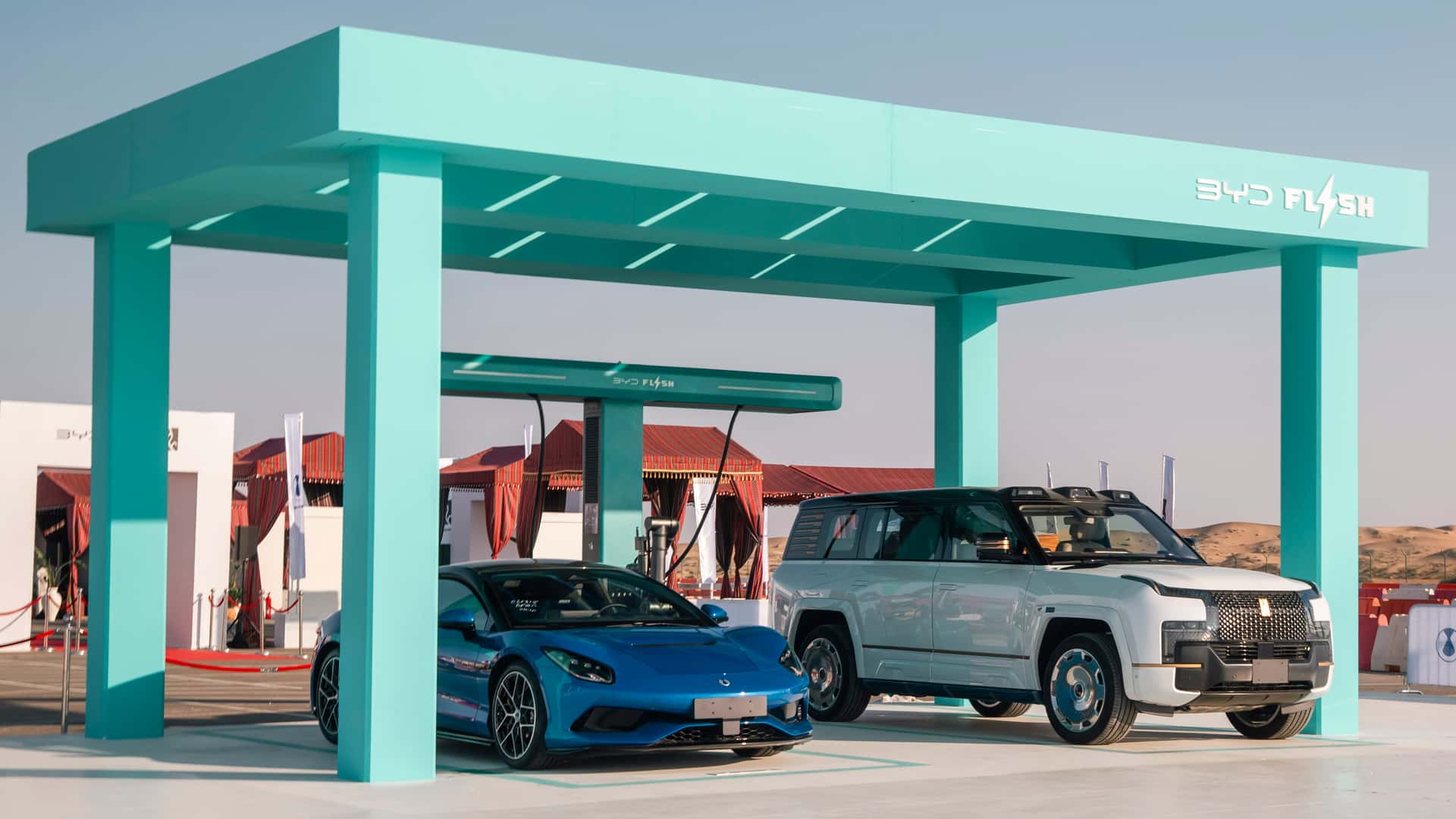
In a significant stride towards revolutionising electric vehicle (EV) infrastructure, global automotive and battery manufacturing giant BYD has introduced a futuristic charging solution capable of operating independently of traditional electricity grids. This innovative system, showcased in the challenging environment of the Abu Dhabi desert, integrates solar power generation, robust battery energy storage, and an advanced robotic arm to deliver high-speed EV charging.
The pioneering deployment by BYD addresses a critical challenge in the widespread adoption of electric vehicles: ensuring access to rapid charging facilities in diverse geographical locations, including those where grid connectivity is limited or unreliable. By harnessing renewable energy and sophisticated storage, the new BYD EV charging station promises greater flexibility and resilience for the expanding EV ecosystem.

A Glimpse into Off-Grid EV Charging Innovation
BYD’s latest innovation represents a comprehensive approach to sustainable and accessible EV charging. The system operates on a simple yet powerful premise: solar panels capture sunlight to generate electricity, which is then stored in large battery arrays. This stored energy powers the Flash Chargers, enabling vehicles to replenish their batteries swiftly, even in remote or underserved areas.
The strategic combination of solar power and battery storage is particularly advantageous. It not only reduces reliance on the conventional power grid but also offers a pathway to extend high-speed charging capabilities to regions previously deemed impractical for such installations. This self-sufficient model positions BYD at the forefront of developing energy-independent charging infrastructure.
The Role of Battery-Backed Charging in Modern Infrastructure
Battery-backed charging solutions are rapidly gaining traction across the electric vehicle industry. These systems allow charging stations to deliver a surge of power exceeding what their direct grid connection could provide on its own. This capability is crucial for implementing ultra-fast charging, which demands immense power delivery in short bursts.

Furthermore, on-site energy storage plays a vital role in stabilising the local grid by reducing peak demand during busy charging periods. Instead of drawing a massive load directly from the grid all at once, the station can discharge from its batteries, which are typically recharged at a slower, more consistent rate, often during off-peak hours.
This approach is not unique to BYD. Industry leaders like Tesla have also embraced similar strategies, as evidenced by their largest Supercharger site featuring solar panels and Megapack batteries. Companies such as Electric Era and Beam Global specialise in providing battery-backed charging solutions, underscoring a growing industry trend towards enhanced energy management for EV infrastructure.
Understanding BYD’s Flash Charging Technology
At the core of BYD’s advanced charging ecosystem is its proprietary Flash Charging technology. Each T-shaped Flash charger within the new desert installation is connected to two 185-kilowatt-hour (kWh) storage batteries, accumulating a total capacity of 370 kWh. These batteries draw power from the grid at rates ranging from approximately 100 to 560 kilowatts (kW).
Once charged, these on-site batteries can supply electricity to connected electric vehicles at significantly higher rates. The Flash chargers are engineered to deliver an impressive 1,500 kW through a single cable, or up to 1,000 kW when two cables are simultaneously in use. This remarkable power output translates directly into expedited charging times for compatible EVs.
Speed and Efficiency: A New Benchmark for EV Charging
The speed offered by BYD’s 1,500-kW Flash chargers sets a new benchmark in the industry. For electric vehicles equipped with BYD’s second-generation Blade battery, the charging process is astonishingly swift. A compatible car can achieve a charge from 10% to 70% in as little as five minutes.
Pushing the boundaries further, the same vehicles can reach a 97% charge level in just nine minutes. These figures highlight BYD’s commitment to making EV charging a seamless and time-efficient experience, closely comparable to traditional refuelling at a petrol station.
In a real-world demonstration, the Denza Z9 GT, an electric wagon and one of the vehicles currently capable of fully utilising this power in Europe, showcased its charging prowess. It accelerated from 10% to 80% charge in a mere six minutes and 32 seconds, subsequently reaching 97% in nine minutes and 22 seconds, reaffirming the system’s exceptional performance.
The Integration of Robotic Automation for Enhanced User Experience
A distinctive feature of BYD’s new EV charging station is the inclusion of a robotic arm, designed to handle the physical connection between the charger and the vehicle. This robotic arm plugs in the car, fundamentally transforming the user experience by making the charging process hands-free.
This automated approach signifies a significant step towards future mobility solutions. By integrating with automated parking systems, the robotic arm can facilitate a scenario where drivers simply park their vehicle, and the entire charging process—from connection to disconnection—is managed autonomously. This level of automation enhances convenience and positions BYD EV charging infrastructure for the era of fully autonomous vehicles.
Global Expansion and Strategic Vision
BYD has articulated an ambitious strategy for global expansion of its advanced EV charging network. The company aims to establish 6,000 Flash Charging stations worldwide by the end of 2027. This aggressive rollout plan underscores BYD’s commitment to building a robust global infrastructure to support the accelerating transition to electric mobility.
While the exact number of these future stations that will feature solar power, off-grid capabilities, or the robotic arm remains unspecified, the current deployment in the Abu Dhabi desert serves as a potent proof-of-concept for the versatility and potential of BYD’s integrated charging solutions.
Europe is already experiencing the deployment of BYD’s Flash charging technology, with operational sites established in key markets such as Italy, Germany, France, and the United Kingdom. Plans are also underway for the expansion of this technology into Canada, further broadening the global footprint of BYD’s rapid charging network.
Future Outlook and Unanswered Questions
The introduction of BYD’s solar-powered, battery-backed, and robotic EV charging station marks a pivotal moment in the evolution of electric vehicle infrastructure. It demonstrates a clear vision for sustainable, accessible, and highly efficient charging, particularly valuable for regions with challenging grid conditions.
However, BYD has yet to disclose specific technical details regarding the battery capacity and solar output of the new desert installation. This lack of detailed information currently prevents a comprehensive understanding of how many vehicles the station can reliably charge, or at what speed, solely on solar power in an off-grid scenario. Further technical disclosures are anticipated to shed more light on the full capabilities of this innovative system.
Despite these unknowns, the strategic implications are clear: BYD is not merely building chargers but developing comprehensive energy solutions that could redefine the landscape of electric vehicle adoption and energy independence globally.
FAQ Section
What is unique about BYD’s new EV charging station?
BYD’s new station integrates solar panels, battery storage, and a robotic arm to provide high-speed EV charging. Its unique capability to operate off-grid makes it suitable for remote locations or areas with unstable power supplies, offering a self-sufficient and automated charging experience.
How fast can BYD Flash Chargers charge an EV?
BYD’s 1,500-kW Flash Chargers can charge compatible electric vehicles equipped with a second-generation Blade battery from 10% to 70% in approximately five minutes. A full charge up to 97% can be achieved in about nine minutes, setting new standards for charging speed.
What role do solar panels and battery storage play in this system?
Solar panels generate clean electricity on-site, which is then stored in large battery arrays. This stored energy allows the station to provide continuous, high-power charging, reduce reliance on the main grid, and supply power independently when grid connection is not feasible or desired.
How does the robotic arm enhance the BYD EV charging experience?
The robotic arm automates the plug-in process for electric vehicles, making charging hands-free. This feature aims to improve convenience for users and seamlessly integrates with future automated parking systems, paving the way for fully autonomous EV charging solutions.
Where is BYD planning to deploy these advanced charging stations?
BYD has ambitious global expansion plans, aiming to establish 6,000 Flash Charging stations worldwide by the end of 2027. Currently, sites are operational in several European countries including Italy, Germany, France, and the United Kingdom, with Canada also slated for future deployment.
What are the power specifications of BYD’s Flash Chargers?
Each BYD Flash Charger is backed by two 185-kWh batteries, totalling 370 kWh. They can deliver up to 1,500 kW of power through a single cable or up to 1,000 kW when two cables are in use simultaneously, ensuring ultra-fast charging capabilities for multiple vehicles.