
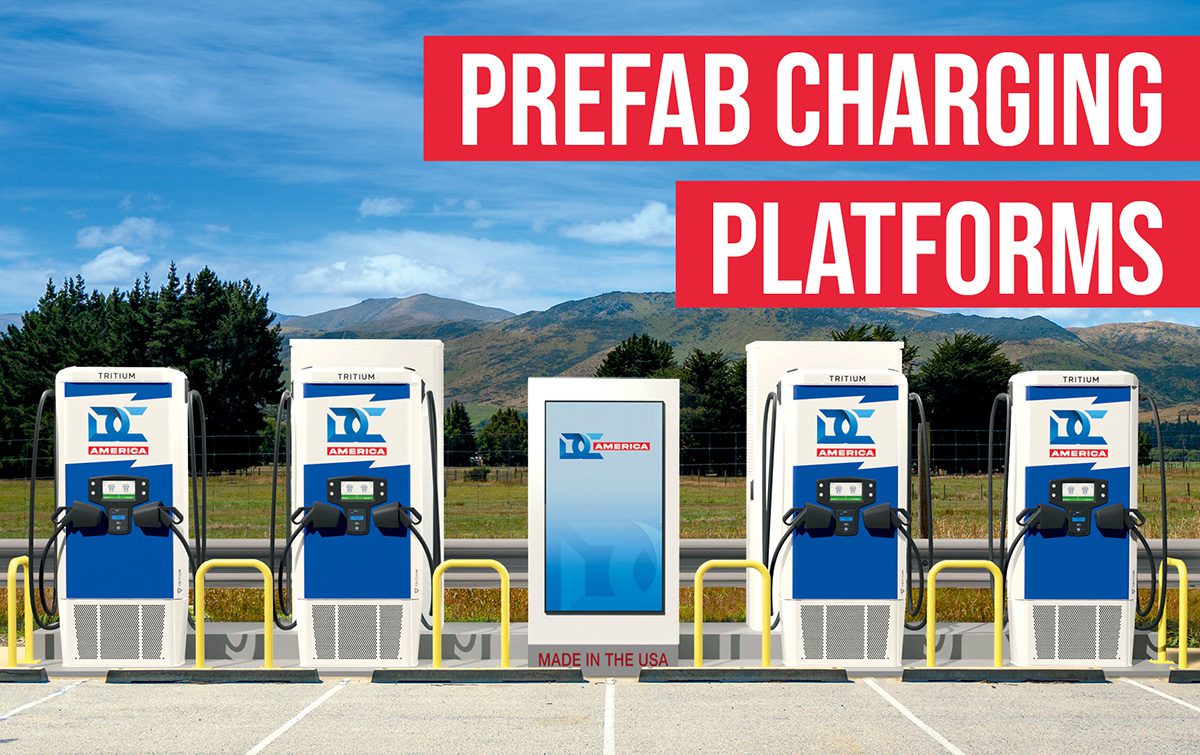
Key Takeaways:
- The primary obstacle to widespread commercial EV adoption is the slow and costly installation of charging infrastructure, rather than hardware or software limitations.
- DC-America addresses this bottleneck with prefabricated, modular EV charging platforms, which include all necessary electrical components mounted on a metal skid.
- These platforms are pre-wired and commissioned at a facility, significantly reducing on-site installation time to as little as four hours in many cases.
- Key benefits include rapid deployment, substantial cost savings by minimising trenching and site preparation, and crucial flexibility for future redeployment.
- The modular approach future-proofs installations, allowing for easy hardware upgrades and adaptation to evolving technology and changing business needs without losing prior infrastructure investments.
- DC-America’s solutions range from permanent installations to fully mobile units, catering to diverse requirements from fleet operations to public charging stations.
The burgeoning electric vehicle (EV) market continues its rapid expansion, particularly within commercial sectors. However, this growth has illuminated a significant bottleneck not in the sophistication of charging hardware or management software, but in the cumbersome and expensive process of installing the infrastructure itself.

While manufacturers consistently deliver advanced AC and DC chargers and robust software solutions for network management and energy optimisation, the real challenge lies in the physical deployment. Site preparation, extensive trenching, and the laborious task of installing and commissioning chargers in the field often prove to be both time-consuming and financially prohibitive.
Addressing the Infrastructure Bottleneck with Modular EV Charging Platforms
Companies frequently grapple with the dilemma of committing to permanent charging setups in a rapidly evolving business landscape. Fleets expand, operational demands shift, and the carefully planned charging station that took months to install might become unsuitable within a couple of years. Furthermore, with technology advancing at an unprecedented pace, businesses are understandably reluctant to invest heavily in infrastructure that could become functionally obsolete in a short span.
To mitigate these challenges, innovative solutions are emerging. While some companies offer fully mobile charging options—such as Soneil’s trailer-mounted units or Beam’s self-contained, solar-powered stalls—DC-America has introduced a highly flexible yet more permanent alternative. The company specialises in manufacturing and installing turnkey charging stations that feature all essential components pre-mounted on a robust metal skid.

These integrated platforms encompass transformers, switchgear, power cabinets, and dispensers, designed for a single-point connection to the main electrical service. Crucially, all welding, assembly, and commissioning are completed at DC-America’s facility in Huntington, West Virginia, before deployment.
The Genesis of a Flexible Solution
Nathan Bowen, President of DC-America, sheds light on the origins and benefits of this innovative approach, particularly how it delivers significant time and cost savings while future-proofing EV charging installations.
“I was building prefabricated skids for the energy industry—natural gas compressor stations, or stuff that would go at a power plant. My background’s in the electrical field, so my aspect of it was doing the wiring, commissioning, pre-wiring sensors,” Bowen explained, tracing his journey.
Around 2021, coinciding with the introduction of NEVI (National Electric Vehicle Infrastructure) funding, Bowen observed the growing EV market. He recognised an opportunity to apply his extensive knowledge of prefabricated infrastructure to the burgeoning field of charging technology.
Rapid Deployment and Cost Efficiency: The Core Advantage
The core proposition of DC-America’s modular EV charging platforms lies in their ability to dramatically simplify and accelerate installation. Each platform arrives at the site ready for connection, drastically cutting down on complex on-site construction.
“Basically any component that you see on a charging site—electrical switchgear, panel boards, transformers, any combination of Level 2 chargers and DC fast chargers—we can mount it on a skid and pre-wire it and commission it before it leaves our facility. We can even put light poles, cameras, or any electrical component that you can think of on the skid. In most cases, this greatly reduces the amount of trenching,” Bowen elaborated.
The speed of deployment is particularly striking. “We can deploy these in less than four hours in most cases,” he stated. This rapid turnaround minimises disruption, reduces labour costs, and allows for quicker operational readiness.
After a couple of years dedicated to marketing and development, the solution has gained significant traction, especially in the ‘behind-the-fence’ fleet sector and for public charging stations catering to charge point operators (CPOs). The appeal extends to any entity seeking to leverage the advantages of prefabricated infrastructure.
Future-Proofing and Flexibility for Evolving Needs
Beyond speed and cost, the modular design offers unparalleled flexibility. “There are many advantages to it: quick deployment obviously, but in a lot of cases, especially in fleet behind-the-fence, what we see is either that folks are leasing their space, or they’re potentially interested in redeployment. Things change, and they want to have the ability to move infrastructure to where they need it without losing all that underground infrastructure investment. As quickly as we can put it in the ground, we can disconnect it, put it on a truck, and send it down the road,” Bowen highlighted.
This adaptability is crucial given the dynamic nature of EV technology and business operations. DC-America’s offerings span a spectrum, from truly mobile units that can be moved by a pickup truck to more permanent, albeit still flexible, installations.
“It’s more of a permanent/semi-permanent solution, and we cover both ends of that spectrum. We have stuff that’s been out there for several years and they have no intention of moving it, but we make single chargers on a small platform that could be put in the back of a pickup truck with quick connections, and they’re 100% intended to be mobile,” Bowen clarified on the semi-mobile nature of their product.
The company also emphasises customisation, working with any charger manufacturer and designing bespoke solutions. An example includes addressing single-phase power limitations for a client requiring three-phase 480 VAC for a DC fast charger. “We worked with one particular client that was trying to fill a need with single-phase situations where there’s no three-phase power, so all the components that it takes to create (from single phase power) for a DC fast charger, we combined that into a mobile unit,” Bowen recounted.
Adapting to Technological Advancements
The pace of technological change in the EV sector necessitates adaptable infrastructure. Modular EV charging platforms are designed with this in mind.
“I’ve seen over the past couple years how much technology’s changed. This skidded infrastructure gives you a good base for keeping up with technology advances because you can change hardware after the fact. If you put conduit in the ground, you’re stuck with the conduits you roughed in, whereas if you’ve got a completely open raceway that’s accessible from the top, you can switch technology in the future—if you’re starting with an all-in-one charger and you’re going towards a distributed DC system, you have the capability to switch those components out later,” Bowen explained.
The terms ‘skid’ and ‘raceway’ define the physical structure and electrical pathways. The skid is the foundational structure holding the equipment, while the raceway system, contained within the skid, manages the electrical wiring. The dimensions of the skid are tailored to the chargers, equipment, and spacing requirements.
Comprehensive Components and Customisation
DC-America’s prefabricated platforms can host a wide array of components beyond just chargers. This includes dispensers, power cabinets, transformers, panel boards, battery energy storage systems (BESS), emergency shutdown (ESD) buttons, and accessories like lights, security cameras, canopies, bollards, tire filling stations, and even vacuum cleaners.
While the company strives for standardisation to maximise efficiency and cost savings—with standard skid sizes accommodating approximately 80% of existing equipment footprints and aligning with standard parking stall widths—custom solutions are readily available for unique requirements. This flexibility allows for adaptation to wide parking spots for large trucks or unique site configurations.
Strategic Partnerships and Commissioning Excellence
DC-America’s business model primarily revolves around manufacturing for charging providers, including those offering ‘charging as a service’ or ‘trucks as a service,’ and CPOs. While the company occasionally undertakes turnkey projects for local entities like school districts in West Virginia, its core focus is manufacturing to support these providers, rather than competing with them.
Customers can either supply their own chargers for installation and commissioning by DC-America, or the company can provide them through its relationships with major charger manufacturers.
The commissioning process is a critical element of DC-America’s value proposition, ensuring that systems are fully operational and optimised before deployment. “It starts at the panel board. There’s a lot of settings, especially on higher-amperage breakers, that should be engineered and set up prior to use,” Bowen noted. This includes setting overcurrent protection, especially for systems over a thousand amps, which require advanced LSIG protection and arc flash remediation based on utility circuit specifics.
The process involves testing wiring, confirming insulation integrity, conducting point-to-point checks for communication wiring (CAT5 or CAN bus), and verifying AC and DC side terminations. Finally, the chargers are activated, sometimes including SIM card configuration for communications and integration with charge management software and payment terminals.
“I think it’s a huge selling point to have the chargers pre-commissioned. When I roll out there, I’m charging a vehicle within a few hours, I’ve already worked out all the bugs. I would want to see that because usually you’re on a site, a site host is watching you, and they either see you do really well or they see you fumble. I like the first scenario,” Bowen emphasised, highlighting the efficiency and professionalism gained from pre-commissioning.
Navigating Industry Discussions and Future Technologies
Bowen also offered insights into ongoing industry debates and emerging technologies, providing valuable context from his experience with modular EV charging platforms.
Distributed vs. Standalone Charging
The discussion around distributed charging versus standalone (all-in-one) units is a key topic. Bowen believes both have merits, but distributed systems offer significant advantages, especially when oversubscribing a site.
He clarified oversubscription: “Let’s say you have a site where the utility will only give you 1,000 amps, but you have enough chargers out there that you could potentially utilize 1,800 amps. One advantage of a dynamic system is that you can still have high-power chargers connected to a 1,000-amp service, but through software, you’re able to smartly shift this power around.”
While all-in-one chargers can manage peak shaving, distributed systems excel at dynamic power reallocation based on vehicle state of charge, ensuring optimal charging rates across multiple vehicles. “It’s a little more complicated installation, but with our system, we do that really well because we have a wide-open raceway and we can separate AC and DC cabling,” Bowen noted, contrasting it with the complexities of a stick-built site.
Ultimately, he posits that dynamic, distributed systems likely prevail for their efficiency in power management, especially for oversubscribed sites.
Onsite vs. Cloud-Based Processing for Energy Management
Regarding energy management, Bowen prefers onsite hardware for processing. “I’m a fan of onsite hardware. Especially if you’re wanting granular information, there’s nothing like having a hardwired input into a controller rather than going up to a cloud and coming back down and getting delayed information,” he stated.
While much of the industry leans towards cloud solutions, Bowen underscores the reliability of hardwired onsite equipment, particularly its ability to function even if 5G connectivity is lost.
Credit Card Readers: A Persistent Challenge
Integrating credit card readers into public charging infrastructure remains a complex issue. Bowen described it as “a tough integration” and one of the most challenging aspects of public charging, particularly concerning payment processing and authentication, despite their ubiquity at gas stations.
Microgrids and Renewable Integration
The potential for microgrids, incorporating components like batteries, solar panels, and even propane generators, is another area of interest. DC-America’s modular platforms can integrate any of these elements. While currently not a dominant trend, Bowen anticipates increased adoption in the future, particularly with solar canopies, though scaling solar for DC fast charging requires substantial setups.
Vehicle-to-Grid (V2G) Technology
Vehicle-to-Grid (V2G) technology, particularly promising for applications like school buses, is considered a viable integration for DC-America. “For us, it’s just another electrical item. I think it’s great technology. The school bus is the perfect application for that,” Bowen affirmed. He noted that some companies even claim V2G software can enhance battery life through intelligent discharge cycles.
Navigating NEVI Program Challenges
The NEVI program, designed to expand EV charging infrastructure, has faced its share of complexities, particularly in rural areas like West Virginia. Bowen highlighted the scarcity of non-Tesla infrastructure in such regions, noting his own GMC Sierra EV’s incompatibility with many existing Superchargers.
He underscored the difficulty in meeting NEVI’s initial specifications—four 150-kilowatt chargers every 50 miles—in all locations, particularly where utilisation rates may not justify the significant investment. “It’s very difficult in a rural state like this to put in what NEVI was speccing out: four 150-kilowatt chargers, every 50 miles. Some people are going to disagree with me on this, but it’s difficult for that to make sense in every location. There’s just not enough utilization. It’s not going to make money,” he argued.
Bowen advocates for greater flexibility for states in determining infrastructure sizing, with an emphasis on building for future growth rather than imposing a one-size-fits-all solution. This aligns perfectly with DC-America’s modular EV charging platforms, which enable initial smaller installations that can be easily expanded as demand grows.
“Yeah, I think it’s perfect for it, but I want to see public charging be successful everywhere, even without my product. I think real conversations need to be had—especially in underutilized areas, do we force a certain size station on everyone? I think we ought to avoid a one-size-fits-all solution,” he concluded, advocating for a pragmatic approach to nationwide EV charging deployment.
This article, which delves into the innovative solutions shaping the future of EV charging infrastructure, first appeared in Issue 75: January-March 2026.
Frequently Asked Questions (FAQ)
What is the main bottleneck in commercial EV charging deployment?
The primary bottleneck is not the charging hardware or software, but the time-consuming and expensive installation process. This includes site preparation, extensive trenching, and the challenges of on-site installation and commissioning, which often delay projects and increase costs significantly.
How do DC-America’s modular EV charging platforms address this bottleneck?
DC-America provides prefabricated charging stations where all necessary electrical components—chargers, transformers, switchgear, etc.—are pre-mounted, pre-wired, and commissioned on a metal skid at their facility. This significantly reduces on-site work, allowing for deployment in as little as four hours in many cases, saving time and money.
What are the key benefits of using prefabricated charging infrastructure?
The main benefits include rapid deployment, reduced on-site labour and trenching costs, and enhanced flexibility. These platforms can be easily moved and redeployed if business needs change or leases expire, protecting the infrastructure investment. They also facilitate future upgrades to keep pace with evolving EV charging technology.
Can these modular platforms be customised for different needs?
Yes, DC-America offers extensive customisation. They work with various charger manufacturers and can integrate diverse components like battery storage, solar canopies, security cameras, and even specific solutions for single-phase power challenges. While standard designs exist for efficiency, bespoke solutions are common for unique site requirements or fleet applications.
What is the importance of ‘commissioning’ in DC-America’s process?
Commissioning is the crucial process of configuring and testing all electrical components and software settings before the platform leaves the factory. This includes setting circuit breaker protections, testing wiring, confirming communication protocols, and even integrating with charge management software. Pre-commissioning ensures systems are fully operational on arrival, minimising on-site issues.
How do modular EV charging platforms support future technological upgrades?
Unlike traditional stick-built installations that might lock in conduit configurations, DC-America’s skidded infrastructure provides an open raceway system. This design allows for easy swapping of hardware components, enabling seamless upgrades from all-in-one chargers to distributed DC systems as technology advances, without needing extensive civil work.
What are the implications of the NEVI program for rural EV charging?
The NEVI program aims to expand EV charging, but its initial specifications (e.g., four 150 kW chargers every 50 miles) can be challenging in rural, underutilised areas where demand may not justify the investment. DC-America suggests that states need more flexibility to tailor infrastructure sizing to local needs, supporting a more gradual, scalable approach that can grow with demand.