
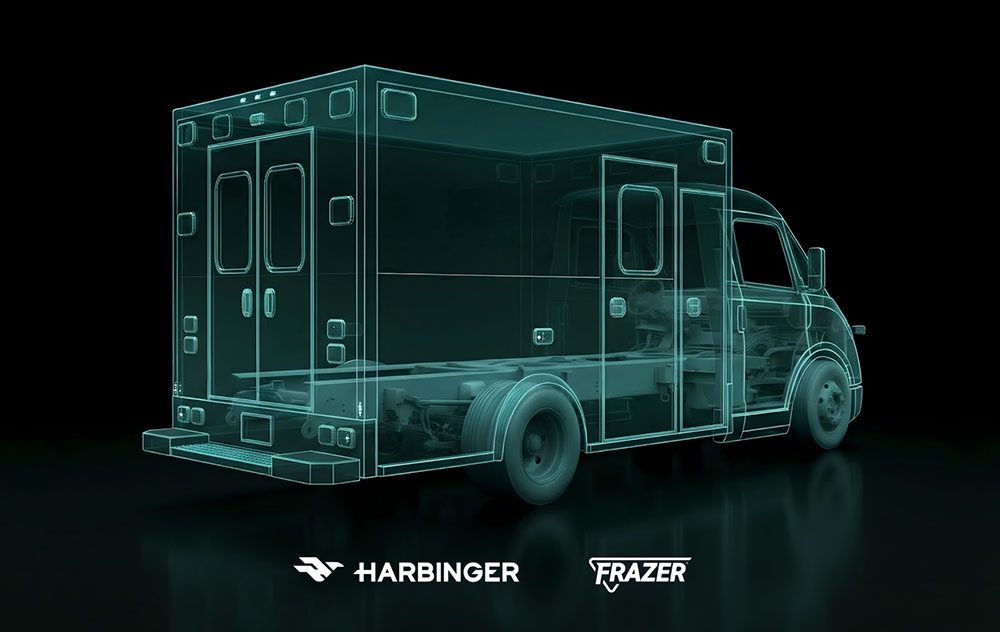
In a significant development poised to reshape emergency medical services, commercial electric vehicle (EV) manufacturer Harbinger has announced a strategic partnership with Frazer, a leading provider of mobile healthcare solutions. This collaboration aims to integrate Harbinger’s innovative plug-in hybrid vehicle chassis and advanced battery technology into the next generation of ambulances and mobile healthcare units, marking a pivotal step towards electrification in critical service sectors.
The alliance underscores a shared vision for enhanced operational efficiency, reduced environmental impact, and superior reliability in emergency response. Frazer, known for designing and building specialized vehicles for EMS agencies, fire departments, hospitals, and specialty care programs, has further solidified this partnership through a strategic investment in Harbinger.

Harbinger’s Momentum in the Commercial EV Landscape
The partnership with Frazer follows a period of rapid expansion and innovation for Harbinger. The five-year-old commercial EV OEM has recently made headlines with several key advancements that highlight its strategic growth and technological prowess within the electric vehicle industry.
In recent months, Harbinger has introduced a new line of battery storage products, expanding its portfolio beyond vehicle integration. The company also notably acquired autonomous driving firm Phantom AI, signaling ambitions to integrate advanced driver-assistance systems and potentially fully autonomous capabilities into its future offerings.
Further demonstrating its commitment to diversified innovation, Harbinger also unveiled a new medium-duty truck, broadening its range of commercial EV solutions. CEO John Harris has previously articulated that the company’s success is rooted in its specialization and vertical integration model, allowing for comprehensive control over its core technologies.

Frazer’s Evolving Vision for Patient Care
Frazer, headquartered in Texas, has long been a stalwart in the emergency vehicle manufacturing sector, consistently delivering purpose-built solutions to healthcare providers. However, the company’s recent strategic move signals a proactive evolution of its mission, extending beyond traditional patient transport to encompass comprehensive mobile healthcare delivery.
Laura Griffin, CEO of Frazer, articulated the company’s forward-thinking philosophy regarding the future of medical care. She emphasized a shift towards bringing medical services directly to patients, rather than solely focusing on their transportation to fixed facilities.
“At Frazer, we believe the future of healthcare should deliver exceptional medical care directly to the patient, rather than simply transport the patient to care,” Griffin stated, highlighting the transformative potential of the collaboration.
The Strategic Imperative of Hybrid-Electric Solutions
Frazer’s investment in Harbinger and the subsequent partnership represent a clear commitment to sustainable and technologically advanced healthcare solutions. The adoption of hybrid-electric vehicles is viewed as a pragmatic initial phase in the broader electrification of emergency and medical fleets.
This approach is designed to maintain full operational readiness and clinical reliability, which are paramount in critical emergency scenarios, while simultaneously beginning the transition towards cleaner energy sources. The hybrid model offers a balance between pioneering electrification and ensuring uninterrupted service in demanding environments.
The integration of Harbinger’s plug-in hybrid technology is expected to address several key challenges faced by traditional ambulance and mobile healthcare units, particularly concerning power demands, fuel efficiency, and environmental impact.
Pioneering New Mobile Healthcare Products
Under the new partnership, Frazer and Harbinger are set to develop and introduce a suite of innovative mobile healthcare products designed to meet the evolving needs of the medical community. These products leverage Harbinger’s advanced hybrid chassis and battery technology to deliver superior performance and reliability.
Emergency Medical Response Vehicle
One of the flagship products planned is an emergency medical response vehicle built upon Harbinger’s robust hybrid chassis. This vehicle is engineered to support mission-critical reliability, a non-negotiable requirement for emergency services where uptime is paramount.
The design also focuses on clinical grade power redundancy, ensuring that essential medical equipment onboard remains operational even in challenging conditions. Furthermore, the hybrid architecture is expected to lead to drastically reduced operational complexity, simplifying energy management for first responders.
Mobile Healthcare Platform
The collaboration will also yield a mobile healthcare platform, also built on Harbinger’s versatile hybrid chassis. This platform is specifically designed to facilitate care delivery outside of traditional fixed-location facilities, expanding the reach of medical services.
Such platforms are envisioned to support diverse applications, including community care facilities, outreach programs, and extensions of hospital systems into underserved areas. The flexibility and efficiency offered by the hybrid chassis will enable these units to operate effectively in various settings, bridging gaps in healthcare access.
Auxiliary Power Systems
Beyond complete vehicle solutions, the partnership will also develop auxiliary power systems based on Harbinger’s cutting-edge battery technology. These systems are crucial for providing redundant power for field medical care.
The auxiliary units will be compatible with both hybrid and traditional internal combustion engine (ICE) vehicles, ensuring that medical professionals have a consistent and reliable power source for their equipment, regardless of the primary vehicle’s powertrain, thereby enhancing the capacity for critical care in remote or prolonged situations.
The Hybrid Chassis Advantage: Powering Critical Missions
Harbinger’s innovative hybrid offering combines its electric chassis with a gas-powered range extender. This integrated system is designed to recharge the battery when needed, providing an optimal balance of electric power and extended operational range, crucial for demanding emergency services.
This architecture delivers several key benefits for ambulances and mobile healthcare units. It enables significantly reduced emissions during idling, a common scenario for emergency vehicles on scene or waiting. This contributes to cleaner air quality and a healthier environment for both patients and personnel.
Crucially, the system provides stable and redundant power delivery for onboard medical equipment, which is vital for maintaining life support systems and diagnostic tools. The simplified energy management inherent in this design allows for more efficient operation and less concern for power availability in critical moments.
John Harris reiterated the adaptability of Harbinger’s core technology. “Through this partnership, Harbinger is entering the mobile healthcare and emergency medical response market for the first time,” said Harris. “Our proprietary platform was designed from the ground up as a modular foundation to support a wide range of commercial and specialty applications.”
He further stressed the essential attributes for medical fleets: “In mobile healthcare, redundancy, uptime and operational flexibility are non-negotiable, and our platform is built to deliver the reliability this market requires.”
Commitment to US-Based Manufacturing and Innovation
A shared principle between Harbinger and Frazer is their dedication to US manufacturing. Harbinger undertakes the design and manufacture of its electric and hybrid chassis entirely in-house at its California headquarters.
This integrated approach extends to all major vehicle systems, including the powertrain, advanced battery system, steering, and braking mechanisms. Such vertical integration ensures stringent quality control and fosters continuous innovation.
Similarly, Frazer maintains its production facilities in Houston, Texas, where it produces its specialized emergency response and mobile healthcare vehicles. This commitment to domestic manufacturing by both partners enhances supply chain resilience and supports local economies, reinforcing the reliability and accessibility of their advanced solutions.
Driving the Future of Emergency and Mobile Healthcare Electrification
The partnership between Harbinger and Frazer represents a significant leap forward in the electrification of mission-critical fleets. By combining Harbinger’s advanced hybrid-electric vehicle technology with Frazer’s deep expertise in mobile healthcare solutions, the collaboration is set to introduce a new era of efficiency, reliability, and environmental responsibility to emergency medical services.
As the healthcare industry continues to seek innovative ways to deliver care, the development of these advanced hybrid-electric ambulances and mobile healthcare platforms will be instrumental. This alliance not only showcases a commitment to technological advancement but also prioritizes the unwavering demands of patient care and emergency response.
The move signifies a broader trend towards sustainable transportation in specialized commercial sectors, promising a future where emergency services are not only highly effective but also environmentally conscious. This development is poised to create a significant impact on how emergency and mobile healthcare services are delivered across the nation.