
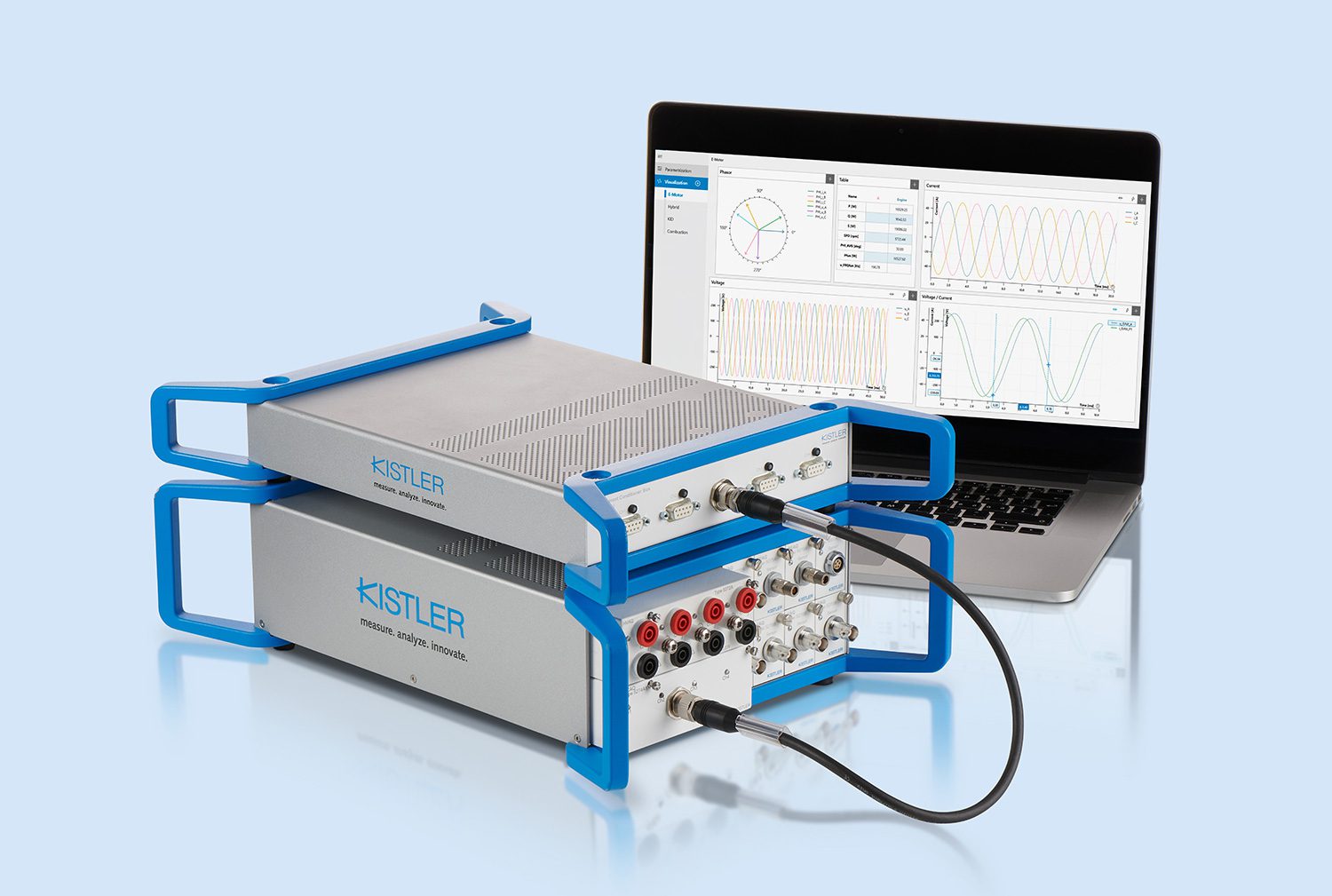
In a significant development for the electric vehicle (EV) industry, Kistler has officially unveiled its new KiBox2 E-Powertrain Analysis platform. This innovative, all-in-one measurement and analysis solution is specifically engineered to cater to the rigorous demands of electric, hybrid, and fuel-cell drives, offering comprehensive support for a wide spectrum of development work, from controlled dyno testing environments to dynamic in-vehicle validation.
The introduction of the KiBox2 marks a pivotal moment in the evolution of tools available for precise and efficient EV powertrain analysis. As the global automotive sector accelerates its transition towards electrification, the need for sophisticated instruments capable of handling complex electrical and mechanical interactions becomes paramount. Kistler’s latest offering is positioned to meet this critical requirement.

Revolutionising Measurement and Processing Capabilities
At the core of the KiBox2 E-Powertrain Analysis platform is a powerful 16-channel measuring unit. This central component is designed to perform real-time measurement, calculation, and visualization at an impressive rate of 2.5 MS/s (megasamples per second) per channel. This high sampling rate ensures that even the most fleeting electrical and mechanical phenomena within an EV powertrain can be accurately captured and analysed.
The system’s inherent modularity allows for remarkable scalability, capable of expanding to an extensive 64 measuring channels. This flexibility enables engineers to monitor a vast array of parameters simultaneously across the entire powertrain, providing a holistic view crucial for advanced EV powertrain analysis and optimisation. Such comprehensive data acquisition is vital for understanding the intricate energy flows and performance characteristics of modern e-drives.
Crucially, the KiBox2 differentiates itself by immediately processing captured signals through dedicated software. Unlike generic data acquisition (DAQ) systems that treat incoming data uniformly, Kistler’s platform is tailored to the specific context of powertrain signals. This specialised approach ensures more relevant and insightful calculations, directly translating into more efficient and accurate EV powertrain analysis.

Advanced High-Voltage and Current Measurement for EV Powertrain Analysis
Understanding the unique electrical characteristics of electric and hybrid vehicles, Kistler has equipped the KiBox2 with a specialised 4-channel high-voltage module. This module features robust electrical isolation and boasts an expansive measurement range, capable of handling up to ±1000 Vrms (volts root mean square) and ±1500 Vpeak (volts peak). These specifications are vital for safely and accurately assessing the high-voltage systems prevalent in contemporary EVs, including battery packs and inverter circuits.
Safety remains a paramount concern in high-voltage testing environments, and the KiBox2 addresses this with impressive safety ratings of 1000 V CAT II / 600 V CAT III. These ratings underscore the platform’s adherence to stringent safety standards, providing engineers with confidence when conducting critical EV powertrain analysis procedures.
Complementing its high-voltage capabilities, the platform also includes a separate 4-channel high-current module. This unit is engineered to support current measurements up to a substantial 2000 A, facilitated through a Current Conditioner Box and external zero-flux current transducers. This configuration is essential for monitoring the high currents drawn by powerful electric motors and during rapid charging cycles, offering comprehensive insights into electrical power consumption and delivery.
Diverse Measurement Capabilities for Comprehensive E-Drive Testing
The KiBox2 E-Powertrain Analysis platform is designed for versatility, supporting a broad array of measurement types critical for in-depth e-drive evaluation. It expertly handles both DC (direct current) and AC (alternating current) measurement, allowing for detailed analysis of various electrical components and systems within an EV.
Furthermore, its capabilities extend to both high- and low-voltage analysis, providing a complete picture of the electrical landscape within the powertrain. This dual-range capability is particularly useful for scrutinising the efficiency of power converters and understanding energy distribution across different voltage domains.
The system is also proficient in energy-management-system testing, a crucial aspect of EV development aimed at optimising battery life and overall vehicle range. By accurately monitoring energy flows, engineers can fine-tune software and hardware to enhance efficiency. A standout feature is its synchronized electric-plus-mechanical power analysis, which integrates electrical data with mechanical inputs such as speed and torque. This integrated approach offers unparalleled insights into the conversion efficiency and dynamic response of the entire e-drive system, providing a holistic view for advanced EV powertrain analysis.
Rugged Design for Real-World Validation and Development
Recognising that modern EV development extends beyond the confines of a laboratory, the KiBox2 is built to withstand the rigours of real-world testing. Its robust construction makes it exceptionally rugged, ensuring reliable performance during demanding on-track and in-vehicle testing scenarios. This durability is critical for capturing authentic performance data under varied environmental and operational conditions.
The platform boasts excellent vibration tolerance, a vital characteristic for maintaining measurement integrity in dynamic driving situations. Additionally, its compatibility with vehicle power supplies ensures seamless integration into test vehicles without the need for cumbersome external power solutions. For data management, the KiBox2 generates ASAM-compatible MDF data output, facilitating straightforward integration with existing data analysis workflows and industry-standard tools.
A key feature for dynamic testing is its real-time cycle detection, which can be configured down to one-quarter of an electrical cycle. This granular level of detection allows engineers to precisely analyse transient events and rapid changes in powertrain behaviour, enabling a deeper understanding of dynamic performance during acceleration, braking, and varying load conditions. This precision is instrumental for cutting-edge EV powertrain analysis.
Setting a New Standard for E-Drive Testing
Kistler’s introduction of the KiBox2 E-Powertrain Analysis platform signifies a leap forward in measurement technology for the electric mobility sector. The comprehensive features and robust design address the increasingly complex challenges faced by engineers developing the next generation of electric, hybrid, and fuel-cell vehicles.
The company itself underscored the platform’s transformative potential, stating, “With real-time power analysis, ultra-fast calculation windows even for highly dynamic and precise testing procedures, and a modular design that scales to virtually any application, the KiBox2 E-Powertrain Analysis sets a new standard for e-drive testing.” This statement highlights the platform’s commitment to precision, adaptability, and performance.
The KiBox2 is poised to empower engineers with the tools necessary to accelerate innovation, enhance efficiency, and ensure the reliability of electric propulsion systems. As the automotive industry continues its rapid embrace of electrification, advanced solutions like the KiBox2 E-Powertrain Analysis will be indispensable in shaping a more sustainable and high-performing future for mobility.