
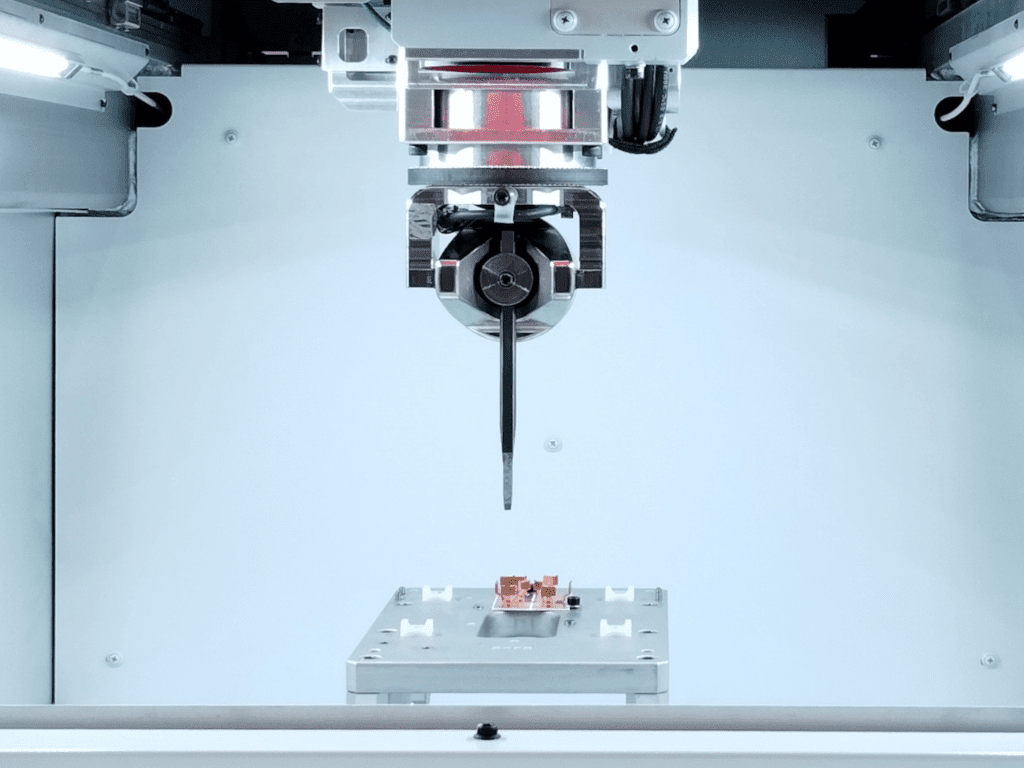
In a significant advancement for the power electronics sector, global semiconductor equipment manufacturer Kulicke & Soffa (K&S) has announced the introduction of its ASTERION-TW system. This innovative ultrasonic terminal welding system is engineered to elevate the standards of next-generation power module manufacturing, offering a solid-state interconnect option that stands out within its established ASTERION platform.
The ASTERION-TW system addresses critical demands in markets requiring high reliability, including the rapidly expanding transportation sector, renewable energy infrastructure, and high-performance data centers. Traditional mass-reflow processes often present limitations in these demanding applications. By moving away from heat-based joining methods, the ASTERION-TW system facilitates the bonding of copper terminals up to 2 mm thick without necessitating external heat, adhesives, consumables, or chemical byproducts.

Revolutionising Power Module Assembly with Ultrasonic Technology
The core innovation behind the ASTERION-TW lies in its use of ultrasonic welding, a distinct departure from conventional heat-based joining techniques such as reflow soldering. This solid-state joining process fuses materials at their interface without inducing bulk melting. For power module manufacturing, this approach offers several compelling advantages, chief among them being the reduction of thermal exposure to sensitive components.
Minimising thermal stress is paramount in power electronics, where components are designed to operate under rigorous conditions. Excessive heat during the manufacturing process can degrade material properties, introduce stresses, and ultimately shorten the lifespan of power modules. The ASTERION-TW’s heat-free method mitigates these risks, contributing to the overall reliability and longevity of the assembled units.
Precision and Performance in Design
Beyond its fundamental welding principle, the ASTERION-TW incorporates advanced motion control systems designed for unparalleled precision in power module manufacturing. The system features a high-resolution linear motor positioning system, ensuring exceptional accuracy with a weld placement repeatability of ±40 µm (3σ). This level of precision is crucial for densely packed power modules where exact component alignment is vital for performance and thermal management.

Furthermore, the system offers robust operational flexibility, supporting a ±180° weld head rotation. This capability allows for intricate and varied weld geometries, accommodating diverse power module designs. A substantial 150 mm vertical stroke enables access into deep cavities, a common requirement in complex module constructions, while a generous 300 mm x 300 mm work area provides ample space for processing larger or multiple components.
For enhanced manufacturing efficiency, an optional material-handling package is available. This package integrates an inline pallet conveyor equipped with high-force clamping mechanisms, ensuring stable and precise component handling throughout the welding process. An integrated cleaning station further streamlines the workflow, contributing to consistent weld quality and reduced manual intervention.
Advantages of Solid-State Interconnect for Critical Applications
The growing interest in ultrasonic terminal welding within the power electronics industry is largely attributable to the inherent benefits of solid-state joining. Unlike reflow soldering, which relies on melting the bulk interface, ultrasonic welding avoids this, leading to several practical advantages for power module manufacturing.
One primary benefit is the significant reduction in thermal exposure. By eliminating the need for high temperatures, the ASTERION-TW system helps prevent thermal degradation of materials and surrounding components, which is particularly critical for sensitive semiconductors and substrates. This also simplifies the materials stack, as engineers can choose materials based purely on their electrical and mechanical properties rather than their thermal compatibility with a high-temperature joining process.
The adaptability of interconnect schemes is another key advantage. As power module designs evolve rapidly to meet increasing demands for efficiency and power density, a flexible joining process like ultrasonic welding allows manufacturers to integrate new materials and design layouts more easily. This reduces development cycles and manufacturing complexity for next-generation power electronics.
Moreover, Kulicke & Soffa highlights the environmental benefits of the process. Ultrasonic welding is positioned as a greener manufacturing option, characterised by lower energy consumption compared to heat-intensive methods. It also boasts zero emissions and improved recyclability of assembled components, aligning with global initiatives for sustainable manufacturing practices across the transportation, renewable energy, and data centre sectors.
Expanding the ASTERION Portfolio for Comprehensive Solutions
The ASTERION-TW is the latest addition to Kulicke & Soffa’s extensive power interconnect lineup, reinforcing the company’s commitment to providing comprehensive solutions for advanced power module manufacturing. This portfolio already includes the established AVALINE clip attach systems, the foundational ASTERION wire and ribbon wedge bonding platform, and ASTERION-PW for pin welding.
The expansion of the ASTERION platform signifies K&S’s strategic focus on addressing the evolving needs of the power electronics market. Ivy Qin, General Manager of Ball & Wedge Bonding at Kulicke & Soffa, affirmed this commitment, stating, “ASTERION-TW reflects our commitment to deliver high performance interconnect solutions through engineering excellence and close collaboration with our customers.”
This holistic approach allows manufacturers to source a range of critical interconnect technologies from a single, experienced provider, streamlining their production processes and ensuring compatibility across different stages of power module assembly. As electric vehicles become more prevalent, renewable energy sources proliferate, and data centres continue to expand, the demand for robust, efficient, and environmentally conscious power module manufacturing solutions will only intensify, making innovations like the ASTERION-TW increasingly vital.