
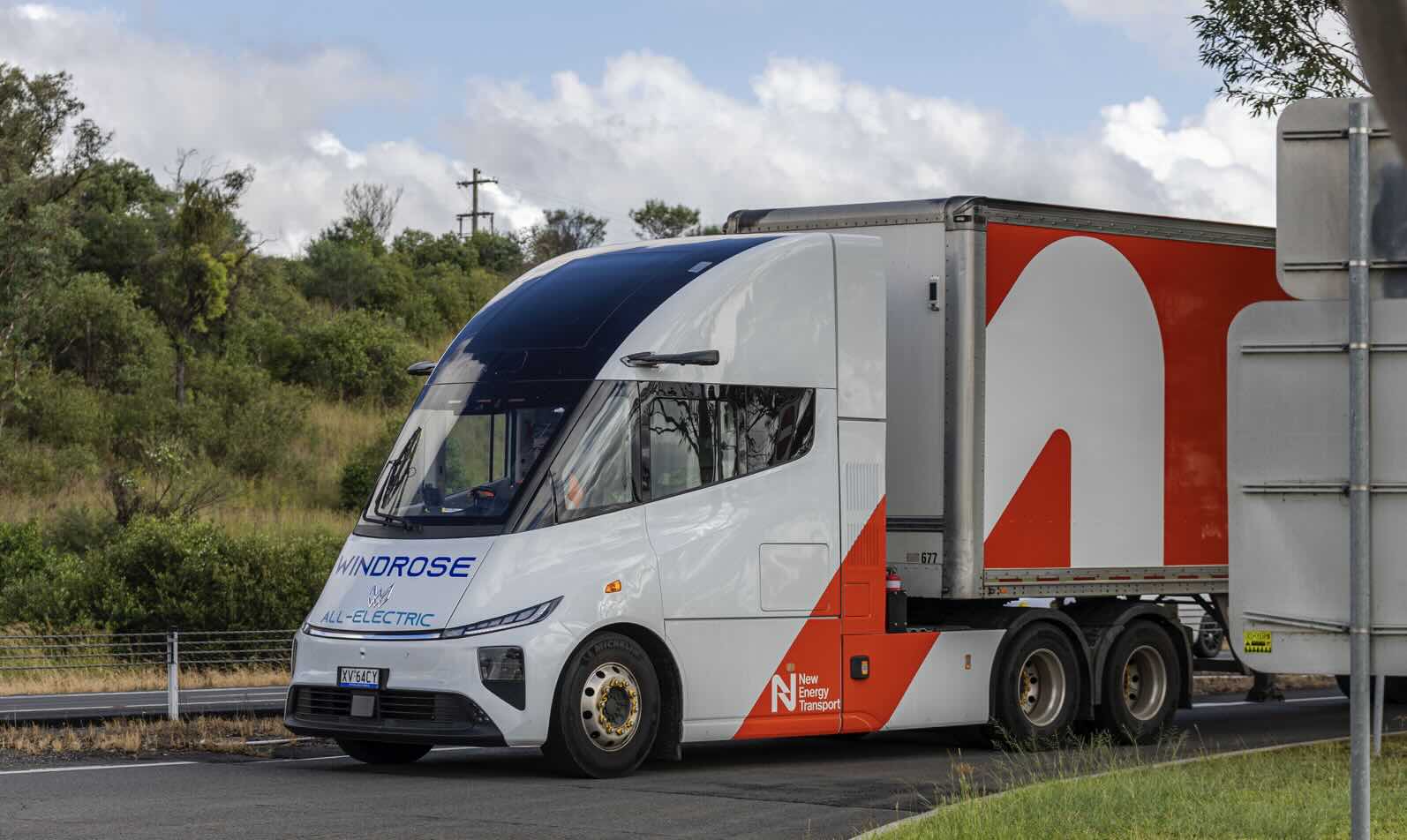
A new chapter in Australian road freight has commenced with the successful completion of the nation’s inaugural inter-city all-electric delivery from a warehouse to its customers. This landmark journey demonstrated significantly lower operational costs and enhanced efficiency compared to traditional diesel-powered transportation, heralding a transformative era for electric trucking Australia.
New Energy Transport (NET), an innovative electric trucking company, orchestrated this pivotal achievement. The delivery involved a bulk consignment of Who Gives A Crap toilet paper, transported from Sydney to Canberra using an electric prime mover, followed by a fleet of electric last-mile delivery trucks to reach final destinations.

Pioneering the Electric Route: Sydney to Canberra
The 460-kilometre journey between Sydney and Canberra served as a crucial proving ground for the capabilities of modern electric heavy vehicles. The core of this operation was a Chinese-made Windrose electric prime mover, augmented by electric last-mile delivery vehicles supplied by logistics group ANC.
Daniel Bleakley of New Energy Transport highlighted the profound economic benefits observed during the trial. The energy costs incurred for the entire 460-kilometre trip, encompassing both the Windrose prime mover and the ANC last-mile fleet, were reported to be an astounding 85 per cent lower than the equivalent cost for a conventional diesel truck.
Beyond cost savings, the electric convoy also demonstrated superior speed. The Windrose electric prime mover, equipped with a substantial 700 kWh battery, completed the entire Sydney-Canberra route on a single charge. Crucially, its ability to maintain consistent speed up steep inclines – a common challenge for diesel trucks – allowed it to complete the journey 25 minutes faster.

Economic Imperatives and Supply Chain Resilience
This development arrives at a critical juncture for Australia’s transport sector. Against the backdrop of global geopolitical instability, particularly the Middle East conflict, and the resultant soaring costs of diesel, the economic pressures on the Australian trucking industry have become immense. Many smaller operators are facing an existential crisis, finding it increasingly unviable to operate their vehicles due to escalating fuel expenses.
Bleakley emphasised the broader implications of this electric transition. “This delivery ushers in a new era for Australian road freight where electric heavy trucks are not just cheaper and faster, they unshackle Australia from volatile global oil markets, dramatically strengthening our supply chain resilience,” he stated. He further urged key stakeholders: “Australia must act now and seize this moment to decouple from diesel. Australia’s major transport buyers, including our supermarket chains who depend on diesel-based trucking to deliver food to millions, have a responsibility to accelerate the transition to resilient road freight.”
Overcoming the Capital Cost Hurdle
Despite the compelling operational savings, a significant barrier for many current operators, especially smaller businesses, remains the substantial upfront capital cost of electric trucks. While the total cost of ownership now demonstrably favours electric vehicles over their lifespan, the initial acquisition price for an electric prime mover is considerably higher than its diesel counterpart.
Bleakley elucidated the contrasting financial models. A traditional diesel trucking business is characterised by low capital expenditure (capex) and high operational expenditure (opex). The upfront cost of a diesel prime mover is typically around $250,000, but this is offset by an estimated $2 million in fuel costs over a decade. The electric truck business model, however, inverts this dynamic.
The upfront investment for an electric prime mover is higher, approximately $500,000, though the Windrose model used in the recent trial reportedly hovers around $450,000. This higher initial outlay is compensated by dramatically reduced fuel costs throughout the vehicle’s operational life. The core challenge lies in empowering operators to secure the upfront capital required to access these long-term benefits of lower fuel costs, faster trips, and a quieter, less stressful environment for drivers.
The Untapped Potential of Long-Haul Electric Trucking
Currently, Australia’s fleet of electric trucks, numbering around 140 of various sizes, predominantly operates in local logistics and intra-city routes. However, Daniel Bleakley firmly believes that the economic advantages of electric trucking are even more pronounced for long-haul operations.
“You are burning a lot of diesel when you are moving 60 tonnes of freight over 1,000 kms,” he noted, explaining his conviction. “We believe the economics are much better with electric trucks for long haul rather than last mile operations.” This perspective suggests a vast untapped potential for electric trucking Australia to revolutionise inter-state freight movement.
James Walmsley, Director of Business Development at Windrose, provided further details on their advanced technology. The Windrose truck boasts an impressive range of up to 670km when carrying a combined mass of 49 tonnes, with the added advantage of a rapid one-hour recharge time. He affirmed that “The Windrose next-generation electric long-haul trucks can match diesel routes at much lower cost.”
Investing in Infrastructure and Policy Support
Realising the full potential of electric trucking Australia necessitates significant investment in crucial supporting infrastructure. Daniel Bleakley underscored the urgent need for a robust charging network capable of accommodating heavy electric vehicles across long distances, along with sustained government support to facilitate the industry’s transition.
He articulated the essential role of policy: “Governments at all levels also have a major role to play. By co-investing in charging infrastructure and making electric prime movers more affordable through targeted subsidies and incentives, they can catalyse industry adoption and unlock long-term economic, productivity, and energy security benefits for Australia.”
Industry Endorsement and Future Outlook
The success of this pilot project has garnered strong endorsement from industry leaders. Simon Griffiths, co-founder and CEO of Who Gives A Crap, emphasised the environmental imperative: “decarbonising supply chains is one of the most impactful steps any business can take for the planet.”
Griffiths further highlighted the immediate feasibility of this transition, stating, “We are proving that the transition to electric vehicle fleets isn’t just a future goal – it’s possible right now.” He affirmed that “By integrating EV freight into our own operations, we’re demonstrating that the solutions are ready and effective for Australian commerce.” He concluded by stressing the power of collective action: “We know that as more businesses make the switch to electric, we create the collective momentum needed to transform our national logistics network.”
The successful Sydney-Canberra delivery marks a critical juncture for electric trucking Australia. It provides tangible evidence that electric heavy vehicles are not only viable but superior in terms of cost-efficiency and performance for inter-city routes. While challenges related to upfront capital and charging infrastructure remain, the demonstrated benefits lay a strong foundation for a more resilient, cost-effective, and environmentally sustainable future for the nation’s freight industry.
Readers interested in further insights into the evolving landscape of electric transport can refer to related discussions:
See also: As petrol and diesel prices soar, EV fast-charging costs are falling
And: “I don’t think she’ll be right this time; Many in trucking industry say it’s electric or bust