
Key Takeaways
- Alpitronic has introduced its HYC1000 megawatt chargers in the U.S., currently undergoing testing at its North Carolina headquarters.
- These advanced chargers offer unprecedented power delivery, up to 1,000 kilowatts (kW) for semi-trucks and 600 kW for passenger electric vehicles (EVs).
- The technology significantly surpasses the charging capabilities of most existing EVs, signaling a transformative shift in ultra-fast EV charging.
- Featuring a modular design and intelligent power management, the HYC1000 aims to make EV recharging as swift and seamless as conventional refueling.
- The arrival of these chargers could catalyze automakers to develop next-generation EVs capable of accepting higher charging rates, fostering broader EV adoption.
Charlotte, North Carolina – A new era in electric vehicle (EV) charging infrastructure is dawning in the United States with the arrival of Alpitronic’s cutting-edge HYC1000 megawatt chargers. These revolutionary units, currently undergoing rigorous testing at the Italian company’s North American headquarters in Charlotte, promise to redefine the speed and efficiency of EV charging.
With capabilities extending up to an astounding 1,000 kilowatts (kW) of power to a single port for heavy-duty semi-trucks and an impressive 600 kW for passenger electric vehicles, these chargers represent a significant leap forward. This capacity dramatically surpasses what even the fastest-charging EVs currently available in the U.S. can accept.

Alpitronic Unveils Groundbreaking Ultra-Fast EV Charging Technology
Alpitronic’s HYC1000 megawatt chargers are designed to deliver power outputs that were once considered futuristic. The ability to supply up to 1,000 kW for heavy-duty applications positions these chargers as a critical component for the electrification of commercial fleets, addressing a significant barrier to their widespread adoption.
For passenger vehicles, the 600 kW output is equally transformative. While current top-tier EVs like the Porsche Cayenne Electric, BMW iX3, and Lucid Gravity typically peak at around 400 kW, the HYC1000 offers substantial headroom for future EV models.
A Leap in Charging Speed and Efficiency
The introduction of such high-power systems is poised to usher in a new paradigm of ultra-fast EV charging across North America. This development holds the potential to significantly alleviate one of the primary bottlenecks hindering mass EV adoption: the time required for recharging.

Achieving charging speeds that rival, or even surpass, the refueling time of conventional gasoline vehicles could fundamentally alter public perception and accelerate the transition to electric mobility. These megawatt EV charging stations aim to make the process as seamless and convenient as possible for drivers.
Mike Doucleff, President of Alpitronic Americas, recently elaborated on the functionality and benefits of the HYC1000 chargers in a video from the Out Of Spec Reviews YouTube channel. His explanations highlighted the sophisticated engineering behind these high-power systems and their potential impact on the evolving EV ecosystem.
Expanding Footprint and Advanced Charger Design
Alpitronic has rapidly established itself as a prominent and fast-growing provider of charging hardware in the U.S. market. Over a relatively short period, the company has forged strategic partnerships with several leading charging networks, including Ionna, Walmart, Mercedes-Benz High Power Charging, Electrify America, and BP Pulse.
These collaborations have already led to the widespread deployment of hundreds of Alpitronic’s HYC400 chargers nationwide, a trend that continues at a rapid pace. The HYC1000 builds upon this foundation, pushing the boundaries of charging technology even further.
Key Features of the HYC1000 Megawatt Dispensers
The newer HYC1000 megawatt dispensers feature a sleek, tall, and rectangular design. Each unit is engineered to accommodate two charging cables, offering versatility and efficiency at the charging stall. They are designed to support a range of industry standards, including the Tesla-style North American Charging Standard (NACS) cables, Combined Charging System (CCS) cables, and the Megawatt Charging Standard (MCS) cable specifically for heavy-duty trucks.
Network providers can configure these chargers with various cable combinations to meet the specific demands of their sites. Enhancing user convenience, the units incorporate swinging arms at the top to manage cable weight, a vehicle-facing touchscreen display for real-time charging details, and an integrated card reader for payment processing.
Each tower within the HYC1000 system is equipped with two plugs, both capable of simultaneously delivering up to 600 amps and 1,000 volts, translating to a substantial 600 kW of power output per plug. This capacity significantly outstrips the current fastest chargers available in the U.S., such as the Tesla V4 Superchargers and the Gravity Charging Center in New York City, which currently top out at 500 kW.
Intelligent Power Management for Optimal Charging
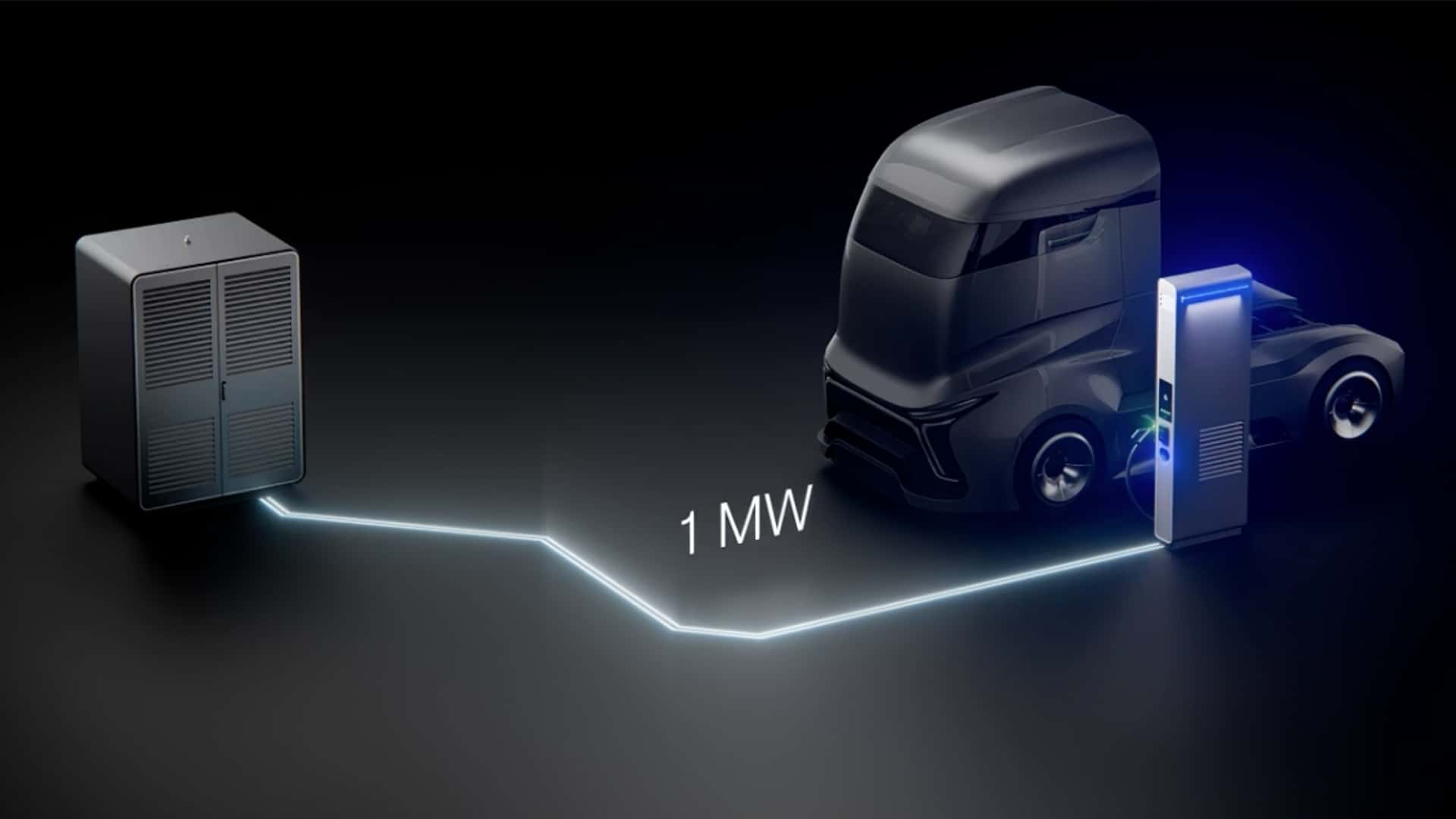
The modularity of these megawatt EV charging units is a significant innovation. The chargers can be configured to deliver a formidable 1,500 amps and 1,000 volts when utilizing the MCS standard, catering specifically to the needs of heavy-duty electric trucks.
This flexibility means that a single charging location can be designed to efficiently serve both semi-trucks and passenger EVs concurrently, optimizing site utilization and addressing diverse charging requirements. Furthermore, Alpitronic collaborated with Mercedes-AMG to develop a specialized version of the HYC1000 capable of delivering 1,000 kW to a passenger EV, exemplified by the Concept AMG GT XX which peaked at 1,041 kW during tests in Italy last year.
Distributed Power Delivery for Precision Charging
A core innovation lies in the dispensers’ distributed power delivery system. The main cabinet houses eight 125 kW silicon carbide power modules, which collectively can power up to eight individual charging towers. Each of these 125 kW modules is further subdivided into 62.5 kW units.
This granular subdivision enables a highly precise distribution of power, dynamically adjusting to the specific demand at each charging stall. This intelligent allocation ensures that power is delivered exactly where it is needed, minimizing waste and maximizing efficiency. For instance, if a Chevy Equinox EV, which typically peaks at 150 kW, is charging next to a Hyundai Ioniq 5, capable of accepting up to 350 kW, the system can precisely deliver the required speeds to each vehicle.
This smart power management is particularly beneficial because EVs typically demand their full charging power at lower states of charge, with the rate gradually tapering off as the battery fills. The HYC1000’s ability to match this fluctuating demand optimizes the charging process for every vehicle.
It is important to note that Alpitronic is not alone in implementing dynamic load balancing technology. Other prominent charging providers such as Tesla, ChargePoint, and Electrify America have also adopted similar sophisticated approaches to power distribution across their networks.
The Global Race for Ultra-Fast EV Charging
While megawatt EV charging technology is gaining traction in the U.S., its democratization is already underway in other parts of the world. In China, for example, mass-market electric vehicle models from manufacturers like BYD and Geely are increasingly integrating megawatt charging capabilities, making ultra-fast charging more accessible to everyday consumers.
In the U.S., Alpitronic is among several key players advancing megawatt-scale charging solutions. Tesla has been rolling out its Megachargers specifically designed for its Semi electric trucks, and Kempower also has plans to deploy similar high-power solutions for the electric semi-truck sector.
The progression of this advanced charging technology, initially focused on heavy-duty applications, increasingly indicates a future where it will trickle down to passenger EVs in the U.S. This development would mark a significant victory for EV adoption, addressing range anxiety and charging convenience concerns that remain prevalent among potential buyers.
The continuous innovation in ultra-fast EV charging technology, spearheaded by companies like Alpitronic, is crucial for accelerating the global transition to sustainable transportation. As charging times decrease and infrastructure expands, the appeal and practicality of electric vehicles will only continue to grow.
FAQ Section
What are Alpitronic HYC1000 megawatt chargers?
Alpitronic HYC1000 chargers are next-generation electric vehicle charging stations capable of delivering extremely high power. They can provide up to 1,000 kilowatts for heavy-duty trucks and 600 kW for passenger EVs, significantly faster than most current charging solutions available in the U.S. These are being tested in North Carolina.
How much faster are these new chargers compared to existing ones?
The HYC1000 chargers can deliver up to 600 kW per port for passenger EVs, while the fastest existing U.S. chargers (like Tesla V4 Superchargers) typically top out at 500 kW. For heavy-duty vehicles, they can reach 1,000 kW. This capacity can charge some EV batteries from 10% to 80% in as little as seven minutes or less, pending vehicle compatibility.
Which types of EVs can utilize these megawatt EV charging stations?
These chargers are designed to be versatile, supporting NACS, CCS, and MCS charging standards. While heavy-duty electric trucks can leverage the full 1,000 kW MCS capability, passenger EVs equipped with compatible high-voltage architectures (such as the Porsche Cayenne Electric or Lucid Gravity, which top out around 400 kW) can benefit from up to 600 kW, with future models expected to accept even higher rates.
What is unique about the HYC1000’s power distribution?
The HYC1000 features a sophisticated distributed power delivery system. It uses multiple silicon carbide power modules, which are further subdivided into smaller units (e.g., 62.5 kW). This modular design allows for dynamic load balancing, precisely delivering the required power to each vehicle based on its capacity and state of charge, optimizing efficiency across multiple charging stalls simultaneously.
How will these chargers impact EV adoption in the U.S.?
By drastically reducing charging times, these megawatt EV charging stations address a key concern for potential EV buyers: range anxiety and the inconvenience of long charging stops. Making EV recharging comparable to traditional refueling times will enhance the overall user experience, encourage automakers to develop more advanced EVs, and ultimately accelerate the mass adoption of electric vehicles in the United States.