
Key Takeaways:
- Alpitronic has introduced its HYC1000 megawatt chargers for testing at its North American headquarters in Charlotte, North Carolina.
- These chargers can deliver up to 1,000 kilowatts (kW) to a single port for semi-trucks and up to 600 kW for passenger electric vehicles (EVs).
- The technology significantly surpasses the charging capabilities of most existing fast chargers and current EVs in the U.S., which typically max out around 400-500 kW.
- The HYC1000 features a modular design, distributed power delivery, and supports multiple charging standards, promising ultra-fast charging sessions.
- Despite the advanced infrastructure, widespread adoption hinges on automakers releasing EVs capable of accepting such high power levels, addressing a critical bottleneck in mass EV integration.
The landscape of electric vehicle charging in the United States is poised for a significant transformation with the arrival of Alpitronic’s groundbreaking megawatt EV charging technology. The Italian hardware provider is currently testing its new HYC1000 chargers at its North American headquarters in Charlotte, North Carolina, marking a pivotal moment for ultra-fast EV charging infrastructure.

These advanced charging units boast the capacity to deliver an unprecedented 1,000 kilowatts of power to a single port, primarily for heavy-duty semi-trucks. For passenger electric vehicles, the chargers can still provide a robust 600 kW. This capacity far exceeds what even the fastest-charging consumer EVs in the U.S. market can currently accept.
The introduction of such high-power systems could fundamentally alter the perception and practicality of electric vehicle ownership. Charging speed has long been identified as a critical bottleneck impeding the mass adoption of EVs. Systems like Alpitronic’s megawatt EV charging promise to make the experience of replenishing an EV battery as quick and seamless as refueling a conventional gasoline car.
The Dawn of Ultra-Fast Charging
Alpitronic has rapidly established itself as a key player in the U.S. charging infrastructure market. Over the past few years, the company has forged partnerships with prominent charging networks, including Ionna, Walmart, Mercedes-Benz High Power Charging, Electrify America, and BP Pulse. These collaborations have already led to the deployment of hundreds of Alpitronic HYC400 chargers nationwide, with expansion continuing at a swift pace.

The newer HYC1000 charger represents a substantial leap forward in megawatt EV charging capabilities. These dispensers are characterized by their sleek, tall rectangular design, each equipped to accommodate two charging cables. They offer versatile compatibility, supporting Tesla’s North American Charging Standard (NACS) cables, CCS cables, and the heavy-duty Megawatt Charging Standard (MCS) cable, catering to diverse network provider requirements.
Enhancing user convenience and functionality, the chargers feature swinging arms at the top to manage cable weight, a vehicle-facing touchscreen for displaying essential charging details, and an integrated card reader for payment processing.
Unmatched Power Output and Design Innovation
Each HYC1000 tower is engineered with two plugs, both capable of simultaneously delivering up to 600 amps and 1,000 volts, equating to an impressive 600 kW of power. To put this into perspective, some of the fastest existing chargers in the U.S., such as Tesla’s V4 Superchargers and the Gravity Charging Center in New York City, peak at around 500 kW.
However, the current generation of passenger EVs in the U.S. is not yet equipped to handle such immense power levels. Premium models like the Porsche Cayenne Electric, BMW iX3, and Lucid Gravity presently top out at approximately 400 kW. This creates a fascinating scenario where the infrastructure is now outpacing the vehicles it serves, highlighting the need for concurrent advancements in automotive battery technology.
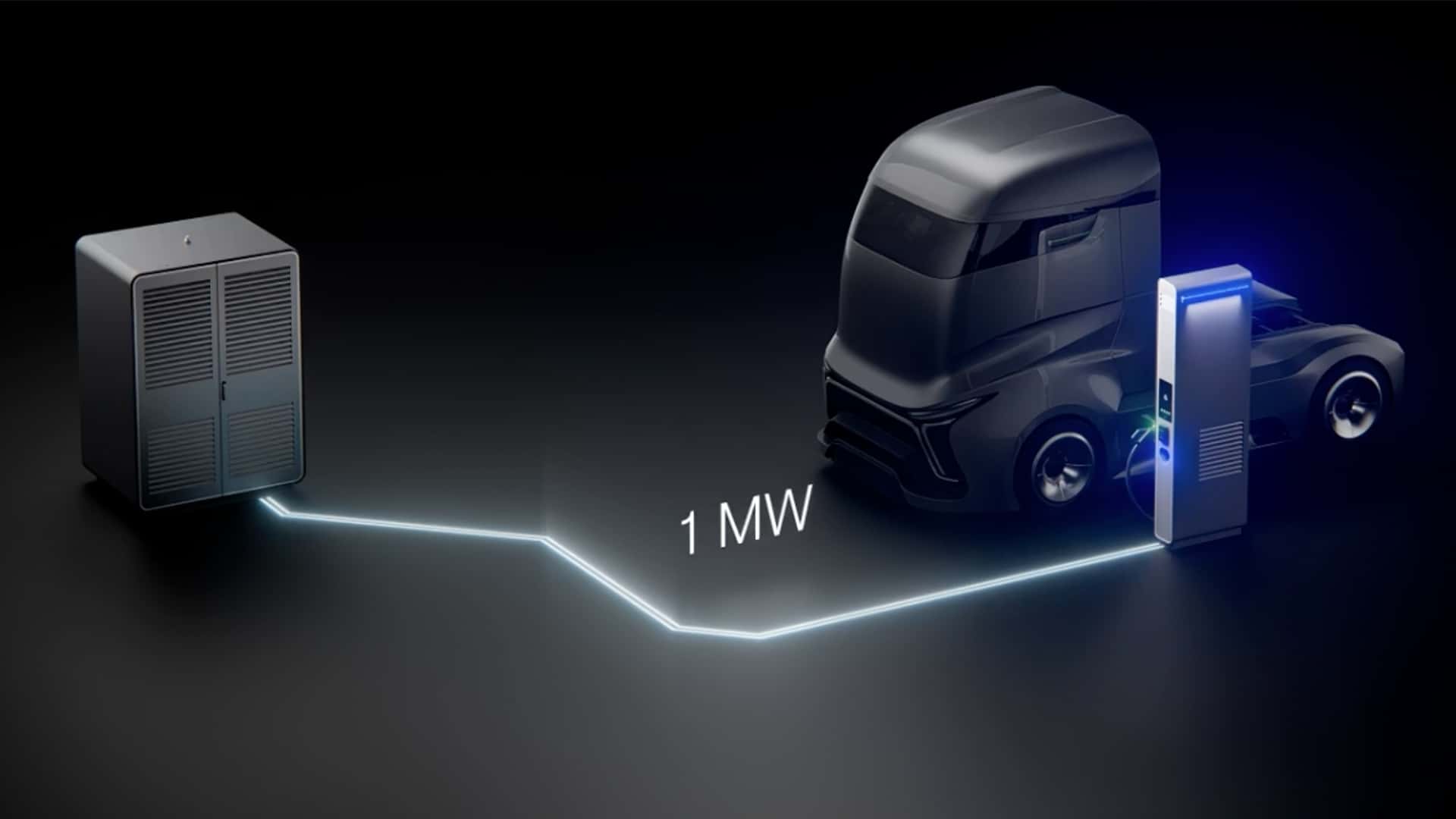
The modularity of the HYC1000 chargers is a significant technical advantage. The system can be configured to deliver 1,500 amps and 1,000 volts when utilizing the MCS standard, making it ideal for the demanding requirements of semi-trucks. This flexibility allows a single charging location to serve both heavy-duty vehicles and passenger EVs simultaneously, depending on the site’s design and the specific combination of available plugs.
In a demonstration of extreme capability, Alpitronic collaborated with Mercedes-AMG to develop a specialized version of the HYC1000. During a test run in Italy last year, this customized unit successfully delivered 1,041 kilowatts to a passenger EV prototype, the Concept AMG GT XX, showcasing the immense potential of megawatt EV charging for future high-performance vehicles.
Intelligent Power Management
A core innovation within the Alpitronic HYC1000 system is its distributed power delivery architecture. The central cabinet houses eight 125 kW silicon carbide power modules, designed to energize up to eight individual charging towers. Furthermore, each 125 kW module is precisely subdivided into 62.5 kW units, enabling highly granular and efficient power distribution based on the specific demand at each charging stall.
This intelligent power management system ensures that energy is allocated precisely where it’s needed, without over-delivering power to vehicles that cannot utilize it fully. For instance, if a Chevrolet Equinox EV, which peaks at 150 kW, and a Hyundai Ioniq 5, capable of charging at up to 350 kW, are parked side-by-side, the charger can precisely match their individual power requirements. This dynamic allocation is particularly beneficial because EVs typically demand their full charging power at lower states of charge, with speeds gradually tapering off as the battery fills.
While Alpitronic’s implementation is sophisticated, dynamic load balancing and smart power management are not exclusive to the company. Leading charging providers such as Tesla, ChargePoint, and Electrify America have also integrated similar approaches into their networks to optimize efficiency and user experience.
The Global Context and Future Outlook
The concept of megawatt EV charging is not entirely new on the global stage. In China, for example, this ultra-fast charging technology is already becoming democratized, with mass-market models from manufacturers like BYD and Geely increasingly equipped to handle higher charging rates.
In the U.S., Alpitronic is not alone in pushing the boundaries of high-power charging. Tesla has begun deploying its Megachargers specifically for its Semi electric trucks, and Kempower has announced similar plans for electric semi-trucks. These initiatives underscore a broader industry trend towards enabling faster charging for commercial and heavy-duty electric vehicles.
The potential for megawatt EV charging to eventually trickle down to passenger EVs in the U.S. represents a significant win for broader EV adoption. Faster charging times directly address range anxiety and inconvenience, making electric vehicles a more viable and attractive option for a wider segment of the population. As automakers continue to innovate battery technology and vehicle architectures, the synergy with advanced charging infrastructure like Alpitronic’s HYC1000 will be crucial in accelerating the transition to an all-electric future.
Frequently Asked Questions About Megawatt EV Charging
What is megawatt EV charging?
Megawatt EV charging refers to electric vehicle charging systems capable of delivering power at rates of 1,000 kilowatts (1 megawatt) or more. This technology significantly surpasses typical fast chargers, which currently operate in the 50 kW to 500 kW range, enabling substantially quicker charging times for compatible electric vehicles, especially heavy-duty trucks.
How fast can Alpitronic’s HYC1000 chargers charge an EV?
Alpitronic’s HYC1000 megawatt chargers can deliver up to 1,000 kW for semi-trucks and up to 600 kW for passenger EVs per port. While this infrastructure is capable of charging batteries from 10-80% in 7 minutes or less for compatible vehicles, current passenger EVs in the U.S. typically top out around 400 kW and cannot fully utilize these higher rates.
Are current EVs in the U.S. ready for megawatt charging?
Generally, current passenger EVs in the U.S. are not yet fully ready for the 600-1,000 kW power levels offered by these new chargers. The fastest-charging models currently accept around 400 kW. While the infrastructure is a significant step forward, widespread utilization of its full capacity by consumer vehicles will require future advancements in EV battery and charging port technology by automakers.
What charging standards do the HYC1000 chargers support?
The Alpitronic HYC1000 megawatt EV charging units are designed for broad compatibility, supporting the Tesla-style North American Charging Standard (NACS) cables, the Combined Charging System (CCS) cables, and the Megawatt Charging Standard (MCS) cable, which is primarily used for heavy-duty trucks. This allows flexibility for various vehicle types and network providers.
How does distributed power delivery work in these chargers?
The HYC1000 chargers employ a modular and distributed power delivery system. A central cabinet contains eight 125 kW silicon carbide power modules, each further subdivided into 62.5 kW units. This allows for precise and dynamic allocation of power to individual charging stalls, ensuring that each vehicle receives the optimal amount of power it can accept without waste, maximizing efficiency.