
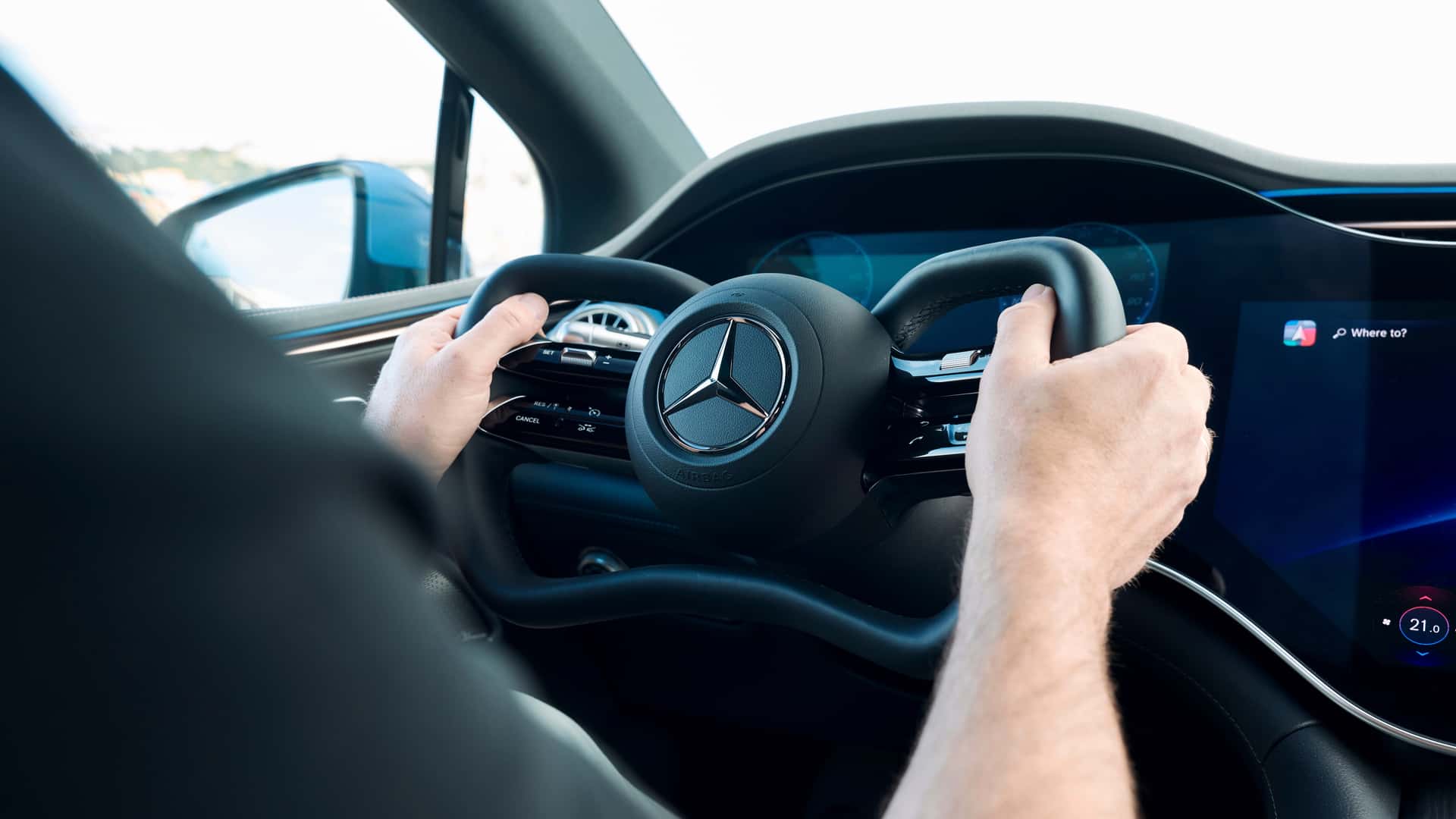
Mercedes-Benz is poised to introduce a groundbreaking optional steer-by-wire system in its refreshed EQS luxury electric vehicle, a development that promises to redefine the driving experience. This innovative technology, which replaces the traditional mechanical link between the steering wheel and the front wheels with an electronic interface, was recently put to the test in an EQS prototype, offering a glimpse into the future of automotive steering.
While Mercedes-Benz is not the pioneer in offering steer-by-wire in a production vehicle, early impressions suggest that its iteration of the system could establish a new benchmark in the industry. A recent evaluation of an EQS prototype equipped with this advanced system, conducted back-to-back with a standard EQS model, revealed a stark contrast in driving dynamics and driver engagement.
Understanding Steer-by-Wire Technology
At its core, steer-by-wire fundamentally alters how a driver interacts with a vehicle’s steering mechanism. Unlike conventional systems where a physical shaft connects the steering wheel directly to the steering rack, steer-by-wire operates entirely through electronic signals. The driver’s input at the steering wheel is converted into electrical commands that are then transmitted to actuators on the steering rack, which control the direction of the wheels.
This digital intermediary opens up a realm of possibilities that mechanical systems cannot match. A primary advantage is the implementation of an infinitely variable steering ratio. In traditional setups, the ratio between the steering wheel’s rotation and the wheels’ turn angle is fixed at the factory. However, with a steer-by-wire system, this ratio can be dynamically adjusted based on factors such as vehicle speed and selected driving mode.
The ability to vary the steering ratio significantly impacts how the vehicle responds. For instance, at lower speeds or during intricate maneuvers like a three-point turn, the system can reduce the amount of steering wheel rotation required to achieve full lock. This design choice streamlines the driving process, demanding notably less physical effort from the driver and simplifying complex maneuvers in confined spaces.
Beyond functional enhancements, the absence of a physical steering column grants designers unprecedented freedom in crafting the steering interface itself. Mercedes-Benz has leveraged this flexibility in the EQS steer-by-wire prototype, opting for a steering device that diverges dramatically from conventional designs. This innovative steerer, akin to an aircraft yoke or a race car’s control, replaces the traditional circular wheel, highlighting the system’s transformative potential for cabin ergonomics and driver interface.
Initial Impressions from the Driver’s Seat
The experience of driving the Mercedes EQS equipped with the steer-by-wire system proved to be immediately distinct from conventional driving. During a test drive, an engineer accompanying the journalist reportedly described the system as “lazier,” a term that, despite its informal nature, accurately encapsulates the reduced effort required from the driver. This ‘laziness’ translates into a significant reduction in the typical “bus driver hand-shuffling” often associated with maneuvering larger luxury sedans.
The system allows the driver to simply “point the thing where you want to go,” underscoring the intuitive and minimal input necessary to guide the vehicle. However, this perceived ease does not equate to a dull or unresponsive feel. On the contrary, the initial impression is one of remarkable alertness. The front end of the vehicle exhibits an astonishingly quick reaction to steering inputs, demanding a brief adjustment period for the brain to recalibrate from expecting the more sedate responses typically associated with a vehicle of the EQS’s considerable size and luxury segment.
The paradoxical sensation of requiring less effort while simultaneously experiencing a heightened level of responsiveness defines the unique character of the Mercedes EQS steer-by-wire system. This dynamic interplay between reduced physical input and amplified vehicle reaction creates a driving experience that is both effortless and surprisingly dramatic, particularly for a luxury electric sedan.
Performance Dynamics and Enhanced Agility
The immediate and precise response offered by the Mercedes EQS steer-by-wire system holds significant promise, especially for vehicles designed with a sporty character. While it doesn’t necessarily foster a traditional “connected” feel, it imbues the front end with a distinct sharpness and an almost “impatient” quality. This characteristic suggests that the vehicle feels poised to turn even before the driver has fully processed the intention, creating an exhilarating sense of agility.
This responsiveness could translate into a more engaging driving experience, making the EQS feel far more nimble than its physical dimensions might suggest. The sensation is akin to a car that “literally wants to take a bite out of that early apex out on track,” a vivid description that highlights the system’s potential to inject a performance-oriented edge into luxury driving. This agility would be particularly beneficial in urban environments, allowing for effortless navigation through traffic and tighter turns, while also enhancing confidence on winding roads by providing swift and decisive steering.
Addressing Critical Concerns: Steering Feel and Latency
A perennial concern with electronically assisted steering systems, and a heightened one with full steer-by-wire, is the potential for a loss of tactile feedback or “feel.” Modern vehicles, even sports cars, are often criticised for isolating drivers from the road, leading to a “numb and disconnected” steering sensation. Intuitively, a fully electronic setup might seem to exacerbate this issue by removing the last vestige of mechanical connection.
However, Mercedes-Benz engineers contend that the opposite is true for their system. They assert that the Mercedes EQS steer-by-wire technology actively enhances feedback and minimizes latency. This is achieved through the sophisticated integration of two electric motors designed to simulate road feel and ensure instantaneous response. These motors work in concert to generate the necessary tactile sensations that drivers associate with a responsive steering system, effectively bridging the gap created by the absence of a direct mechanical link.
While the low-speed test course used for the prototype evaluation did not fully showcase the nuances of this simulated feedback, its benefits are expected to become more pronounced at higher speeds and during aggressive cornering. The system’s ability to precisely control and replicate steering forces is designed to provide drivers with a clear understanding of the front axle’s grip and behaviour, a crucial element for confident and engaging driving.
Regarding latency, a common misconception is that a conventional steering column inherently offers an instant, lag-free connection. However, as a Mercedes engineer explained during the test drive, traditional systems are not entirely devoid of delay. The presence of multiple joints within the steering column, the inherent compliance of rubber components, and the integration of an electrically assisted steering rack all contribute to a measurable degree of lag in conventional setups.
In contrast, the Mercedes steer-by-wire system is engineered to surpass conventional solutions in terms of responsiveness. The engineer stated that the electronic system achieves an impressive one-millisecond delay, a figure that is reportedly less than the cumulative lag found in many traditional steering systems. This near-instantaneous response was visually affirmed during static tests, where rapid movements of the steering yoke translated immediately to the wheels, demonstrating the system’s remarkable precision and minimal lag.
A Comparative Revelation: Steer-by-Wire vs. Traditional Steering
The true impact of the Mercedes EQS steer-by-wire system became strikingly apparent when the journalist transitioned from the prototype back into a standard EQS model. The conventional vehicle, despite being a modern luxury electric sedan, immediately felt “older.” This was not due to any inherent flaw in the standard EQS, which remains a sophisticated and capable vehicle, but rather a direct consequence of the advanced capabilities demonstrated by the steer-by-wire system.
The return to traditional steering highlighted the “extra arm work” required and the “slower responses” that had become almost unnoticeable before experiencing the electronic alternative. There was a “faint sense that this big luxury EV is asking more of you than it needs to,” an observation that underscores the degree to which the steer-by-wire system enhances driver comfort and reduces operational burden. The effortlessness and precision of the electronic system made the conventional setup feel comparatively cumbersome and less refined.
This direct comparison served as a powerful testament to the transformative potential of the Mercedes EQS steer-by-wire technology. While a definitive judgment awaits extensive testing on public roads, the initial impressions are overwhelmingly positive. Mercedes-Benz appears to have harnessed a technology that might initially sound like a mere novelty or “gimmick” and successfully applied it to create a fundamental improvement in the driving experience, making conventional steering feel, by comparison, somewhat obsolete.
The Road Ahead for Automotive Innovation
The optional steer-by-wire system for the refreshed Mercedes EQS represents a bold step forward in automotive engineering and driver interface design. By meticulously addressing the inherent challenges of electronic steering, particularly regarding feedback and latency, Mercedes-Benz is pushing the boundaries of what is possible in vehicle control.
The implications of this technology extend beyond mere convenience. It promises enhanced safety through more predictable and immediate vehicle responses, greater customization of driving dynamics across different modes, and expanded possibilities for advanced driver-assistance systems and autonomous driving functionalities. As the automotive industry continues its rapid evolution towards electric and increasingly intelligent vehicles, innovations like the Mercedes EQS steer-by-wire system will be pivotal in shaping the next generation of driving experiences.
While the full impact of this technology will only be fully understood once it reaches wider production and undergoes extensive real-world evaluation, the initial trial offers compelling evidence that Mercedes-Benz has developed a system with the potential to significantly elevate luxury driving, setting a new standard for responsiveness, ease, and dynamic capability.