
Key Takeaways:
- The rapid evolution of Electric Vehicle (EV) architectures, particularly with advanced ADAS and autonomous driving capabilities, necessitates robust, high-bandwidth in-vehicle communication networks.
- Validating these increasingly complex 10GBASE-T1 Automotive Ethernet links demands innovative testing methodologies that go beyond conventional road testing.
- Automated MEMS-based fault insertion systems are emerging as a pivotal solution, enabling engineers to precisely simulate real-world connectivity faults within a controlled lab environment.
- This advanced approach significantly enhances test repeatability, protects crucial signal integrity, accelerates Hardware-in-the-Loop (HIL) validation cycles, and ultimately instills greater confidence in the performance of high-speed automotive networks.
- Industry guides are becoming indispensable resources for test engineers seeking practical strategies to navigate the intricate landscape of multi-gig automotive ethernet validation.
The Imperative for High-Bandwidth In-Vehicle Networks
The automotive industry is undergoing a transformative shift, driven by the relentless pursuit of electric mobility, advanced driver-assistance systems (ADAS), and fully autonomous driving capabilities. This paradigm change has profound implications for in-vehicle communication architectures, which must now handle unprecedented volumes of data with extreme reliability and speed.

As Electric Vehicles (EVs) become increasingly sophisticated, they integrate a growing array of sensors, cameras, and processing units. These components generate terabytes of data that need to be transmitted, processed, and acted upon in real-time, demanding a communication backbone far more capable than traditional automotive networks.
Evolution of EV Architectures and Data Demands
Modern EV architectures are evolving towards centralized, software-defined platforms, moving away from disparate electronic control units (ECUs) communicating over slower buses. This architectural shift consolidates computing power and data flows, creating a need for high-speed, scalable network solutions. The sheer volume of data, ranging from high-resolution video streams for surround view systems to LiDAR point clouds and radar data, necessitates a robust and future-proof networking standard.
Traditional automotive communication protocols, while reliable for their intended applications, simply cannot keep pace with these escalating data demands. The continuous push for enhanced safety, convenience, and connectivity features further underscores the critical role of advanced networking technologies in delivering the full potential of contemporary EVs.

ADAS and Autonomous Driving: The Connectivity Backbone
At the heart of the ADAS and autonomous driving revolution lies the seamless and reliable exchange of data between various vehicle systems. Features such as adaptive cruise control, lane-keeping assist, automatic emergency braking, and ultimately, fully autonomous navigation, depend on instantaneous communication across the vehicle’s network.
Failure or degradation in this communication can have severe safety implications. Therefore, the underlying network infrastructure, specifically high-speed Ethernet, must exhibit unparalleled performance, resilience, and error-free operation. Ensuring the integrity and reliability of this backbone is paramount for the safe deployment of these cutting-edge technologies.
Understanding 10GBASE-T1 Automotive Ethernet
To address the escalating data requirements of advanced EVs, the automotive industry has increasingly adopted Ethernet as the networking standard of choice. Specifically, 10GBASE-T1 Automotive Ethernet represents a significant leap forward, designed to meet the unique demands of in-vehicle environments while offering multi-gigabit speeds.
Key Characteristics and Advantages for Modern Vehicles
10GBASE-T1 is an automotive-specific variant of Ethernet, optimized for single-pair unshielded twisted-pair cabling. This design offers several advantages crucial for vehicle integration, including reduced weight, simpler wiring harnesses, and cost-effectiveness compared to multi-pair shielded cables. It supports data rates up to 10 Gigabits per second, providing the necessary bandwidth for high-resolution cameras, sophisticated sensor fusion, and rapid software updates.
Its robustness against electromagnetic interference (EMI) and its ability to operate reliably within the harsh automotive environment are key differentiators. The standard’s single-pair design also facilitates easier routing and connector integration, making it ideal for the confined spaces within a vehicle, while ensuring high-speed data transfer critical for advanced applications.
The Growing Complexity of Network Validation
While 10GBASE-T1 offers immense benefits, its higher speeds and intricate protocols introduce new layers of complexity for multi-gig automotive ethernet validation. Ensuring that these high-bandwidth links function flawlessly under all potential operating conditions is a formidable engineering challenge. The validation process must account for a wide array of potential faults, from transient signal interference to persistent cable damage, all of which can severely impact network performance and vehicle safety.
Traditional methods of testing, often involving extensive and time-consuming road trials, are proving insufficient. These methods struggle with repeatability, making it difficult to precisely reproduce specific fault conditions or to isolate the root cause of intermittent issues. This lack of control and precision hinders efficient development and thorough verification.
Beyond Road Testing: Simulating Real-World Faults in the Lab
The limitations of conventional testing highlight the urgent need for advanced, lab-based validation techniques. Simulating real-world connectivity faults in a controlled environment offers unparalleled advantages for identifying and rectifying issues early in the development cycle, significantly impacting the safety and reliability of next-generation vehicles.
Challenges of Traditional Validation Approaches
Relying solely on road testing for validating complex multi-gig automotive ethernet networks presents several inherent difficulties. Achieving consistent and repeatable fault conditions is nearly impossible in dynamic real-world scenarios. A fault observed one day may not manifest again in the same way, making diagnosis and rectification an arduous process.
Furthermore, road testing is resource-intensive, demanding significant time, specialized vehicles, and a large testing team. This not only inflates development costs but also extends time-to-market for new vehicle features. The inability to precisely control environmental variables and network stresses further limits the depth and accuracy of the validation process.
Introducing Automated MEMS-Based Fault Insertion
Automated Micro-Electro-Mechanical Systems (MEMS)-based fault insertion is rapidly emerging as a transformative technology for multi-gig automotive ethernet validation. This innovative approach allows test engineers to simulate a vast range of connectivity faults directly within a laboratory setting, offering a level of precision and control previously unattainable.
MEMS devices, characterized by their miniature size and electro-mechanical capabilities, can precisely introduce various fault conditions, such as opens, shorts, or impedance mismatches, onto high-speed data lines. This granular control over fault simulation enables engineers to rigorously test the resilience and error handling capabilities of 10GBASE-T1 links under specific, reproducible scenarios, thereby accelerating the identification of design flaws and potential vulnerabilities.
Enhancing Test Methodologies with MEMS Technology
The integration of MEMS-based fault insertion into the validation workflow provides critical advantages that directly address the complexities of high-speed automotive networking. These benefits are fundamental to improving the overall quality and reliability of in-vehicle communication systems.
Achieving Repeatability and Precision in Fault Simulation
One of the most significant advantages of MEMS-based fault insertion is its ability to ensure high repeatability and precision in test scenarios. Unlike manual methods or ad-hoc fault introduction, MEMS technology allows for the exact replication of specific fault conditions across multiple test runs.
This reproducibility is crucial for thorough debugging and verification, enabling engineers to consistently evaluate the system’s response to errors, refine fault recovery mechanisms, and validate the robustness of network components. Such precision is indispensable for effective multi-gig automotive ethernet validation, particularly in safety-critical ADAS and autonomous driving applications.
Safeguarding Signal Integrity in High-Speed Links
Maintaining signal integrity is paramount for high-speed data transmission like 10GBASE-T1 Automotive Ethernet. Any degradation in signal quality due to interference, impedance mismatches, or cable faults can lead to data loss, increased latency, and ultimately, system failures.
MEMS fault insertion modules are designed to protect signal integrity even while injecting faults. Their low insertion loss and excellent return loss characteristics minimize their impact on the overall signal path when not actively inserting a fault. This ensures that the base performance of the network under test is accurately preserved, allowing for a focused evaluation of how faults specifically affect signal integrity without introducing additional artifacts from the testing apparatus itself.
Accelerating Development: Hardware-in-the-Loop (HIL) Validation
Hardware-in-the-Loop (HIL) validation is a cornerstone of modern automotive development, allowing manufacturers to test complex electronic control units (ECUs) and software in a simulated real-world environment. Integrating advanced fault insertion capabilities significantly enhances the efficacy of HIL systems, thereby accelerating the entire validation process for multi-gig automotive ethernet.
Integrating Fault Insertion for Comprehensive HIL Testing
HIL systems typically simulate the vehicle’s environment, including sensors, actuators, and other ECUs, to interact with the actual hardware under test. By incorporating MEMS-based fault insertion into the HIL setup, test engineers can introduce network anomalies and failures directly into this simulated environment. This allows for a comprehensive evaluation of how ECUs and embedded software react to unexpected communication errors, data corruption, or link disruptions.
Such integration enables early detection of vulnerabilities, validates fault-tolerant designs, and ensures that the vehicle’s systems can gracefully handle adverse network conditions without compromising safety or functionality. This proactive approach to testing dramatically reduces the need for expensive and time-consuming physical prototyping and road testing.
Building Confidence in Network Performance and Reliability
The ability to extensively test 10GBASE-T1 networks with precise and repeatable fault scenarios through HIL and MEMS technology instills greater confidence in the overall performance and reliability of high-speed automotive communication. This rigorous validation process helps identify and mitigate potential risks long before vehicles reach production.
Ultimately, comprehensive multi-gig automotive ethernet validation contributes directly to improved vehicle safety, enhanced operational stability, and a better user experience. By simulating even the most challenging real-world conditions in a controlled lab environment, manufacturers can ensure their advanced EV architectures are robust, resilient, and ready for the demands of the future.
Accessing Expertise in Automotive Ethernet Testing
For test engineers navigating the complexities of modern EV architectures and the critical need for robust multi-gig automotive ethernet validation, specialized resources are invaluable. Understanding the practical approaches to leveraging automated MEMS-based fault insertion can significantly improve testing methodologies.
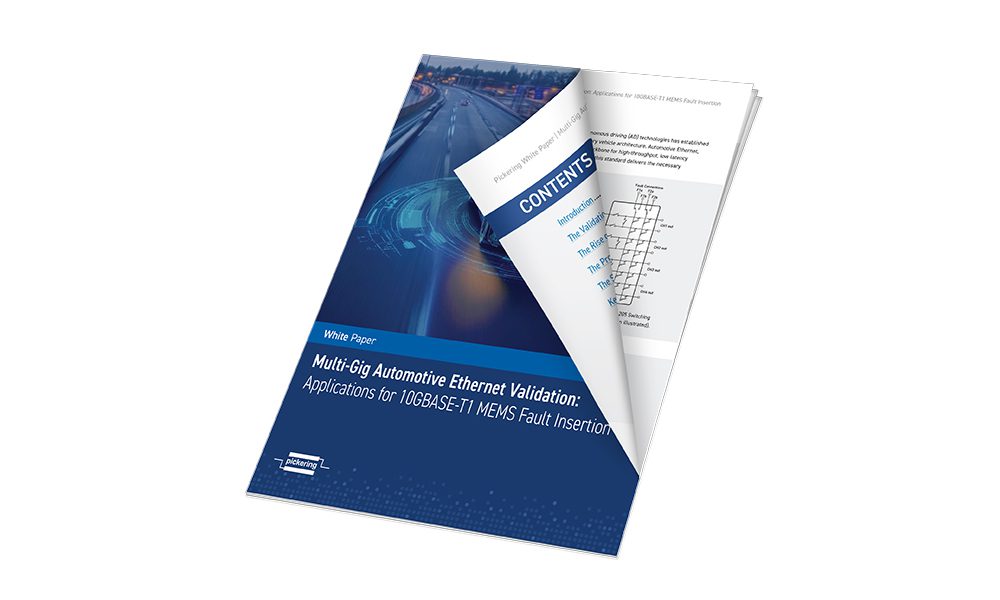
An in-depth white paper, focusing on the applications for 10GBASE-T1 MEMS Fault Insertion, offers practical guidance. It delves into strategies for improving repeatability, protecting signal integrity, accelerating HIL validation, and ultimately building greater confidence in high-speed automotive network performance. Such resources provide actionable insights for engineers committed to pushing the boundaries of vehicle innovation and safety.
Frequently Asked Questions (FAQ)
What is Multi-Gig Automotive Ethernet Validation?
Multi-gig automotive ethernet validation is the process of rigorously testing high-speed in-vehicle communication links (operating at gigabit speeds and above) to ensure their reliability, performance, and adherence to standards. This is crucial for advanced features like ADAS and autonomous driving in modern EVs.
Why is 10GBASE-T1 Automotive Ethernet critical for new EVs?
10GBASE-T1 Automotive Ethernet provides the necessary high bandwidth (up to 10 Gbps) and robust single-pair cabling essential for handling the massive data generated by multiple sensors, cameras, and processing units in advanced EVs, facilitating complex ADAS and autonomous functions.
What challenges does validating high-speed automotive networks present?
High-speed network validation faces challenges such as the difficulty in reproducing real-world faults, ensuring signal integrity, managing increased data volumes, and the time-consuming nature of traditional road testing. These complexities demand more precise and controlled lab-based testing methods.
How does MEMS-based fault insertion improve validation?
MEMS-based fault insertion precisely and repeatedly simulates various connectivity faults (e.g., opens, shorts, impedance changes) within a lab setting. This allows engineers to systematically test network resilience, diagnose issues efficiently, and improve the overall confidence in high-speed automotive network performance.
What is Hardware-in-the-Loop (HIL) validation, and how does it relate to fault insertion?
HIL validation is a technique where real hardware (like an ECU) is tested against a simulated environment. Integrating MEMS-based fault insertion into HIL systems allows engineers to introduce network faults into the simulation, enabling comprehensive testing of how ECUs react to communication failures under controlled, reproducible conditions, thus accelerating development cycles.
Why is protecting signal integrity important for multi-gigabit links?
Signal integrity is vital for multi-gigabit links because any degradation can lead to data errors, retransmissions, increased latency, or complete communication failure. Preserving signal quality ensures accurate and timely data transfer, which is critical for safety-related functions in ADAS and autonomous driving.
Where can engineers find practical guidance on this topic?
Engineers can find practical guidance on multi-gig automotive ethernet validation, particularly regarding 10GBASE-T1 MEMS fault insertion, through specialized white papers and industry resources. These documents often detail practical approaches for improving testing repeatability, safeguarding signal integrity, and accelerating HIL validation processes.