
Key Takeaways:
- The Rivian R1T, an all-electric truck, brings advanced digital control and instant torque to off-road challenges, excelling in high-speed sand driving due to its smooth power delivery and unibody construction.
- The hybrid Toyota Tacoma TRD Pro leverages traditional mechanical advantages like locking differentials and a body-on-frame chassis, proving superior in slow-speed technical terrains such as steep hill climbs and rock crawling.
- Despite the R1T’s impressive power figures, its brake torque vectoring system has limitations compared to the Tacoma’s mechanical rear locker in certain extreme low-traction scenarios.
- The choice between the two highly capable trucks ultimately depends on the specific off-road conditions and the driver’s preference for advanced electronic management versus robust mechanical systems.
Electric vehicles, once largely confined to urban landscapes, are increasingly being positioned as formidable contenders in the rugged world of off-road adventure. Automakers like Rivian are at the forefront of this shift, vigorously promoting their EVs as capable explorers ready to tackle diverse terrains, from rock crawls to snow drifts and sandy expanses. Rivian, in particular, has carved out an adventurous niche for its R1T, distinguishing it from rivals like Tesla and Lucid.

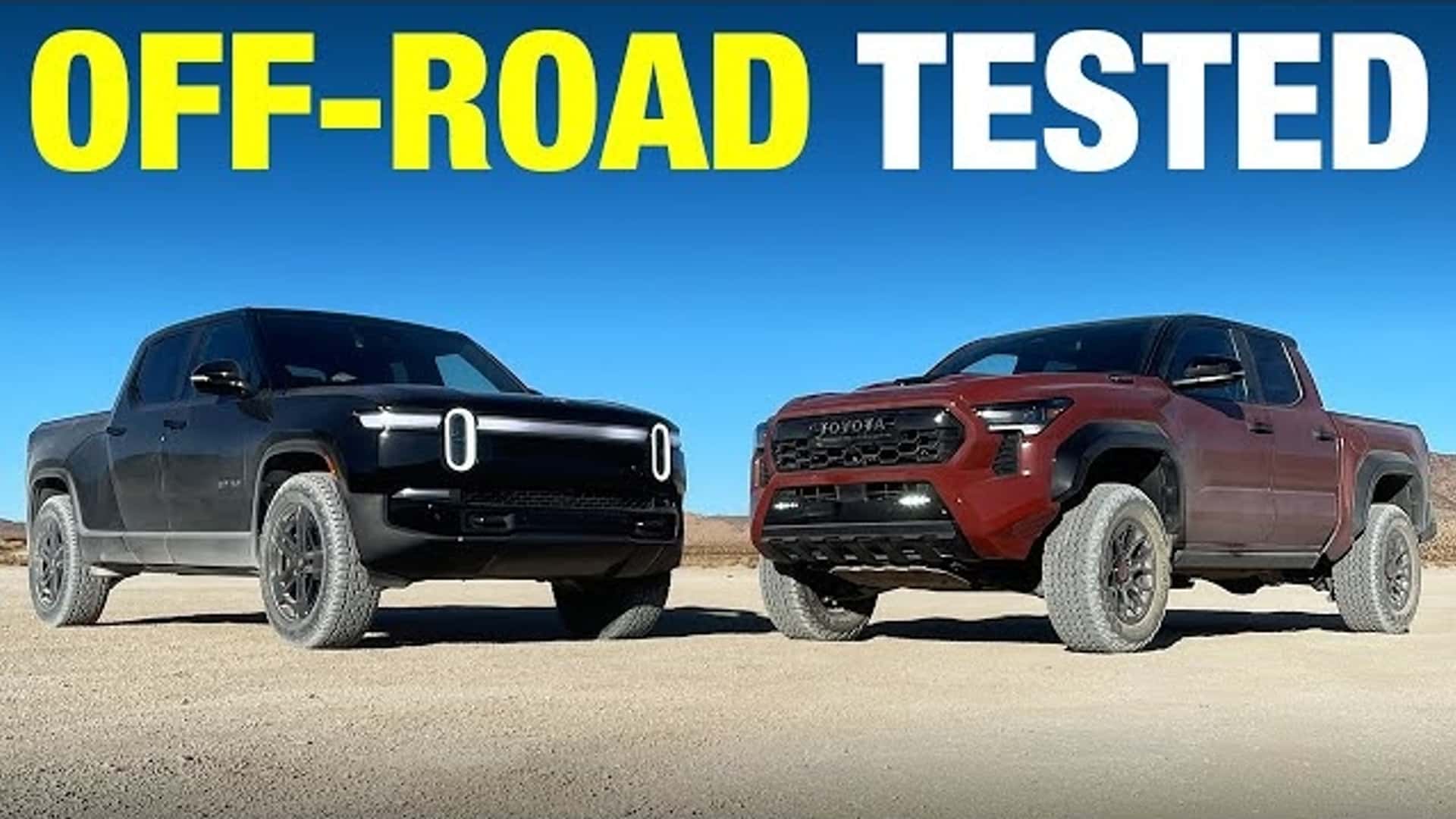
However, the crucial question remains: how does this electric pioneer truly perform when pitted against a well-established, proven hybrid off-roader in real-world conditions? To answer this, automotive experts at Edmunds recently put the second-generation Rivian R1T head-to-head against the hybrid Toyota Tacoma TRD Pro. The objective was clear: determine which truck could navigate the most challenging adventure settings with greater efficacy.
The Contenders: A Clash of Philosophies
The comparison sets up a fascinating dichotomy in automotive engineering. On one side, the Rivian R1T embodies the cutting edge of electric vehicle technology, often described as a ‘computer on wheels.’ It represents a digital approach to vehicle dynamics, where sophisticated software and electric powertrains manage traction, power delivery, and suspension with unprecedented precision.
On the other side stands the Toyota Tacoma TRD Pro, a vehicle lauded for its ‘raw and mechanical’ character. It relies on decades of proven off-road engineering, featuring robust traditional components designed for maximum durability and articulation in extreme conditions. This inherent mechanical integrity has long been the hallmark of its off-road prowess.

Rivian R1T: The Electric Adventure Vehicle
The Rivian R1T tested was the dual-motor version, equipped with the substantial 149 kilowatt-hour Max battery pack. While its specifications are undeniably impressive – boasting 533 horsepower and a staggering 800-plus pound-feet of torque – off-roading demands more than sheer power. The R1T’s sophisticated electronic architecture underpins its off-road capabilities.
Key features include an adaptive air suspension system and a trick hydraulic suspension, which collectively allow for dynamic adjustments to ride height and damping. High approach and departure angles ensure it can clear obstacles, while specialized off-road tires provide enhanced grip. Furthermore, its advanced brake torque vectoring system and a suite of selectable drive modes finely tune traction and suspension settings to suit various terrains.
Toyota Tacoma TRD Pro: The Hybrid Mechanical Marvel
In stark contrast, the Toyota Tacoma TRD Pro operates on a more traditional, mechanical foundation. Its powertrain consists of a 2.4-liter, four-cylinder, turbocharged engine paired with a hybrid system, collectively producing 326 horsepower and 465 pound-feet of torque. This setup delivers power efficiently and reliably, a characteristic highly valued in demanding off-road environments.
Crucially, unlike the Rivian R1T’s unibody construction, the Tacoma employs a body-on-frame chassis. This design is generally favored for its superior rigidity and durability when subjected to the torsional stresses of extreme off-roading. Its mechanical toolkit for tackling tough terrain includes a locking rear differential, a robust solid rear axle, a disconnecting sway bar at the front for improved articulation, a traditional 4×4 transfer case, and performance-tuned Fox shocks designed to absorb severe impacts.
The Off-Road Arena: Johnson Valley Trials
To rigorously test these distinct philosophies, Edmunds correspondent Emme Hall and her team ventured to Johnson Valley in Southern California, a locale renowned for its challenging off-road trails. This proving ground allowed for a direct comparison of how each truck’s unique engineering performed across various obstacles.
The Hill Climb Challenge: Torque vs. Traction
One of the initial and most telling tests was a steep hill climb. Despite the R1T’s immense electric motor output, delivering instant torque, it struggled to conquer the steepest section of the incline. The Rivian’s brake torque vectoring system is designed to apply braking force to slipping wheels, directing power to those with greater traction. However, in this specific scenario, this system proved insufficient.
Brake torque vectoring primarily manages wheel spin but does not actively redistribute lost torque to the wheels that maintain traction in the same way a mechanical locker does. This limitation became apparent as the R1T’s system couldn’t provide the continuous, synchronized power delivery needed for maximum upward momentum on the extremely steep, low-grip surface.
The Tacoma, conversely, excelled in the same hill climb. Its crucial advantage was the mechanical rear locker. This feature forces both rear wheels to spin at the same rate, effectively putting down power simultaneously and more consistently, irrespective of varying traction levels on individual wheels. This mechanical synchronization allowed the Tacoma to maintain forward momentum where the R1T faltered.
Rock Crawling and Articulation: Adapting to Terrain
Beyond the hill climb, the Tacoma continued to demonstrate its traditional off-road prowess in rock climbing and articulation tests. Its disconnecting front sway bar was a key enabler here. By decoupling the sway bar, the front axle gains significantly increased independent wheel travel, allowing it to ‘dance’ up and down and conform more closely to the irregular contours of the terrain. This superior articulation keeps more tires in contact with the ground, maximizing grip and control over challenging rock formations.
While the Rivian’s adaptive air suspension offers flexibility, its inherent design, even with advanced hydraulic elements, could not match the raw mechanical articulation afforded by the Tacoma’s disconnecting sway bar in these slow-speed, high-articulation scenarios. The Tacoma’s solid rear axle also contributed to its predictable and robust performance over uneven rocks.
Conquering the Sand: Where Electric Power Shines
The narrative shifted dramatically when the test moved to a sandy section. Here, the Rivian R1T found its stride, excelling where its electric powertrain could fully leverage its strengths. The sheer, instantaneous power and torque from its electric motors proved highly advantageous on the loose sand, allowing for rapid acceleration and sustained momentum without the need for gear changes or waiting for an engine to build revs.
Furthermore, the R1T’s traction control system, likely optimized for high-power delivery on less grippy surfaces, seemed less intrusive in the sand, permitting the necessary wheel spin to maintain speed. The unibody construction, while a factor in technical crawling, paradoxically benefited the R1T in this high-speed, bumpy sand environment. A unibody chassis is generally more effective at absorbing, distributing, and dissipating harsh impacts, leading to a smoother and more controlled ride, especially when moving quickly over uneven surfaces.
Beyond the Trail: On-Road Comfort and Future Outlook
The inherent design characteristics that influenced their off-road performance also extend to their on-road dynamics. The Rivian R1T, with its unibody construction and sophisticated adaptive suspension, generally offers a more comfortable and smoother ride on paved roads. This makes it a more refined daily driver, capable of seamlessly transitioning between urban commutes and weekend adventures.
Conversely, the Tacoma’s body-on-frame design, while providing exceptional rigidity for off-roading, typically translates to a less refined on-road experience, often characterized by a firmer ride. Ultimately, the Johnson Valley trials underscored a clear distinction: the Tacoma’s mechanical setup is inherently better suited for the slow-speed, technical challenges of hill climbs and rock crawls, where robust, positive traction is paramount. The R1T, while immensely capable, truly shines in scenarios demanding rapid, smooth power delivery over dynamic, less technical terrains like sand.
Looking ahead, the evolving landscape of electric off-roaders promises even more direct comparisons. The upcoming Scout Terra, an electric pickup, has indicated it will feature a solid rear axle and locking front and rear differentials. This combination could position it as a more direct competitor to traditional mechanical off-roaders like the Tacoma, potentially bridging the gap between electric powertrain advantages and established mechanical robustness. Such developments suggest that the future of extreme off-roading may well involve a blend of these distinct engineering philosophies.
Frequently Asked Questions (FAQ)
Q1: What is the primary difference in construction between the Rivian R1T and Toyota Tacoma?
A1: The Rivian R1T features a unibody construction, integrating the body and frame into a single structure, which contributes to a smoother on-road ride. The Toyota Tacoma TRD Pro uses a body-on-frame design, where the body is mounted onto a separate, rigid frame, providing enhanced durability and torsional stiffness ideal for severe off-road conditions.
Q2: Why did the Toyota Tacoma excel in the hill climb test?
A2: The Toyota Tacoma excelled due to its mechanical rear locking differential. This system forces both rear wheels to spin at the same speed, ensuring consistent power delivery to both wheels even when one loses traction. This mechanical synchronization is highly effective for maintaining momentum on steep, low-grip inclines.
Q3: How does the Rivian R1T’s brake torque vectoring system work, and what are its limitations?
A3: The Rivian R1T’s brake torque vectoring system applies braking force to individual wheels that are slipping excessively, redirecting power to wheels with more traction. While effective for many situations, its limitation in extreme off-road scenarios is that it only manages slip rather than actively redistributing lost torque as a mechanical locker would, which can hinder progress in very low-traction, steep climbs.
Q4: Why was the Rivian R1T better suited for sand driving?
A4: The Rivian R1T’s instant and abundant electric torque allows for smooth, continuous power delivery crucial for maintaining momentum on loose sand. Its unibody construction also helps absorb and dissipate impacts more effectively at higher speeds, contributing to a more comfortable and controlled experience over bumpy sandy terrains.
Q5: What is the benefit of a disconnecting sway bar on the Toyota Tacoma?
A5: A disconnecting sway bar, featured on the Tacoma TRD Pro, allows the front axle to move more independently. This increases wheel articulation, meaning the wheels can travel further up and down. This enhanced flexibility keeps more tires in contact with the ground over uneven surfaces like rocks, significantly improving traction and control during rock crawling.
Q6: Does the R1T’s unibody design impact its off-road capability negatively?
A6: While the R1T’s unibody design offers superior on-road comfort and handling, it can present limitations in extreme, slow-speed articulation challenges compared to body-on-frame vehicles with mechanical components. However, its sophisticated adaptive suspension systems mitigate many of these traditional unibody drawbacks, making it highly capable in a wide range of off-road scenarios.
Q7: How do electric powertrains change the off-road experience compared to traditional engines?
A7: Electric powertrains offer instant torque from a standstill, precise motor control, and often quieter operation, which can enhance the off-road experience. They also eliminate the need for complex gearboxes in some applications. However, they introduce new considerations such as battery range in remote areas and the specific dynamics of electric traction control systems compared to mechanical differentials.