
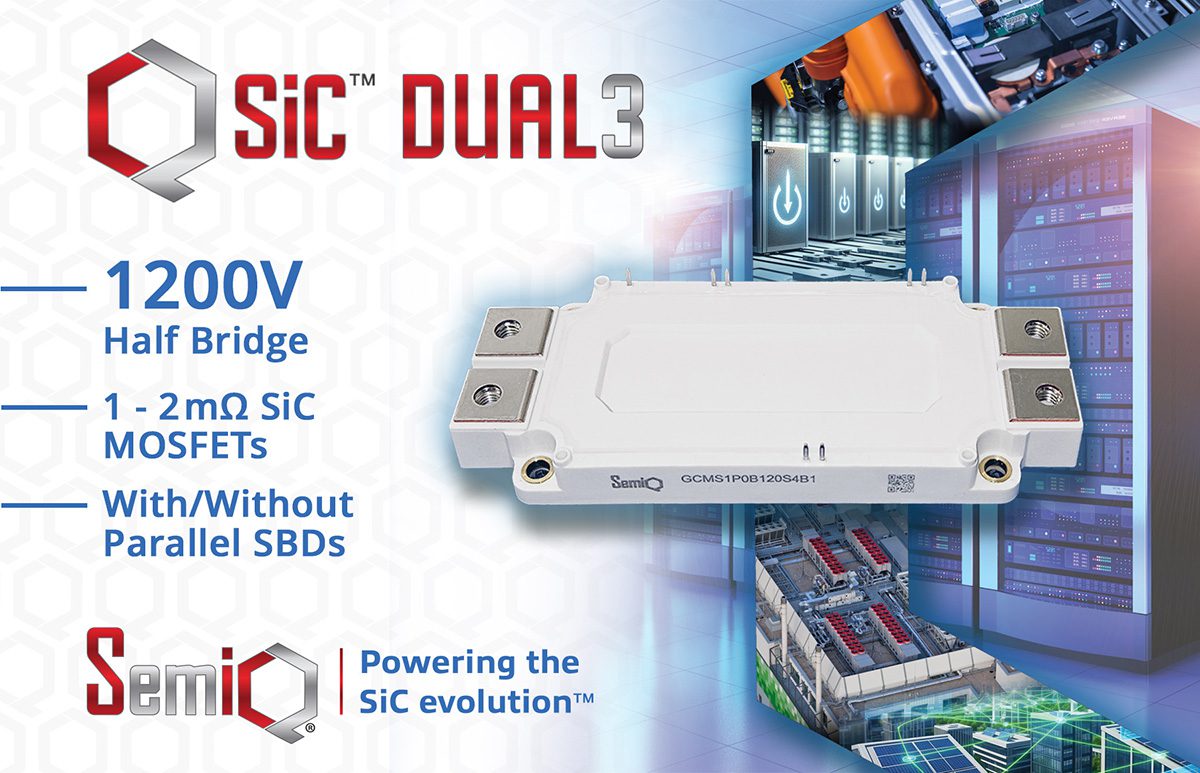
In a significant development for the power electronics sector, SemiQ has officially launched its QSiC Dual3 family of 1200 V half-bridge Silicon Carbide (SiC) MOSFET modules. These advanced components are engineered to address the escalating power and thermal demands across critical applications, including motor drives in data center cooling systems, grid converters in energy storage systems (ESS), and various industrial drives. The introduction of these modules marks a pivotal step in enhancing efficiency and reliability in high-power environments.
The new lineup boasts impressive technical specifications designed to offer superior performance compared to traditional silicon-based solutions. With SiC technology at its core, these modules are poised to facilitate a smoother transition for industries seeking more robust and energy-efficient power conversion.

The Strategic Significance of Silicon Carbide in Modern Power Electronics
Silicon Carbide (SiC) has emerged as a game-changer in the power electronics landscape, particularly in applications demanding high voltage, high frequency, and high-temperature operation. Unlike conventional silicon-based semiconductors, SiC offers superior intrinsic properties such as wider bandgap, higher thermal conductivity, and higher breakdown field strength. These characteristics translate into devices that can switch faster, operate at higher temperatures, and reduce energy losses significantly. The ongoing advancements in SiC technology are crucial for innovations across various fields, often highlighted in major EV Engineering News for its impact on electric vehicle powertrains and charging infrastructure.
For industries like data centers, energy storage, and industrial automation, the benefits are manifold. SiC-based modules contribute to smaller, lighter, and more efficient power systems, directly addressing the growing need for sustainable and high-performing solutions.
SemiQ’s QSiC Dual3 Series: Engineering Excellence Detailed
SemiQ’s QSiC Dual3 family introduces six distinct modules, all housed within a compact 62 mm x 152 mm S4B1 half-bridge package. This standardized form factor is a deliberate design choice, aiming to simplify integration into existing system architectures. The modules are available with three critical on-resistance (Rds(on)) options: 1 mΩ, 1.4 mΩ, and 2 mΩ. These variations allow engineers to select the optimal balance between conduction losses and switching performance for their specific application requirements.

A notable enhancement in three of the new versions is the integration of a parallel Schottky barrier diode. This addition is specifically designed to further reduce switching losses, especially under high-temperature operating conditions. This feature is particularly valuable in applications where thermal management is a critical concern, allowing systems to operate more efficiently and reliably even in challenging environments.
Unpacking Unprecedented Power Density and Thermal Efficiency
Among the standout achievements of the QSiC Dual3 family is its remarkable power density. SemiQ reports that two of the new devices achieve an impressive power density of 240 W/in³. This metric signifies the amount of power a device can handle per unit of volume, directly correlating to the potential for more compact and lighter power conversion systems. High power density is particularly advantageous in space-constrained applications, where every cubic inch counts.
Furthermore, SemiQ has prioritized thermal management in the design of these modules. The company highlights that the QSiC Dual3 modules feature low junction-to-case thermal resistance. This characteristic is vital for dissipating heat generated during operation effectively. Lower thermal resistance means heat can be transferred more efficiently from the semiconductor junction to the heatsink, enabling the use of smaller and lighter heatsinks. This, in turn, contributes to a simpler overall system design, reduces material costs, and enhances the long-term reliability of the power converter.
A Seamless Transition: Enabling SiC Upgrades from IGBT Modules
One of the key advantages SemiQ is championing with its Dual3 family is its positioning as a relatively easy upgrade path for systems currently built around Insulated Gate Bipolar Transistor (IGBT) modules. The transition from silicon-based IGBTs to SiC MOSFETs typically requires significant redesign efforts due to differences in electrical characteristics and packaging. However, SemiQ has engineered the Dual3 parts specifically to enable IGBT replacement with minimal redesign.
This design philosophy significantly lowers the barrier to entry for companies looking to leverage SiC technology’s benefits without undertaking extensive development cycles. Such backward compatibility is a critical factor for accelerated adoption in industrial and energy sectors where legacy systems are prevalent.
Ensuring Robustness and Reliability
Reliability is paramount in high-power applications, and SemiQ has implemented stringent quality control measures for its SiC modules. The company states that all MOSFET die undergo wafer-level gate-oxide burn-in screening above 1,450 V. This rigorous testing process helps to identify and eliminate potential latent defects in the gate oxide layer, which is a critical part of a MOSFET’s structure. By performing this screening at the wafer level and at voltages exceeding typical operational limits, SemiQ aims to ensure the long-term stability and robust performance of its modules in demanding real-world conditions.
Addressing the Demands of AI and Energy Storage Systems
The applications targeted by the QSiC Dual3 family underscore the pressing challenges faced by modern technology and infrastructure. Data centers, for instance, are experiencing an unprecedented surge in power consumption and heat generation, largely driven by the exponential growth of Artificial Intelligence (AI) and machine learning workloads. These AI-driven processes require immense computational power, leading to increased power draw and subsequent thermal challenges.
Timothy Han, President of SemiQ, emphasized the direct relevance of these modules to current industry trends. He stated, “Rising AI-driven power and thermal demands in data centers are pushing the limits of traditional cooling and power systems.” His comments highlight the critical need for more efficient power solutions to manage the energy footprint and cooling requirements of advanced computing infrastructure.
Han further elaborated on the specific use cases for the new series, noting that “the Dual3 series is aimed at 250 kW liquid chiller applications on both active front ends and compressor drives, with lower size and weight than comparable silicon IGBT solutions.” This focus on liquid chiller applications is crucial for next-generation data centers, where conventional air cooling is often insufficient to manage the heat generated by high-density server racks. By offering SiC modules that contribute to smaller and lighter chiller systems, SemiQ provides a tangible solution to enhance the overall efficiency and footprint of data center cooling infrastructure.
Beyond data centers, the modules are also vital for grid converters in energy storage systems. As the world transitions towards renewable energy sources and smarter grids, efficient and reliable ESS are indispensable. SiC technology enables these converters to operate with higher efficiency, reducing energy losses during charging and discharging cycles and improving the overall economics and environmental impact of energy storage solutions. Industrial drives also benefit significantly from these advancements, leading to more efficient motor control and reduced operational costs for various manufacturing and automation processes.
The Broader Impact: Pushing Boundaries in Power Electronics
The introduction of SemiQ’s QSiC Dual3 family signifies a notable stride in the field of power electronics. By delivering high-performance, high-density, and thermally efficient SiC MOSFET modules, the company is directly addressing some of the most critical power conversion challenges across fast-evolving sectors. These advancements resonate deeply within the broader landscape of power engineering, including vital EV Engineering News, as SiC technology continues to be a cornerstone for next-generation electric vehicle powertrains, charging infrastructure, and grid-tied applications.
As industries continue to demand more from their power systems—be it in terms of efficiency, compactness, or reliability—innovations like the QSiC Dual3 series play a crucial role in enabling future technological progress and sustainability goals. The ability to replace traditional IGBTs with minimal redesign offers a practical pathway for widespread adoption of SiC, paving the way for more efficient and robust power systems globally.