
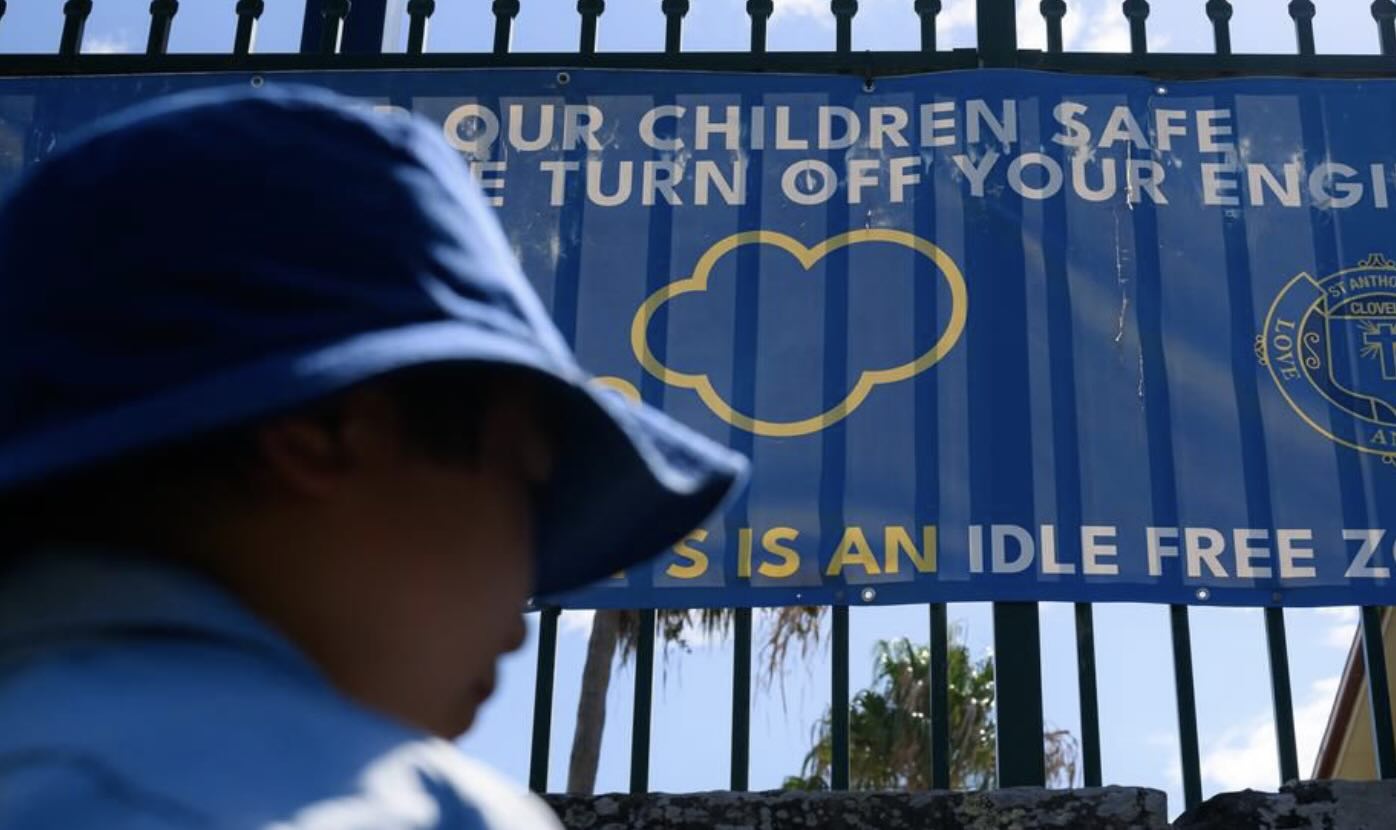
The familiar rumble of idling car engines outside school gates is increasingly being replaced by a quieter, more conscious approach, as parents at St Anthony’s Catholic Primary School in Clovelly, Sydney, take a stand against harmful air pollution.
Initiative Tackles Air Pollution Hotspots Near Schools
A growing movement, spearheaded by parents with medical backgrounds, is urging caregivers to switch off their vehicles while waiting to drop off or pick up their children. This initiative aims to combat the concentrated pollution emitted by stationary cars, which can create dangerous “harm hotspots” in areas frequented by vulnerable children.

Anthony Hull and Fiona Foo, a husband-and-wife team, were instrumental in launching the campaign at their children’s school after witnessing firsthand the visible exhaust fumes. “You smell it, and you’re like, ‘Oh, this is just awful’,” Dr. Foo told AAP, highlighting the immediate sensory impact of the pollution.
The Hidden Dangers of Idling for Children’s Health
The World Health Organisation (WHO) has long warned that there is no “safe level” of air pollution, with an overwhelming 99 per cent of the global population breathing air that exceeds its recommended guidelines. The impact of idling vehicles, particularly around schools, is a growing concern.
Children are uniquely susceptible to the effects of air pollution. Their lungs are still developing, their faces are closer to the ground where fumes often concentrate, and they inhale more air relative to their body weight compared to adults. Exposure can exacerbate existing conditions like asthma and, over the long term, can impede the development of crucial organs such as the lungs, heart, and brain.

Medical experts draw a stark parallel between the effects of prolonged idling near children and the dangers of second-hand cigarette smoke, underscoring the severity of the issue.
“Idle Off” Project Shows Promising Results
An initial audit at St Anthony’s revealed that approximately 50 per cent of cars remained running while parked during pick-up and drop-off times. This finding, recorded during mild autumn weather, suggested that frequent idling might be more of a habit than a necessity for climate control.
The school implemented a multi-faceted educational campaign, including distributing informative flyers, hosting a poster competition for students, and conducting awareness sessions during parent gatherings. The project, dubbed “Idle Off,” has been hailed as a success by school principal Anna Novak.
“Once made aware of the harms, most parents and carers are happy to switch off their engines or park nearby and walk,” Ms Novak stated. She noted that the initiative even inspired some families to purchase electric vehicles. “Some parents bought electric cars as a result,” she added.
Australia’s Lagging Response to Transport Pollution
Despite successful local initiatives, Australia’s response to transport pollution, particularly concerning unnecessary idling, has been notably slow compared to other nations. International examples like London’s “Engine off at every stop” and India’s “Red light on, Gaadi off” campaigns demonstrate more robust global efforts to curb vehicle emissions.
Clare Walter, a health and policy researcher at Deakin University, suggests that a common perception of Australia having “good” air quality may hinder progress. “How do you define good? We don’t say we have a ‘good’ road toll,” Dr. Walter commented, arguing that air pollution is often “overlooked, underestimated and deliberately minimised” within the country.
She identifies a systemic challenge where responsibility for air pollution issues is often passed between different government portfolios and across multiple administrative levels. While the increasing adoption of electric cars is seen as a solution by some, Dr. Walter cautioned that a generation of children will continue to be exposed to harmful exhaust fumes in the interim.
The Medical Case Against Air Pollution
Dr. Kate Wylie, a General Practitioner and executive director of Doctors for the Environment Australia, emphasized the direct health impacts of particulate matter from vehicle exhausts. “Those particles tend to get stuck in our upper airways,” she explained, noting their ability to enter the lungs and bloodstream.
Data from 2018 indicated that air pollution contributed to 1.3 per cent of Australia’s total disease burden and was linked to over 3,200 deaths, with other estimates suggesting even higher figures. The scientific consensus highlights the pervasive and serious health consequences of airborne pollutants.
Practical Solutions and Wider Benefits
Addressing parental concerns about comfort during warmer weather, Dr. Hull suggested practical measures. “Air conditioners can stay running most of the time but switched off briefly while kids jump in,” he proposed. Alternatively, he recommended considering lighter clothing or parking in shaded areas and waiting.
Beyond the immediate health benefits, reducing idling offers economic and environmental advantages. “Idling less is better for engines and saves fuel,” Dr. Hull pointed out, a consideration that resonates particularly in light of rising global petrol prices. Furthermore, stopping unnecessary engine idling contributes significantly to reducing greenhouse gas emissions, with the cumulative effect being equivalent to removing 1.6 million cars from the road.
A Call for Awareness and Action
Organisations like Parents for Climate are actively collaborating with Doctors for the Environment Australia to champion the anti-idling cause. Laura Billings from Parents for Climate expressed surprise at the level of concern among parents regarding idling pollution.
“It doesn’t cost anything, it doesn’t require new technology, no new infrastructure,” Ms. Billings told AAP, stressing that the core requirement is heightened awareness. “It’s just awareness.”
The message is clear: a simple act of switching off an engine can have a profound impact on children’s health and the environment, requiring minimal effort but yielding significant benefits.