
Key Takeaways
- Tesla officially confirmed its plans for a ride-hailing service during its Q1 earnings call, outlining a unique hybrid model combining company-operated vehicles with owner participation.
- CEO Elon Musk described the envisioned service as a “combination of Airbnb and Uber,” allowing owners flexibility in how their vehicles contribute to the autonomous network.
- The automaker is significantly investing in its “vision-only architecture” and “end-to-end neural networks,” trained on extensive real-world data, to achieve scalable vehicle autonomy for the Tesla Robotaxi Fleet.
- While showcasing app functionality, Tesla indicated that an accelerated launch of “new vehicles, including more affordable models,” would precede the full deployment of the robotaxi service.
- The announcement aims to reassure investors amidst speculation about product strategy, even as the company continues to refine its Full Self-Driving (FSD) technology, which still requires driver supervision.
NEW DELHI — Tesla has offered its most detailed glimpse yet into its ambitious plans for a self-driving ride-hailing service, revealing a hybrid model that marries company-operated autonomous vehicles with a novel opportunity for existing Tesla owners. During its first-quarter earnings call on April 23, 2024, the electric vehicle giant outlined a strategic pivot aimed at leveraging its advanced AI and electric vehicle platform to disrupt the urban mobility landscape.
The announcement comes at a crucial juncture for the company, as investors and analysts closely scrutinize its future product roadmap and technological capabilities. This strategic direction, centered on the widespread deployment of a Tesla Robotaxi Fleet, represents a significant evolution in the automotive industry’s pursuit of autonomous transportation.
Tesla’s Dual Vision for Autonomous Mobility
Tesla CEO Elon Musk elaborated on the envisioned ride-hailing service during the investor conference call, characterizing it as a groundbreaking synthesis of two dominant sharing economy models. “Think of it like a combination of Airbnb and Uber,” Musk stated, providing a clear analogy for the proposed operational framework of the Tesla Robotaxi Fleet.
This innovative approach suggests a multi-faceted service. On one hand, Tesla itself plans to operate a substantial portion of the self-driving taxi fleet, ensuring a baseline level of service and availability. On the other, it introduces an unprecedented level of participation for individual Tesla owners, fundamentally redefining vehicle ownership.
Empowering Owners: The Flexible Fleet Integration
A core component of Tesla’s strategy for its Robotaxi Fleet involves empowering private vehicle owners to integrate their cars into the ride-hailing network. Musk detailed a flexible system where owners would have considerable control over how their autonomous vehicles are utilized, offering a degree of customization currently unavailable in traditional ride-hailing platforms.
Owners will possess the agency to “add or subtract their cars from the fleet whenever they want,” granting them dynamic control over their vehicle’s availability. Furthermore, the system will allow for granular control over user access. Owners “can decide if they want to only let the car be used by friends and family, or only by five-star users or by anyone,” Musk added.
This level of owner involvement is designed to create a scalable network, potentially expanding the Tesla Robotaxi Fleet’s reach and availability significantly, while also offering a new revenue stream for vehicle owners. It positions Tesla not just as a manufacturer, but as a comprehensive mobility service provider.
Technological Foundations: Vision-Only Autonomy
The success of the Tesla Robotaxi Fleet hinges on the company’s ability to deliver robust and reliable full self-driving capabilities. Tesla’s first-quarter earnings report provided insights into the technological backbone supporting this ambitious endeavor, emphasizing its continued investment in key hardware and software ecosystems.
The report highlighted Tesla’s conviction that “a scalable and profitable autonomy business can be realized through a vision-only architecture with end-to-end neural networks, trained on billions of miles of real-world data.” This statement underscores Tesla’s unique approach, which largely eschews lidar and radar in favor of camera-based computer vision for perceiving and navigating the environment.
The extensive training data, accumulating “billions of miles” from the global Tesla fleet, is crucial for refining these neural networks, enabling the vehicles to interpret complex driving scenarios and make autonomous decisions. This data-driven strategy is central to achieving the level of autonomy required for a widespread Tesla Robotaxi Fleet.
Visualising the Future: App Integration and User Experience
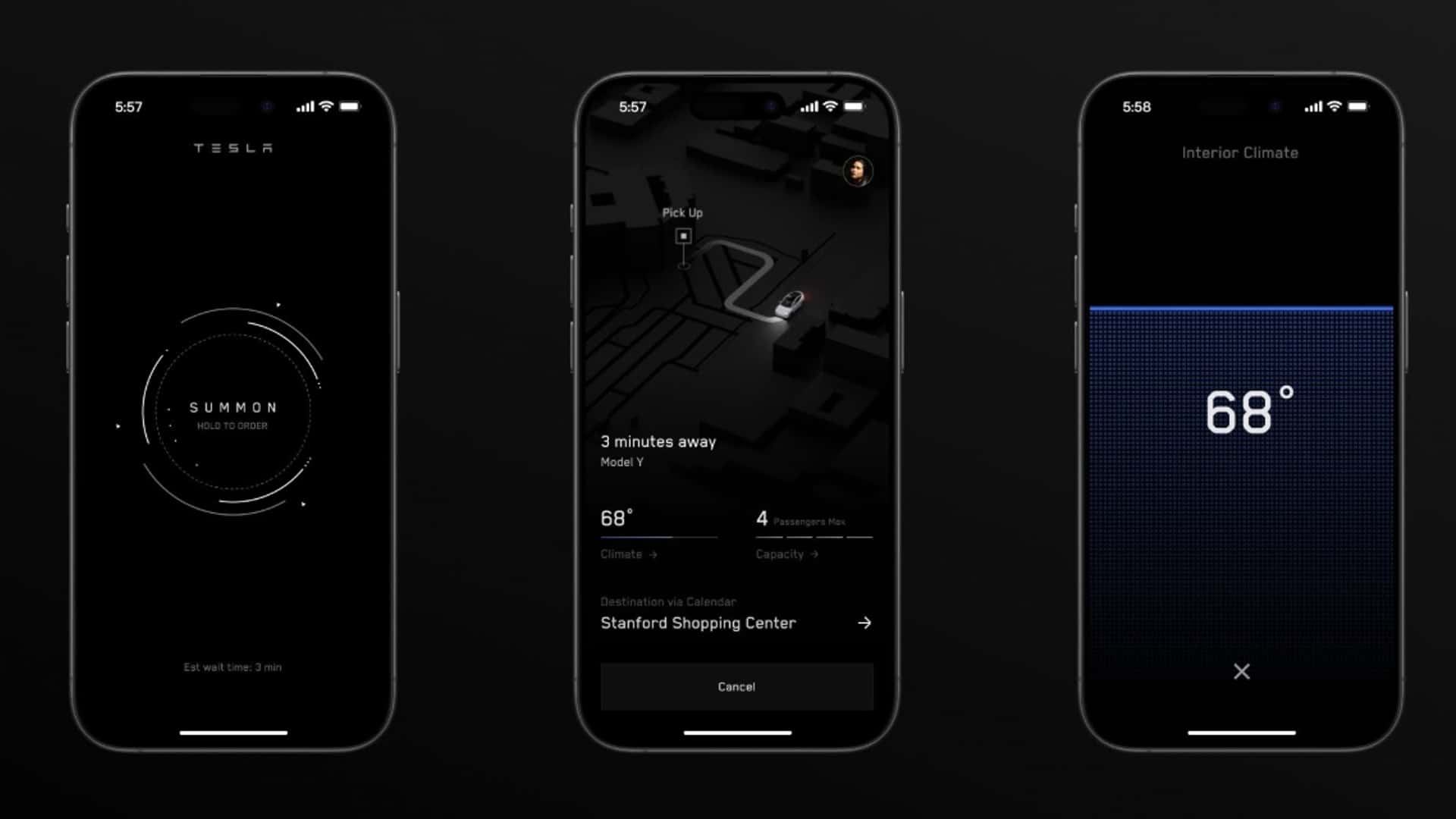
To further illustrate its progress, Tesla unveiled a preliminary preview of what the ride-hailing functionality might look like when integrated into the existing Tesla mobile application. These renderings offer an early glimpse into the user interface and potential features for customers.
The visuals notably displayed a “Summon” button, suggesting a seamless process for requesting an autonomous taxi. Another intriguing detail was a screen showing a temperature setting of “68 degrees,” which could indicate that users will have the ability to pre-set cabin climate preferences before their Tesla Robotaxi arrives, enhancing the personalized travel experience.
While specific details remain scant, these previews aim to solidify the concept for investors and the public, showcasing a tangible user interface for a service that is still in its developmental stages. The focus remains on making the experience intuitive and highly customizable.
Strategic Alignment and Investor Confidence
The emphatic focus on the Tesla Robotaxi Fleet during the earnings call also served a broader strategic purpose. It provided clarity and reassurance following recent reports, including one by *Reuters*, which suggested Tesla had shelved plans for a more affordable consumer vehicle to prioritize robotaxis. This created considerable uncertainty among investors regarding the automaker’s future growth trajectory and product portfolio.
Tesla subsequently addressed these concerns directly in the earnings call, stating its commitment to “accelerating the launch timing of new vehicles, including more affordable models.” This clarification indicated that the robotaxi initiative would arrive at a later stage, integrated into a broader product strategy that still includes vehicles accessible to a wider market segment.
The announcement of ride-hailing functionality and the unique business model is thus designed to “assuage investors” by presenting a clear, albeit long-term, vision for future revenue streams and market expansion, demonstrating a comprehensive plan behind the highly anticipated Tesla Robotaxi Fleet.
Navigating the Path to Full Autonomy: Challenges and Realities
Despite the grand vision and ongoing investments, the realization of a fully functional Tesla Robotaxi Fleet faces significant technological hurdles. A key point of contention and a critical factor for investor and public trust is Tesla’s current Full Self-Driving (FSD) feature.
Years after initial promises, FSD still requires “total driver supervision” and has been documented to “regularly make mistakes.” This necessitates that human drivers remain attentive and ready to intervene, underscoring that the technology has not yet achieved true Level 4 or Level 5 autonomy—the threshold required for unsupervised robotaxi operations.
The transition from advanced driver-assistance systems (ADAS) to fully autonomous vehicles is a complex engineering challenge, involving intricate software development, robust sensor interpretation, and rigorous safety validation. The gap between current FSD capabilities and the demands of a driverless Tesla Robotaxi Fleet remains a substantial bridge to cross.
Historical Context and Future Outlook
The concept of a Tesla-operated autonomous taxi service is not new. CEO Elon Musk has previously made ambitious projections regarding the deployment of self-driving fleets. Notably, he famously proclaimed that the company would have “1 million robotaxis on the road by 2020,” a target that was not met.
This historical context underscores the importance of carefully evaluating timelines and grand pronouncements surrounding the Tesla Robotaxi Fleet. While the company continues to push the boundaries of automotive technology, the complexities of regulatory approval, public acceptance, and the sheer technical challenge of achieving widespread, reliable autonomy often lead to extended development cycles.
The current updates from the Q1 earnings call provide more concrete details on the operational model but still leave many questions regarding the precise timeline for widespread deployment. The automotive industry and tech sector will continue to watch closely as Tesla navigates the path from ambitious vision to operational reality for its autonomous ride-hailing service.
FAQ Section
What is Tesla’s new robotaxi plan?
Tesla plans to launch a ride-hailing service featuring a hybrid model. This will include both company-owned self-driving vehicles and a system allowing private Tesla owners to integrate their cars into the fleet. CEO Elon Musk described it as a “combination of Airbnb and Uber,” offering flexible usage options for owners.
How will Tesla owners participate in the robotaxi fleet?
Tesla owners will have the flexibility to add or remove their vehicles from the robotaxi fleet as they choose. They can also customize who uses their car, opting to allow only friends and family, five-star rated users, or any approved rider, providing significant control over their car’s deployment.
What technology will power the Tesla Robotaxi Fleet?
The Tesla Robotaxi Fleet will rely on a “vision-only architecture” utilizing “end-to-end neural networks.” These systems are continuously trained on “billions of miles of real-world data” collected from Tesla vehicles globally. This camera-centric approach forms the foundation for its autonomous driving capabilities.
When can we expect the Tesla Robotaxi service to launch?
While Tesla confirmed active development, the company indicated that the full robotaxi service is still “far down the line” and will follow the accelerated launch of “new vehicles, including more affordable models.” No specific launch date for the widespread Tesla Robotaxi Fleet has been provided.
Is Tesla’s Full Self-Driving (FSD) ready for robotaxis?
Currently, Tesla’s Full Self-Driving (FSD) feature is an advanced driver-assistance system that requires “total driver supervision” and “regularly makes mistakes.” It is not yet at the Level 4 or 5 autonomy required for unsupervised robotaxi operations, meaning human intervention is still necessary.
Why is Tesla focusing on robotaxis now?
Tesla’s renewed emphasis on its Tesla Robotaxi Fleet aims to reassure investors about future revenue streams and growth potential. This comes after speculation about changes to its product roadmap and serves to present a clear long-term vision for the company’s expansion into autonomous mobility solutions.