
Key Takeaways:
- Tesla is actively developing a ride-hailing service, aiming for a hybrid operational model combining features of Airbnb and Uber.
- The company plans to manage a significant portion of the autonomous vehicle fleet itself while also allowing individual Tesla owners to integrate their cars.
- Owners will have control over when their vehicles are part of the fleet and who can use them, from close contacts to highly-rated users.
- This strategic pivot, emphasized during the Q1 2024 earnings call, seeks to reassure investors about future revenue streams amid evolving product strategies.
- Realisation of this ambitious vision hinges on the successful development and deployment of Tesla’s full self-driving technology, a long-standing challenge.
In a significant disclosure during its first-quarter earnings call on April 23, 2024, Tesla shed new light on its highly anticipated entry into the robotaxi business. The electric vehicle (EV) giant confirmed its plans to launch a dedicated ride-hailing service, envisioning a unique operational model described by CEO Elon Musk as a “combination of Airbnb and Uber.” This announcement provides crucial details amidst swirling speculation regarding Tesla’s future product roadmap and commitment to autonomous driving technology.
The revelation comes as the automotive industry and investors closely scrutinise Tesla’s strategic direction. The company aims to operate a substantial part of its autonomous vehicle fleet directly, while also empowering individual Tesla owners to participate in the burgeoning shared mobility economy by making their personal vehicles available for ride-hailing.
A Hybrid Model for Autonomous Mobility
Elon Musk, during the investor conference call, elaborated on the proposed dual-pronged approach for the robotaxi fleet. He stated that Tesla intends to build and manage its own contingent of self-driving taxis, ensuring a core operational presence in the ride-hailing market. This move underscores Tesla’s ambition to control key aspects of the service, from vehicle maintenance to user experience.
Crucially, the vision extends to integrating existing Tesla owners into this ecosystem. Musk confirmed that individual Tesla owners would possess the flexibility to “add or subtract their cars from the fleet whenever they want.” This feature introduces an unprecedented level of owner control and potential for passive income generation, mirroring the flexibility offered by platforms like Airbnb.
Furthermore, owners will retain significant autonomy over who can utilise their vehicles. Musk highlighted the option for owners to “decide if they want to only let the car be used by friends and family, or only by five-star users or by anyone.” This granular control over user access is designed to enhance owner trust and participation in the shared mobility platform.
Technological Foundations and Future Functionality
Tesla’s first-quarter earnings report provided additional details on the foundational work supporting this ambitious project. The document explicitly stated, “We are currently working on ride-hailing functionality that will be available in the future.” This confirms active development beyond mere conceptualisation, signaling a concrete step towards market entry.
The report further clarified the significant investments being made in this domain: “We have been investing in the hardware and software ecosystems necessary to achieve vehicle autonomy and a ride-hailing service.” This comprehensive approach aims to create a robust infrastructure capable of supporting a large-scale autonomous driving operation.
Central to Tesla’s technological strategy for self-driving capabilities is its vision-only architecture. The company reiterated its conviction, stating, “We believe a scalable and profitable autonomy business can be realized through a vision-only architecture with end-to-end neural networks, trained on billions of miles of real-world data.” This reliance on camera-based systems and advanced artificial intelligence algorithms differentiates Tesla from some competitors who integrate LiDAR and radar technologies.
Preview of the Tesla Ride-Hailing App
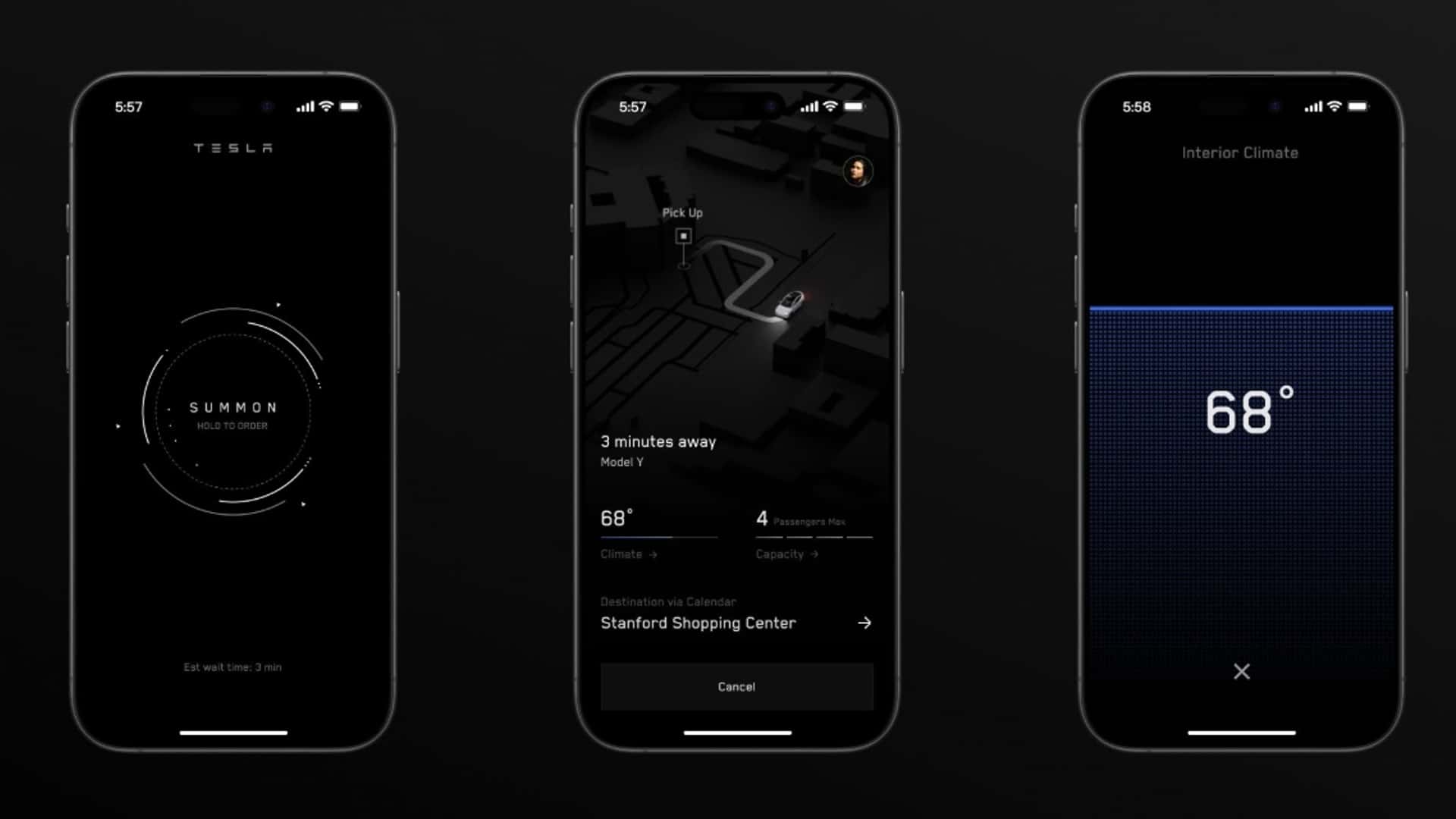
Accompanying the announcements, Tesla released a preliminary rendering of what the ride-hailing functionality might look like within the existing Tesla mobile application. The mock-ups displayed a prominent “Summon” button, presumably for users to hail an autonomous taxi. While details remain sparse, one screen showing a temperature of 68 degrees suggests potential features like remote climate control customisation for passengers before their ride commences.
These early glimpses indicate Tesla’s focus on user experience and integration within its established digital ecosystem, aiming for seamless interaction with its EV fleet.
Navigating Strategic Shifts and Investor Confidence
The detailed exposition on robotaxis comes at a pivotal time for Tesla. Earlier reports from *Reuters* suggested that the company had abandoned plans for a more affordable consumer vehicle, opting instead to fast-track its robotaxi project. This report caused considerable uncertainty among investors and consumers alike, impacting the company’s stock performance.
During the recent earnings call, Tesla addressed these concerns by stating it is “accelerating the launch timing of ‘new vehicles, including more affordable models’,” while indicating that a dedicated robotaxi model would arrive at a later stage. This clarification suggests a recalibration of priorities, aiming to balance the introduction of budget-friendly EVs with the long-term vision of an autonomous mobility service.
The emphasis on the ride-hailing business serves as a crucial signal to the market, demonstrating a clear strategic direction and potential future revenue streams beyond traditional vehicle sales. It aims to bolster investor confidence by outlining a path to leveraging Tesla’s technological advancements in autonomous driving technology.
Challenges and Realism in the Autonomous Landscape
Despite the grand pronouncements, the successful implementation of Tesla’s robotaxi ambitions rests squarely on its ability to deliver fully self-driving cars. This remains a significant hurdle. The company’s Full Self-Driving (FSD) feature, despite its name and premium pricing, currently requires constant human supervision and has been documented to make errors.
Critics and industry observers frequently point to a disconnect between Tesla’s ambitious timelines and the actual capabilities of its current autonomous driving software. This gap is further highlighted by past pledges from Elon Musk, notably his 2019 declaration that Tesla would have 1 million robotaxis on the road by 2020 – a target that was not met.
The journey towards widespread autonomous vehicle deployment involves not only overcoming complex engineering challenges but also navigating intricate regulatory frameworks and public acceptance issues. The development of truly reliable and safe self-driving capabilities remains one of the most demanding tasks in modern engineering, requiring extensive real-world testing and validation.
While the prospect of a Tesla-operated autonomous taxi service is intriguing, it is essential to approach such pronouncements with a degree of critical evaluation, considering the historical context of technological advancements and past timelines in the automotive industry. The future of urban transportation and EV mobility could be profoundly reshaped by Tesla’s success, but significant challenges lie ahead.
FAQ Section
What is Tesla’s robotaxi plan?
Tesla plans to launch a ride-hailing service with a hybrid model, allowing both Tesla-owned autonomous vehicles and individual owners’ cars to operate as self-driving taxis, akin to a combination of Airbnb and Uber.
When will Tesla’s robotaxi service be available?
Tesla has stated it is “currently working on ride-hailing functionality that will be available in the future,” without providing a specific launch date. The company indicated that a dedicated robotaxi model would arrive after more affordable consumer vehicles.
How will Tesla owners participate in the robotaxi fleet?
Owners will be able to add or remove their vehicles from the fleet as desired. They will also have control over who can use their car, with options to limit usage to friends and family, five-star rated users, or the general public.
What technology underpins Tesla’s robotaxi development?
Tesla relies on a “vision-only architecture” using cameras and “end-to-end neural networks” trained on billions of miles of real-world data to achieve scalable and profitable autonomy for its ride-hailing service.
Has Tesla made robotaxi promises before?
Yes, Elon Musk famously predicted in 2019 that Tesla would have 1 million robotaxis on the road by 2020, a goal that was not achieved. This history underscores the complexity and challenges of developing fully autonomous technology.
Does Tesla’s FSD (Full Self-Driving) currently enable robotaxis?
No, Tesla’s current Full Self-Driving (FSD) feature requires active driver supervision and does not enable vehicles to operate autonomously as robotaxis. The company is still working to evolve FSD into a truly self-driving capability.