
Key Takeaways
- Tesla is actively developing a ride-hailing service, planning to operate a significant portion of the fleet directly.
- The company intends to integrate a model allowing existing Tesla owners to contribute their vehicles to the robotaxi network, reminiscent of a “combination of Airbnb and Uber.”
- Users will have granular control over their car’s availability and who can utilise it within the fleet.
- Tesla’s ride-hailing functionality is expected to be integrated into the existing Tesla app, featuring elements like a “Summon” button.
- The ambitious robotaxi project hinges on the successful development of true full self-driving capabilities, a goal Tesla has pursued for years.
During its first-quarter earnings call on April 23, 2024, electric vehicle giant Tesla provided clearer insights into its highly anticipated robotaxi initiative. Responding to widespread questions from analysts, investors, and enthusiasts regarding the company’s reported strategic pivot towards autonomous ride-hailing, Tesla elaborated on how this ambitious venture is envisioned to unfold.
The company confirmed its deep commitment to developing a comprehensive ride-hailing service, outlining a hybrid operational model that blends a corporate-managed autonomous fleet with a unique opportunity for current Tesla vehicle owners to participate.
Tesla’s Dual-Layered Robotaxi Vision
Tesla CEO Elon Musk detailed the company’s plans to establish and operate its own fleet of self-driving taxis. This foundational layer ensures direct control over a substantial portion of the autonomous network, allowing for consistent service quality and operational efficiency as the technology matures.
Beyond this core fleet, a distinctive aspect of Tesla’s strategy involves leveraging its vast existing customer base. Musk articulated a model where Tesla owners would possess the flexibility to “add or subtract their cars from the fleet whenever they want.” This optionality aims to create a dynamic and scalable network, potentially expanding the available robotaxi pool significantly.
Furthermore, owners contributing their vehicles to the network would retain considerable control over their assets. Musk clarified that “they can decide if they want to only let the car be used by friends and family, or only by five-star users or by anyone.” This user-centric approach suggests a tiered system of access, empowering owners to manage the usage parameters of their personal electric vehicles within the broader ride-hailing ecosystem.
Musk encapsulated this innovative model by describing it as a “combination of Airbnb and Uber.” This analogy underscores the dual nature of the service: the direct operational presence akin to traditional ride-hailing platforms, combined with the peer-to-peer asset sharing mechanism reminiscent of short-term rental services.
Technological Foundation and App Integration
Tesla’s first-quarter earnings report reinforced these statements, noting that the company is “currently working on ride-hailing functionality that will be available in the future.” This confirms the active development phase of the necessary software and infrastructure for the service.
The report highlighted significant investments in the underlying technology: “We have been investing in the hardware and software ecosystems necessary to achieve vehicle autonomy and a ride-hailing service.” This encompasses not only the self-driving capabilities of the vehicles themselves but also the digital platforms required to manage bookings, dispatch, and owner participation.
A core tenet of Tesla’s autonomous driving philosophy, as reiterated in the earnings report, is its “vision-only architecture with end-to-end neural networks, trained on billions of miles of real-world data.” This approach relies exclusively on cameras and advanced artificial intelligence to navigate and perceive the environment, eschewing alternative sensors like LiDAR. The company believes this vision-based methodology offers a scalable and ultimately profitable pathway to full autonomy.
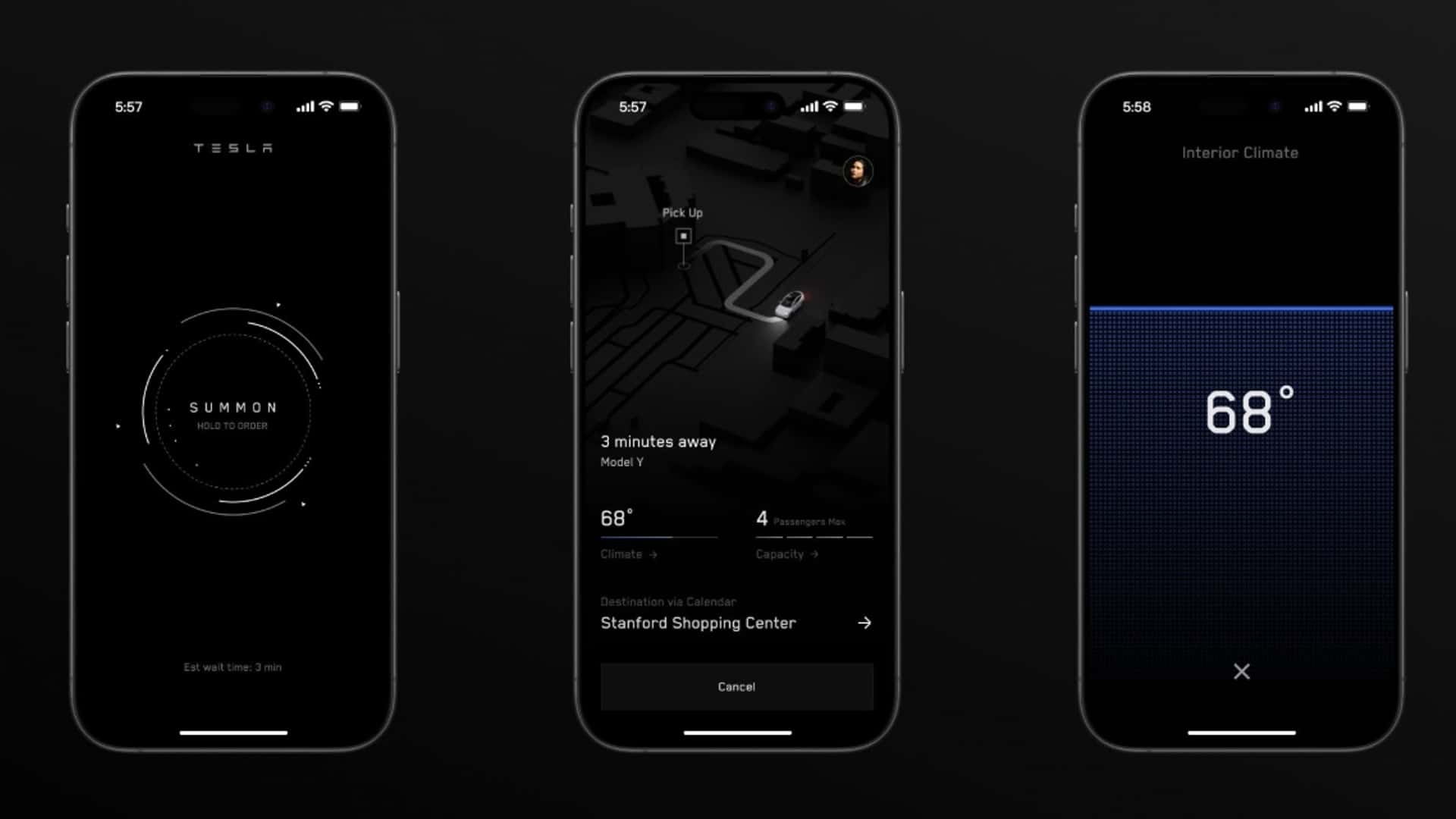
A preview of the proposed ride-hailing functionality within the Tesla app was also made public. Renderings showcased a prominent “Summon” button, presumably the primary interface for users to order an autonomous taxi. While details remain sparse, one screen depicting a temperature of 68 degrees Fahrenheit hints at potential features, such as the ability for customers to pre-set climate control settings before their ride commences.
Addressing Market Uncertainty and Future Roadmap
The recent focus on robotaxis follows a significant period of speculation and investor scrutiny. Reports from Reuters had suggested Tesla might have shelved plans for a more affordable consumer vehicle to prioritise the robotaxi project. This sparked considerable uncertainty about the automaker’s product roadmap and future revenue streams.
In response to these concerns, Tesla clarified its position during the earnings call, stating it is accelerating the launch timing of “new vehicles, including more affordable models.” This statement aims to assuage investors and consumers that a diversified product portfolio, including accessible electric vehicles, remains part of the company’s long-term strategy, with the robotaxi service arriving at a later stage.
The detailed mention of the ride-hailing business can be seen as a strategic move to provide clarity and reassure stakeholders that a concrete plan underpins the robotaxi ambition, offering a clear vision for its integration into Tesla’s future offerings.
The Road Ahead: Challenges and Past Proclamations
Crucially, the entire robotaxi strategy is predicated on Tesla’s ability to achieve true, reliable full self-driving capabilities. This remains a significant technological hurdle that the company has been striving to overcome for several years. Tesla’s existing Full Self-Driving (FSD) feature, despite its advanced nomenclature, currently mandates constant driver supervision and has been documented to exhibit errors.
Elon Musk has historically made ambitious predictions regarding autonomous driving. Notably, he famously asserted that Tesla would have one million robotaxis operational on the road by 2020. While the concept of a Tesla-operated autonomous taxi service presents an intriguing vision for urban mobility and vehicle utilization, the substantial gap between past projections and current reality necessitates a measured perspective on future timelines.
The path to a fully autonomous, scalable robotaxi service is complex, involving not only technological breakthroughs but also regulatory approvals, public acceptance, and robust operational infrastructure. Tesla’s latest disclosures offer a structured glimpse into its strategic direction, but the ultimate success will depend on its execution of the core self-driving technology and its ability to navigate the multifaceted challenges of a nascent industry.
FAQ
What is Tesla’s robotaxi strategy?
Tesla plans a hybrid ride-hailing service combining its own autonomous fleet with a system allowing private Tesla owners to add their vehicles to the network. This model is likened to a “combination of Airbnb and Uber,” offering flexibility for owners and a scalable service.
When will Tesla’s robotaxi service be available?
Tesla’s first-quarter earnings report indicated that ride-hailing functionality is “currently working on” and “will be available in the future.” The company also noted that robotaxis would arrive later than its new, more affordable vehicle models.
How can Tesla owners participate in the robotaxi fleet?
Tesla owners will have the option to “add or subtract their cars from the fleet whenever they want.” They can also set preferences, deciding if their car is used only by friends and family, five-star users, or anyone requesting a ride.
What technology underpins Tesla’s autonomous vehicles?
Tesla’s autonomy strategy relies on a “vision-only architecture with end-to-end neural networks.” This system processes visual data from cameras, trained on billions of miles of real-world driving data, to enable self-driving capabilities.
What features will the Tesla robotaxi app include?
Renderings of the app show a “Summon” button for ordering a taxi. Speculation suggests possible features like pre-setting climate control (indicated by a temperature display) before the passenger enters the vehicle, though details are still limited.
Has Tesla made similar robotaxi claims in the past?
Yes, Tesla CEO Elon Musk famously stated in the past that the company would have one million robotaxis operating on the road by 2020, a projection that was not met. This historical context suggests a cautious approach to new timelines.
What are the primary challenges for Tesla’s robotaxi plan?
The main challenge is achieving true, reliable full self-driving capabilities, as Tesla’s current Full Self-Driving (FSD) feature still requires driver supervision and has known limitations. Regulatory hurdles and public trust also remain significant factors.