
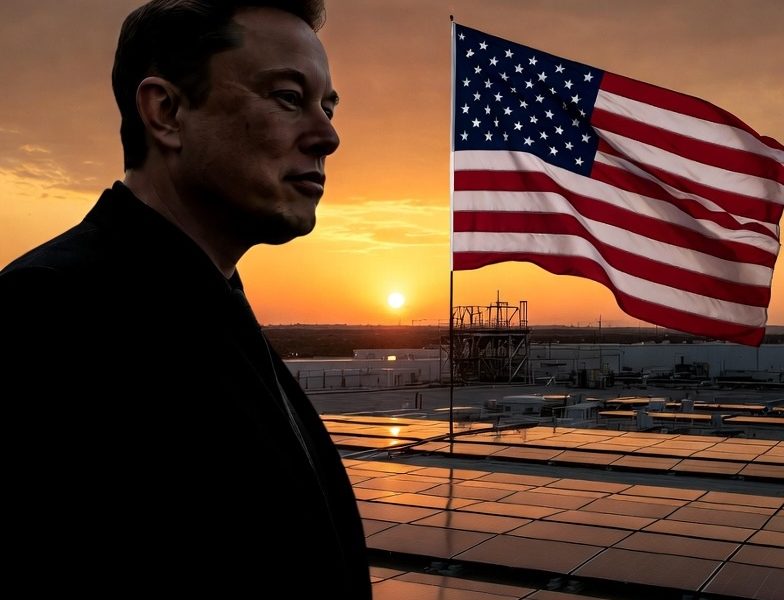
In a significant strategic move poised to redefine America’s renewable energy landscape, Tesla is reportedly in advanced discussions to acquire approximately $2.9 billion worth of solar manufacturing equipment from Chinese suppliers. This substantial investment underscores the electric vehicle giant’s accelerated commitment to establish large-scale domestic solar production capacity within the United States, a critical component of its broader energy ambitions.
Sources close to the negotiations, as reported by Reuters, indicate that the sophisticated equipment is expected to be delivered by autumn and subsequently shipped to Texas. This state is slated to become the hub for Tesla’s next phase of US solar manufacturing, a pivotal step in the company’s efforts to localize and expand its energy supply chain.

Elon Musk’s Bold Vision: Targeting 100 GW Annual Solar Capacity
This substantial procurement directly aligns with an ambitious vision articulated by Tesla CEO Elon Musk. Earlier this year, at the World Economic Forum in Davos, Musk declared that both Tesla and its aerospace counterpart, SpaceX, were independently working towards achieving an astonishing 100 gigawatts (GW) of annual solar manufacturing capacity within the United States.
The urgency and scale of this commitment were further solidified days later during Tesla’s Q4 2025 earnings call. Musk explicitly stated the company’s concrete objective: “We’re going to work toward getting 100 GW a year of solar cell production, integrating across the entire supply chain from raw materials all the way to finished solar panels.”
This long-term strategic goal is not merely a verbal aspiration. Tesla’s official job postings on its corporate website corroborate this aggressive timeline and scope. Language within these listings explicitly calls for 100 GW of “solar manufacturing from raw materials on American soil before the end of 2028.” These postings are a clear indicator of Tesla’s hands-on approach to rapidly building out its domestic production capabilities.

Catalysts for Growth: AI, Electrification, and Rising Power Demands
The intensified focus on enhancing US solar manufacturing capacity is rooted in a confluence of rapidly escalating pressures impacting the nation’s energy infrastructure. A primary driver is the explosive growth of Artificial Intelligence (AI) data centers, which are known for their prodigious energy consumption requirements.
Coupled with the widespread electrification of transportation – a domain where Tesla itself is a key player – the demand for electricity in the U.S. has seen unprecedented surges. In 2025, the country experienced its second consecutive record high in power consumption, a trend projected to continue climbing significantly through 2026 and 2027.
Tesla’s burgeoning energy division, responsible for the production of its utility-scale battery storage system, Megapack, is experiencing rapid expansion. Adequate and reliable solar supply is deemed a critical companion component to enable this business segment to scale effectively and meet the burgeoning demand for energy storage solutions. Musk has consistently argued that solar power is not merely a clean energy alternative but the only economically viable option capable of meeting the immense energy demands posed by next-generation AI infrastructure.
The China Paradox: Sourcing for Domestic Solar Production
Ironically, Tesla’s immediate path to achieving domestic solar independence appears to run through China. This latest $2.9 billion equipment deal vividly illustrates a fundamental tension that Musk himself acknowledged at Davos. Despite Tesla’s stated push to localize its supply chain, the global realities of solar manufacturing often necessitate reliance on China-based suppliers to maintain cost efficiency and technological leadership.
China holds a dominant position in the global solar equipment manufacturing sector, a reality that impacts procurement strategies for companies worldwide. Musk highlighted this dynamic, stating, “Unfortunately, in the U.S. the tariff barriers for solar are extremely high and that makes the economics of deploying solar artificially high, because China makes almost all the solar.” This creates a paradoxical situation where building a solar factory in America, aimed at reducing dependence on foreign supply, currently requires purchasing essential machinery from the very country it seeks to reduce reliance on.
Integrating Supply Chains: A Broader Strategy
This substantial solar equipment acquisition is not an isolated incident but rather a critical piece within Tesla’s broader, evolving strategy for supply chain localization. The company has demonstrated a consistent effort to bring more manufacturing processes onto American soil, mirroring initiatives such as its recently announced plan for a $4.3 billion LFP battery manufacturing partnership with LG Energy Solution in Michigan.
However, the simultaneous reliance on Chinese suppliers, particularly for advanced manufacturing equipment, underscores the complex balancing act between achieving cost-effectiveness and establishing resilient, localized production capabilities. Tesla’s approach reflects the current global industrial landscape where specialized equipment often originates from specific regions, regardless of the end product’s intended market.
Regulatory Hurdles and Market Reactions
The intricate nature of international trade and supply chains adds another layer of complexity to Tesla’s plans. Suzhou Maxwell Technologies, identified as a key supplier and the world’s largest producer of screen-printing equipment for solar cell production, is reportedly seeking export approval from China’s commerce ministry for this significant transaction. The timeline and ease with which this clearance will be granted remain an open question, posing a potential regulatory hurdle for the ambitious project.
Despite these complexities, the market has already reacted positively to the news. Following the Reuters report that initially broke the story, shares in the Chinese firms reportedly involved in the talks experienced a surge of over 7%. This immediate market response highlights the perceived strategic importance and economic impact of such a large-scale deal.
Ambitious Targets and Tesla’s Proven Track Record
Whether Tesla can achieve its formidable 2028 target of 100 GW of US solar manufacturing capacity remains a subject of considerable debate. The sheer scale of this ambition, particularly within such a compressed timeframe, is staggering by industry standards. Nevertheless, observers of Elon Musk’s ventures are familiar with his documented history of setting extraordinarily ambitious deadlines and, despite occasional delays and challenges, ultimately “always pulling it off.”
This track record suggests that while the path to 100 GW will undoubtedly be challenging and may encounter various obstacles, the underlying commitment and eventual realization of the goal are highly probable. Tesla’s capacity for innovation and its aggressive execution strategy provide a strong foundation for tackling such a monumental undertaking in the renewable energy sector.
Conclusion: Charting America’s Renewable Energy Future
Tesla’s $2.9 billion investment in Chinese solar manufacturing equipment for US production represents a pivotal moment in the nation’s push towards greater energy independence and sustainability. This move, driven by soaring energy demands from AI and electrification, showcases Tesla’s dual commitment to both rapid innovation and strategic supply chain development.
While navigating the complexities of global manufacturing and regulatory frameworks, Tesla, under Elon Musk’s leadership, is steadfastly working to build out critical US solar manufacturing infrastructure. This effort promises to bolster domestic capabilities, contribute significantly to the country’s renewable energy goals, and firmly establish America as a major player in the future of solar power.